
Students believe that studying more hours should lead to better results. The logic seems obvious: more time with the material means more learning. This belief drives students to extend study sessions from three hours to five, then from five to eight.
What actually happens is different. The increased time often replaces effective learning with repetition. Students reread the same chapters and review the same notes without changing how they interact with the material. The method stays the same. Only the duration increases.
The common experience follows a clear pattern. Students spend longer days studying than their classmates. They sacrifice sleep and social time to create more study hours. Then exam results arrive, and the scores are the same as before. Sometimes they are lower.
The failure is specific. Time investment rises, but learning output stays flat.
The Core Problem: More Time, Same Performance
Studying more hours does not improve recall, understanding, or exam performance. This is not a statement about effort. The problem is not a lack of effort or self-control.
The breakdown occurs at the method level, not the time level. The learning system itself is broken. Adding more time to a broken system does not repair it.
Students assume the problem is personal. The real problem is structural. The methods they use do not create strong memory or deep understanding, regardless of how long they are applied.
Why Studying More Hours Fails to Improve Learning
The failure happens for three distinct reasons, each operating independently but often appearing together.
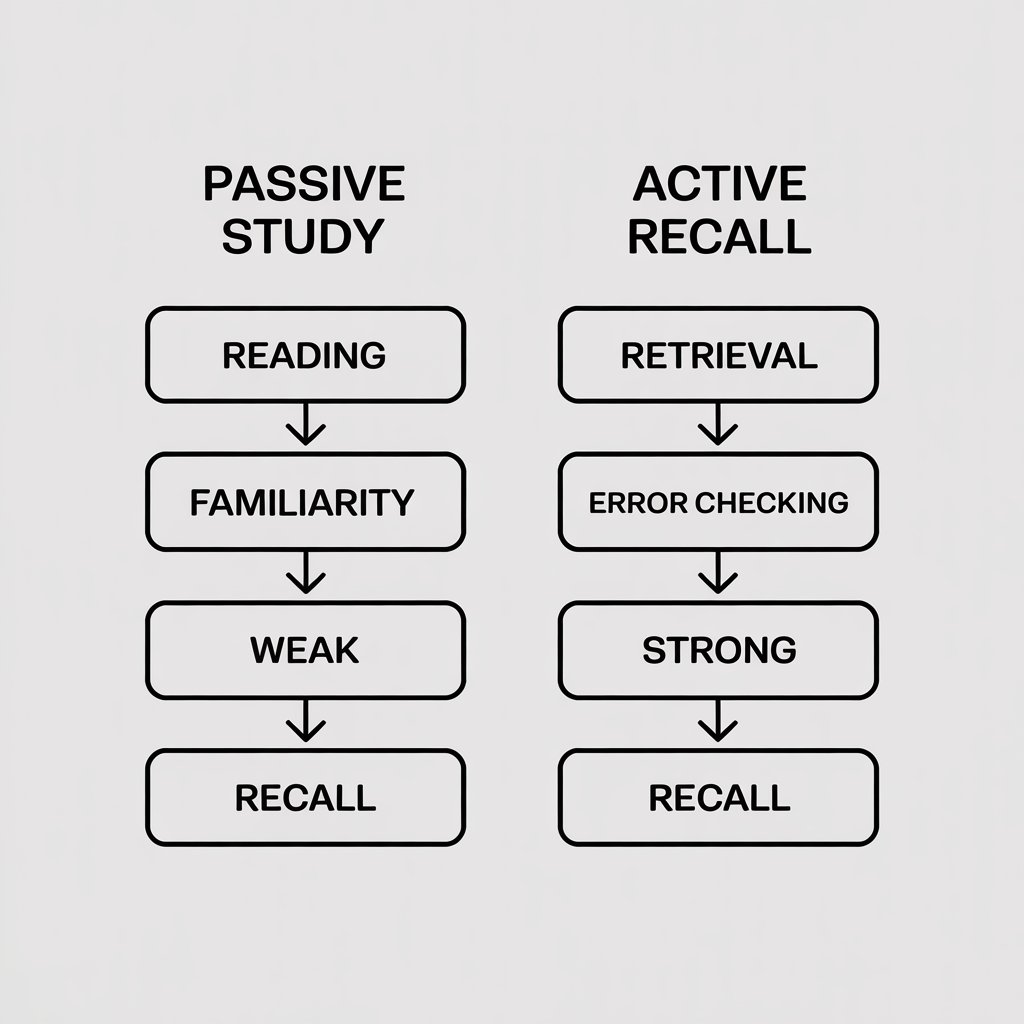
Inefficient Study Methods Consume Time Without Building Memory
Most students rely on passive reading, highlighting, rereading lectures, and rewatching videos. These methods feel productive because turning pages and marking text creates the sense that learning is happening.
These methods create familiarity, not memory. Familiarity means you recognize information when you see it. Memory means you can retrieve information when you need it.
Exposure without retrieval produces weak memory traces. Each time you reread a chapter, the information feels slightly more familiar. Recognition feels like understanding, so students mistake progress for actual retention.
This is the same mechanism explained in why passive studying leads to poor retention, where repeated exposure creates familiarity without building retrievable memory.
The problem becomes clear during exams. Information that felt familiar during review cannot be retrieved under pressure. Recognition collapses when recall is required.
Mental Fatigue Reduces Learning Quality Over Long Sessions
Attention and cognitive energy decline after approximately 60 to 90 minutes of focused work. Hour one and hour six are not equivalent in learning capacity.
Fatigue is invisible to the learner in the moment. Students do not notice the gradual decline in focus. They continue working, believing they are still learning at the same rate. They are not.
Later hours in a long study session produce minimal actual learning. The student is present, materials are open, and time passes, but the brain is not encoding information effectively.
Students mistake time spent for learning done. They measure success by hours completed, not by what was actually retained.
Time-Based Goals Replace Learning-Based Goals
When students measure progress by hours, they stop measuring progress by understanding. The goal becomes completing a five-hour study session, not being able to explain a concept from memory.
This removes the feedback loop on what was actually learned. The student finishes the session and moves forward without checking whether they can recall or apply the material.
Mistakes are repeated across sessions without detection. If a student misunderstands a concept during the first study session, they will continue misunderstanding it through every subsequent session because no one is checking for accuracy.
What Happens When You Keep Studying Longer Hours
Continuing this pattern produces three predictable outcomes.
Poor Exam Recall Despite Heavy Preparation
The material feels familiar during review. Students recognize terms and feel confident they understand the content. This confidence is based on recognition, not retrieval.
During the exam, the student cannot retrieve specific information when needed. The gap between recognition and recall becomes obvious. Familiarity creates false confidence.
Information collapses under pressure because exams do not provide the same cues that were present during review.
This false confidence is the same illusion described in why learning feels easy but doesn’t stick, where recognition during review is mistaken for real understanding.
Increased Errors in Application-Based Questions
Students who rely on long passive sessions cannot transfer knowledge to new problems. They memorized facts and formulas but did not build an understanding of how those elements connect.
Application-based questions require understanding the structure of the concept and adapting knowledge to new situations. Passive study methods do not build this capacity.
Pattern matching fails on modified questions. If the exam question is phrased differently, the student cannot adapt because they learned specific examples, not underlying principles.
Burnout Without Skill Improvement
Physical and mental exhaustion increases as study hours extend. Students sacrifice sleep and recovery time to create more study hours.
Confidence declines despite the effort. The student is working harder than ever, but results are not improving. Results stay flat or worsen, sometimes because fatigue interferes with exam performance.
Students blame themselves, not the method. The cycle continues until breakdown.
How to Fix the Problem: Replace Hours With Learning Output
The solution requires replacing time measurement with output measurement across four specific changes.
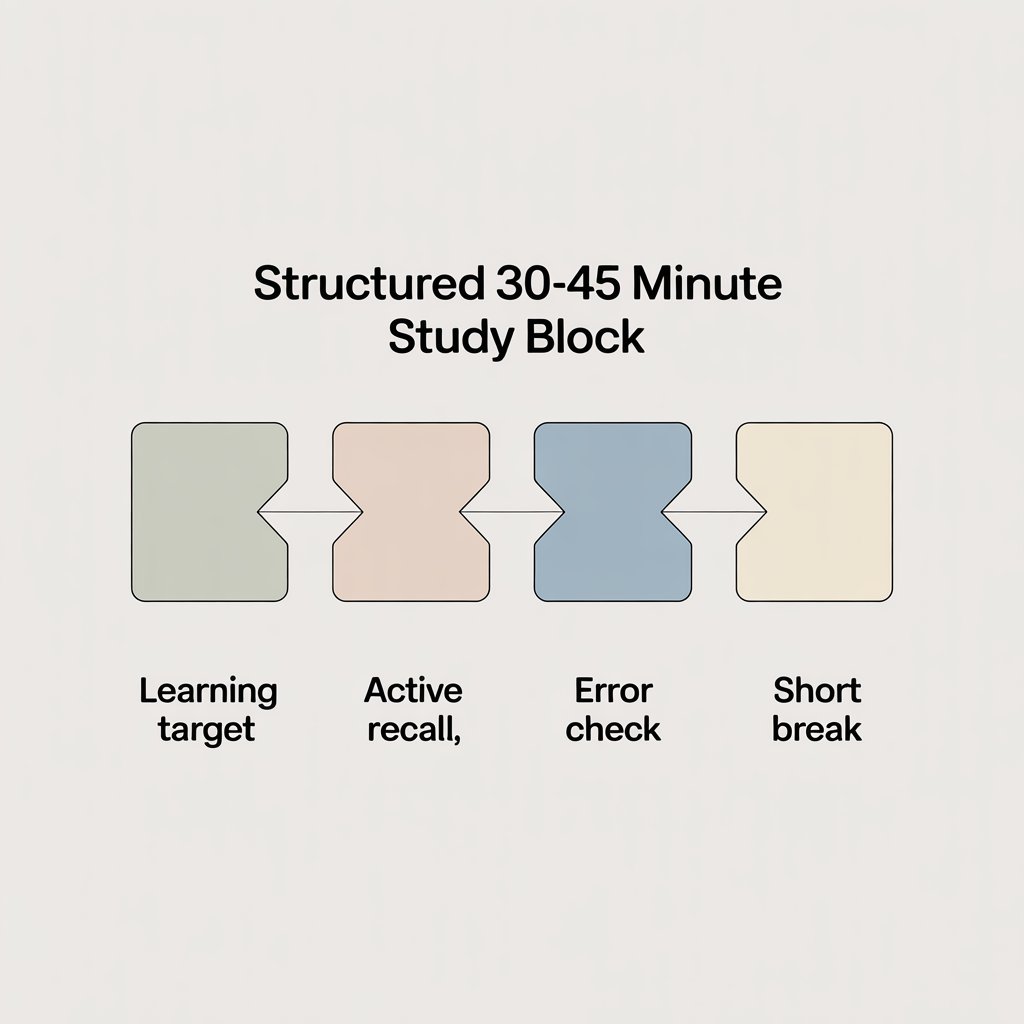
Step 1: Set Learning Targets Instead of Time Targets
Define what you will be able to recall or explain by the end of the session. For example: “Describe how photosynthesis works without looking at notes, covering each main stage and how they connect.”
The session ends when the target is reached, not when the timer ends. If you can explain it accurately after 30 minutes, the session is complete.
This makes learning success measurable. You know whether you succeeded by testing yourself, not by checking a clock.
Step 2: Break Study Sessions Into Short, High-Output Blocks
Use 30 to 45 minute focused blocks for each study session. This duration maintains high cognitive quality throughout the block.
Stop before fatigue sets in. If you notice your attention drifting, end the block. Continuing past this point produces minimal learning.
Take short breaks between blocks. Five to 10 minutes allows mental recovery. After the break, cognitive quality returns to baseline.
Total daily study time may decrease, but learning increases. Three focused 40-minute blocks often produce more retention than one five-hour session.
Step 3: Use Active Recall in Every Session
Close all materials before you begin. Write everything you remember about the topic. Do not filter or edit. If you get stuck, leave a blank space and continue.
After writing, open your materials and check accuracy. Mark what you got wrong, what you missed, and what you got partially correct.
Repeat the recall attempt on missed items. Close the materials again and try to recall only the information you got wrong. This targets the gaps directly.
One recall cycle is more effective than three hours of rereading. Retrieval practice forces your brain to reconstruct the information, which strengthens the memory. Rereading only creates familiarity.
Active recall also reveals gaps immediately. You know exactly what you do not understand because you cannot retrieve it.
Step 4: Track Errors, Not Hours
Keep a simple list of mistakes and gaps from each recall attempt. This becomes your error log.
Review the error log before your next study session. Start each session by targeting the errors from the previous session. Do not reread entire chapters. Focus only on the specific items you got wrong.
Measure progress by declining error count. If your first recall attempt produced 15 errors and your second produced 8 errors, you improved.
A structured alternative to long study hours is outlined in a simple study workflow that improves learning, which focuses on recall, feedback, and short high-quality sessions.
Session success is defined by fewer errors on the recall test. Accuracy becomes the metric, not time logged.
Better Alternatives to Studying More Hours
Three direct replacements change the study pattern entirely.
Replace Long Sessions With Focused Cycles
Shorter sessions with higher intensity produce better results than long sessions with declining focus. A 90-minute session built around active recall produces more retention than five hours of passive reading.
Focus on output produced, not time endured. Quality of the session matters more than length. Fewer hours often lead to higher retention.
Replace Passive Review With Retrieval Practice
Testing yourself is the learning mechanism, not a method for checking whether you already learned. Each retrieval attempt strengthens the memory.
Exposure alone does not create memory. You need to practice retrieving information to build the neural pathways that allow you to access it during exams.
Each successful retrieval makes the next one easier. The first recall attempt is difficult. By the third or fourth attempt, retrieval becomes fast and accurate.
Replace “read it again” with “test yourself on it.” When you encounter material you do not understand, close the material and try to recall it. Then check and correct errors.
Replace Exhaustion With Spaced Learning
Spread study sessions across multiple days instead of concentrating them into single long sessions. Shorter daily sessions maintain cognitive energy and prevent fatigue accumulation.
This allows memory consolidation between sessions. Your brain continues processing information after the study session ends. Sleep and rest periods strengthen the memories formed during study.
Spacing reduces forgetting by revisiting material before it is lost. You return to the material just as you begin to forget it, which strengthens the memory more than reviewing material you still remember clearly.
What to Stop, What to Start, and Next Steps
Stop measuring study success by hours completed. Hours are not a measure of learning. You can spend 10 hours and learn nothing.
Stop extending sessions past the fatigue point. When your focus drops, end the session. Continuing to work while fatigued produces minimal learning.
Stop using passive review as your primary study method. Reading and highlighting do not build strong memories.
Start setting recall targets before each study session. Define exactly what you need to be able to explain or retrieve.
Start measuring progress by accuracy and error reduction. Count how many items you can recall correctly. Track your errors and watch those numbers improve.
Start ending sessions when learning quality drops. Pay attention to your focus and cognitive energy. When they decline, stop.
Take your next study session and redesign it. Pick one topic. Set one specific recall target. Study the material for 30 minutes. Close all materials. Write everything you remember from memory. Check your accuracy. Note every error. Repeat the recall attempt on errors only.
Do this once. Compare the results to your previous study sessions. If you retained more from this single focused session than from longer passive sessions, repeat this process for every topic.