
Students often finish a study session feeling confident. The material makes sense. The notes look complete. Everything feels clear.
One week later, most of that information is gone.
This happens consistently, but students usually blame their memory. They assume they forgot because they did not study enough or because their brain does not retain information well.
The real problem is not memory capacity. The problem is how the information was studied in the first place.
Forgetting after studying is predictable. It follows clear patterns. When students rely on common methods like rereading notes or highlighting textbooks, they create temporary familiarity instead of stable knowledge. The brain treats this familiarity as learning, but it fades quickly.
Poor retention is not a memory flaw. It is a learning breakdown.
This article explains why information disappears after one week. It shows what causes memory decay and what students can do to prevent it. The goal is not to study harder. The goal is to study in a way that makes information last.
The real problem is not memory loss, but unstable learning
Forgetting after studying is not caused by weak memory. It is caused by weak learning methods.
Most students confuse familiarity with understanding. When they reread notes or review highlighted sections, the material looks familiar. This familiarity feels like learning. The brain interprets it as progress.
But familiarity is not the same as knowledge. Familiarity is temporary. It depends on external cues like notes, textbooks, or highlighted passages. When those cues are removed, the information becomes inaccessible.
Stable knowledge works differently. It exists independently. It can be retrieved without prompts or visual aids. It stays accessible even when context changes.
Common study methods create recognition, not retrieval, which is why passive studying leads to poor retention over time. Recognition collapses after a few days. Retrieval lasts much longer.
When students forget what they studied, the problem is not their brain. The problem is that the information was never stored in a stable, retrievable form. It was encoded as surface-level familiarity, and familiarity decays fast.
Why information fades so quickly after studying
Memory decay after studying happens for specific reasons. Understanding these reasons makes it easier to prevent forgetting.
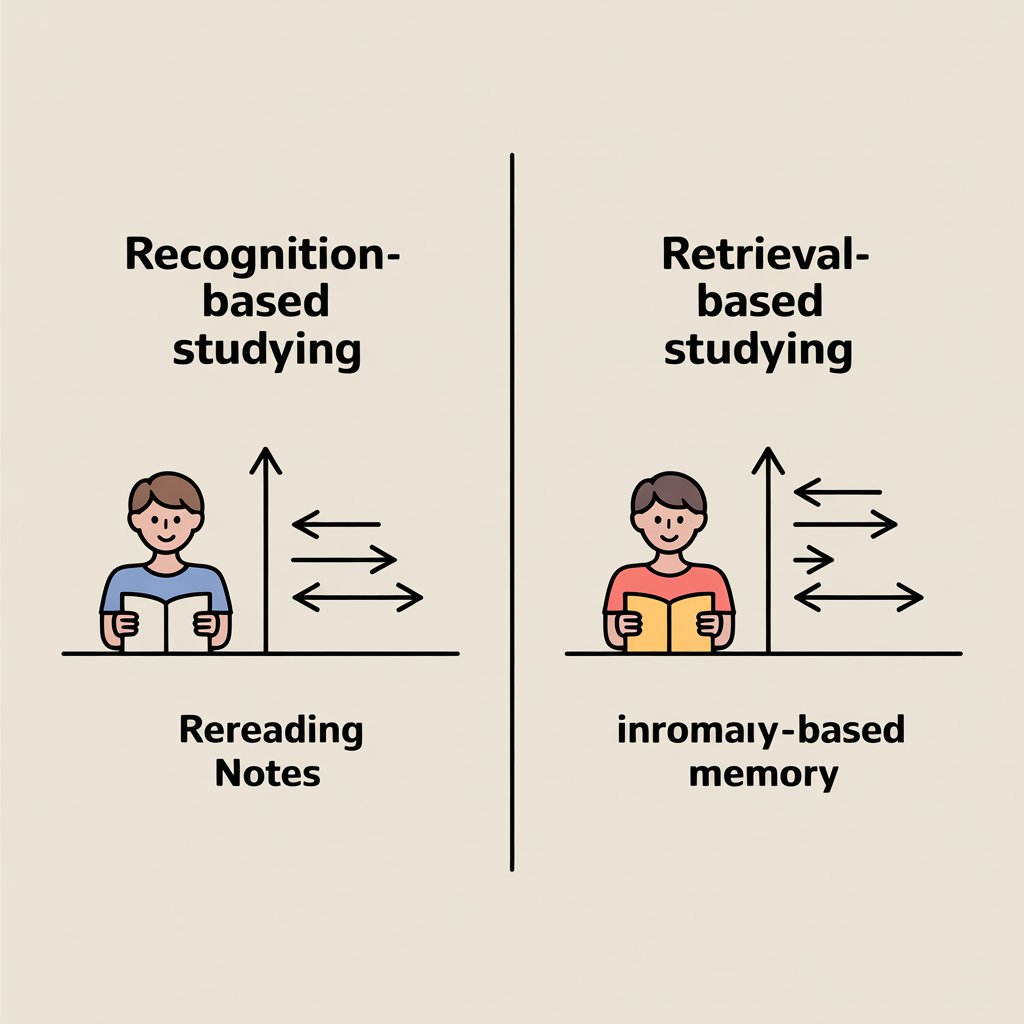
Studying creates recognition, not retrieval
Most students study by rereading notes or reviewing highlighted sections, a method that feels productive but rereading notes does not actually improve long-term recall. These methods feel effective because the material looks familiar each time it is reviewed.
But familiarity is not the same as recall. Familiarity means recognizing information when it appears. Recall means retrieving information from memory without external prompts.
Rereading and highlighting train recognition. They do not train retrieval. When students review notes, their brain registers the material as familiar, but it does not practice accessing that material independently.
After a few days, recognition fades. The brain stops prioritizing information that is only passively reviewed. Without active retrieval practice, the material becomes inaccessible.
Information is not anchored to meaning
Many students memorize facts without understanding how those facts connect to larger concepts. They treat each piece of information as isolated.
Isolated facts decay faster than connected ideas. The brain stores information more effectively when it is linked to meaning, structure, or purpose.
When students memorize a list of definitions without understanding how those definitions relate to each other, the brain has no framework to hold the information in place. Each fact exists independently, which makes it fragile and easy to forget.
No retrieval happens after the study session
Most students finish studying and do not return to the material until the next review session or exam. During that gap, no retrieval occurs.
The brain uses retrieval as a signal. When information is actively recalled, the brain interprets it as important and strengthens the memory pathway. When information is never recalled, the brain deprioritizes it.
Without retrieval practice, even information that felt clear during the study session becomes harder to access. The brain treats unused knowledge as unnecessary and lets it fade.
Review timing works against memory
Many students delay review until right before an exam. They assume that studying closer to the test will keep the information fresh.
This approach accelerates forgetting. When all review happens in a single session right before the exam, the brain does not have time to reinforce the material over multiple intervals.
Memory strengthens through repetition over time. A single intense study session creates short-term access but does not build long-term retention. After the exam, most of the information disappears within days.
What forgetting after one week leads to
When students forget what they studied, the consequences extend beyond poor test performance. Forgetting creates ongoing problems that make learning harder over time.
Poor exam recall
Students often feel prepared before an exam. They recognize the material when they review notes. They feel confident about their understanding.
During the exam, that confidence disappears. Questions require retrieval, not recognition, which explains why students struggle to recall information during exams. The information that felt familiar during review does not come to mind when needed.
This failure is not caused by test anxiety or lack of preparation. It is caused by the gap between what recognition training provides and what exams require.
Inability to apply concepts
Some students can remember definitions but fail when asked to apply those definitions to solve problems or analyze situations.
Recognition-based studying creates surface-level familiarity. It does not train the brain to manipulate or apply information in new contexts.
When an exam or assignment requires application, students realize they can recall facts but cannot use them. The information exists in memory but remains disconnected from practical use.
Repeated relearning cycles
When students forget what they studied, they must relearn the same material later. This creates a cycle where study time increases but retention does not improve.
Each relearning session feels productive. The material becomes familiar again. But without changes to the study method, the same forgetting pattern repeats.
Over time, students spend more hours studying without seeing better results. The problem is not effort. The problem is that the learning method does not create durable retention.
How to stop information from disappearing after studying
Preventing memory decay requires changes to how information is studied. The goal is to replace methods that create recognition with methods that build retrieval.
Replace rereading with recall-first study
Instead of rereading notes, students should start each study session by attempting to recall what they already learned.
This means closing the textbook and trying to write or say everything they remember about the topic. No prompts. No external aids. Just retrieval from memory.
After the recall attempt, students can check their notes to identify gaps or errors. This comparison shows what was retained and what needs more attention.
Recall-first study trains the brain to access information independently. It builds the retrieval pathways that exams and real-world applications require.
Build meaning before memorization
Before memorizing details, students should identify the core ideas that organize the material. What is the main concept? How do the details relate to it? Why does this information matter?
Understanding structure makes memorization easier and more durable. When facts are connected to meaning, the brain has a framework to hold them in place.
Students can build meaning by asking questions before studying details. What issue is this idea addressing? How does it link to what I already understand? What would change if it were incorrect?
These questions anchor facts to purpose, which prevents isolated memorization and supports long-term retention.
Add short retrieval sessions after studying
Instead of waiting days or weeks to review, students should test their recall soon after the initial study session.
A simple schedule works well: recall the material on the same day, the next day, and one week later. Each retrieval session should be short. Five to ten minutes is enough.
During each session, students should attempt to recall the material without notes. After the attempt, they check for accuracy and reinforce anything they missed.
These short retrieval sessions signal the brain to prioritize the information. Each successful recall strengthens the memory pathway and slows forgetting.
Use spaced review instead of single-session study

Instead of studying all material in one long session, students should spread review over multiple days.
Spacing slows memory decay. When the brain encounters information multiple times with gaps in between, it strengthens retention more effectively than repeated exposure in a single session.
A simple spacing pattern might look like this: study the material today, review it tomorrow, review it again three days later, and review it one week later.
The spacing does not need to be perfect. The key principle is to avoid cramming all review into one session and to return to the material at intervals.
What to stop doing vs what to replace it with
Improving retention requires replacing ineffective study habits with methods that build durable recall.
Stop rereading notes → Start recalling from memory
Rereading creates familiarity but does not train retrieval. Recalling from memory forces the brain to access information independently.
This replacement improves retention because it builds the skill exams require: retrieving information without external prompts.
Students should close their notes and attempt to recall everything they studied. After the recall attempt, they can check their notes to identify gaps.
Stop cramming → Start spaced reinforcement
Cramming creates short-term access but accelerates forgetting. Spaced reinforcement builds long-term retention.
Instead of reviewing all material right before an exam, students should return to the material at intervals: one day later, three days later, one week later.
This spacing gives the brain time to strengthen memory pathways between review sessions. The result is better recall during exams and less relearning after exams.
Stop memorizing lists → Start organizing concepts
Isolated facts fade quickly. Connected ideas last longer.
Before memorizing details, students should identify the structure that holds those details together. What is the main concept? How are the individual facts connected to one another? Why does this information matter?
Organizing concepts before memorizing facts gives the brain a framework to store information more effectively. This makes recall easier and reduces forgetting.
What to do next
To stop forgetting what you study, make three immediate changes.
Stop rereading notes as your primary study method. Start each study session by attempting to recall information from memory without looking at external aids.
Stop delaying review until right before exams. Add short retrieval sessions on the same day, the next day, and one week after studying new material.
Stop treating memorization as the first step. Before memorizing details, identify the core ideas and structure that organize the information.
Test whether retention improves by recalling one topic from memory one week after studying it. If you can retrieve the material without notes, the method is working. If it does not, change your method and repeat the process.