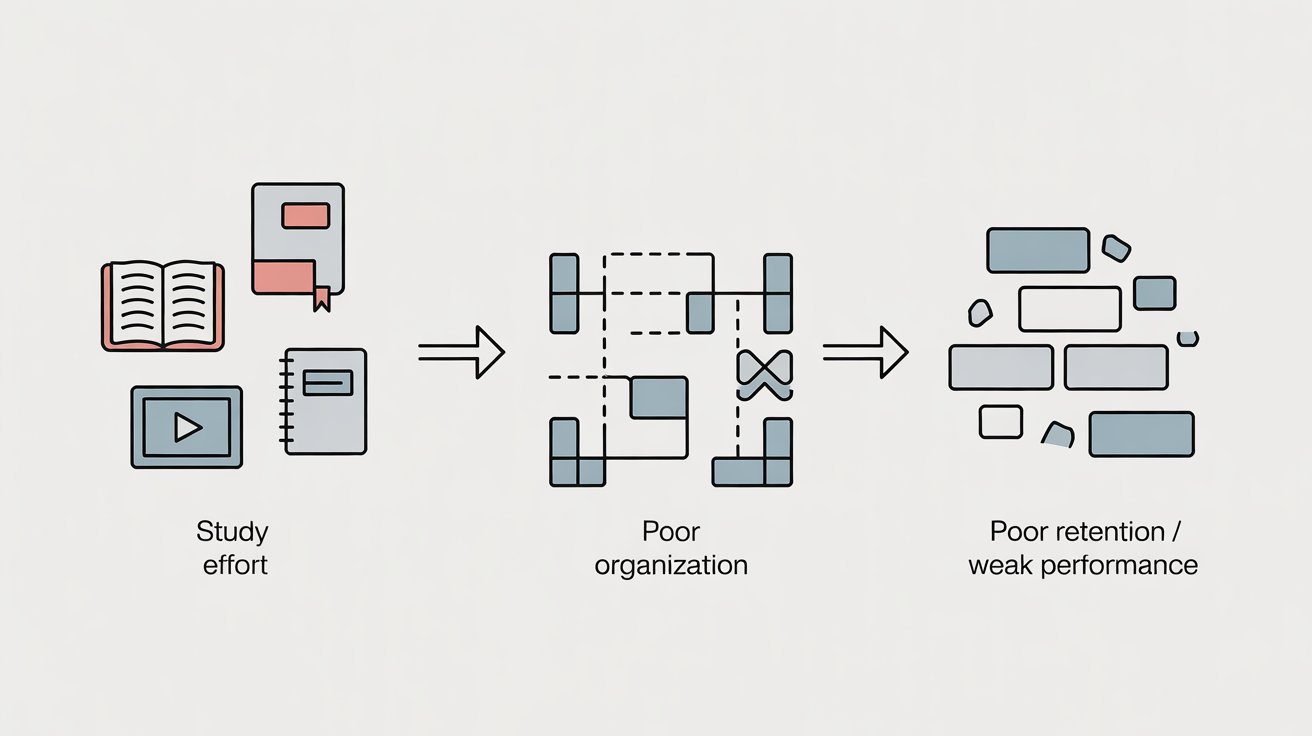
Students choose self-study when classrooms feel too slow or when formal instruction is unavailable. The method appears efficient. You set your own schedule, choose your own materials, and work at your own speed. But most self-study attempts fail.
Students spend hours reading, watching videos, and taking notes, then perform poorly on tests or forget everything within weeks. The problem is not effort or intelligence. The problem is structure.
Without a clear learning sequence, defined endpoints, and regular feedback, self-study creates scattered knowledge that does not build into usable skill.
Hours of work produce minimal retention. This is not a motivation problem. This is a systems problem. When learning lacks structure, the process breaks down regardless of how hard you work.
The Core Problem: Unstructured Self-Study Breaks the Learning Process
Learning requires specific conditions. Information must appear in the correct order. New concepts must connect to previous knowledge. Understanding must be tested and corrected. Knowledge must be reviewed before it fades. When these conditions are missing, learning fails.
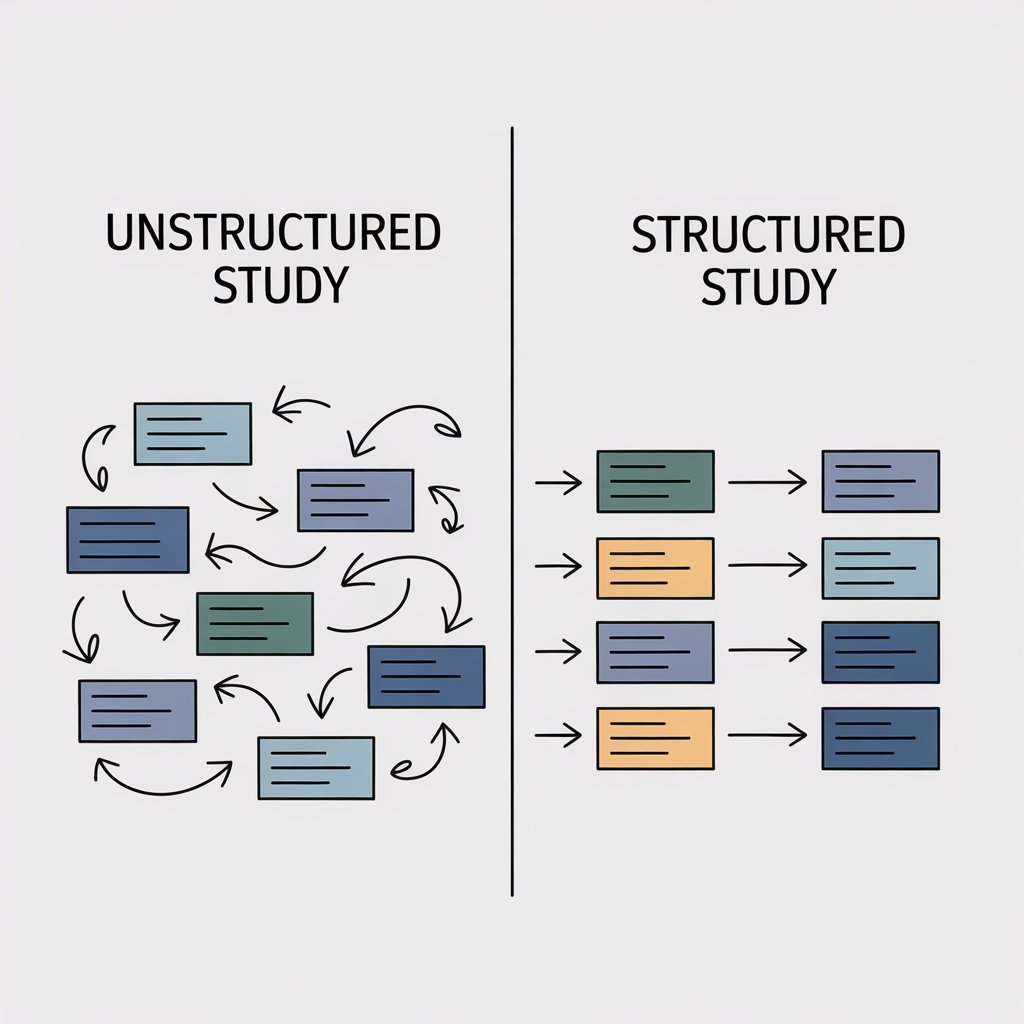
Unstructured self-study removes all of these conditions. You study topics in random order. You move to new material before mastering prerequisites. You judge progress by time spent instead of understanding gained. You never test whether you actually know what you studied.
The result is knowledge that does not accumulate. Each study session exists separately from the others. Information learned last week does not connect to information learned today. You are constantly relearning instead of building forward.
This is not a discipline issue. Adding more study hours does not fix a broken system. The method itself prevents progress.
Why Self-Study Fails Without Structure
Unstructured self-study fails for three specific reasons.
No Defined Learning Sequence
You choose topics based on interest or difficulty perception instead of logical dependency. This creates gaps in foundational knowledge.
You might study advanced applications before understanding basic principles. You might skip topics that seem boring but provide necessary context. Prerequisites get missed because there is no map showing what depends on what.
The result is uneven knowledge. You understand some topics deeply while completely missing others. This pattern mirrors why passive studying leads to poor retention, where time spent feels productive but knowledge fails to accumulate. New concepts become harder to learn because you lack the foundation they assume. You spend time backtracking to fill gaps you did not know existed.
No Clear Scope or Finish Line
Study sessions begin without defined endpoints. You open a textbook without knowing which sections you need to complete. You start a video series without determining which lectures matter.
Without boundaries, nothing ever finishes. There is always one more article, one more explanation, one more resource. Your brain never receives the signal to consolidate information into long-term memory because the learning phase never ends.
You cannot measure progress without a finish line. You cannot build confidence without completed milestones. Sessions drift. Topics blur together. Mastery gets replaced by vague familiarity.
No Feedback or Correction Loop
Studying alone means mistakes go undetected. You misunderstand a concept and nothing corrects you. You apply a method incorrectly and no one catches it. You build entire frameworks on wrong foundations.
This creates false confidence. You feel like you understand something because you spent time with it. In reality, you memorized a distorted version. Errors compound as new learning incorporates previous mistakes.
Without regular testing, you can spend months reinforcing incorrect understanding. You only discover the problem when facing an exam or real application.
What Happens When You Keep Studying Without Structure
The consequences of unstructured self-study reveal themselves when you need your knowledge.
Poor Retention Over Time
Information learned without structure fades quickly. Your brain lacks the retrieval cues and connections that make memory stick.
You study a topic thoroughly one week. You can barely recall it next month. Each study session feels like starting over. You are relearning material you already covered instead of moving forward.
Knowledge never transfers from short-term recognition to long-term retrieval. This is the same reason learning often feels easy but doesn’t stick when study sessions rely on familiarity instead of recall. You spend more time maintaining old information than acquiring new understanding.
Inconsistent Exam and Test Performance
Tests expose weak foundations immediately. You recognize concepts but cannot explain them. You remember studying topics but cannot access information under pressure.
Performance becomes unpredictable. Sometimes you do well on material you barely studied. Other times you fail on topics you spent hours reviewing.
This inconsistency comes from partial understanding and missing connections. Under exam conditions, when retrieval must be fast, scattered knowledge collapses.
Inability to Apply Knowledge
You know concepts in theory but cannot use them in practice. You can explain an idea when prompted but cannot recognize when to apply it.
Problem-solving becomes slow and uncertain. You lack the automatic pattern recognition that comes from structured practice.
Your knowledge stays inert. It exists but remains inaccessible when you need it. This gap between recognition and application shows that unstructured study creates familiarity, not competence.
How to Fix Self-Study Problems Caused by Lack of Study Structure
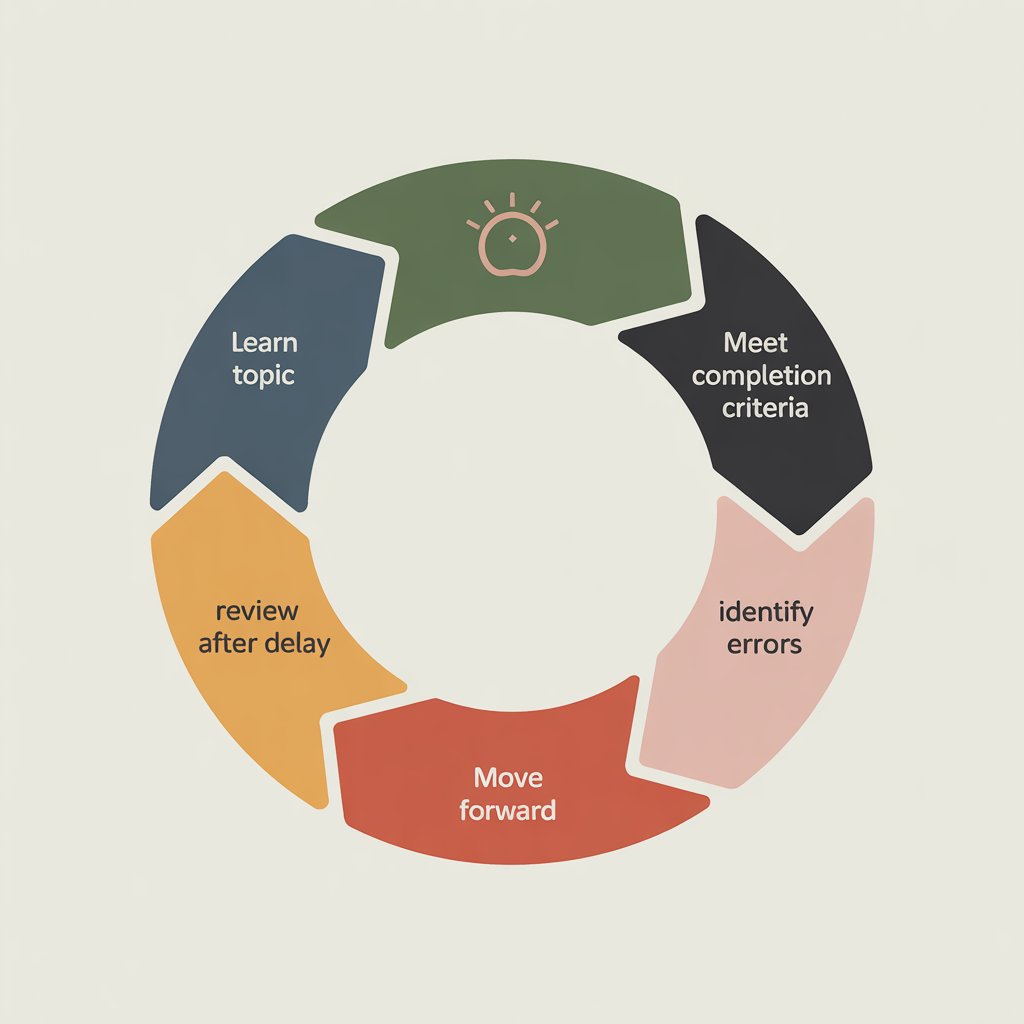
Fixing unstructured self-study requires implementing systems before you begin learning. A structured example of this approach is outlined in a simple study workflow that improves learning through clear sequence and review rules.
Step 1: Define a Fixed Learning Path Before Studying
Before opening any resource, map the complete learning sequence. Identify what each topic requires as prerequisite knowledge. Order topics by dependency so each step assumes mastery of previous steps.
Write down the exact sequence. Commit to following it without deviation. No jumping ahead when something seems interesting. No skipping topics that feel boring.
The sequence is the structure. Breaking it recreates the original problem. This eliminates decision-making during study sessions. You always have a clear understanding of the next topic you should study.
The path should be specific enough that anyone could follow it and reach the same outcome.
Step 2: Set Clear Completion Criteria for Each Topic
For every item in your learning sequence, define observable criteria that prove completion. Avoid time-based goals. “Spending three hours” studying calculus does not show whether you actually understood anything.
Use output-based criteria instead. “Complete twenty derivative problems without notes” or “explain the chain rule without referencing materials” are measurable demonstrations of understanding.
Criteria must be specific and directly connected to the skill you are building. They must force you to demonstrate understanding, not just exposure.
Once you meet the criteria, stop. Move to the next topic even if you feel you could learn more. This prevents session drift and creates the closure necessary for memory consolidation.
Step 3: Build Scheduled Review and Error Checks
After completing a topic, schedule recall tests before your memory fades. Test yourself three days later, then one week later, then two weeks later.
These are not study sessions. These are checks where you retrieve and use information without referencing sources. When you fail to recall something, that shows you exactly where understanding is weak.
This allows targeted correction before knowledge is lost. Spaced repetition with active recall transforms temporary exposure into permanent retention.
Build these review points into your original learning path so they become non-negotiable parts of the structure.
Step 4: Separate Learning From Resource Collection
Choose one primary resource per topic before starting. Commit to finishing it completely before adding anything else.
Collecting multiple textbooks, courses, and articles feels productive but creates fragmentation. Different resources explain concepts differently, use different terminology, and assume different prerequisites. Switching between them introduces confusion.
Limiting yourself to one resource until completion builds coherent mental models within a consistent framework. If the resource proves inadequate, finish it anyway. Then identify the gaps and choose one supplementary resource to address those specific gaps.
This prevents resource hoarding that delays actual learning.
Better Alternatives to Unstructured Self-Study
Certain approaches consistently outperform pure self-directed exploration because they provide necessary structure.
Structured Syllabi Over Free Exploration
Following a pre-designed curriculum removes the cognitive burden of deciding what to learn next. Someone with expertise already determined the optimal sequence, identified prerequisites, and allocated appropriate time to each topic.
This ensures comprehensive coverage without gaps. It provides visible milestones that mark real progress. You trade freedom for effectiveness. The path someone else designed will likely produce better results than exploration guided only by interest.
Output-Based Study Over Passive Consumption
Measuring progress by what you can produce exposes gaps that passive consumption hides. When you must demonstrate understanding instead of simply recognizing information, weaknesses become immediately visible.
This forces active engagement and provides continuous feedback about learning quality. Attempting output before you feel ready drives improvement. Study sessions centered on production naturally incorporate the testing that structured learning requires.
Limited Resources Over Endless Options
Depth within a single complete resource produces better results than surface exposure across many sources. When you commit to thoroughly exhausting one textbook or course, you develop fluency within that framework.
Concepts connect. Terminology becomes familiar. The progression reveals its logic over time. This depth creates genuine understanding.
Sampling many resources without finishing any produces scattered knowledge and constant context-switching that prevents coherent mental models from forming.
What to Stop Doing, What to Start Doing, and the Next Step
Implementing structure requires specific changes to your current approach.
Stop Doing
Stop selecting topics randomly based on whatever seems interesting. Stop judging progress by hours spent or pages read. These metrics measure exposure, not understanding.
Stop collecting multiple resources on the same topic before finishing any of them. These behaviors feel productive while actively preventing learning.
Start Doing
Create a fixed learning sequence before your next study session. Follow it exactly. Resist all temptation to skip ahead or explore tangents.
Replace time-based study goals with completion criteria that require demonstrated understanding. Implement scheduled review points where you test recall without referencing materials.
These changes feel restrictive because they remove the autonomy that attracted you to self-study. But they are the necessary constraints that transform effort into results.
Next Step
Choose one subject you want to learn. Spend thirty minutes designing a simple structure. List topics in dependency order. Define completion criteria for each. Schedule review points.
Keep it minimal. No more than ten steps.
Then follow this structure for two weeks without deviation. This limited trial shows whether the problem was your approach rather than your ability. The structure either works or it does not. You will know within two weeks whether fixing the system fixes the results.