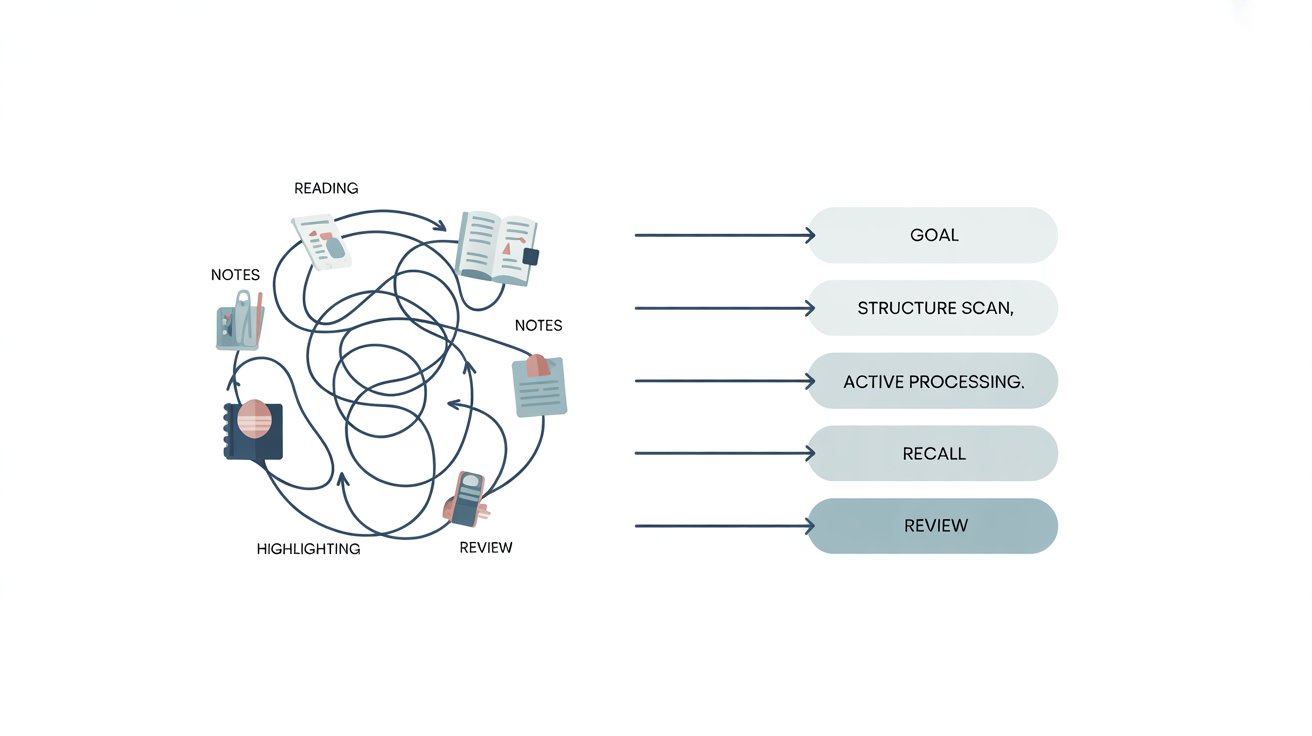
Most students study without a clear process. They read chapters, highlight sentences, rewrite notes, and review materials when they feel uncertain. These actions happen in no particular order.
Reading might come before note-taking one day and after it the next. Highlighting happens during reading or sometimes during review. The sequence changes based on mood, available time, or how difficult the material feels.
This approach feels productive because tasks are completed. Time is spent. Pages are covered. But when exams arrive, recall fails. Information that seemed familiar becomes hard to retrieve.
The real problem is not effort or intelligence. The problem is the absence of a usable study workflow.
Without a structured studying approach, actions remain disconnected. Each task happens in isolation. No clear order exists to guide when reading should stop and recall should begin. This randomness weakens learning even when hours are invested.
Why studying without a workflow leads to poor results
Studying becomes a collection of disconnected actions instead of a sequence. Reading happens without knowing what comes next.
Notes are taken without understanding their purpose in the larger process. Review occurs when panic sets in, not when memory begins to fade.
This lack of order weakens learning even when effort is high. Time spent studying increases, but retention does not improve at the same rate.
The brain processes information differently depending on how it is encountered. Random exposure to material creates surface familiarity, not deep understanding.
When study tasks have no fixed order, the mind treats each session as separate. Connections between concepts remain weak. Patterns that should become obvious stay hidden.
Poor structure does not just waste time. It actively prevents the kind of processing that builds strong memory. The absence of a study workflow means students repeat the same ineffective patterns without realizing what is broken.
What actually breaks when the study process is unstructured
When studying lacks structure, multiple failures happen at once. Each failure compounds the others.
Information is processed too shallowly
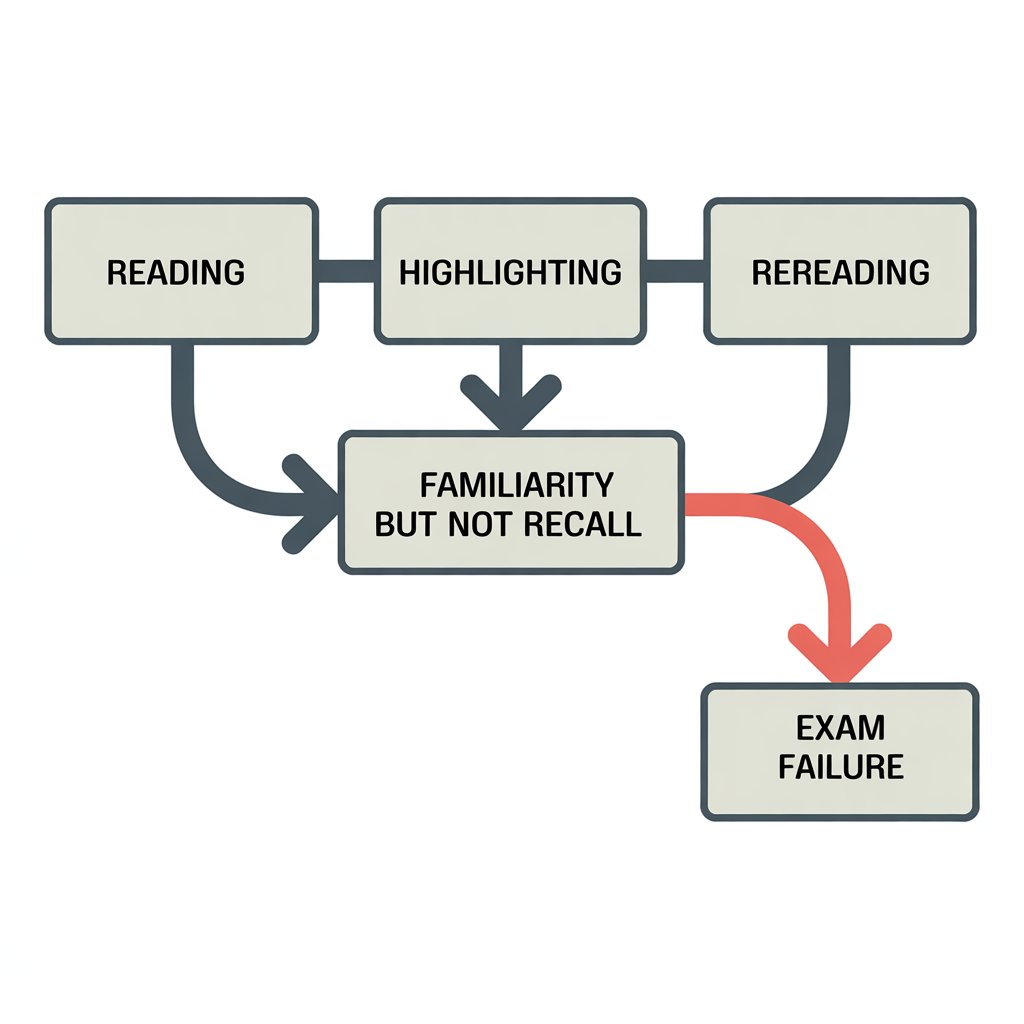
Without a workflow, most learners rely on reading and highlighting as primary study methods. Reading creates exposure, but exposure alone does not force deep processing. Highlighting marks sentences that seem important, but this action requires no explanation or retrieval.
The brain recognizes information as familiar without being able to reproduce it independently. This results in surface familiarity.
Students believe they understand because they recognize concepts when they see them. But recognition is not recall. When a test presents a question without the original text, the familiarity vanishes. What felt solid becomes vague.
This happens because the study process never required the learner to explain, summarize, or retrieve information from memory. Shallow processing is the direct result of unstructured studying.
Review happens too late or not at all
Most learners assume that understanding equals memory. After reading or taking notes, they move to the next topic. Review is postponed until an exam approaches.
By that time, forgetting has already occurred. The information must be relearned rather than reinforced. This delay makes studying feel harder than it should be.
When review happens early, small gaps can be corrected quickly. When review happens late, entire sections must be rebuilt.
The problem is not laziness. The problem is that unstructured studying provides no signal for when review should occur.
Without a workflow, learners rely on feelings of confidence or uncertainty. These feelings are unreliable indicators of actual memory strength. The result is that review happens reactively instead of strategically.
Effort increases but results stay flat
When studying feels ineffective, the first response is to add more time. Learners assume they are not working hard enough. They extend study sessions, add extra review days, and increase the number of hours spent with materials.
Effort increases, but results remain flat. Fatigue grows without corresponding learning gains.
The issue is not the amount of time spent studying. The issue is that the same broken process is repeated for longer periods.
More time does not fix poor structure. It only delays the realization that the process itself is the problem. Without a study workflow, additional effort is distributed across the same ineffective tasks.
Many students respond to poor results by increasing study time, but this often backfires, as explained in why studying more hours doesn’t improve results.
The core problem with most study methods
Most study methods focus on tools rather than order. Learners are told to use flashcards, practice tests, mind maps, or spaced repetition apps. These techniques can be effective, but they fail when applied without a clear sequence.
A flashcard used at the wrong time adds little value. A practice test taken before concepts are processed produces frustration, not learning.
The difference between a technique and a workflow is fundamental. A technique is an action. A workflow is the order in which actions occur. Techniques answer the question of what to do. Workflows answer the question of when to do it.
Good study methods fail when learners do not know where they fit in the process. Highlighting is useful when it serves a specific purpose in a structured pass. It becomes useless when it is the only action taken.
The same applies to note-taking, summarizing, and reviewing. Without a study workflow, even effective techniques produce weak results.
This is especially common with passive studying, which leads to poor retention even when students spend hours reviewing material.
A simple study workflow that supports real learning
A functional study workflow has clear steps that occur in a fixed order. Each step builds on the previous one.
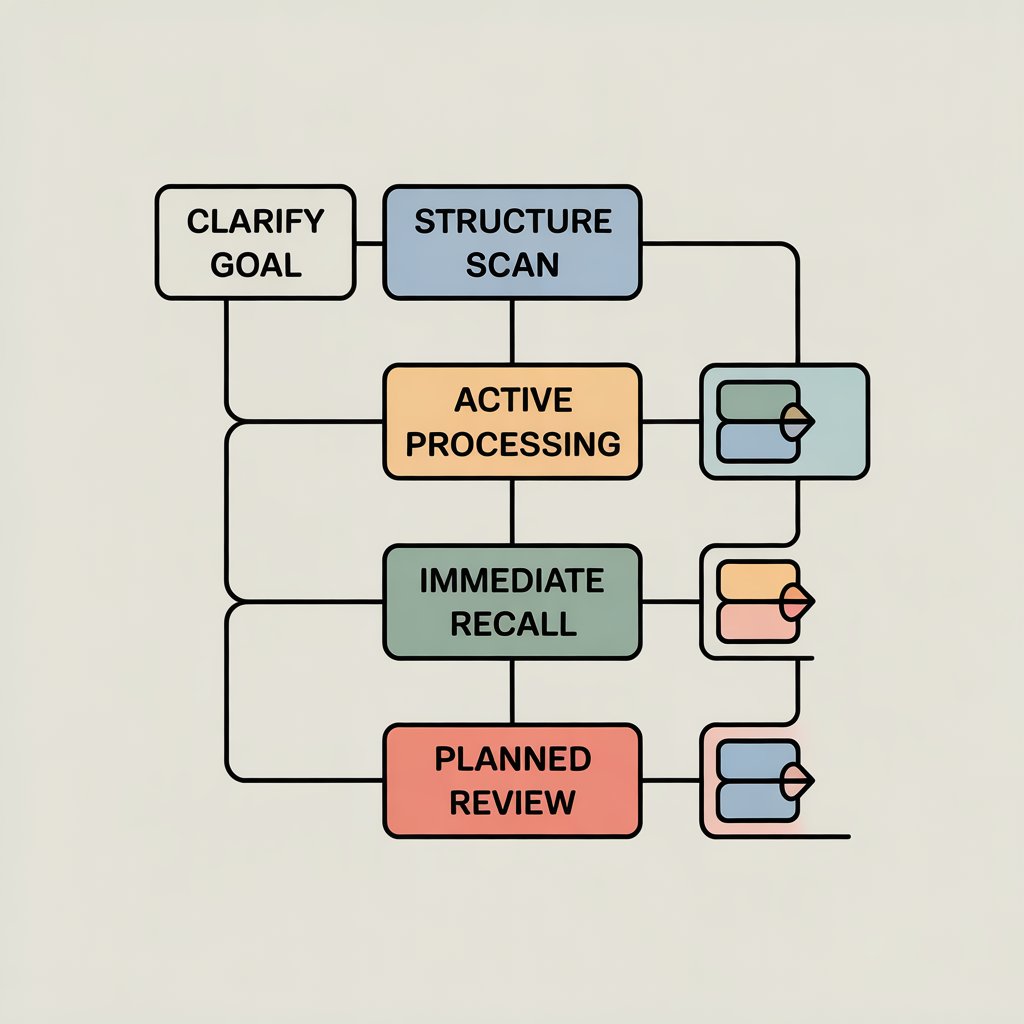
Step 1 – Clarify the learning goal before studying
Before opening a textbook or starting a lecture video, identify what needs to be learned. This does not mean writing vague intentions like “understand the chapter.” It means defining the specific concepts, processes, or facts that must be recalled later.
Vague goals lead to vague studying. Without a clear target, learners spend time on material that will not be tested or that they already understand.
Clarifying the goal focuses effort on what matters. It also makes it easier to recognize when studying is complete.
If the goal is to explain how a process works, studying continues until that explanation can be produced from memory. If the goal is unclear, studying continues indefinitely without a clear endpoint.
Step 2 – First pass for structure, not memorization
The first interaction with material should focus on structure, not details. Scan headings, subheadings, and introductory paragraphs to identify the main ideas. Notice how concepts are organized. Look for patterns, sequences, and relationships.
Ignore the urge to memorize at this stage. The purpose of the first pass is to build a mental map of the material. This map provides a framework for deeper processing later.
Without it, details are encountered in isolation, and connections remain hidden.
The first pass is not reading in full. It is not highlighting every sentence. It is scanning for structure and noting what the material is trying to explain.
This step takes less time than traditional reading but prepares the mind for more effective learning in the next steps.
Step 3 – Active processing of core concepts
After the structure is clear, process the core concepts actively. This means explaining ideas in simple language, either aloud or in writing. Avoid copying sentences from the source. Instead, describe what the concept means, how it works, or why it matters.
Write short meaning-based notes that capture the explanation, not the exact wording.
This step forces the brain to translate information rather than passively recognize it. Translation reveals whether understanding is real or superficial. If an explanation cannot be produced, the concept is not yet understood.
Active processing takes longer than passive reading, but it produces stronger memory. This is where real learning happens.
Step 4 – Immediate recall without materials
After processing a concept, test recall immediately. Close the book, turn off the screen, and try to explain the concept from memory. Do not check notes yet. Let the recall attempt happen without support.
If the explanation is complete, the concept has been learned. If it is incomplete, gaps are now visible.
This step reveals what is known and what is not. It removes the illusion of understanding created by passive review.
Immediate recall is uncomfortable because it exposes failure. But failure at this stage is useful. It shows where more processing is needed. Waiting until an exam to discover these gaps is far more costly.
Step 5 – Short, planned review sessions
Review should happen based on forgetting, not on comfort. After initial learning, schedule a short review session the next day. Test recall again without materials.
Focus only on concepts that were difficult or incomplete during the previous session. Do not review material that was recalled easily. This keeps review sessions short and efficient.
Over time, increase the interval between reviews. The goal is to catch forgetting just before it becomes complete.
Review sessions do not need to be long. Five to ten minutes of focused recall is more effective than an hour of passive rereading. The key is consistency and targeting weak areas.
This approach aligns closely with how to remember what you study without re-reading, where recall is tested before review.
How this workflow replaces common ineffective habits
A structured study workflow changes how ineffective habits are used.
Re-reading vs structured passes
Re-reading is a common study habit. Learners read the same chapter multiple times, hoping repetition will create memory.
This approach fails because each reading session is identical. The brain is exposed to the same information in the same way.
Familiarity increases, but retrieval strength does not.
Structured passes work differently. The first pass scans for structure. The second pass processes concepts actively. The third pass tests recall. Each pass has a different purpose.
The brain engages with the material in a new way each time. This variation forces deeper processing.
Re-reading provides no structure. It treats all information equally and processes nothing deeply. Structured passes assign specific tasks to each interaction, making studying more efficient.
Highlighting vs recall-based checking
Highlighting feels productive. Learners mark important sentences and create visual emphasis. This action is quick and requires little mental effort.
But highlighting does not test understanding. It only marks exposure.
When reviewing highlighted text later, the brain recognizes familiar sentences. This recognition is mistaken for memory.
Recall-based checking works differently. After reading or processing material, the learner closes the book and attempts to explain the concept.
If the explanation is accurate, memory is confirmed. If it is incomplete, a gap is identified.
Highlighting hides gaps. Recall-based checking exposes them. This exposure is uncomfortable, but it prevents the false confidence that leads to poor exam performance.
How to use this study workflow consistently
The same study workflow applies across subjects. The steps do not change. What changes is the time required for each step.
A dense physics chapter may require more active processing time than a history chapter. A mathematics problem set may need more immediate recall practice than a literature passage.
The workflow remains the same, but the allocation of time adjusts based on difficulty.
This consistency makes studying predictable. Learners know what comes next without needing to decide in the moment. Decisions about how to study are made once, not repeatedly. This reduces mental load and prevents the return to unstructured habits.
Keep study sessions controlled and repeatable. Each session should follow the same sequence. Over time, this workflow becomes automatic.
What to stop doing, what to start doing, and next steps
Stop mixing study techniques randomly without knowing when each one should be used. Stop assuming that more time spent studying will fix poor results. Stop relying on recognition as a substitute for recall.
Start following a fixed study workflow that includes structure scanning, active processing, immediate recall, and planned review. Start testing memory before reviewing material. Start focusing review sessions on weak areas rather than comfortable ones.
Next step: apply this study workflow to one subject for one week and assess recall at the end of the week. Compare the results to previous study sessions where no workflow was used.