QA in DevOps integrates testing, automation and quality validation throughout software delivery, so teams find defects early and make release decisions from evidence. Testing is no longer a phase after development. QA engineers help shape acceptance criteria, build automated checks that run in the pipeline, investigate failures, inform release decisions and turn production feedback into better tests.
IQlancer explains what that looks like day to day. QA in DevOps follows one illustrative software change through a CI/CD pipeline and shows where quality gates fit, what goes wrong in practice, and which skills employers ask for in a small sample of public job listings.
What Is QA in DevOps?
QA in DevOps integrates testing, automation and quality validation throughout software delivery to identify defects early and support reliable releases.
ISTQB’s Quality in DevOps syllabus separates two terms. Quality assurance covers activities that build confidence quality requirements will be met. Quality engineering is broader and covers every activity that helps produce software that meets customer needs. In a DevOps setting, quality engineering takes place in all lifecycle phases.
Traditional QA versus quality engineering
In sequential models, testing usually happens at separate levels, run by specialised test teams. DevOps extends the Agile mindset: testing is part of building each piece of work, and automation applies across test levels and test types. The shift is from detecting defects late to preventing them earlier.
Manual testing does not disappear. The same syllabus says some quality aspects, such as usability, are hard to assess automatically, and some stakeholders want to see the software working themselves. Exploratory testing remains the main manual approach.
Shared ownership of quality
ISTQB frames the underlying principle as quality being everyone’s responsibility, not just the tester’s. The syllabus describes a role as a set of responsibilities and not a job title, and says all members of a cross-functional DevOps team share responsibility for quality engineering. Developers stay accountable for their code, and QA engineers contribute testing expertise rather than acting as a gatekeeper for everyone else.
Does DevOps replace QA engineers?
No. The syllabus lists building a pipeline with little or no test automation, and relying only on automated tests where manual testing would help as common DevOps pitfalls. Some commentators do argue that a separate QA layer sits awkwardly with continuous delivery.
Both views agree on one point: the testing work stays, even where the job title or team structure changes. If you are comparing this work with the DevOps engineer role, our guide on how to become a DevOps engineer explains what that role covers.
What Does a QA Engineer Do in a DevOps Team?
A QA engineer designs test strategies, validates application behaviour, maintains automation and collaborates with developers to identify and prevent defects.
QA in DevOps work falls into five areas:
- Risk and strategy. Deciding what is most likely to fail, what failure would cost, and which checks belong where. The syllabus describes a risk-based approach to effort and scheduling as part of quality engineering.
- Scenario design. Turning acceptance criteria into examples and edge cases, often through acceptance test-driven or behaviour-driven development.
- Automation and manual validation. Building repeatable checks and keeping human exploration where it finds more.
- Collaboration. Reviewing pull requests, which the syllabus says can act as a quality gate that triggers automated runs and limits risky changes.
- Defect investigation. Working out whether a failure is a product defect, a test problem or an environment problem.
Illustrative responsibility matrix
This is an example, not a standard for QA in DevOps. The split changes with team structure, product risk and engineering maturity.
| Quality activity | QA / Quality Engineer | Developer | DevOps / Platform | SRE / Operations |
|---|---|---|---|---|
| Acceptance criteria and risk review | Often leads test and risk questions | Contributes technical feasibility | Raises deployment constraints | Raises reliability needs |
| Unit and component tests | Reviews coverage and gaps | Usually writes and owns them | Provides pipeline capacity | Rarely involved |
| API and integration automation | Often designs and maintains | Contributes, fixes defects | Supports environments | Rarely involved |
| Pipeline configuration | Contributes test stages and reports | Contributes build stages | Often owns the platform | May define reliability checks |
| Test environments and data | Defines needs, validates results | Supports setup | Often provisions | Advises on production parity |
| Release readiness | Provides risk and test evidence | Provides change knowledge | Provides deployment status | Provides operational readiness |
| Monitoring and incidents | Uses signals to improve tests | Fixes defects | Supports tooling | Commonly owns response |
How Does QA Work in a CI/CD Pipeline?
QA works across CI/CD stages by defining test conditions, validating code changes, analysing test results and supporting release readiness.
Not every test runs at every stage, and pipelines differ widely between organisations. To keep this concrete, follow one illustrative change QA in DevOps: a team adds payment validation to a checkout service. This is a hypothetical example, not a documented case study.
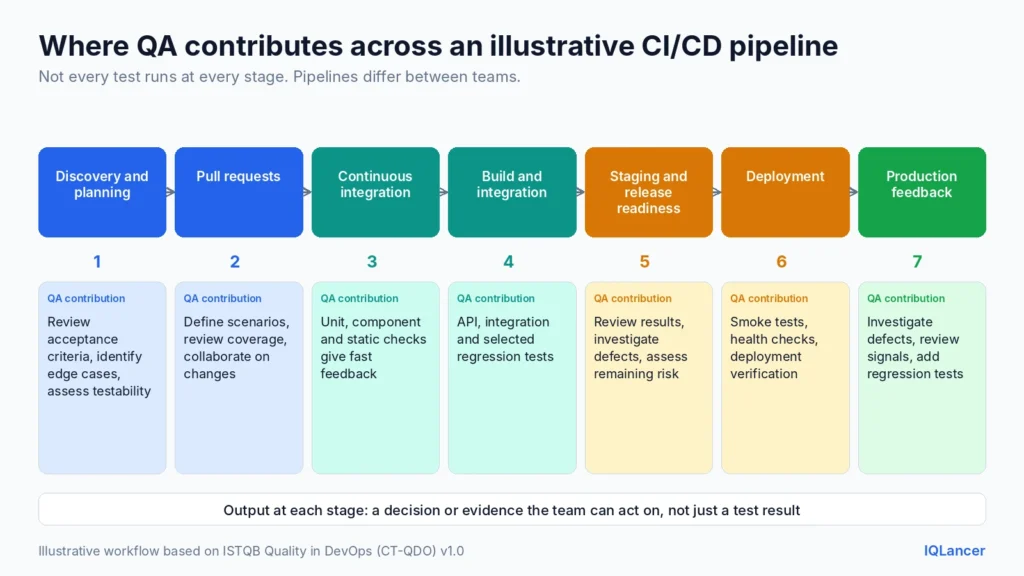
1. Discovery and planning
Before code exists, QA reviews the acceptance criteria. The syllabus describes planning as the point where quality characteristics and risks are identified and features are sliced into smaller stories. For payment validation, a QA engineer asks about expired cards, mismatched currencies, duplicate submissions when a user double-clicks, and what error message the user sees.
Output: clearer criteria, a list of edge cases and a decision on which checks are automated.
2. Code changes and pull requests
A developer opens a pull request. QA helps confirm that scenarios are covered by tests and that the change is small enough to test sensibly.
Output: agreed scenarios and review feedback before merge.
3. Continuous integration
The pipeline builds the change and runs fast checks. The syllabus describes CI as a commit stage covering compilation, low-level automated tests and static analysis, followed by an acceptance stage. It also describes a stop-and-fix practice: when the build or tests fail, the team fixes it before continuing. In our example, unit tests for the validation rules and static analysis run here.
Output: a pass or fail signal within minutes.
4. Build and integration testing
Slower checks follow. API tests confirm the validation endpoint returns the right responses and errors. A contract test confirms the checkout front end and the payment service still agree on request and response shapes. The syllabus notes that contract tests supplement other API tests and help detect breaking changes before deployment.
Suppose one integration test fails intermittently here. The team must decide whether this is a real race condition, a test that waits badly for an asynchronous queue, or a shared environment problem.
Output: a classified failure and a ticket or a fix QA in DevOps.
5. Staging and release readiness
The change is deployed to a production-like environment. The syllabus says smoke tests commonly run after each deployment to confirm it succeeded, before planned tests begin. QA runs selected regression tests and spends time on exploratory testing of error handling and duplicate submissions.
Output: a summary of results QA in DevOps , open defects and remaining risks.
6. Deployment
In continuous delivery, a person decides whether to deploy based on test results and readiness assessments. In continuous deployment, every change that passes its automated tests is deployed automatically. After deployment, smoke tests and health checks confirm the service behaves.
7. Production feedback
Production signals show real behaviour. If monitoring shows rejected validations for one currency format, QA works with developers to reproduce it and adds a regression test so the defect cannot return unnoticed.
What Types of Testing Are Used in DevOps?
DevOps teams use unit, integration, API, functional, regression, performance, security and exploratory testing according to application risks.
Team capacity, architecture and release requirements decide which of these run where. The syllabus makes the point about regression testing directly: all tests could theoretically run on every pipeline execution, but that wastes time, cost and energy. Teams usually build several suites with different coverage, run some before merge, some after, some overnight, and select them by risk using tags and filters.
| Testing type | Where it often runs | What it gives you | What it costs |
|---|---|---|---|
| Unit | Commit stage | Fastest feedback on small pieces of logic | Cannot show components work together |
| Integration and contract | After build, often on merge | Finds interface and service mismatches | Needs stable dependencies or test doubles |
| API | CI and build stages | Faster feedback than GUI testing and easy pipeline integration | Tests must follow evolving API contracts |
| Functional | Acceptance stage | Confirms features match expected behaviour | Slower than lower-level checks |
| Regression | Layered: selected per change, fuller before release | Protects existing behaviour | Suite size grows and needs curation |
| End-to-end | Staging, critical journeys only | Validates complete workflows | Slowest, often most fragile |
| Smoke | After builds and deployments | Quick check that essentials work | Shallow by design |
| Performance | Scheduled or pre-release for sensitive systems | Shows behaviour under load | Needs realistic environments and data |
| Security | Scans in pipeline plus periodic deeper testing | Surfaces weaknesses early; see the OWASP Web Security Testing Guide | Automated scans do not replace specialist review |
| Exploratory | Staging and sometimes production-adjacent | Human judgement finds what scripts did not anticipate | Depends on tester skill and time |
| Acceptance | Before release | Confirms business and user readiness | Needs stakeholder time |
The trade-off sits between early feedback, coverage, execution time and risk. A payment service justifies deeper security and regression checks than a static marketing page.
How Is Automated Testing Integrated into CI/CD?
Automated tests connect to pipeline events so teams can validate changes, review results and detect defects before release.
The flow is consistent across platforms. A developer opens a pull request or pushes a commit, and the CI system starts the configured pipeline. Automated checks run, and reports and failures become visible to the team. The team then decides whether a failure is a code defect, a test issue or an environment problem. Passing checks let the change progress according to the release process.
Platforms differ in the details, and those details matter:
- GitLab. A pipeline is triggered by events such as a commit, a merge request, a schedule or a manual run. Test results can be shown in merge requests through JUnit XML reports, but these reports do not affect job status; the job’s script must exit with a non-zero code to fail.
- Jenkins. A pipeline with failing tests is marked UNSTABLE, not FAILED, and by default execution continues. Skipping later stages after unstable results requires explicit configuration.
- GitHub Actions. Required status checks can block merging, and a required check skipped by path filtering can leave a pull request waiting for a status that never arrives.
QA in DevOps : The shared lesson is that a red or yellow result and a blocked release are different things. Someone must configure the connection.
Frameworks and languages
Teams write automated checks with frameworks such as Playwright or Selenium for browser tests and with REST API testing libraries for services, in languages including Java, Python and JavaScript or TypeScript. These are examples, not requirements. Frameworks need ongoing maintenance, because interface and API changes break scripts.
Environments, data and speed
- Environments. The syllabus argues that standardised, automated environments remove variability so results are reproducible, often using infrastructure as code.
- Test data. Options include synthetic data, subsetting and masking personal data. The same source warns that generated data may miss real-world complexity and that poor masking can expose sensitive information.
- Speed. The syllabus suggests that when a commit stage grows too long, for example beyond about five minutes, it makes sense to split it into parallel jobs. Treat that figure as an example, not a rule.
How Do Quality Gates Work in DevOps?
Quality gates apply defined checks and acceptance conditions to determine whether a software change can progress to the next delivery stage.
A gate can be automated, such as a required status check on a pull request, or a human decision for QA in DevOps, such as a release review. The syllabus notes that pull requests themselves act as a gate, and that pipelines commonly stop a build when agreed thresholds are not met.
Blocking and non-blocking checks. A blocking check stops progression until fixed. A non-blocking check reports a result without stopping the change, and someone still has to read it. As shown above, whether a failing test blocks anything depends on configuration.
Illustrative release-readiness example For QA in DevOps
This is an example only QA in DevOps. Conditions, thresholds, exception processes and approval authority differ by organisation. I deliberately give no universal pass percentages.
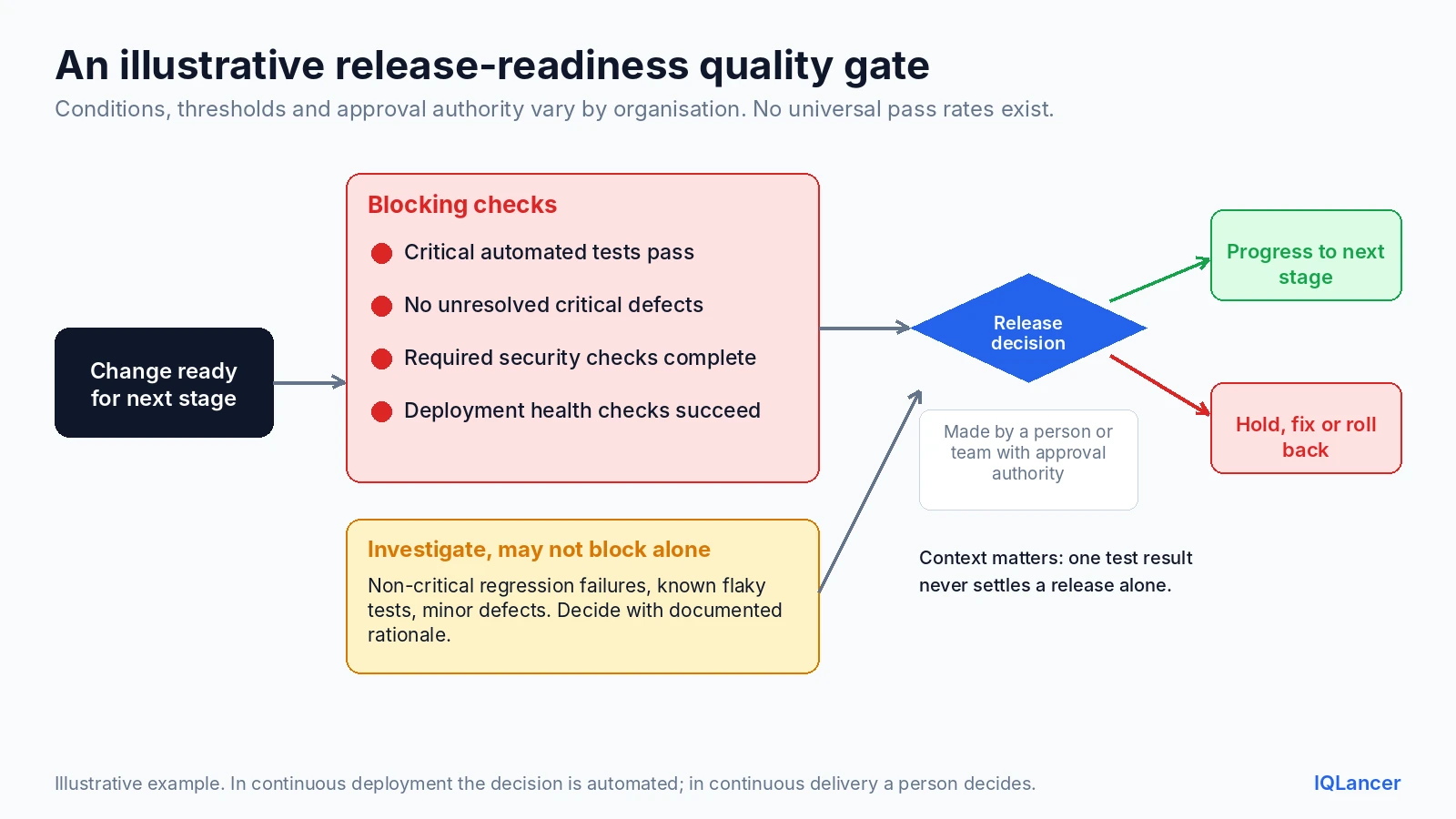
| Check | Blocks release? | If it fails |
|---|---|---|
| Critical automated tests (payment flows) | Yes | Investigate; fix code, test or environment before progressing |
| Unresolved critical defects | Yes | Triage with developers and product owner |
| Required security checks complete | Yes | Complete or review findings with security owners |
| Deployment health checks | Yes | Stop or roll back per the release strategy |
| Non-critical regression failures | Depends on risk | Investigate; decide with documented rationale |
| Known-flaky test failures | Usually not alone | Verify it is flaky, log it, plan the fix |
Who decides also varies. In continuous delivery, a person decides based on test results and readiness assessments. Depending on the team, that person could be a product owner, release manager or engineering lead, with QA supplying the risk picture. One test result never settles it, because context does: what changed, what else was tested, and what a failure would cost.
How should teams measure quality work?
Treat metrics as support for engineering decisions. Useful signals include defect escapes to production, test execution time, flaky test rate and defect resolution time. QA in DevOps each has limits. High coverage does not make an application reliable, a high pass rate does not prove the suite covers important risks, and more tests do not automatically mean better quality.
DORA’s five software delivery metrics are change lead time, deployment frequency, failed deployment recovery time, change fail rate and deployment rework rate. They describe delivery throughput and stability for a team or service, not the performance of an individual QA professional. Thoughtworks cautions that stability metrics only mean something when they reflect real user-impacting incidents, and recommends using them for team reflection.
What Challenges Do QA Teams Face in DevOps?
QA teams commonly address flaky tests, slow execution, inconsistent environments, test data problems and defects that escape into production.
These problems do not appear everywhere in the same form. They tend to show up as automation grows, environments are shared, or release frequency rises.
Flaky tests. A flaky test gives different results without a real change. Google’s testing team described how rerunning a failing test may or may not pass, which teaches engineers to see such tests as unreliable and lowers their value. The investigation question is whether the cause is the test, the environment or a real timing defect. A rerun that passes is not proof it was harmless.
Slow suites. When feedback takes too long, developers move on and context is lost. The response is to select tests by risk and runtime, split suites and run slower checks later, which is the layered regression approach described earlier.
Environment inconsistency. If staging differs from production, tests can fail for reasons users never see, or pass when they should not. Standardising environments reduces time spent troubleshooting environment differences instead of code defects.
Test data problems. Stale, incomplete or sensitive data can produce false failures or false confidence. In the payment example, a test using an expired sandbox token would fail for reasons unrelated to the code.
Automation maintenance. Changes to interfaces and APIs break scripts. The syllabus lists keeping tests current with evolving API contracts among the challenges of API testing.
Defect investigation. The core skill is classification. Ask whether the application is wrong, the test is wrong, the data is wrong, or the environment or infrastructure failed. Re-running with logs, comparing against a known-good build and checking recent environment changes usually narrows it quickly. Dedicated troubleshooting of failed builds is a separate topic that this article does not cover.
How Does QA Contribute to Software Quality After Deployment?
QA contributes after deployment through validation, defect investigation and improvements to test coverage based on production feedback.
Immediately after release, smoke tests and deployment verification confirm that critical workflows work. The syllabus describes release techniques that extend testing into production: dark launches that run a feature unseen by users, and canary releases that expose a small user group first.
QA is not automatically responsible for monitoring or incident response. In many organisations operations or SRE teams own those. The syllabus notes that service level indicators are measured through testing during development and through monitoring in operations, which is where QA in DevOps and monitoring meet. Production defect reports and monitoring signals become input for new scenarios, and each escaped defect should leave a regression test behind.
What Skills Does a QA Engineer Need to Work in DevOps?
QA engineers working in DevOps need testing, automation, programming, API, debugging, Git and CI/CD skills appropriate to their responsibilities.
What a small sample of employer listings shows
This is a sample of four public listings, not the hiring market. Titles, seniority and stacks differ, and listings change or close. For the wider picture QA in DevOps, see what recruiters look for in IT candidates.
- Cognizant’s QA Automation Engineer role asks for six or more years of QA experience, Playwright frameworks in JavaScript or TypeScript, Java or Python, and CI/CD integration using tools such as Jenkins, GitHub Actions or Azure DevOps. QA in DevOps candidates targeting this employer can also read our Cognizant hiring guide.
- Protolabs’ Senior QA Engineer listing describes owning continuous testing in GitHub Actions or Azure DevOps, running tests on pull requests, enforcing quality gates, managing flaky tests and failure triage.
- HCLTech’s SDET Test Lead listing centres on API and web services testing, Selenium, tools like Postman, SoapUI and JMeter, and experience with CI/CD pipelines and version control, with certifications listed as a plus. Whether that matters more than hands-on work is covered in certifications versus projects.
- Hitachi Vantara’s Principal SDET listing asks for deep automation experience with frameworks such as Selenium and Cucumber. A job-board summary of that role presents Kubernetes and CI/CD as essential for QA in DevOps, so confirm on the official page.
| Skill | Essential or role-dependent | Why it matters |
|---|---|---|
| Testing fundamentals and risk assessment | Essential across roles | Decides what to test and what to skip |
| Programming or scripting | Essential for automation and SDET roles; lighter for manual-focused roles | Builds and debugs automated checks |
| Automation frameworks | Essential for automation roles; the specific tool varies | Playwright, Selenium and others all appear |
| API testing | Common across the sample | Fast, stable feedback on backend behaviour |
| Git and CI/CD | Common for automation roles | Connects tests to delivery |
| Debugging and root-cause analysis | Essential | Separates product, test and environment failures |
| SQL and backend validation | Role-dependent | Verifies data behind the interface |
| Test data and environments | Increasingly important | Determines whether results are trustworthy |
| Docker, Kubernetes, cloud basics | Role-dependent, not universal | Matters where teams run containerised services |
| Communication and collaboration | Essential | Quality is shared work |
Expectations differ by QA in DevOps role. Manual-focused QA roles emphasise test design, exploratory skill and domain knowledge. Automation QA and SDET roles add framework code and pipeline integration. Quality engineering roles often add strategy, risk and release-readiness judgement. No single tool guarantees selection, and not every employer assesses CI/CD skills directly.
Evidence that demonstrates the skills
Practical evidence tends to say more than a skills list. Examples include a repository with API tests that run in a CI pipeline and publish a readable report, a short write-up of how you diagnosed a flaky test, a risk-based test plan for a small feature, and a regression test added after a real defect. For QA in DevOps project ideas that recruiters respond to, see DevOps projects recruiters want to see.
Conclusion
QA in DevOps spreads quality work across the delivery lifecycle: risk analysis before code, early checks on pull requests, layered automation in CI, release-readiness evidence, deployment verification and production learning. QA in DevOps changes where and how that work happens. It does not remove the need for testing expertise.
If you want to build these capabilities, start with one small change and trace it end to end. Write the risks, choose which checks run at which stage, automate one API check in a pipeline, and practise classifying a failure as product, test, data or environment. That one exercise covers most of what this article describes. When you are ready to plan the move, follow our QA Engineer to DevOps Engineer roadmap.
1 thought on “QA in DevOps: How Quality Engineering Works Inside CI/CD Pipelines 2027”