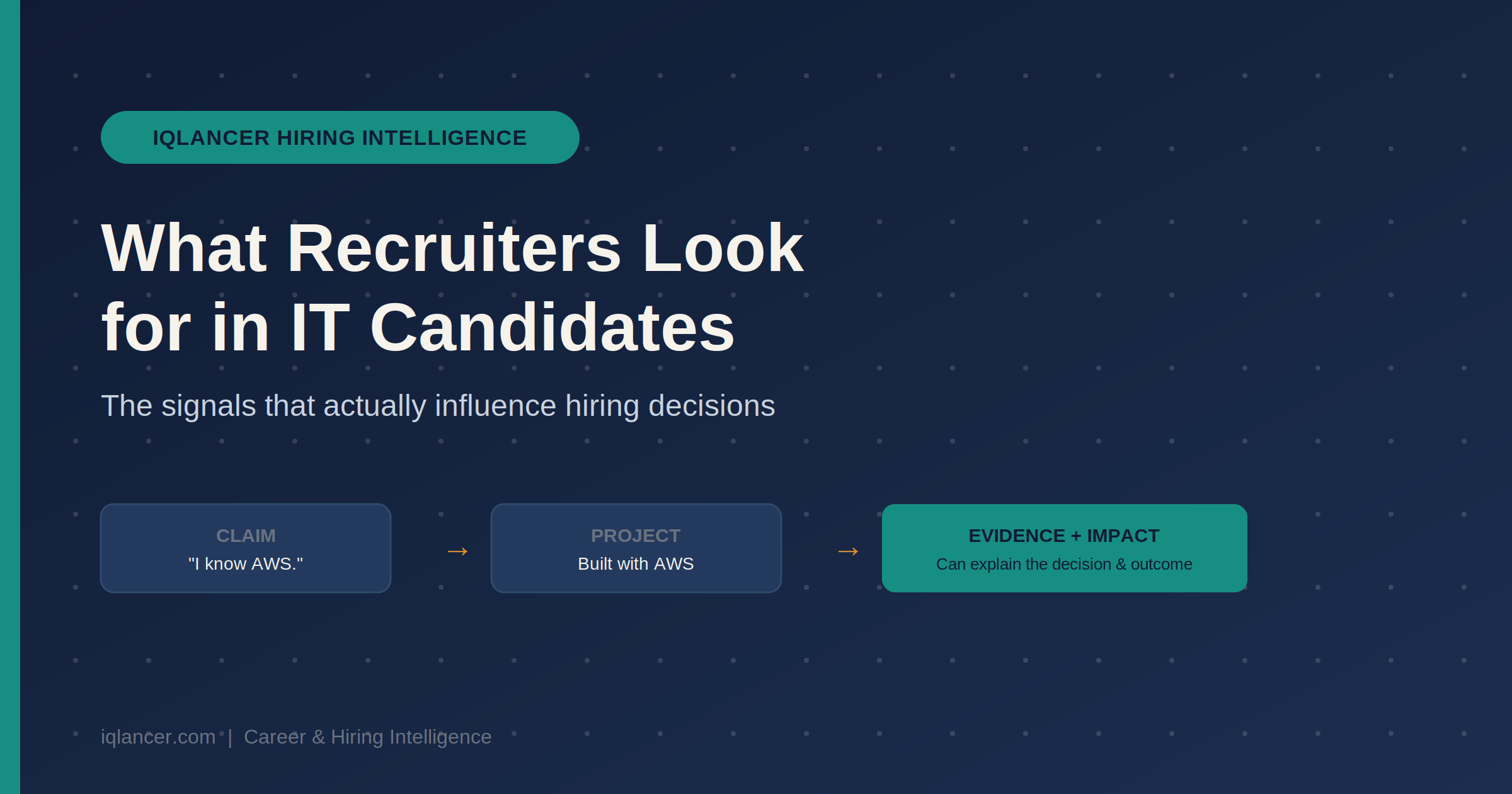
Most IT candidates prepare for hiring the same way list every tool they’ve touched, add a certification or two, and hope the resume speaks for itself. Then they get rejected without knowing why. The problem usually isn’t a missing skill, it’s that what recruiters look for in IT candidates is not a list of claimed abilities but proof that those abilities are real, relevant, and applicable to the job at hand.
A recruiter, a hiring manager, and a technical interviewer are each asking a different version of the same question: is there enough credible evidence here to believe this person can do the work? IQlancer breaks down what that evidence looks like at every stage of IT hiring, how expectations shift by role and career level, and how to audit your own profile before you apply.
What Recruiters Actually Evaluate in IT Candidates
A recruiter’s job is narrower than most candidates assume. They are not deciding whether you’re the best engineer in the applicant pool, they are deciding whether you’re worth sending forward to someone who can make that call. That means the first pass is largely about fit and eligibility, not depth.
In practice, recruiters commonly screen for:
- Role fit: does your background match the actual job, not just the job title
- Baseline qualifications: required experience, education, certifications, or clearances specified in the posting
- Relevant experience: work history that maps to the responsibilities listed, not just years in “IT” broadly
- Career trajectory and consistency: whether your titles, skills, and progression tell a coherent story
- Location and work constraints: remote/hybrid/onsite requirements, time zone, visa or work-authorization status
- Resume clarity: whether a reader can understand what you did and where, within a short scan
Recruiters do not universally weigh these factors the same way, a startup recruiter screening fifteen applications a week behaves differently than an enterprise recruiter running a structured pipeline for hundreds. What’s consistent is the underlying question: does this person plausibly belong in the next stage of this specific process? That’s a screening decision, not a hiring decision, a distinction that matters more than most candidates realize.
Recruiter Expectations vs Hiring Manager Expectations
One of the most common misunderstandings in technical hiring is treating “the recruiter” and “the hiring manager” as the same evaluator with the same standards. They’re not, and confusing the two leads candidates to prepare for the wrong conversation at the wrong stage.
A recruiter typically owns sourcing, screening, and moving candidates through the pipeline, while the hiring manager, usually the person you’d report to, defines the actual requirements, runs the substantive interviews, and makes the final call, according to Indeed’s breakdown of the two roles. The recruiter does not typically make the hiring decision; they build and manage the shortlist that the hiring manager evaluates.
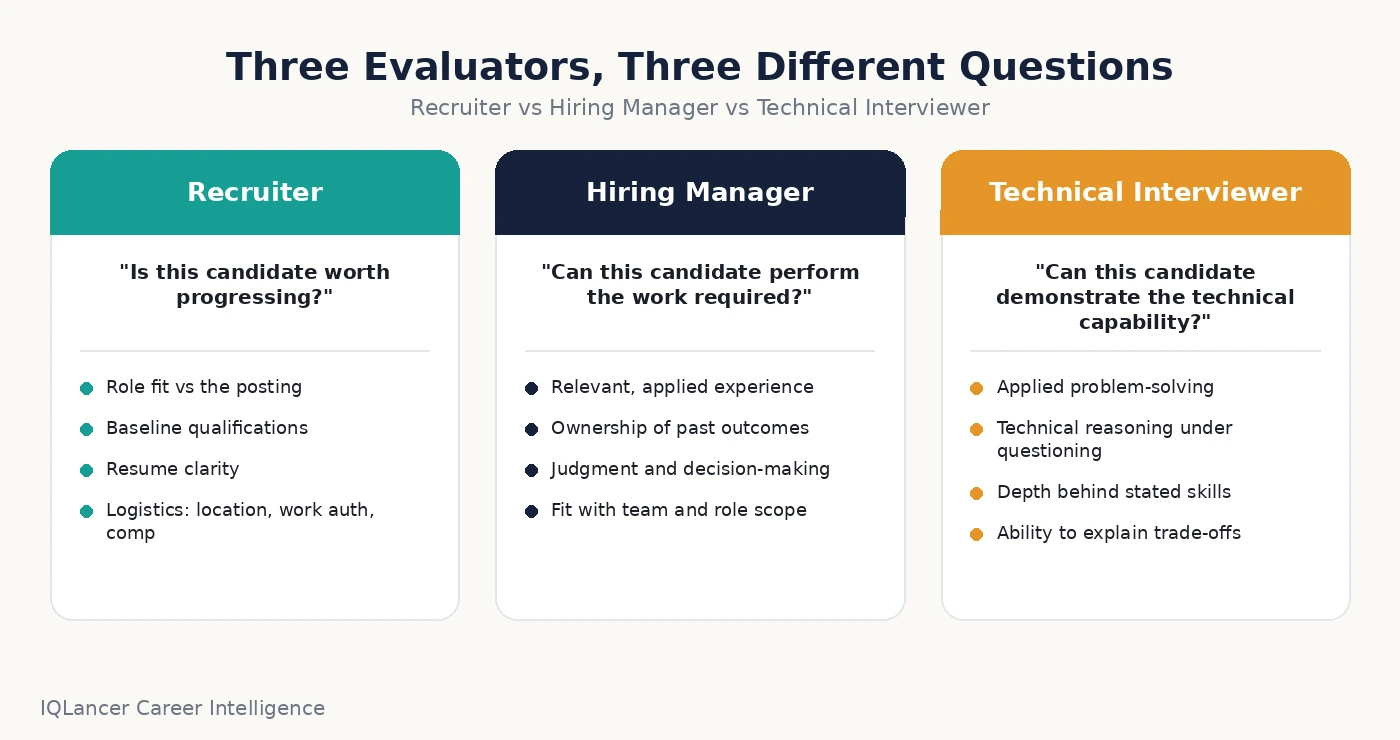
This split isn’t cosmetic. SHRM’s 2026 recruiting benchmarking data, cited by Noon, notes that requisitions per recruiter have risen sharply even as engagement between recruiters and hiring managers has declined, meaning the handoff between “worth progressing” and “worth hiring” is often less coordinated than candidates assume.
Practically, this means the language that gets you past a recruiter screen (clear, relevant, matched to the posting) is not automatically the language that convinces a hiring manager (specific, evidenced, tied to outcomes). Candidates who only optimize for the first filter often stall at the second.
How an IT Candidate Moves Through the Hiring Funnel
Each stage of the funnel answers a different question, and being strong at one stage doesn’t guarantee readiness for the next:
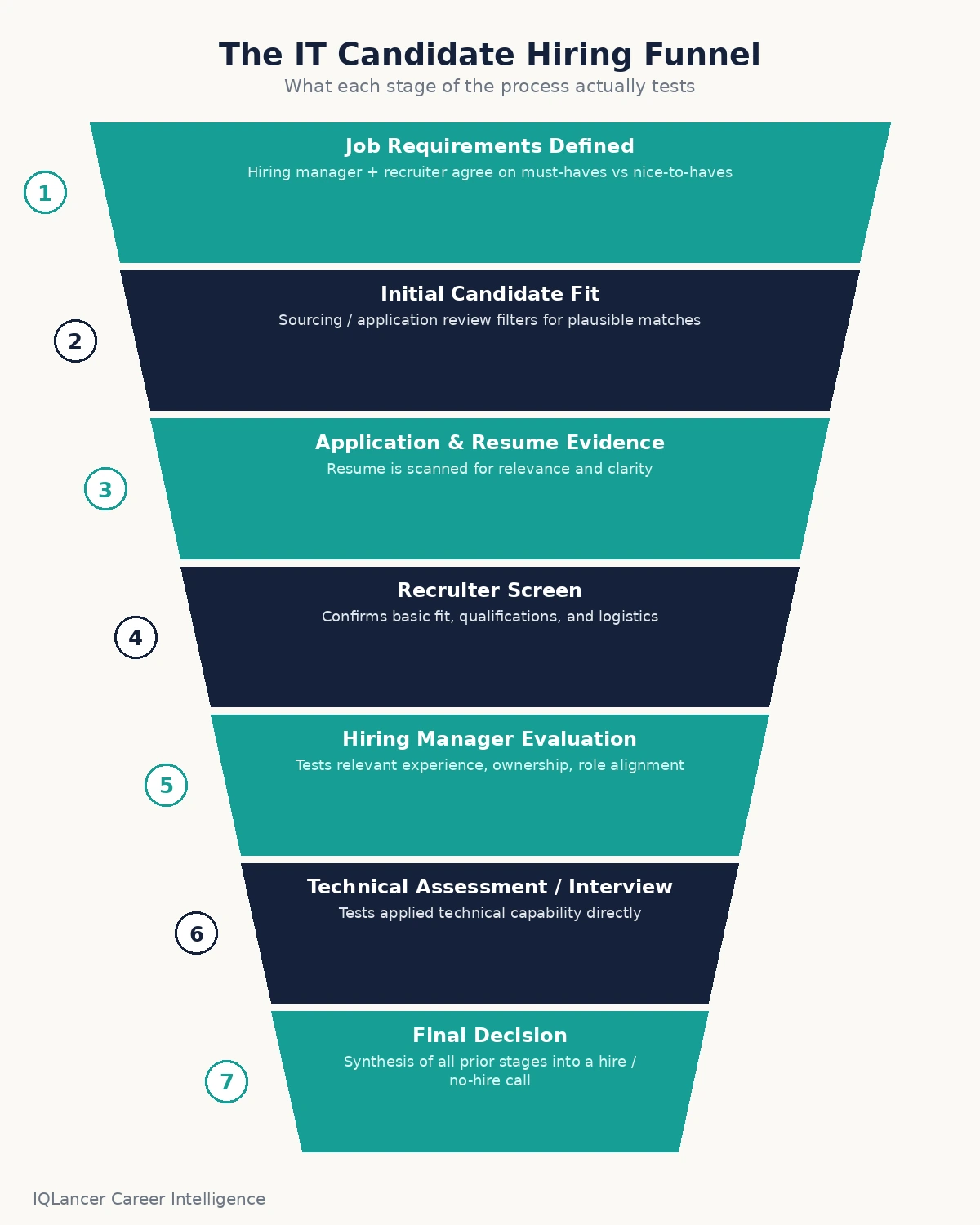
- Job requirements defined: the hiring manager and recruiter agree on must-haves vs nice-to-haves
- Initial candidate fit: sourcing or application review filters for plausible matches
- Application/resume evidence: the resume is scanned for relevance and clarity
- Recruiter screen: a short conversation (or automated screen) confirms basic fit and logistics
- Hiring manager evaluation: deeper discussion of experience, ownership, and role alignment
- Technical assessment/interview: direct evaluation of applied technical capability
- Final decision: synthesis of all prior stages, often with input from multiple interviewers
The practical takeaway: a candidate who is strong on paper but weak in the technical assessment doesn’t fail because their resume was wrong, they fail because a later stage tests something the resume can’t prove. Preparing for “the interview” as one event misses this; each stage has its own bar.
Minimum Requirements vs Differentiating Signals
Meeting the minimum bar and being competitive are two different achievements, and IT candidates frequently confuse them.
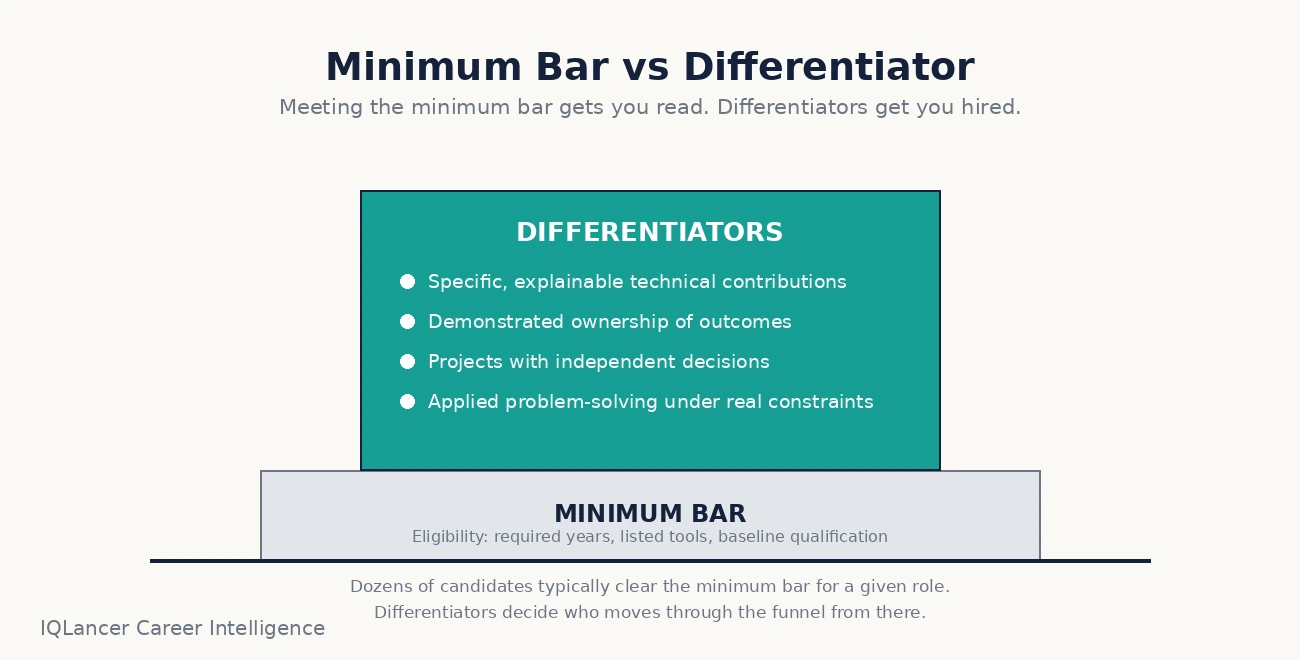
Minimum bar is what makes you eligible to be considered, the required years of experience, the listed technologies, the baseline qualification. Meeting it gets your application read. It does not get you hired, because in most competitive IT roles, dozens of applicants also clear that bar.
Differentiators are what separate candidates who clear the bar from candidates who get hired: specific, relevant evidence that you’ve actually applied the required skills in a way that matters for this role.
Illustrative example: A job posting for a Cloud Engineer role lists “AWS experience” as a requirement. Candidate A has AWS experience and lists it. Candidate B has AWS experience and can describe a specific migration they worked on, which services they chose and why, and what broke along the way. Both meet the minimum bar. Only one has demonstrated a differentiator.
This is the core of candidate evaluation in competitive IT hiring: minimum requirements filter the pool, but differentiating evidence decides who moves through it.
What Counts as Strong Evidence in IT Hiring?
This is the section most career advice skips, because “evidence” is treated as self-evident. It isn’t. Strong evidence in IT hiring generally follows a chain:
SKILL → APPLICATION → EVIDENCE → OUTCOME
- Skill: the underlying capability (e.g., “SQL query optimization”)
- Application: where and how it was used (“optimized reporting queries for a data pipeline handling daily batch loads”)
- Evidence: something that supports the claim (a project, a documented change, a described before/after, a portfolio artifact, a reference)
- Outcome: what changed as a result, where this is genuinely knowable, not every task produces a clean, measurable number, and candidates should not fabricate one to fit the template
Recruiter and hiring-manager guidance in 2026 increasingly frames this as evaluating demonstrated competencies rather than credentials alone, research from CertiProf notes that organizations are prioritizing what a candidate can actually do, backed by tangible experience, projects, or assessments, over a list of past titles and duties. That shift doesn’t mean every bullet needs a percentage attached to it, it means every claim needs something behind it: a project, a decision you can explain, a problem you can walk through.
IQLancer analysis: the most common gap we see isn’t missing skills, it’s candidates who have the evidence but never surface it. A candidate who fixed a production incident, wrote a migration script, or built an internal tool often describes it in one flat line instead of the reasoning that makes it evidence. The fix is rarely “get more experience.” It’s “explain the experience you already have.”
Why Relevant Evidence Matters More Than a Long Skills List
A resume with forty listed technologies is not stronger than one with twelve, it’s often weaker, because it signals breadth without depth and forces the reader to guess which of those forty you can actually use under pressure.
The shift toward skills-based hiring made this more explicit, not less. TestGorilla’s State of Skills-Based Hiring 2025 survey found that a large majority of employers globally report using some form of skills-based hiring, with many explicitly dropping formal degree requirements. But intent and practice have diverged in ways candidates should understand: a joint Harvard Business School and Burning Glass Institute study tracking more than 11,000 roles found that removing a degree requirement from a posting translated into a meaningful hiring shift at only about 37% of companies, the rest either changed nothing in practice (“skills-based in name only”) or reverted within a year. The overall effect was fewer than 1 in 700 new hires nationally.
IQLancer analysis: this gap matters for candidates specifically because it means a posting that says “skills over degrees” doesn’t guarantee an evaluation process that actually screens on skills. The safest strategy is to assume evaluators, recruiter, hiring manager, or interviewer, will ask you to demonstrate a skill, not just list it, and prepare accordingly regardless of how the posting is worded.
On the resume-screening side specifically, the belief that stuffing a resume with keywords beats automated filters is largely outdated. Modern applicant tracking systems increasingly use semantic matching rather than raw keyword counting, and multiple 2026 analyses, including a peer-reviewed model described by KraftCV, note that transformer-based matching captures meaning and context, not keyword frequency, and that stuffing is more likely to be flagged than rewarded.
A resume built around relevant, specific, applied evidence performs better at both the automated and human stages than one built around keyword density.
How Recruiter Expectations Change by Career Level
Career level changes what counts as sufficient evidence, not just how much of it you need. Reducing this to “years of experience” misses the point, a candidate with five years in a narrow, repetitive role can present weaker evidence than a candidate with two years across varied, high-ownership work.
Entry-level
- Fundamentals, can you explain core concepts, not just recite them
- Personal or academic projects, especially ones that go beyond tutorial replication
- Internships or coursework applied to something real
- Demonstrated learning ability, how quickly you pick up unfamiliar tools
- Basic problem-solving under guidance
Mid-level
- Independent execution, can you take a task from requirement to delivery with minimal oversight
- Production experience, work that shipped and was maintained, not just built
- Ownership of a defined area or system
- Collaboration across roles (e.g., working with product, security, or other engineering teams)
- Measurable impact where it’s genuinely available, without inventing metrics where it isn’t
Senior
- Technical judgment, knowing which trade-off to make and why, not just how to implement
- Architecture and system-level thinking
- Scope, influence beyond a single ticket or feature
- Mentoring and technical leadership
- Comfort operating in ambiguity, where requirements are incomplete
- Business impact, connecting technical decisions to organizational outcomes
NACE’s Job Outlook 2025 research found that structured problem-solving is the single most commonly screened-for skill across surveyed employers, and that its weighting increases, rather than decreases, as candidates move into roles with more ambiguity. In other words, problem-solving isn’t just an entry-level filter; it becomes a harder bar at senior levels, evaluated through more open-ended scenarios instead of clean, bounded ones.
What Recruiters Look for Across Different IT Roles
Generic advice treats “IT hiring” as one evaluation process. It isn’t. What counts as evidence differs meaningfully by role.
| Role | Core requirements | Practical evidence that stands out |
|---|---|---|
| Data Analyst | SQL, data visualization, statistical reasoning | A project where you defined the question, cleaned messy data, and explained why a specific metric or visualization answered the business question, not just a dashboard screenshot |
| DevOps Engineer | CI/CD, infrastructure automation, cloud platforms | Evidence of pipelines you built or maintained, incidents you diagnosed, and specific trade-offs made between reliability, speed, and cost |
| Cloud Engineer | Cloud architecture (AWS/Azure/GCP), networking, cost and security awareness | A described migration, architecture decision, or cost-optimization effort with the reasoning behind service choices, not just a certification badge |
| Cybersecurity Analyst | Threat detection, incident response, security fundamentals | A documented incident walkthrough, a vulnerability you identified and remediated, or a security tool you configured and why, CompTIA Security+ is widely treated as a baseline entry credential, not a substitute for applied evidence |
| AI Engineer | Model development, deployment, evaluation, data pipelines | A project describing model selection reasoning, evaluation methodology, and what happened when the model failed or underperformed, not just “built an ML model” |
| Full Stack Developer | Frontend/backend integration, APIs, databases, deployment | A shipped application where you can explain architecture decisions end-to-end, including what you’d change with more time |
Not every company evaluates these roles identically, a fintech cybersecurity role and a startup cybersecurity role will weight compliance knowledge differently, for example. The consistent thread is that role-specific, explainable evidence outperforms a generic technology list every time.
How Projects and Portfolios Demonstrate Technical Ability
A project only functions as evidence if it demonstrates thinking, not just output. Hiring teams evaluating a project generally look at:
- The problem being solved: was it a real constraint, or an arbitrary exercise
- Technical choices and trade-offs: why this stack, this architecture, this approach
- The candidate’s actual contribution: especially for team or open-source projects, where credit needs to be specific
- Documentation: can someone else understand and use what you built
- Testing and deployment, where relevant to the role
- Results, where genuinely available: without fabricated metrics
A project built by closely following a tutorial, with no independent modification or troubleshooting, generally provides weaker evidence than a smaller project where the candidate made and can explain their own decisions. This isn’t a judgment on tutorials as a learning tool, it’s a distinction about what tutorial-completion actually proves to an evaluator, which is that instructions were followed, not that judgment was exercised.
IQLancer recommendation: don’t fabricate outcomes to make a project sound more impressive. If a project doesn’t have a measurable result, describe the reasoning and trade-offs instead, that’s still evidence, and it’s more credible than an invented number.
What Certifications Signal to Recruiters
Certifications function as a supporting signal, not proof of job readiness. That distinction matters, and conflating the two is one of the more common candidate mistakes.
CIAT’s 2026 IT certification roadmap frames certifications as proof of specific, verifiable skills that employers can hire against, while degrees tend to satisfy broader HR screening filters, the two serve different, complementary purposes rather than substituting for each other.
A certification’s value also depends heavily on context: an entry-level credential like CompTIA A+ or Security+ carries more weight for a candidate with limited hands-on experience, while for an experienced candidate, an advanced certification like CISSP or an AWS Solutions Architect credential signals readiness for more senior responsibility rather than basic competence, according to CadreIT’s 2026 certification analysis.
What certifications generally do not do on their own is prove you can apply the knowledge under real conditions, that’s the gap technical interviews and practical evidence are designed to close. A candidate with a certification and no supporting project or experience will usually be asked to demonstrate the underlying skill directly.
Why Ownership, Problem-Solving and Impact Matter
There’s a meaningful difference between three ways of describing the same work:
- “I worked on X”: passive, ambiguous about your actual role
- “I owned X”: signals accountability for a defined outcome or system
- “I solved X problem using Y approach”: signals applied problem-solving with a traceable decision process
Hiring teams weight these differently because they answer different questions. “I worked on X” tells an evaluator almost nothing about your contribution on a team project. “I owned X” tells them you were accountable for a result. “I solved X using Y” tells them how you think, which is often what a technical interview is actually trying to assess, just through a live conversation instead of a resume line.
Illustrative example: “Worked on the deployment pipeline” versus “Owned the migration of our deployment pipeline from a manual process to automated CI/CD, and had to resolve environment-configuration inconsistencies that were causing intermittent failures.” The second version doesn’t require an invented statistic to be far stronger evidence, it shows ownership, a specific problem, and an implied resolution.
How Technical Communication Is Evaluated
Technical communication in hiring isn’t a generic soft-skill checkbox, it’s a specific, evaluable capability: can you explain a technical decision to someone who wasn’t in the room when you made it?
In practice, this shows up as the ability to explain:
- What was built or changed
- Why a particular approach was chosen over alternatives
- What went wrong, and how it was diagnosed
- What trade-offs existed and how they were weighed
- What you would do differently with more time or information
Interviewers frequently probe this deliberately, asking “why” after a candidate describes a decision, specifically because the answer reveals whether the candidate understood the trade-off or just executed a step. Candidates who prepare only to describe what they built, without rehearsing why, are often surprised by how quickly a technical interview moves past the surface description.
What Your Career Story Signals to Recruiters
Consistency across your resume, LinkedIn, job titles, and described skills matters less for the individual data points and more for the overall coherence it creates. Recruiters and hiring managers are reading for a story that makes sense: does the progression of roles, skills, and responsibilities logically build on itself?
Career changes and shorter tenures are not inherently negative signals, research and recruiter commentary on job hopping in 2026 increasingly frames the explanation for movement, not the movement itself, as what matters, and candidates who can clearly articulate their career path are generally viewed favorably even with several transitions. What creates friction is unexplained inconsistency, a title that doesn’t match the described responsibilities, a skill claimed on LinkedIn but absent from the resume, or a gap that isn’t addressed anywhere. The issue isn’t the change; it’s the missing context around it.
High-Signal vs Low-Signal Candidate Evidence
This is an IQLancer practical framework, not a scientifically validated universal ranking, hiring is not fully standardized, and different evaluators weight signals differently. But across the funnel stages discussed above, some patterns of evidence consistently perform better than others.
| High-signal evidence | Low-signal evidence |
|---|---|
| Relevant production or hands-on experience | Long, undifferentiated skill lists |
| Specific, explainable technical contributions | Generic adjectives (“hardworking,” “detail-oriented”) |
| Clear ownership of a defined outcome | Unrelated certifications with no connection to the role |
| Projects with independent decisions and trade-offs | Tutorial-only projects with no modification |
| Strong, structured explanations of past work | Unsupported or vague claims (“expert in 15+ technologies”) |
| Demonstrated problem-solving under real constraints | Achievements irrelevant to the target role |
| Role-specific relevant experience | Keyword-matched but shallow experience |
What Candidates Think Recruiters Want vs What Hiring Teams Need to See
| Candidate thinks | Hiring team actually needs |
|---|---|
| “I know AWS.” | “Can you demonstrate how you used AWS and explain the problem it solved?” |
| “I have 10 certifications.” | “Can you apply this knowledge under real conditions in this role?” |
| “I have five years of experience.” | “What relevant work did you actually perform in those five years?” |
| “My resume is keyword-optimized.” | “Does the application accurately represent relevant, applicable qualifications?” |
| “I listed every technology I’ve touched.” | “Which of these can you actually use independently, right now?” |
This contrast is the recurring thread through every section above: candidate evaluation in IT hiring is not about the volume of claims on a page, it’s about whether those claims survive a follow-up question.
The IQLancer Candidate Evaluation Framework
An original IQLancer framework for structuring your own readiness across nine dimensions. This is IQLancer’s synthesis, not an industry-standard certification framework:
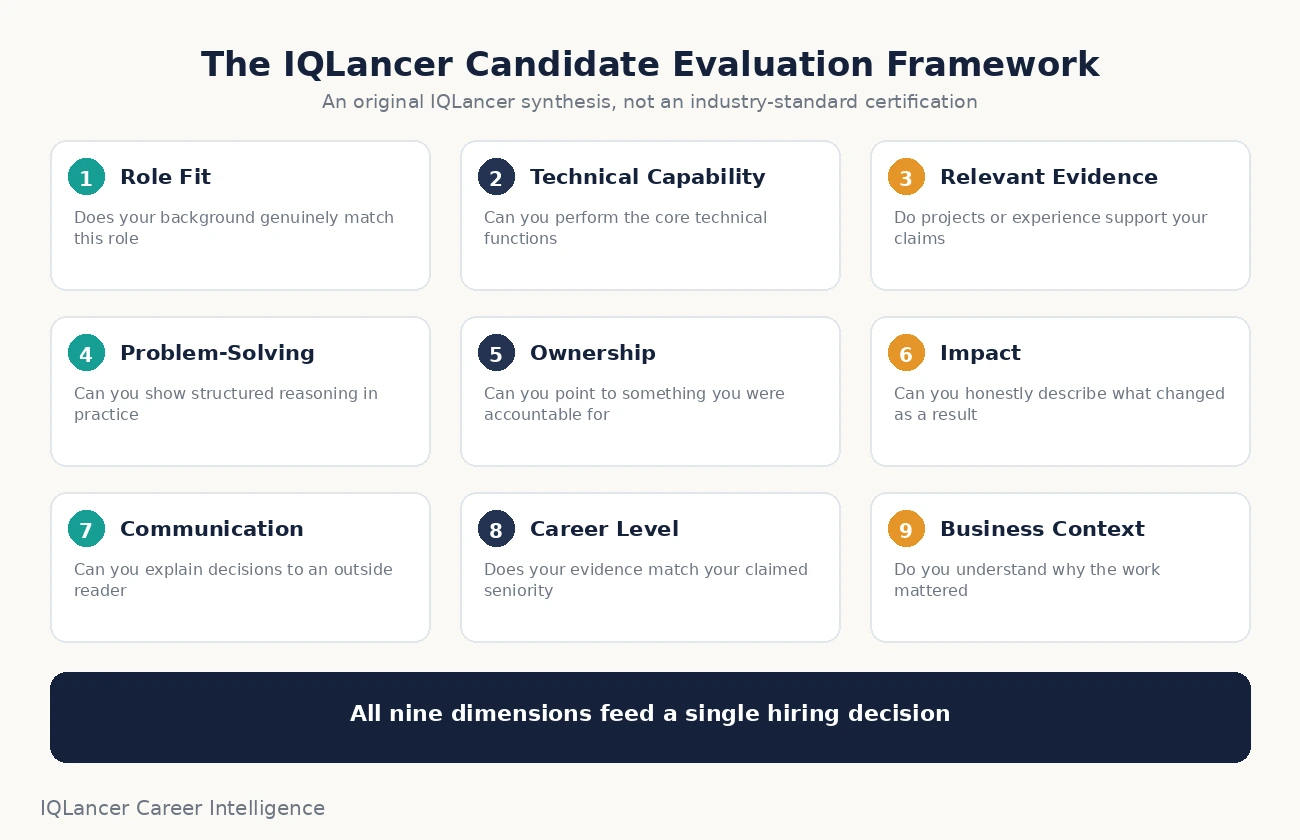
- Role Fit: does your background genuinely match this specific role
- Technical Capability: can you perform the core technical functions of the job
- Relevant Evidence: do you have projects, experience, or artifacts that support your claims
- Problem-Solving: can you demonstrate structured reasoning through a real or realistic scenario
- Ownership: can you point to something you were accountable for, not just involved in
- Impact: can you describe what changed as a result of your work, honestly
- Communication: can you explain your decisions to someone unfamiliar with the context
- Career Level: does your evidence match what’s expected at your claimed seniority
- Business/Context Awareness: do you understand why the work mattered beyond the task itself
The IQLancer Signal Hierarchy: From Claims to Evidence
An illustrative IQLancer model showing how the same underlying skill becomes progressively stronger evidence:
CLAIM → “I know AWS.” CREDENTIAL → “AWS certification.” PROJECT → “Built an AWS-based project.” EXPERIENCE → “Used AWS professionally.” EVIDENCE + IMPACT → “Used AWS to solve a specific technical problem, and can explain the decisions, implementation, and outcome.”
Each step down this hierarchy narrows the gap between what you say and what you can prove. Most candidates stop at credential or project level and assume that’s sufficient, but hiring managers and technical interviewers are generally probing for the bottom tier, whether or not the job posting says so explicitly.
What a Resume Can Prove and What It Cannot
A resume can effectively communicate:
- Relevant experience and job history
- Named skills and technologies
- Qualifications and education
- Listed projects and achievements
- Career progression over time
What a resume generally cannot fully establish on its own:
- Technical depth (how well you actually know a tool, not just that you’ve used it)
- Real-time problem-solving ability
- Judgment and decision-making quality
- Communication quality under questioning
- Team behavior and collaboration style
- Architecture-level reasoning
This is precisely why the hiring funnel has multiple stages. The resume gets you screened; the recruiter conversation and hiring manager interview test relevance and ownership; the technical assessment or interview tests the things a document structurally cannot prove. A resume that oversells relative to what a candidate can demonstrate in later stages doesn’t just risk a bad interview, it can undermine the credibility of everything else on the page.
How to Audit Your IT Candidate Profile Before Applying
Before applying, work through these questions honestly:
- Am I targeting a role that actually matches my current level and background?
- Do I meet the essential (not just preferred) requirements listed?
- Can I prove my core claimed skills with something specific?
- Is my listed experience genuinely relevant to this role, or just adjacent?
- Can I explain what I personally owned in past team projects?
- Can I describe impact honestly, without inflating or inventing numbers?
- Do my projects demonstrate independent thinking, or just tutorial completion?
- Can I explain the why behind my past technical decisions, not just the what?
- Does my career story hold together across resume, LinkedIn, and interview answers?
- What specifically differentiates me from other candidates who meet the same minimum bar?
If you’re preparing for a specific IT path, IQLancer’s career blueprint guides walk through the skills, learning sequence, and evidence-building steps for individual roles in more depth than a general audit can cover.
IQLancer IT Candidate Readiness Checklist
- Resume is tailored to this specific role, not a generic all-purpose version
- Every claimed skill has at least one piece of supporting evidence behind it
- At least one project demonstrates independent decisions, not just tutorial completion
- You can explain the reasoning behind at least three past technical decisions
- You can describe what you personally owned versus what a team did
- Certifications are relevant to the target role, not just accumulated
- Career transitions are explainable, not just present on the timeline
- You’ve rehearsed answering “why,” not just “what,” for your key projects
- Your LinkedIn, resume, and interview answers tell a consistent story
- You know what differentiates you from a candidate who meets the same minimum bar
Final Thought
Recruiters, hiring managers, and technical interviewers are not evaluating the same thing, but they’re all asking versions of the same underlying question: is there real evidence behind this claim? Understanding what recruiters look for in IT candidates means recognizing that a long skills list, a stack of certifications, or years of tenure only matter to the extent they’re backed by something you can explain and defend.
The candidates who move furthest through IT hiring processes aren’t necessarily the ones with the most credentials, they’re the ones who can show, specifically and honestly, what they actually did and why it mattered. Before your next application, the more useful question isn’t “what else can I add to my resume,” but “what can I prove, right now, if someone asks me to explain it.”
1 thought on “What Recruiters Look for in IT Candidates: The Evidence That Gets You Hired”