Yes, a QA engineer can move into DevOps, but QA experience alone is not enough. Testing builds habits that carry over well automation, debugging, release awareness and close work with developers. DevOps widens the scope from validating software to delivering and running it. That means owning deployment automation, infrastructure, environments, cloud, observability and operational reliability.
IQLancer QA to DevOps roadmap follows one framework: existing QA capability, skill gap, ordered learning, evidence and transition readiness. It is capability-led rather than tool-led. Treat it as a devops transition roadmap to adapt to your background, not a checklist that guarantees a role.
Can a QA Engineer Become a DevOps Engineer?
Yes. QA engineers can move into DevOps by extending automation, CI/CD and debugging experience with Linux, cloud, infrastructure and operations skills.
A QA to DevOps career switch of this kind works because AWS describes DevOps as a mix of culture, practices and tools that speeds up delivery. Several of those practices, such as automation and quality checks, already sit close to testing work.
QA Experience That Transfers to DevOps
| QA experience | DevOps connection | Additional capability needed |
|---|---|---|
| Test automation | Repeatable, code-driven workflows | Automating builds, deployments and operational tasks |
| CI test execution | Familiarity with pipelines and quality gates | Designing and maintaining the pipeline itself |
| Test environments | Awareness of configuration drift | Provisioning environments reproducibly |
| Debugging defects | Structured root-cause thinking | Tracing faults through OS, network and infrastructure |
| API testing | Understanding of service behavior | Service networking, authentication, load balancing |
| Git | Version control habits | Branching strategy, tags, release workflows |
| Scripting | Automation fluency | Bash or Python for operations and tooling |
| Release validation | Deployment verification mindset | Automated rollout, rollback, post-deploy checks |
| Environment troubleshooting | Practical diagnosis | Linux administration, logs, configuration management |
| Developer collaboration | Cross-team communication | Shared ownership of delivery and incidents |
QA gives you habits (automation, verification, diagnosis). DevOps asks you to apply them to delivery and infrastructure.
What QA Experience Does Not Automatically Give You
Linux administration, networking, cloud infrastructure, Infrastructure as Code, containers and Kubernetes are rarely part of a testing role. Neither are production monitoring, observability, infrastructure security and operational ownership, meaning accountability when a live service degrades.
A transferable foundation is not complete DevOps experience, but it shortens the distance. The stages below close each gap.
QA to DevOps Skill Gap: What Changes?
The gap is one of scope. QA validates that software works; DevOps also owns how it is delivered, run and observed in production.
The table below lists the DevOps skills for testers to build, as capability layers rather than tools.
| Layer | What QA may already understand | What DevOps adds | Why it matters |
|---|---|---|---|
| Systems | Where logs and services live in test environments | OS administration, processes, services | Faults often start below the application |
| Networking | Endpoints, status codes, timeouts | DNS, routing, ports, load balancing, firewalls | Many “app bugs” are connectivity problems |
| Engineering automation | Test scripts | Tooling for builds, releases, operations | Removes repetitive engineering work |
| Software delivery | Test stages in a pipeline | The full build, release and deployment flow | Delivery speed and safety depend on it |
| Containers | The pain of environment setup | Packaged, isolated, portable runtimes | Consistency across environments |
| Cloud | Cloud-hosted test targets | Compute, storage, IAM, scaling | Many teams run workloads on cloud platforms |
| Infrastructure as Code | Test environment configuration | Infrastructure defined in version-controlled code | Repeatability and auditability |
| Orchestration | Multi-service test setups | Scheduling, scaling and restarting containers | Running many services reliably |
| Observability | Reading failure reports | Logs, metrics, alerts, dashboards | Understanding behavior after release |
| Operational ownership | Raising defects | Responsibility for availability and incidents | Changes the accountability model |
QA to DevOps Roadmap: What Should You Learn First?
Start with Linux and systems, then networking, Git and scripting, CI/CD, Docker, cloud, IaC, Kubernetes and observability, proving each stage with hands-on evidence.
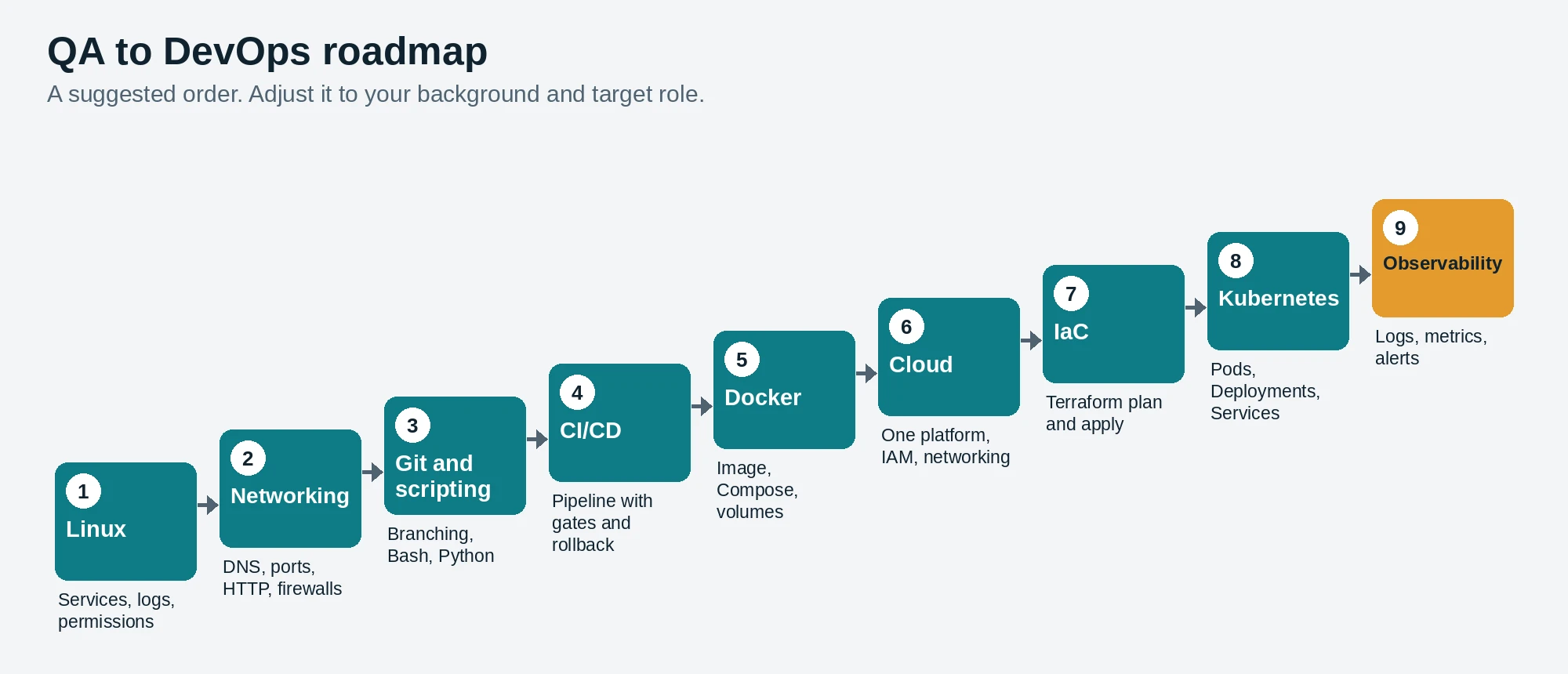
QA Foundation → Linux & Systems → Networking → Git & Scripting → CI/CD → Docker → Cloud → Infrastructure as Code → Kubernetes → Monitoring & Observability → Hands-on Evidence → Applications
The order matters because later layers assume earlier ones. Containers assume Linux and networking. Kubernetes assumes containers and cloud. IaC assumes you know what you are provisioning.
This is not the only valid order. An SDET comfortable with Git, scripting and CI can move through Stages 3 and 4 quickly, and a specific job posting can reorder your priorities.
Stage 1: Strengthen Linux and Systems Fundamentals
Focus on what DevOps work uses daily: the filesystem, permissions, processes, services, logs, SSH, package management and Bash basics. The Linux man-pages project is a reliable reference.
A QA engineer may already trace a failure from test to application to environment to logs. DevOps extends the chain: application, service, process, operating system, infrastructure, logs, root cause.
Evidence: a written investigation of a service that would not start (wrong permissions, port conflict, full disk), showing the commands and logs used to find the cause.
Stage 2: Learn Networking for DevOps
Cover IP addressing, DNS, ports, HTTP/HTTPS, TCP basics, load balancing and firewall or security-group rules. MDN’s HTTP overview and Cloudflare’s DNS explainer are good starting points.
You have likely met the symptoms already: API failures, unreachable environments, wrong endpoints, services that cannot talk to each other, blocked access. You should be able to tell whether a failure is DNS, a closed port, a security rule, a certificate problem or the application, and show how you checked. This is troubleshooting depth, not CCNA depth.
Stage 3: Move From Test Automation to Engineering Automation
Automating tests checks software. Engineering automation removes repetitive work from building, releasing and operating it.
Build fluency with branching, merges, conflict resolution, rebasing and tags using the Pro Git book, and learn how commits trigger CI. Add Bash and one practical language such as Python. Automation QA engineers can reuse existing scripting skills, but the target changes: log collection, environment setup or release notes instead of test cases.
Evidence: a script in a repository, run by a workflow, that replaces a manual task.
Stage 4: Learn CI/CD From the DevOps Side
A QA view is often Code → Build → Test. The delivery flow is wider: Code → Build → Test → Artifact → Deployment → Environment → Verification → Monitoring → Rollback.
Learn triggers, builds, artifacts, environment variables, secrets, deployment, quality gates and rollback. Choose one system and learn it deeply: GitHub Actions, GitLab CI/CD, Jenkins Pipeline or Azure Pipelines.
QA engineers often have an edge because they already understand automated test execution and quality gates. But running tests in Jenkins is different from designing and maintaining a delivery pipeline.
Evidence: a pipeline you can explain stage by stage, including why each gate exists and how a failed deployment is reversed.
Stage 5: Learn Docker and Containerization
Understand images, containers, Dockerfiles, registries, ports, volumes, container networking and Docker Compose. The Docker overview explains the model.
Traditional environment thinking installs dependencies on a shared server and hopes it matches production. Containerized thinking packages the application with its runtime so it behaves the same on laptops, CI and servers. The goal is to explain how applications are packaged, isolated, moved and run consistently, not to memorize commands.
Evidence: a Dockerfile and Compose file whose choices you can justify, covering base image, exposed ports and persistent data.
Stage 6: Build Cloud Fundamentals
Learn compute, storage, networking, IAM, security, scaling, availability and monitoring. AWS, Azure and Google Cloud are examples, and none is mandatory. Build depth in one before sampling others, since job descriptions usually ask for hands-on use of a specific platform.
Start with the provider’s own material, such as AWS IAM documentation, the Azure Architecture Center or the Google Cloud Architecture Framework. The DevOps responsibility is choosing and securing resources, controlling access and keeping services available.
Evidence: an application deployed with least-privilege access and a clear explanation of its network layout.
Stage 7: Learn Infrastructure as Code
IaC moves you from manual infrastructure to repeatable infrastructure. Terraform is the usual example. Providers connect to platforms, resources describe components, variables and outputs make configurations reusable, state records what exists, modules package patterns, and plan/apply separates review from change.
It matters because infrastructure in version control can be reviewed, reproduced and audited, unlike a trail of console clicks. The capability is “I can define infrastructure repeatably,” not “I know a few commands.”
Evidence: a configuration that builds and destroys an environment from scratch, with a reviewed plan.
Stage 8: Learn Kubernetes After the Foundations
Do not start here. Kubernetes assumes Linux, containers, networking and usually a cloud environment: Linux → Containers → Cloud → IaC → Kubernetes.
Then learn Pods, Deployments, Services, ConfigMaps, Secrets, scaling and basic troubleshooting. Kubernetes is useful because it schedules, scales and restarts containers across machines, which matters once you run many services. The depth expected varies by employer.
Evidence: deploy an application, break it deliberately (bad image, failing probe), then diagnose it.
Stage 9: Monitoring, Logging and Observability
Learn logs, metrics, alerts, dashboards, health checks and incident investigation. Prometheus and Grafana are common examples, not requirements. The Google SRE book’s monitoring chapter covers the concepts.
The key capability is whether you can understand what is happening after deployment and investigate failures. QA engineers already ask what changed and what broke. Here you answer from telemetry instead of test reports.
Evidence: a dashboard and alert tied to a service level you can justify, plus a short incident write-up.
How Can a QA Engineer Turn Existing Experience Into DevOps Evidence?
Translate each QA responsibility into a DevOps capability, then prove it with something you built, rather than relabeling past duties.
| Existing QA experience | DevOps-relevant interpretation | Evidence |
|---|---|---|
| Automated regression testing | Automation mindset | Maintainable workflow running on every commit |
| Jenkins test execution | CI exposure | Pipeline that runs tests and publishes artifacts |
| Environment testing | Environment awareness | Reproducible environment built from code |
| API testing | Service understanding | Documented service troubleshooting case |
| Release validation | Deployment verification | Deployment pipeline with a verification stage |
| Scripting | Engineering automation | Script integrated into a workflow |
| Defect investigation | Troubleshooting | Written root-cause investigation |
Credibility warning: do not relabel QA work as DevOps work if you did not perform the responsibility. Running a Jenkins job is not the same as designing and maintaining a CI/CD platform. Describe your actual duties accurately and present gap-closing work as personal projects. In practice, interviewers probe depth quickly, and honest positioning survives that. When you later write this up, ATS resume requirements for DevOps engineers explains how to represent demonstrated capability.
What DevOps Projects Should a QA Engineer Build?
Build four evidence milestones: a CI/CD quality pipeline, a containerized application, cloud infrastructure defined as code, and a deployment with monitoring.
Detailed guidance belongs in QA to DevOps projects. The strongest QA to DevOps projects are ones you can defend, since a project is not professional experience and should be presented as a project.
Project 1: CI/CD Quality Pipeline
Demonstrates Git, pipeline automation, testing, artifacts and quality gates. It shows you can shape delivery rather than only run tests. Evidence: a repository, pipeline file, passing and failing run history, and documented gate rules.
Project 2: Containerized Application
Demonstrates Docker, application packaging and environment consistency. It shows you can make runtimes reproducible. Evidence: Dockerfile, Compose setup and a README explaining image and volume choices.
Project 3: Cloud Infrastructure With IaC
Demonstrates cloud and Terraform or similar IaC. It shows repeatable infrastructure. Evidence: versioned code, a reviewed plan, proof of teardown and an explanation of access policies.
Project 4: Deployment + Monitoring
Demonstrates deployment, health checks, logs, metrics and operational troubleshooting. It shows you can run what you ship. Evidence: a running deployment, dashboard, alert and an incident write-up.
Manual QA vs Automation QA: Which Transition Is Different?
Both can transition, but they start from different places.
Manual QA engineers typically need more development in scripting, Git, CI/CD, automation, Linux and infrastructure, so Stages 3 and 4 deserve extra time. Their strengths are real, though: domain knowledge, exploratory instinct and sharp failure analysis.
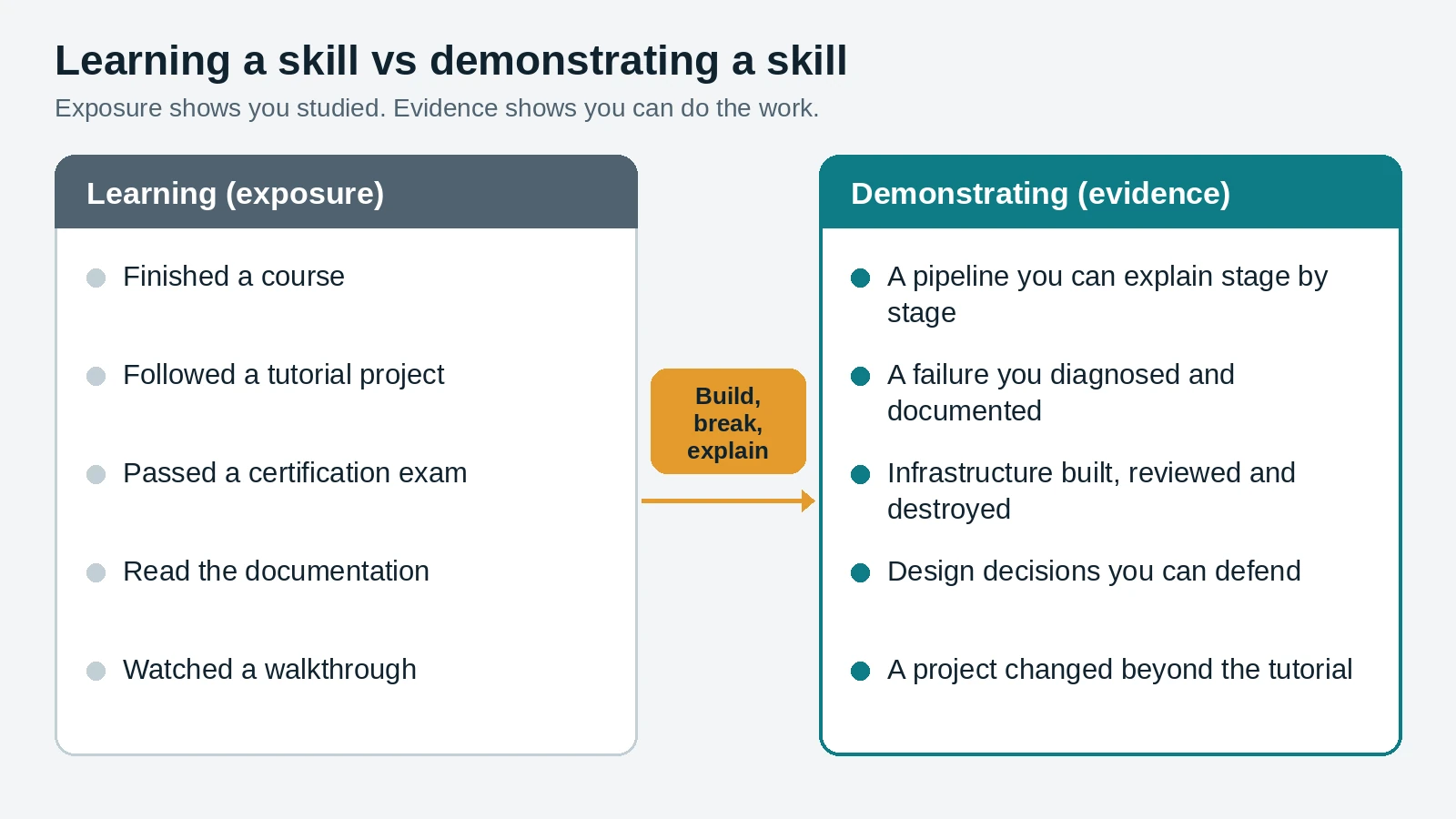
Automation QA engineers and SDETs often have stronger exposure to scripting, Git, CI, automated testing, APIs and engineering workflows. That is a stronger starting foundation, not automatic readiness. They still need Linux, cloud, IaC and operational skills. The QA to DevOps path differs by starting point, but the destination requirements do not.
How Do You Know You Are Ready for a QA to DevOps Transition?
You are ready when you can demonstrate DevOps capabilities, rather than describe them, through projects, troubleshooting and explanations of your own design decisions.
Can you:
- troubleshoot Linux issues
- explain basic networking problems
- use Git confidently
- write practical scripts
- build and explain a CI/CD pipeline
- containerize an application
- deploy to a cloud environment
- provision infrastructure with IaC
- explain Kubernetes fundamentals
- inspect logs and metrics
- troubleshoot a deployment failure
- explain the architecture and decisions behind your projects
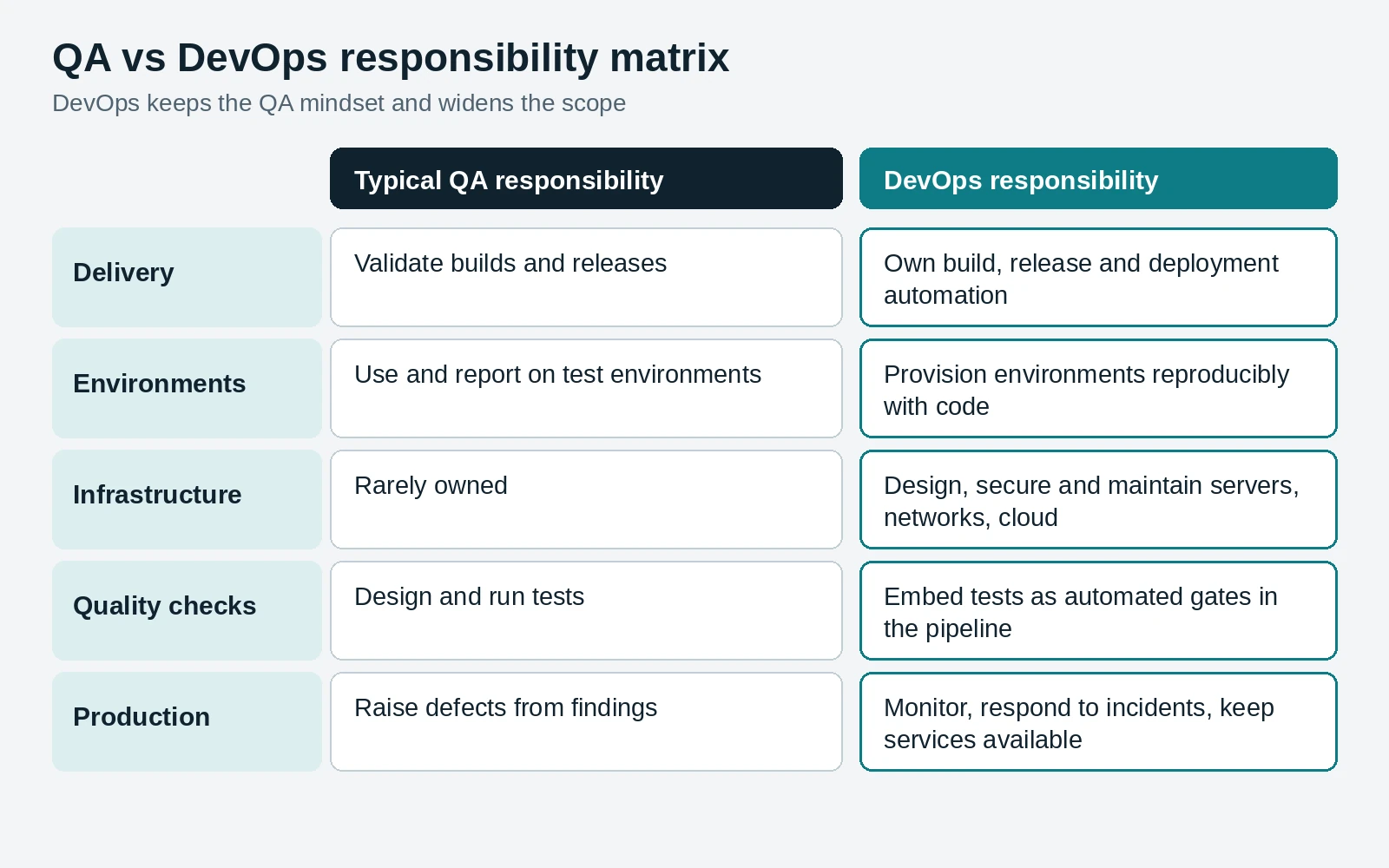
Learning a skill is not the same as demonstrating a skill. Finishing a course proves exposure. Demonstrating means a working artifact, a failure you diagnosed and a reasoned explanation of your choices. Employers weigh these differently, and [INTERNAL LINK OPPORTUNITY: PAGE NOT YET PUBLISHED | what recruiters look for in IT candidates] covers what they evaluate.
What DevOps Roles Can QA Engineers Target?
Realistic targets include junior DevOps, DevOps, cloud/DevOps, build and release, infrastructure automation and, where requirements align, platform engineering roles, depending on demonstrated evidence.
- Junior DevOps Engineer: the most common entry point for people with limited infrastructure history.
- DevOps Engineer: possible when evidence covers pipelines, containers, cloud and IaC.
- Cloud/DevOps Engineer: suits those with depth in one cloud platform.
- Build/Release Engineer: a natural fit for strong CI and release-validation backgrounds.
- Infrastructure/Automation Engineer: suits scripting-heavy profiles.
- Platform Engineer: usually needs more depth in orchestration and internal tooling.
Fit depends on QA experience, automation exposure, infrastructure skills, cloud experience, hands-on evidence and employer requirements. A QA to DevOps move may not preserve your previous seniority level. For the wider career picture, see how to become a DevOps Engineer.
How Long Does a QA to DevOps Transition Take?
There is no fixed timeline. It depends on your background, existing skills, practice time and target role, so milestones matter more than months.
Several factors change the pace: manual or automation background, years of experience, Linux exposure, scripting ability, CI/CD and cloud experience, weekly learning time, amount of hands-on practice, target role and local job-market requirements.
Use readiness milestones instead:
- Foundation: Linux, networking, Git and scripting are solid.
- Hands-on capability: you can operate CI/CD, containers and one cloud platform.
- Integrated projects: the pieces work together in projects you built.
- Troubleshooting ability: you can diagnose failures across layers.
- Role-specific readiness: your evidence matches a target role’s requirements.
Common Mistakes QA Engineers Make When Moving to DevOps
| Mistake | Why it hurts | Better approach |
|---|---|---|
| Learning tools instead of capabilities | You can name tools but not solve problems | Tie each tool to a capability and an artifact |
| Starting with Kubernetes | It lacks context without Linux, containers and networking | Follow the stage order |
| Ignoring Linux | Every later layer assumes it | Diagnose real service failures |
| Treating certifications as experience | They show study, not production work | Pair any certification with projects |
| Copying tutorial projects | You cannot explain the decisions | Change the design, break it, document it |
| Claiming DevOps experience you lack | It collapses under follow-up questions | Describe QA work accurately, label projects as projects |
| Learning too many clouds superficially | Shallow exposure convinces no one | Go deep in one platform |
| Avoiding troubleshooting | Operations work is largely diagnosis | Break and fix your own systems |
| Waiting to know every technology | The ecosystem is never finished | Apply when evidence matches a role’s core requirements |
| Building without understanding the architecture | You cannot defend it | Write a short design note per project |
FAQs For QA to DevOps
Can a QA engineer become a DevOps engineer?
Yes. QA engineers can move into DevOps by extending automation and debugging skills with Linux, cloud, infrastructure and operations experience.
Is QA experience useful for DevOps?
Yes. Test automation, CI exposure, troubleshooting and developer collaboration transfer well, but they are a foundation, not complete DevOps experience.
Can a manual tester switch to DevOps?
Yes, but the gap is larger. Manual testers should first build scripting, Git, CI/CD and Linux skills before cloud work.
Is automation QA better positioned for DevOps?
Generally yes. Scripting, Git and CI experience give a stronger start, but Linux, cloud, IaC and operations skills are required.
What DevOps skills should testers learn?
Learn Linux, networking, Git, scripting, CI/CD, Docker, one cloud platform, Infrastructure as Code and monitoring first, then Kubernetes.
Does a QA engineer need Kubernetes?
Not at first. Learn Kubernetes after Linux, containers and cloud basics, then go deeper if your target roles require it.
Does QA experience count as DevOps experience?
Only where you did the work. Running tests in a pipeline is CI exposure; designing and operating delivery is DevOps.
Do you need a DevOps certification to switch?
Not universally. Certifications help structure learning, but hands-on evidence like pipelines, infrastructure code and troubleshooting write-ups usually shows capability better.
How long does a QA to DevOps transition take?
It varies by background, practice time and target role. Track readiness milestones rather than a fixed number of months.
Final Thoughts
A QA engineer does not need to abandon existing experience. They need to extend it. Quality thinking, automation and troubleshooting form the foundation. Linux, delivery pipelines, infrastructure, cloud and operations supply the missing scope.
Combined with projects you can explain and honest positioning of your past work, they create a credible QA to DevOps path. Any devops transition roadmap should end in evidence. Measure progress by what you can demonstrate and defend, not by tools listed or months elapsed, and target roles whose requirements match the evidence you already hold.