A data analyst can build a career through permanent employment, fixed-term contracts, freelance projects, retainers, fractional arrangements or consulting. Each model changes who defines the work and who carries the risk.
A freelance data analyst is one version of that choice, and the label is easy to misread. It sounds like a change of tools or location. In practice it is a change of responsibility. An employee is usually handed problems to solve. An independent analyst often has to find the client, turn a vague request into defined work, deliver it, and keep the relationship going afterwards.
IQLancer compares work structures rather than job titles. It does not claim that independent work pays more or that employment is safer. The evidence comes from live project briefs, job advertisements, official guidance and vendor pages checked on 30 October 2026. It is a snapshot of how work is structured now, not proof of where the market is heading. Readers who still need role-entry context can start with IQLancer’s Data Analyst roadmap.
What Career Options Can Data Analysts Choose Beyond Full-Time Jobs?
Beyond full-time employment, analysts can take fixed-term contracts, freelance projects, retainers, fractional roles or consulting engagements. These are practical labels, not universal legal categories.
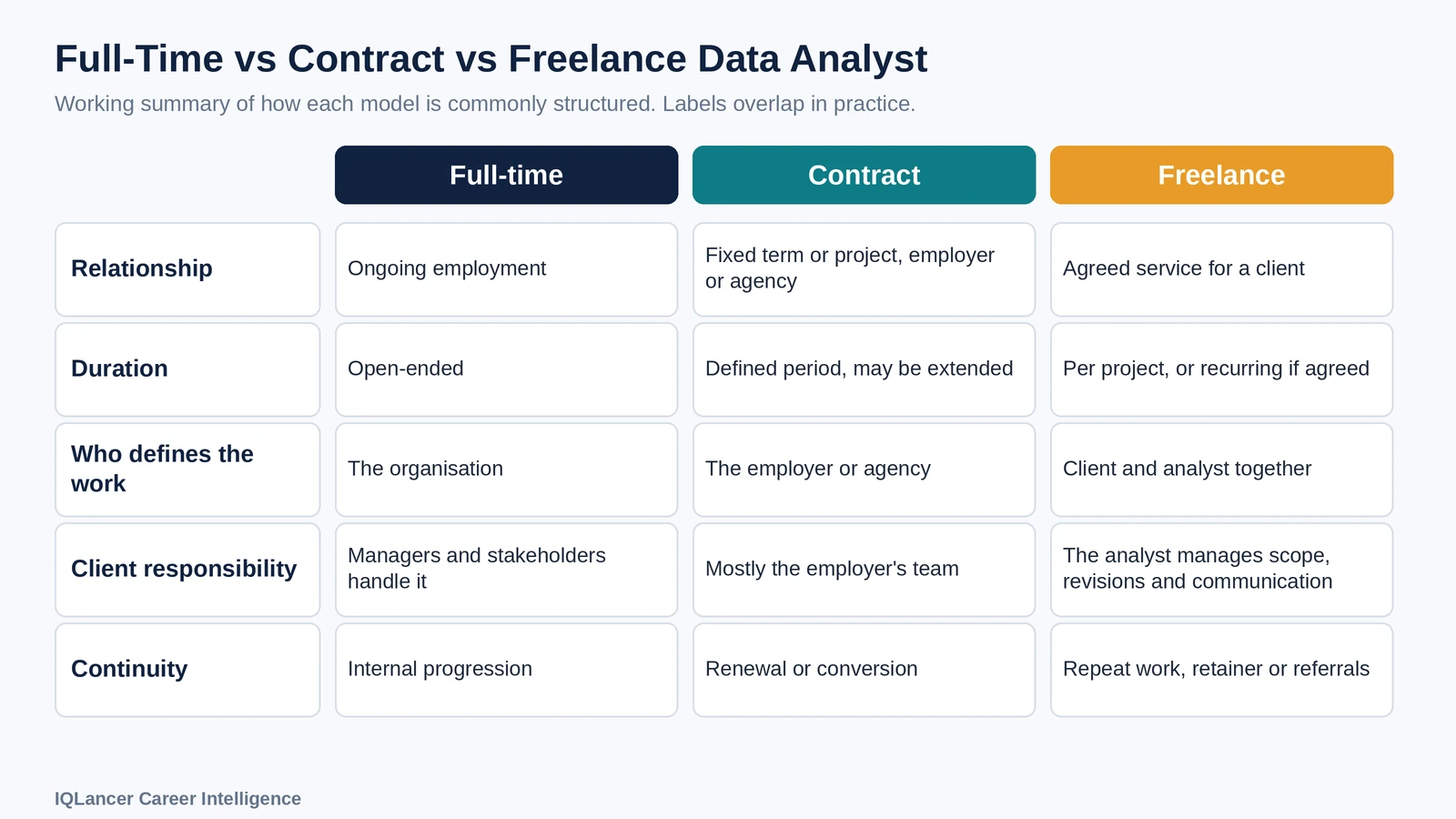
The table below summarises how each model is commonly structured, based on the listings and guidance reviewed for this article. It is a working summary, not a standard.
| Engagement model | How work is structured | Typical responsibility | Continuity |
|---|---|---|---|
| Full-time employment | Open-ended role; the organisation sets priorities and team structure | Deliver assigned analysis inside internal processes and reviews | Continues until the role changes or ends; progression is internal |
| Fixed-term contract | A defined period or project, with duties set by the employer or an agency | Work to the organisation’s requirements for the term | Ends at the term; may be extended or converted |
| Project-based freelancing | One client problem with an agreed deliverable and timeline | Scope, client communication, revisions and delivery | Ends at delivery; repeat work depends on the client |
| Retainer | Recurring services over an agreed period | Reporting, maintenance or analysis within agreed limits | Renews or lapses each period |
| Fractional | Limited, recurring capacity inside the client’s operations | Ranges from hands-on reporting to analytics leadership | Continues while both sides agree |
| Independent consulting | Diagnosis and recommendation, sometimes with delivery | Frame the problem, recommend metrics and an approach | Depends on trust and follow-on work |
These models overlap in practice, and job titles blur the lines. A freelance data analyst vacancy can describe anything from a supervised short contract to an independent project. A London agency advertised a “freelance” data analyst role as a six-week minimum contract with three office days a week, working under senior supervision. That reads more like a short contract inside a team than an independent project.
In India, TE Connectivity advertised a Power BI analyst assignment of about six months that could be done remotely, although the page was no longer available when we checked. A cloud consultancy listed a six-week remote Power BI contract open to candidates in India, with possible extension. Meanwhile, a Bangalore Data Analyst vacancy at Mott MacDonald that includes Power BI maintenance is listed as permanent and full time. The same type of work can sit under different structures, so read the stated contract type, not just the duties.
The fractional label is just as loose. One vendor describes a fractional data team billed hourly with no retainer, another describes a foundation build followed by a monthly retainer, and a third reports that a typical fractional senior analyst engagement runs about 35 hours a week. These are vendor descriptions, so treat them as examples of usage rather than definitions.
Legal status depends on the actual arrangement and the country. UK government guidance says a contractor can be self-employed, a worker or an employee depending on the arrangement, and Citizens Advice notes that status turns on how the work happens in practice, not only what a contract says. Those are UK sources. India applies its own tests, which this article does not cover, so confirm your position with a qualified adviser.
Full-Time vs Contract vs Freelance Data Analyst: What’s Different?
The main differences are who defines the work, who manages the relationship, how long it lasts and who carries commercial risk. Working remotely or in an office matters far less.
To keep the comparison practical, this article uses the IQLancer Independent Analytics Work Framework: Capability, Engagement, Delivery, Continuity. It is an editorial model created for this article, not an academic or industry standard, and independent analysts do not all follow it in order.
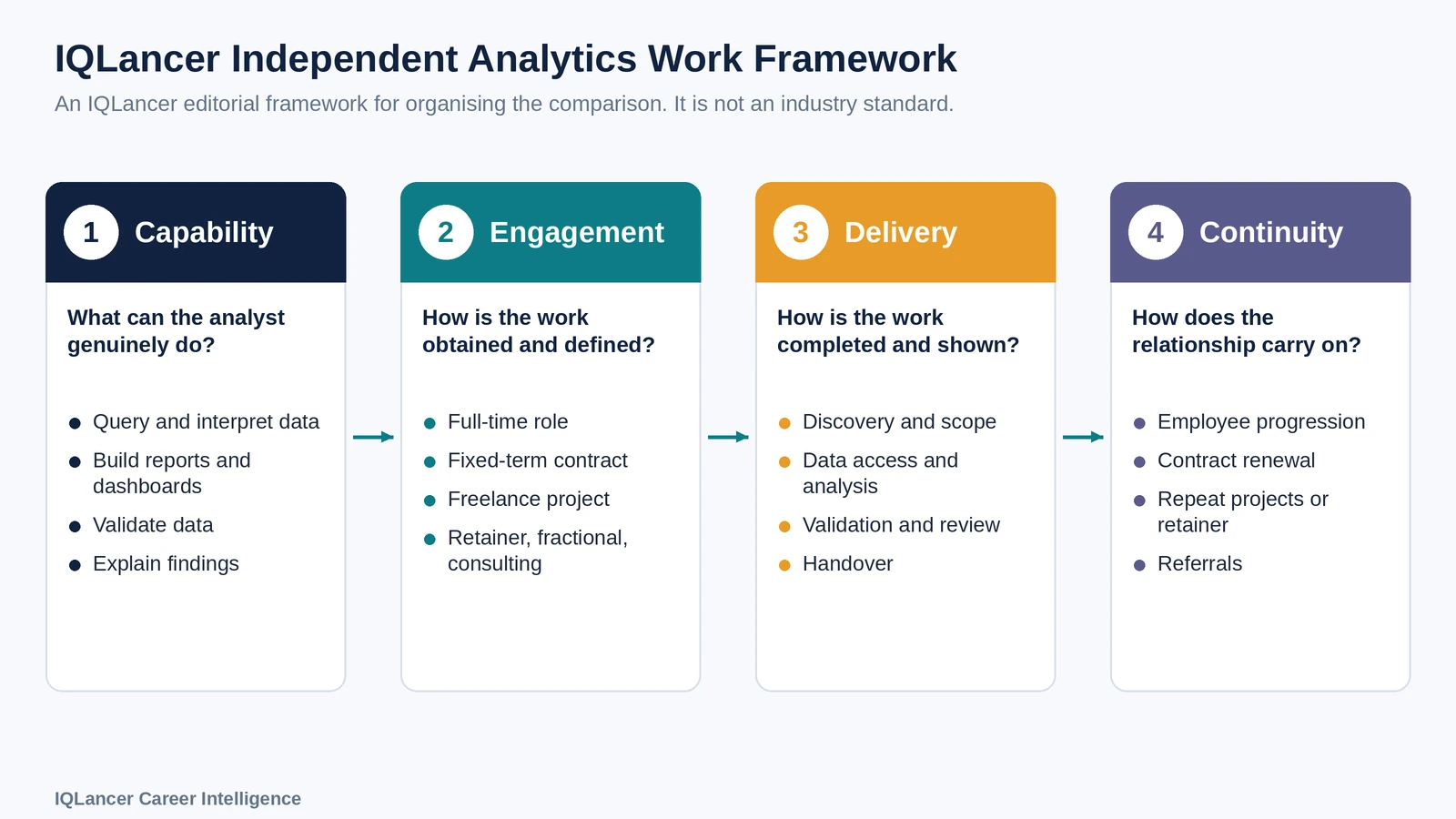
- Capability is the shared base. Querying data, validating it, building reports and explaining findings are needed in every model. What changes is how often someone else checks the work.
- Engagement is how work is obtained and defined. An employer hires and sets priorities. A contract fixes a term. A freelance project starts from a client problem that the analyst helps shape.
- Delivery is how the work is completed and shown. Employees usually work inside existing processes and reviews. Independent analysts run discovery, scope, data access, validation and handover themselves.
- Continuity is how the relationship carries on: promotion, contract renewal, repeat projects, retainer renewal or referrals.
Mentorship is where the gap shows most clearly. The agency contract listing above promises supervision, onboarding to internal playbooks and a line manager. A 2022 CareerFoundry guide adds that independent analysts also handle invoicing, bookkeeping, rate setting and building their own client pipeline. A freelance data analyst therefore has to arrange their own review and learning.
Income structure differs too, from salary to fees, but this article does not quote earnings. Salary aggregator pages and marketing posts rely on averages or single examples that cannot be compared across countries, platforms and experience levels.
What Services Can a Freelance Data Analyst Offer?
Common offerings include dashboards, reporting automation, SQL analysis, data cleaning and recurring reporting support. Clients buy a defined outcome, not a tool.
The examples below come from a small sample of Upwork listings and marketplace pages seen in October 2026. They show what clients ask for, not how much demand exists.
| Service | Business problem | What the client receives | Structure in the examples |
|---|---|---|---|
| Dashboard development | Leaders lack a reliable view of performance | A dashboard and the data model behind it | One-time projects, such as a Power BI build from an Odoo database and a risk dashboard redesign at $850 fixed price |
| Reporting automation | Reports are assembled by hand every week | A data connection and dashboard, with automated reporting | A $600 fixed-price listing to build an automated reporting solution that connects Excel data to Power BI |
| Dashboard conversion | Existing analytics sit in a tool the client wants to leave | A rebuilt dashboard in Power BI or Looker Studio | A $700 fixed-price listing labelled as an ongoing project |
| Recurring analytics support | Reporting needs upkeep and new questions | Regular reports, maintenance and ad hoc analysis within agreed limits | A listing that leaves hourly or fixed pricing to be discussed |
| Data cleaning and quality checks | Inconsistent data blocks analysis | Cleaned data and documented checks | Described on a marketplace hire page that mentions flagging quality issues and documenting methodology |
| SQL and business analysis | A specific question needs an answer | Query results and a written explanation | One-off dashboards, recurring pipelines and statistical analysis are listed as typical on a regional Freelancer hire page |
Two details are worth noticing. The $700 listing is fixed price but labelled ongoing, so the engagement type has to be clarified before work starts. And the recurring-support listing shows a $5 budget despite asking for an expert and ongoing work, which is a reminder that an advertised budget is not a payment.
For each service, a freelance data analyst should agree what is out of scope. New data sources, extra dashboard pages, user training and long-term maintenance are common additions that should be quoted separately.
How Does an Independent Data Analytics Project Work?
A project usually runs from discovery and scope to data access, analysis, validation, delivery, handover and possible ongoing support, with the analyst responsible for each step.
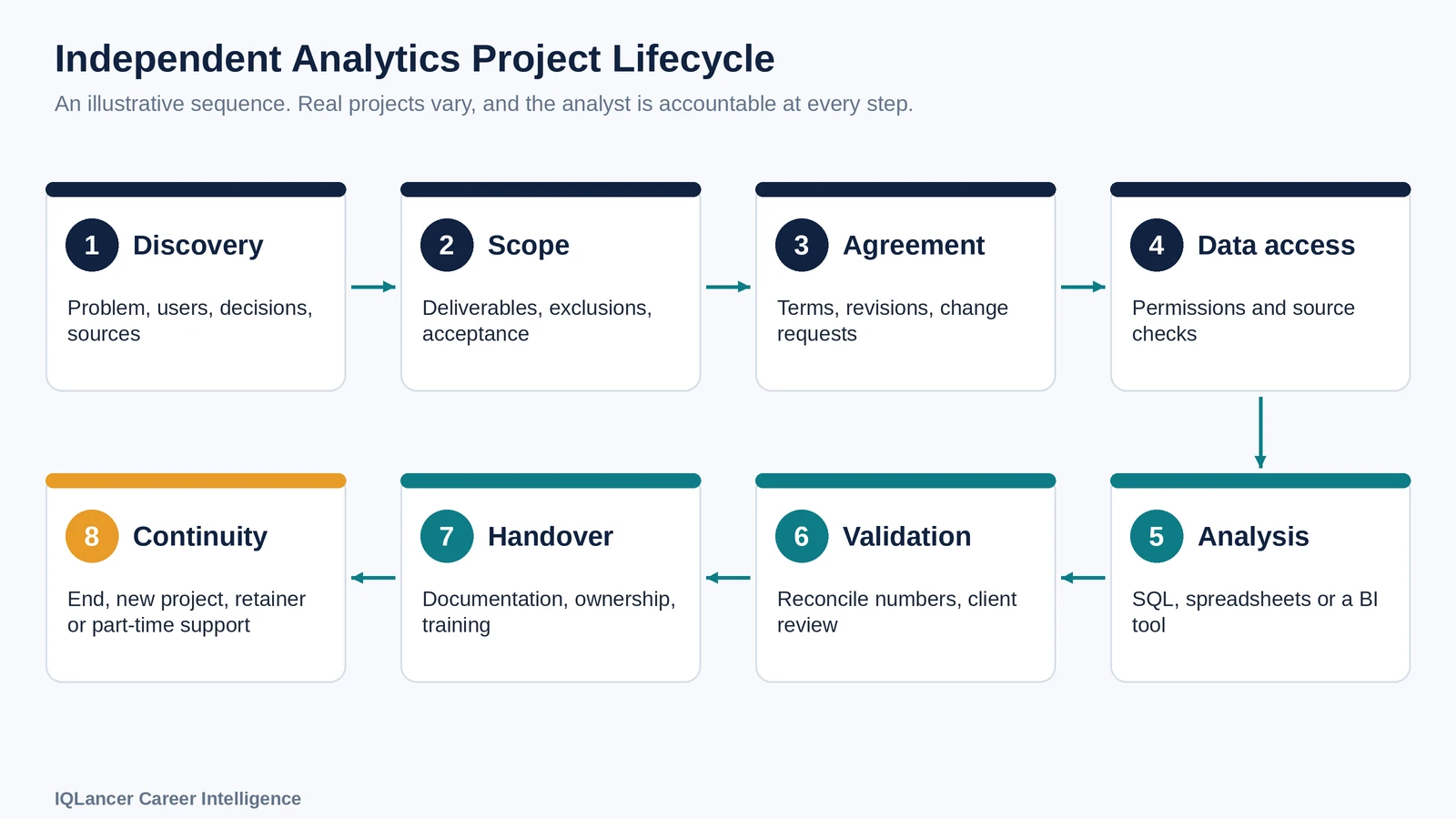
Illustrative example, not a real client project. A growing e-commerce business brings in a freelance data analyst because it relies on disconnected spreadsheets and manually prepared reports. It wants a clearer view of revenue, product performance and sales trends. Any numbers below are hypothetical.
Stage 1: Discovery. The analyst asks what problem the business is solving, who reads the reports and which decisions they should support, such as reordering stock or judging campaigns. They list available sources, for example a store platform export, a payment processor and several spreadsheets, and write back a short summary of what they understood.
Stage 2: Scope and agreement. Deliverables might be a cleaned dataset, an agreed set of metric definitions, a dashboard, a documented refresh process and a handover session. The agreement settles what “revenue” means (before or after refunds), how acceptance is judged (for example, totals reconcile with the finance team’s monthly figures) and how many review rounds are included, say two as a hypothetical. A new data source or an extra dashboard page would count as additional work.
Stage 3: Data access and preparation. The analyst requests the narrowest access needed, ideally read-only, verifies where each source comes from, removes duplicates, standardises dates and product names, and documents every change. Customer records are personal data, so confidentiality terms matter here.
Stage 4: Analysis and development. If the data sits in a database, SQL may do the heavy lifting. For small volumes, spreadsheets can be enough. If the client already licenses a BI tool, the dashboard is built there. No single tool is required.
Stage 5: Validation and client review. The analyst reconciles results with source totals, tests edge cases such as cancelled orders and refunds, and walks stakeholders through the numbers. Feedback is logged and sorted into revisions, which fix the agreed scope, and change requests, which add to it.
Stage 6: Delivery and handover. The client receives the dashboard, written metric definitions, process documentation and a walkthrough. Ownership and access are confirmed. A managed-analytics vendor that sells a competing service publishes a useful handover checklist for freelance contracts: keep assets in the client’s accounts, write down metric definitions, hold a handover session, agree a post-launch rate and set a response time for breakages. Read it as a checklist, not neutral evidence.
Stage 7: Continuity. Four outcomes are common. The project ends at delivery, the client requests a new project, the client agrees to recurring reporting support, or the client wants part-time ongoing analytics help.
Career lesson. The same business problem could be handled in several ways:
- A full-time employee manages it as part of ongoing internal responsibilities.
- A contract analyst is hired for a defined period or project.
- A freelance data analyst agrees to a defined deliverable.
- A retainer analyst provides recurring reporting and maintenance.
- A fractional analyst offers limited, ongoing analytical support.
These are illustrations, not claims that every company works this way.
What Do Clients Expect Before Hiring an Independent Analyst?
Clients generally look for evidence they can verify: relevant work samples, business understanding, clear explanations, validation habits and reliability. A list of tools or certificates is weaker evidence.
The listings reviewed point the same way. The ongoing Power BI and Excel brief asks applicants for links to two or three sample dashboards, a rate or fixed estimate and availability. A talent marketplace lists business acumen, project management and communication alongside visualisation skills as things to look for.
It helps to separate three kinds of evidence:
- To win the engagement: samples close to the client’s problem, a proposal that restates the problem clearly, and a realistic scope.
- To deliver it: careful requirement gathering, validation of calculations, regular updates and responsible handling of client data.
- To earn repeat work: documentation, reliability, and flagging data problems early instead of hiding them.
A certificate shows that someone studied a tool. To a client assessing a freelance data analyst, a dashboard whose figures reconcile with source data, backed by written metric definitions, shows judgement. For ideas on building that evidence, see IQLancer’s Data Analyst project guidance. <!– INTERNAL LINK PENDING: add the verified URL for the Data Analyst projects article on this sentence –>
How Are Independent Analytics Projects Scoped and Paid For?
Work is typically priced hourly, per project, by milestone or as a recurring retainer. Each needs written scope, acceptance criteria, revision limits and a change-request process.
Pricing models. A freelance data analyst can choose among several structures. Hourly billing suits uncertain or evolving work, and one fractional-team vendor explains its model as hours worked multiplied by each person’s hourly rate. Fixed-project pricing suits well-defined deliverables, and most Upwork dashboard listings reviewed were fixed price. A retainer suits recurring work, and the vendor Fabi warns that some arrangements give too few hours to maintain a real data stack. Fixed prices advertised for similar dashboard work ranged from about $10 to $1,000 across the dashboard and business intelligence listing pages, so advertised budgets are not reliable guides to pay.
Milestones and payment risk. Milestones split a project into paid stages. On Upwork, fixed-price protection works only for milestones funded in advance, and the platform says it cannot help recover payment for unfunded work.
Scope terms. Deliverables describe what is handed over. Acceptance criteria describe how both sides will judge it. A revision corrects work against the agreed scope. A change request adds to the scope and normally changes time or price.
Confidentiality, data access and ownership. Agree in writing who owns code, models, dashboards and documentation, and keep client data in client-controlled accounts. In India, the government notified the Digital Personal Data Protection Rules on 13 November 2025, with parts commencing in stages. One law-firm summary notes that the rules expect agreements between a data fiduciary and its processors to require reasonable security safeguards. In practice, an analyst who touches a client’s customer data should expect security and confidentiality terms.
Tax and registration. Rules are jurisdiction-specific. One Indian chartered accountant’s guide states that GST registration for service providers becomes mandatory above ₹20 lakh of turnover, or ₹10 lakh in special category states, but other sources differ on edge cases such as exports. A UK contract listing shows a day rate marked “inside IR35”, a UK-only tax classification described in government contractor guidance. None of this is legal or tax advice. Check official portals and a qualified adviser.
What Are the Career Risks and Trade-Offs of Independent Analytics?
Independent work shifts risk to the analyst: finding clients, irregular income, unclear briefs, scope creep, late payment and thinner mentorship. Employment and contracts carry different risks.
- Client acquisition. A permanent hire goes through one hiring process. A fixed-term contractor faces a new search at each end date. A freelance data analyst has to keep a pipeline going, and the CareerFoundry guide notes that this means acting as your own salesperson.
- Income variability. Fees can swing between busy and quiet months. Employment is not risk-free either, because roles can change or end, but the pay arrangement is more predictable.
- Unclear requirements and scope creep. Briefs can be loose, as the fixed-price “ongoing” listing above shows. Written scope and change-request rules reduce the damage.
- Payment delays. Milestones, deposits and clear invoicing terms matter more when no employer pays you automatically.
- Unpaid administration. Proposals, invoicing, bookkeeping and client communication take time that no one pays for directly.
- Limited mentorship and isolation. The agency listing above offers line management and development programmes. Independent analysts must build their own review habits and learning plan.
Neither model is inherently risky or inherently rewarding. They distribute risk differently.
Which Data Analyst Career Model Should You Choose?
Choose by capability, income needs, tolerance for irregular work, client skills and appetite for administration, not by which model sounds more independent.
Ask yourself eight questions:
- Can I deliver analysis without someone reviewing it first?
- How much experience do I have, and can I show it?
- How predictable does my income need to be?
- Can I absorb a quiet month?
- Am I comfortable talking directly to clients and handling disagreement?
- How much autonomy do I want?
- Do I need mentorship and team collaboration to grow?
- Will I handle contracts, invoices, taxes and data responsibilities?
Full-time employment may suit people who need structured experience, want regular team collaboration, prefer an established reporting structure or need predictable arrangements.
Contract work may suit people who prefer defined engagements, can work within existing project requirements, want experience across organisations and can manage the gap between contracts.
Working as a freelance data analyst may suit people who can demonstrate relevant capability, communicate directly with clients, define and deliver scoped work and accept business responsibilities.
Retainer or fractional arrangements may suit people who can provide recurring value, understand ongoing business needs and manage agreed availability.
These are decision considerations, not eligibility rules. Beginners can take small scoped projects, but the CareerFoundry guide says the first client is the hardest to win, so expect thinner support early on. Some analysts combine employment with side projects, which depends on their employment contract, conflict-of-interest rules and local tax obligations.
Frequently Asked Questions
Can a data analyst work as a freelancer?
Yes. A freelance data analyst works independently for clients, often several at once, rather than as an employee of one organisation, as Springboard’s guide describes it. Legal and tax treatment depends on your country and agreement.
What services can a freelance data analyst offer?
Dashboards, reporting automation, SQL analysis, data cleaning, quality checks and recurring reporting support appear most often in the listings reviewed. See the services table above.
What is the difference between a contract and freelance data analyst?
A contract data analyst role usually fills a defined term inside an organisation’s structure. Freelance work usually centres on a deliverable that the analyst scopes and manages. They overlap, and status depends on the actual agreement, as the UK government guidance illustrates.
Is freelance data analytics suitable for beginners?
It is possible, but harder. Without a track record, early clients are harder to win and mentorship is limited. Small, clearly scoped projects reduce risk.
Do freelance data analysts work with multiple clients?
Often, yes, though some contracts restrict other work. Read exclusivity and conflict-of-interest clauses before agreeing.
Can a data analyst combine full-time employment with independent projects?
Sometimes, Check your employment contract, your employer’s policies on outside work, ownership of what you build and your tax obligations before taking on clients.
Conclusion: Choose the Work Structure, Not Just the Job Title
Full-time roles, fixed-term contracts, freelance projects, retainers, fractional work and consulting differ in who defines the work, how it is delivered and how the relationship continues. The title tells you little.
Becoming a freelance data analyst means taking responsibility for securing, defining and delivering the work as well as doing the analysis. That can suit analysts who have verifiable capability, can manage clients and can absorb irregular income. Employment or contract work can be the better fit when structure, mentorship and predictability matter more.
IQLancer’s Career Intelligence approach is to show how these work models operate so you can weigh the trade-offs against your own capability, finances and preferences. The right choice can also change as your career does.
AI and Data Analyst Jobs: How the Work Is Changing in 2026-2027
How to Become a Senior Data Analyst: Skills, Responsibilities & Promotion 2027