Listing SQL, Excel, Python and Power BI at the top of a resume is not the same as showing an employer you can do the job. An ATS resume for data analyst has to communicate something more specific, which requirements from the target job description you meet, and what evidence proves it. Keywords without evidence read as guesswork to both parsing systems and recruiters, and job-specific relevance matters more than a generic “skills” list, because the same title (data analyst, reporting analyst, product analyst) can mean different tools and responsibilities depending on the employer.
The framework this article builds around is simple job description leads to requirement, requirement leads to keyword, keyword leads to actual skill, skill leads to evidence, and evidence has to be readable by both the ATS-supported hiring workflow and the recruiter reviewing it afterward.
If you are still building the skills, projects, certifications and career foundation required for data analyst roles, start with our Data Analyst career blueprint . IQlancer is guide focuses specifically on turning that preparation into a role-aligned resume.
What Does an ATS Resume Need to Show for a Data Analyst Role?
An ATS Resume for Data Analyst needs to show role-relevant tools, analytical responsibilities and business context, backed by real evidence rather than a keyword list.
That means the resume should communicate, in plain and specific language:
- The technical tools you have actually used (SQL, Excel, Power BI, Tableau, Python, or others relevant to the target role)
- The analytical work you did with those tools (querying, cleaning, modeling, dashboarding, reporting)
- The business or functional context behind that work (sales, operations, marketing, finance, product)
- Your experience level and how it maps to the role’s expectations
- Evidence that connects each keyword to something you actually did
The core distinction to hold onto is this: keyword presence is not the same as qualification evidence. A resume can contain the word “Python” without demonstrating that the candidate used it for anything analytically meaningful. Recruiters and hiring managers read for the second part, not the first.
It also helps to be precise about what an ATS actually does. Applicant tracking systems are ecosystems, not one machine with fixed rules. Depending on the platform and how an employer configures it, an ATS can extract text from your resume, sort candidates by keyword or field matches, and surface a ranked list for recruiter review, but the exact mechanics differ by vendor and employer setup.
Independent testing across platforms like Workday, Greenhouse, Lever, Taleo and iCIMS has found that parsing accuracy varies by document structure and by which platform an employer uses, not by a single universal standard. No ATS independently decides whether a candidate is qualified; it organizes and filters information so a recruiter can review it faster.
How Data Analyst Job Descriptions Translate Into Resume Requirements
Reading a job description as a set of requirements to translate, rather than a script to copy, is what separates a relevant resume from a generic one.
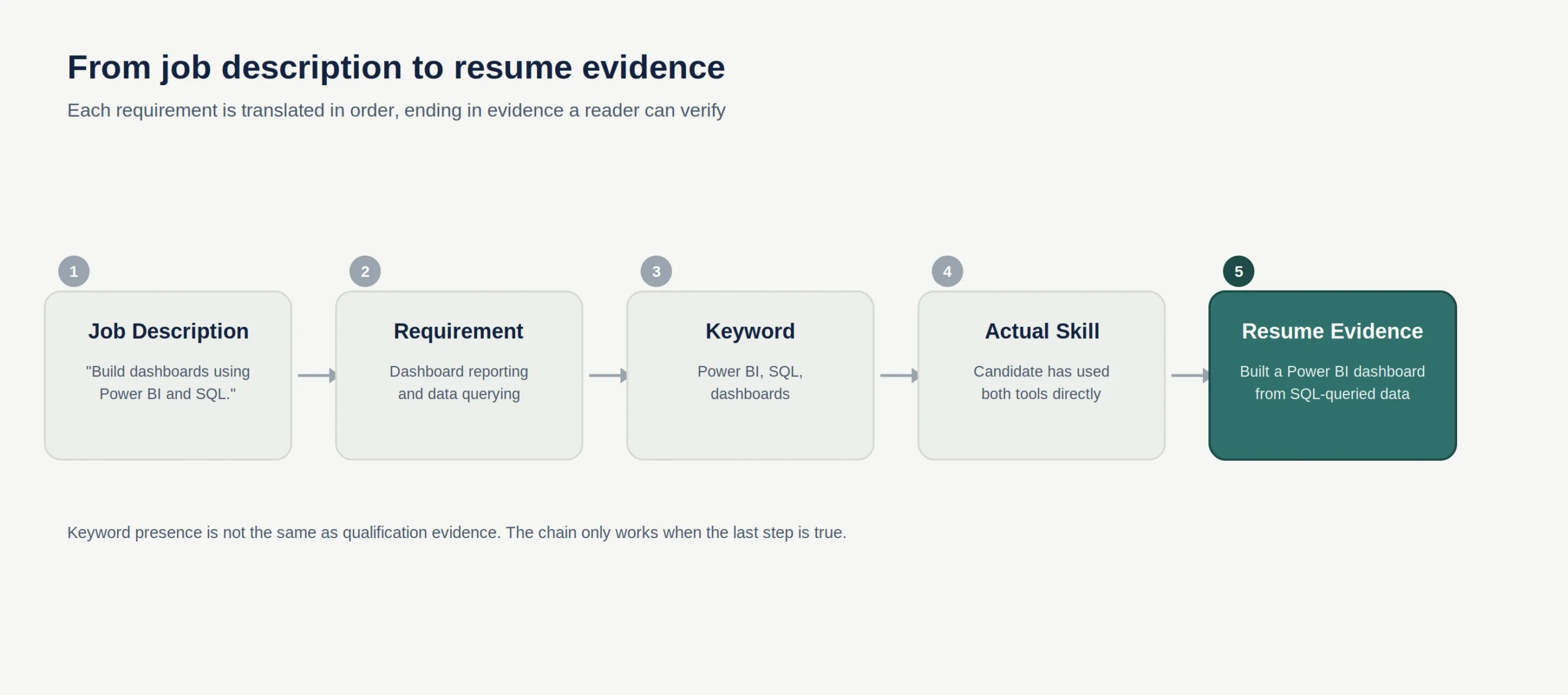
Most candidates read a job description looking for keywords to insert. A stronger approach is to read it for requirements, then work through a short translation chain:
Job description → Requirement → Keyword or phrase → Actual skill → Resume evidence
Example 1
JD language: “Build dashboards using Power BI and SQL to support weekly business reviews.”
- Requirement: Dashboard reporting and data querying for a recurring business process
- Keywords: Power BI, SQL, dashboards, business reviews
- Actual skill: The candidate has genuinely queried data with SQL and built dashboards in Power BI
- Resume evidence: “Queried transaction data with SQL and built a Power BI dashboard used in weekly business review meetings to track revenue and order volume.”
Example 2
JD language: “Clean and validate large datasets and perform exploratory analysis to support product decisions.”
- Requirement: Data cleaning, validation and exploratory analysis tied to product decisions
- Keywords: data cleaning, data validation, exploratory analysis, product decisions
- Actual skill: The candidate has cleaned datasets and run exploratory analysis, likely in Python or Excel
- Resume evidence: “Cleaned and validated a customer events dataset in Python, then ran exploratory analysis that informed a product team’s decision on feature prioritization.”
Notice that neither example fabricates a metric the candidate did not have. The evidence sentence stays truthful and specific, which is what makes it usable on a real resume.
Data Analyst Resume Keywords: Which Terms Should You Include?
Data analyst resume keywords should come from the target job description first, grouped by category, rather than pulled from a generic master list.
It helps to think in categories instead of one long list:
| Category | Examples |
|---|---|
| Technical tools | SQL, Excel, Python, Power BI, Tableau, Looker |
| Analytical terminology | data analysis, data visualization, statistical analysis, reporting, KPI analysis |
| Data workflow terminology | data cleaning, data transformation, ETL/ELT, data modeling, databases, data warehouses |
| Business and functional terminology | KPI, dashboards, stakeholder reporting, business insights, performance analysis |
Not every data analyst needs every term in this table. An analysis of 328 real data analytics job descriptions found Excel appearing in 81% of postings, SQL in 60%, Power BI in 43% and Python in 41%, which means SQL and Python are common but not universal, and a role built around spreadsheet reporting will weight differently than one built around a Python-heavy pipeline. Prioritize terminology according to:
- What the target job description actually asks for
- What you have genuinely done
- The responsibilities the role emphasizes
- Whether the role is generalist or specialized (reporting, product, operations, financial analytics)
- Your experience level
How to Prioritize Data Analyst Keywords Instead of Stuffing Them
Not every keyword in a job description deserves equal space on a resume; prioritizing them by relevance keeps the resume readable and credible.
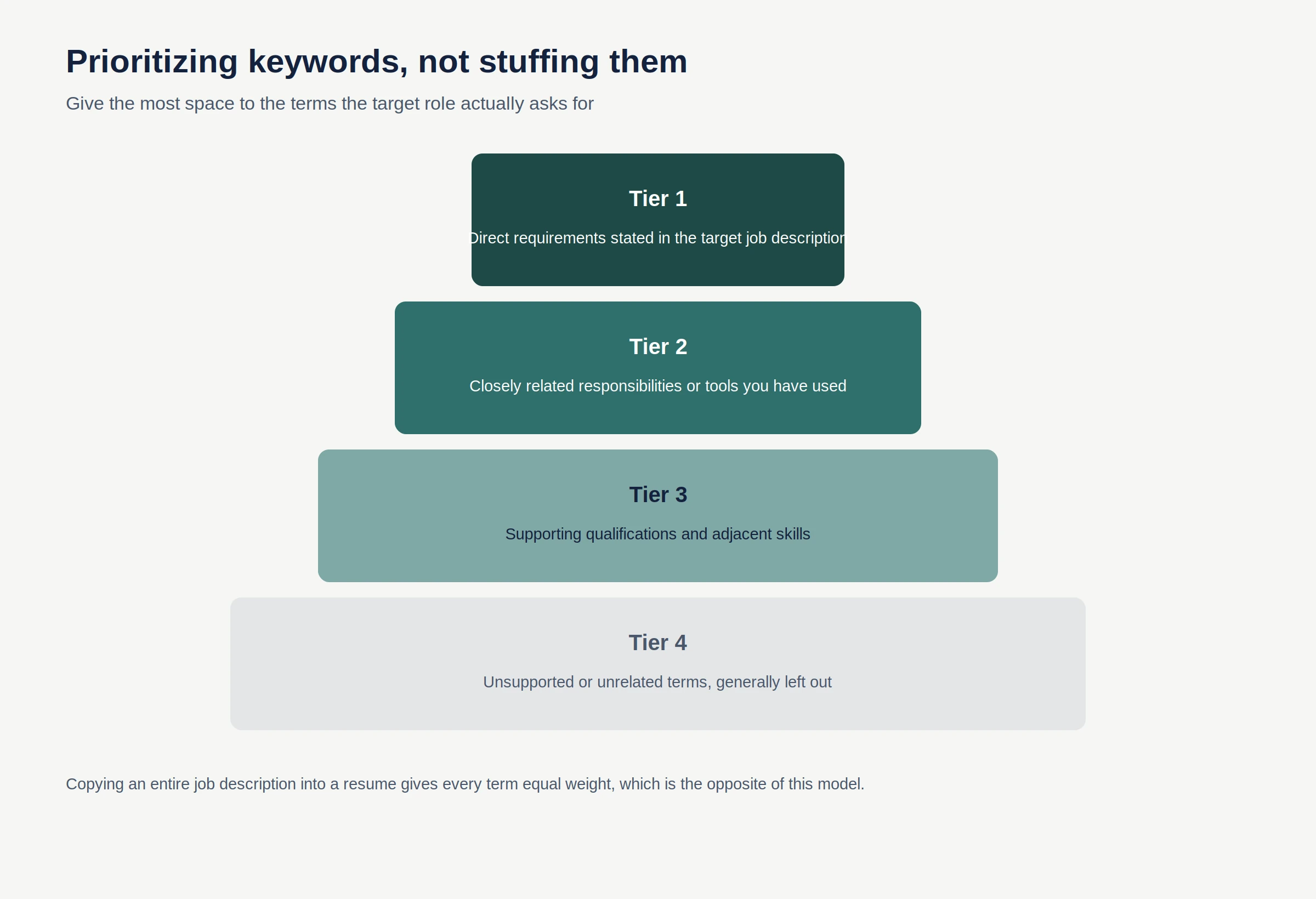
A simple tier model helps:
- Tier 1: Direct requirements stated in the target job description (the tools and tasks named explicitly)
- Tier 2: Closely related responsibilities or tools you have used (a secondary BI tool, a related database technology)
- Tier 3: Supporting qualifications (certifications, coursework, adjacent skills)
- Tier 4: Terminology that is unrelated to the role or that you cannot back with evidence, which should generally be left out
Giving every keyword the same prominence, or copying an entire job description into the skills section, does not make a resume more relevant. It makes it harder for a recruiter to tell what you are actually strong at, and it can read as an attempt to game a keyword match rather than a genuine account of your background.
How to Turn Data Analyst Skills and Keywords Into Resume Evidence
A keyword becomes useful on a resume only when it is connected to the specific task and context in which it was applied.
The chain here is: keyword → skill → context → evidence.
| Weak resume wording | Better resume wording | Why it is better |
|---|---|---|
| “SQL, Python, Excel, Power BI” | “Used SQL to query and transform relational data, then built Power BI dashboards to present KPI trends for a portfolio analytics project.” | Names the tools inside a real task, with context and an outcome the reader can evaluate |
| “Data analysis, reporting, dashboards” | “Analyzed weekly sales data in Excel and built a recurring report that tracked performance against regional targets.” | Turns generic nouns into a specific, verifiable activity |
| “Skilled in data visualization” | “Built a Tableau dashboard visualizing customer churn by segment for a marketing analytics project.” | Replaces a vague claim with a described piece of work |
Not every bullet needs to pack in multiple keywords. A single well-described accomplishment that clearly uses one or two tools is often stronger than a bullet crowded with terminology and thin on substance.
ATS Resume Requirements for Data Analysts
An ATS resume for a data analyst role should combine clear structure, job-aligned terminology and evidence-backed skills, since automated systems and recruiters both rely on the same document.
Actual considerations worth attending to:
- A clear, predictable information hierarchy (summary, skills, experience or projects, education)
- Consistent section headings using conventional labels
- Terminology that reflects the target job description, not a generic industry list
- Skills that are supported by at least one piece of evidence elsewhere in the resume
- Consistent, unambiguous dates and employment or project details
- Text that remains machine-readable rather than locked inside an image
- Content that a human recruiter can also read and understand quickly
Common myths worth separating from these actual considerations: the claim that two-column resumes always fail, that PDFs can never be read, that tables always break parsing, that any graphic causes automatic rejection, or that every ATS produces one universal score.
None of these hold up as absolute rules. Parsing and workflow behavior differ by platform, by how a document is built, and by how an employer has configured their system. Independent ATS testing across major platforms has found that some legacy systems misparse complex layouts while newer platforms handle them more reliably, which is a formatting-complexity issue rather than a fixed rule about any one file type.
How to Write Data Analyst Resume Bullets for ATS and Recruiters
A strong data analyst resume bullet names the action, the tool or method, the analytical task, and the context or outcome, in that order of emphasis.
Structure: Action + Tool/Method + Analytical Task + Context/Outcome
Examples across common tools:
- SQL: “Wrote SQL queries with joins and window functions to build a customer retention report used by the marketing team.”
- Excel: “Built a pivot-table-based monthly expense tracker in Excel that consolidated data from three regional teams.”
- Power BI: “Created a Power BI dashboard tracking weekly order volume and fulfillment time for the operations team.”
- Python: “Used Python and pandas to clean a survey dataset and identify data quality issues before analysis.”
- Data cleaning: “Standardized inconsistent date and currency formats across a multi-source sales dataset before reporting.”
- Dashboarding: “Designed a Tableau dashboard summarizing campaign performance metrics for stakeholder review.”
- Reporting: “Delivered a recurring weekly report on key business metrics to department leadership.”
For candidates without professional experience, the same structure applies to coursework, capstone projects or internships, described honestly as what they were: “Built a SQL and Power BI project analyzing publicly available retail sales data as part of a coursework capstone.” For experienced candidates, the structure has room for genuine ownership, scale and business context: which team relied on the work, how often it ran, and what changed because of it, without inventing numbers that were never tracked.
ATS-Friendly Formatting for a Data Analyst Resume
Formatting for a data analyst resume should prioritize a predictable structure and readable text over visual complexity.
Practical guidance ATS Resume for Data Analyst:
- Use standard section headings (Summary, Skills, Experience, Projects, Education)
- Keep information hierarchy predictable: most relevant and most recent information first
- Use consistent formatting for dates, job titles and section labels
- Keep important information in real text, not embedded inside an image
- Clearly separate professional experience from projects or coursework
- Submit the file format an employer requests when one is specified
- Avoid unnecessary visual complexity that adds no informational value
What this article will not claim, because the evidence does not support it as an absolute rule: that two-column resumes always fail an ATS, that PDFs can never be read by an ATS, that tables always break parsing, that graphics automatically cause rejection, or that every ATS produces a single universal score for every candidate. Testing across major platforms has consistently shown that text-based PDFs and Word documents both parse successfully on modern systems, with failures tied more often to scanned images, unusual layouts or restricted files than to the format itself. When a job posting specifies a format, follow that instruction directly rather than relying on a general rule.
ATS Optimization vs Keyword Stuffing for Data Analysts
ATS optimization means making genuine qualifications easier to identify; keyword stuffing means adding terminology that is not backed by real experience.
- Optimization example: “Built Power BI dashboards using SQL-derived datasets to monitor sales KPIs.” This sentence names two tools, describes the analytical task, and gives business context, all in one line.
- Stuffing example: “SQL, Python, R, Power BI, Tableau, Looker, Excel, VBA, data analysis, data visualization, machine learning, statistics, data warehousing, big data, cloud computing.”
This kind of keyword wall adds terms without evidence, and it can work against a candidate. Recruiters reviewing a resume like this often cannot tell which of these tools the candidate actually used, and a resume that reads as an unfiltered term dump can undermine credibility even if it happens to trigger keyword matches during automated sorting.
From Data Analyst Job Description to Resume: A Practical Example
Working through one job requirement end to end shows how the same requirement produces different, equally honest resume bullets depending on a candidate’s background.
Fictional job requirement: “Analyze customer data using SQL and create Power BI dashboards to support business reporting.”
| Step | Detail |
|---|---|
| Requirement interpretation | Data querying plus dashboard-based reporting for a business audience |
| Important keywords | SQL, Power BI, customer data, business reporting |
| Candidate evidence needed | Genuine SQL querying and genuine Power BI dashboard-building |
Resulting resume bullets, all fictional and clearly labeled as such:
- Fresher with a coursework project: “Built a SQL and Power BI project analyzing a public customer transaction dataset, including a dashboard summarizing purchase trends by segment.”
- Intern: “Supported the analytics team by writing SQL queries to pull customer data and assisting in building a Power BI dashboard used in weekly reporting.”
- Experienced data analyst: “Queried customer transaction data with SQL and built a Power BI dashboard adopted by the sales team for monthly business reviews, replacing a manual spreadsheet process.”
Each version stays truthful to a different level of real-world exposure while still directly answering the same job requirement.
Data Analyst Resume Sample: ATS Requirements and Keyword-to-Evidence Mapping
A resume sample is most useful when it is paired with an explanation of why each element appears, rather than offered as a template to copy directly.
The excerpt below is entirely fictional and included to demonstrate the framework, not as a downloadable template.
- Professional Summary Data analyst with experience using SQL and Power BI to support business reporting and dashboarding for cross-functional teams.
- Technical Skills SQL, Power BI, Excel, Python (pandas), data cleaning, dashboard reporting
- Experience Data Analyst, [Fictional Company], 2023-Present “Queried customer transaction data using SQL and built Power BI dashboards tracking monthly sales KPIs for the commercial team.” “Cleaned and standardized data from multiple regional sources in Excel to support a recurring quarterly performance report.”
- Education B.S. in a relevant field, [Fictional University]
- Certifications [Only listed where genuinely relevant to the target role]
Mapping table
| Resume element | Target requirement | Keyword/phrase | Evidence | Why it matters |
|---|---|---|---|---|
| “Queried customer transaction data using SQL and built Power BI dashboards tracking monthly sales KPIs” | SQL analysis and dashboard reporting | SQL, Power BI, sales KPIs | Querying data and building a dashboard | Directly answers a common data analyst requirement with a specific, checkable action |
| “Cleaned and standardized data from multiple regional sources in Excel” | Data cleaning and preparation | Excel, data cleaning | A described data-preparation task | Shows a foundational analyst responsibility rather than just naming Excel |
This sample is stronger than a keyword-only resume because every listed tool is tied to a described task. It is not a guarantee of a particular ATS score, and it does not guarantee an interview; it demonstrates one way to connect requirements to evidence, which candidates should adapt to their own background.
How to Use a Data Analyst Resume Sample Without Copying It
A resume sample is evidence of structure and reasoning, not a script meant to be copied word for word.
Use a sample to understand why each section exists and how keywords connect to evidence, then adapt:
- Terminology, to match your actual target job description
- Skills, to reflect tools you have genuinely used
- Experience and projects, to reflect your own background
- Achievements, to reflect outcomes you can honestly describe
Never copy fake metrics, unsupported technologies, fabricated achievements, or another candidate’s experience. A sample that is copied wholesale is easy for an experienced recruiter to recognize, and it puts a candidate in the position of being unable to speak credibly about their own resume in an interview.
ATS Resume for Data Analyst Freshers vs Experienced Candidates
Freshers and experienced candidates should emphasize different kinds of evidence on an ATS resume, while following the same keyword-to-evidence structure.
| Freshers | Experienced candidates |
|---|---|
| Relevant projects and coursework | Actual job responsibilities |
| Internships | Business context and stakeholder interaction |
| Academic analytical work | Measurable outcomes, only when genuine |
| Practical, honestly described evidence | Ownership of recurring processes or systems |
| Relevant certifications where appropriate | Production or live-environment experience |
Broader questions about which skills, certifications or projects to build next belong in career development rather than resume writing; for that, see the Data Analyst career blueprint.
Common ATS Resume Problems Data Analysts Should Fix
Most resume problems specific to data analyst candidates come from listing tools without evidence or copying a job description too literally.
- Listing tools (SQL, Python, Power BI) with no task or context attached
- Copying most or all of a job description’s keywords into the skills section
- Using inconsistent terminology for the same skill across different sections
- Burying genuinely relevant analytical experience under less relevant content
- Describing projects vaguely, without naming the tool, task or outcome
- Listing advanced tools that are not actually backed by real use
- Failing to distinguish a coursework project from actual employment
- Writing generic bullets that could apply to any analyst, at any company
- Overloading the skills section with tools irrelevant to the target role
- Optimizing so heavily for keyword presence that a human recruiter struggles to follow the resume
Formatting mistakes that are not specific to data analyst roles (general ATS formatting errors, broad resume mistakes) are covered in ATS Resume Mistakes IT Professionals Make in 2027.
IQLancer Data Analyst ATS Audit Framework
Running a resume through a structured audit surfaces gaps between keyword presence and actual evidence before you submit it.
Evaluate each area as Pass, Review, or Fix:
- Job match: Does the resume align with the specific target role, not a generic data analyst template?
- Keyword relevance: Are the keywords present ones the target job description actually asks for?
- Skill evidence: Is every listed skill connected to a described task somewhere in the resume?
- Context: Does each piece of evidence include enough business or project context to make sense?
- ATS readability: Is the text extractable, with clear headings and no critical information locked in images?
- Recruiter readability: Can a human reviewer understand your relevant experience within a quick read?
- Credibility: Are claims truthful, without fabricated metrics or unsupported tools?
- Experience alignment: Does the resume distinguish clearly between projects, internships and employment?
Example findings:
- Keyword relevance: Review. “Power BI” appears in the skills section, but no bullet anywhere demonstrates actual Power BI work.
- Skill evidence: Fix. SQL is listed but never connected to a query, dataset or analytical task.
This audit is meant to surface gaps, not produce a numeric score; no single audit result should be read as a guarantee of ATS or recruiter outcome.
Final Checklist for an ATS Resume for Data Analyst
- Target role identified
- Target job description analyzed
- Requirements identified from the job description
- Relevant keywords mapped to those requirements
- Keywords supported by actual skills
- Skills connected to evidence
- Projects clearly identified as projects, not employment
- Experience described with truthful responsibilities and results
- No keyword stuffing
- No unsupported tools listed
- Clear, consistent structure throughout
- Important information remains readable text, not an image
- Formatting follows any format instructions in the job posting
- Common ATS myths avoided
- A recruiter can understand your relevance quickly on first read
FAQ For ATS resume for data analyst
What is an ATS resume for a data analyst?
It is a resume built to be read accurately by ATS-supported hiring workflows and by recruiters, using terminology drawn from the target job description and backed by real evidence of skills and experience.
What keywords should a data analyst put on a resume?
Keywords should come primarily from the specific target job description, grouped by technical tools, analytical terminology, data workflow terms, and business or functional terms, prioritized by what the role actually requires and what you can back with evidence.
How do I optimize my data analyst resume for ATS?
Analyze the target job description for requirements, translate those requirements into relevant keywords, connect each keyword to a real skill and a piece of evidence, and keep formatting clear and text-readable.
What are the ATS requirements for data analyst resume?
A clear structure, consistent section headings, job-aligned terminology, evidence-backed skills, consistent dates, and text that remains machine-readable while also being understandable to a human recruiter.
Should I include SQL and Python keywords on my data analyst resume?
Include them if the target job description asks for them and you have genuinely used them; SQL appears in the majority of data analyst postings and Python in a large share, but neither is universal to every role, so let the specific job description guide inclusion.
How can a fresher show data analyst skills on an ATS resume?
By describing coursework, capstone projects, or internships honestly, using the same action-plus-tool-plus-context structure used for professional experience, without implying the work was paid employment.
Does an ATS reject a data analyst resume because of formatting?
Not automatically, and not as a blanket rule. Parsing and workflow behavior vary by ATS platform and by how a document is built. Following an employer’s stated format instructions and keeping key information as readable text reduces risk.
Is keyword stuffing useful for ATS optimization?
No. Adding excessive or unsupported terminology can hurt credibility with recruiters and does not substitute for evidence connecting keywords to real skills.
What should a data analyst resume sample include?
A professional summary, a technical skills section, experience or projects, education, and certifications where genuinely relevant, each connected to evidence rather than presented as a standalone keyword list.
The distinction between listing SQL, Excel, Python, and Power BI and proving how you used them is especially useful. Matching keywords to the target job description while backing them with measurable project or work evidence makes the ATS strategy much more credible.
Absolutely ! Right, When we changed the focus to only matching the keywords to project or work evidence. it makes more credible.