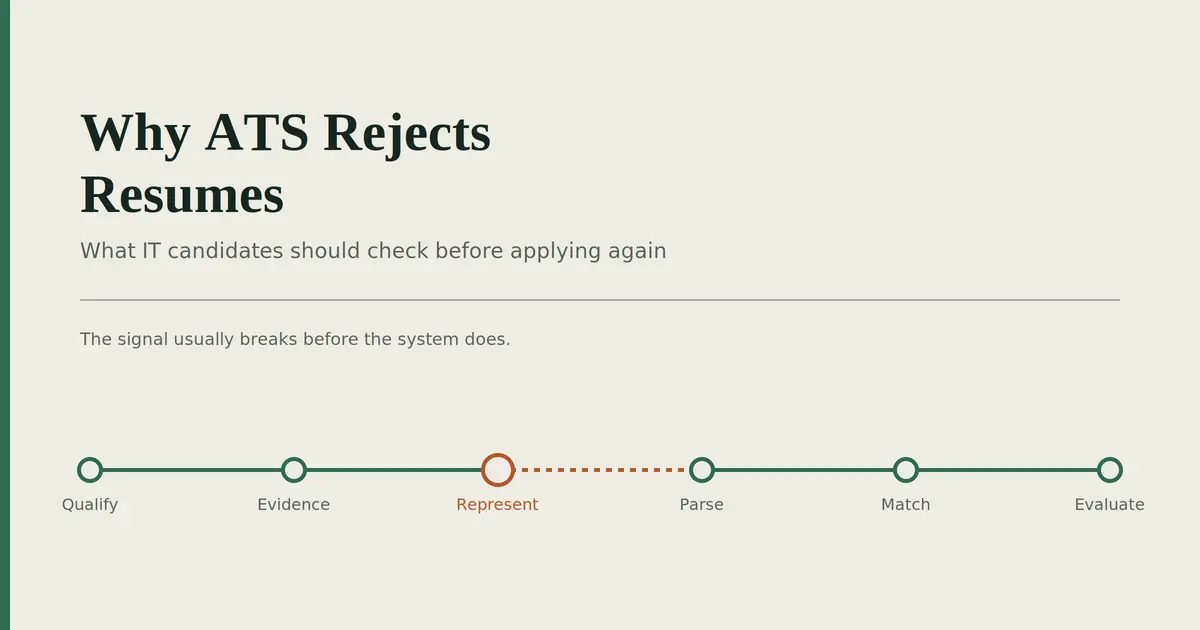
You apply to a role you’re genuinely qualified for in 2026-27 but, No response. You apply to twenty more. Still nothing. At some point almost every IT candidate lands on the same explanation: the ATS rejected me. It’s a satisfying answer because it points at the software instead of the resume. But “why ATS rejects resumes” is rarely a single, provable event. It’s usually a chain of smaller things, some of them about the system, most of them about how clearly your actual skills got represented. This article walks through that chain so you can diagnose your own resume instead of guessing.
What Happens During the ATS Screening Process?
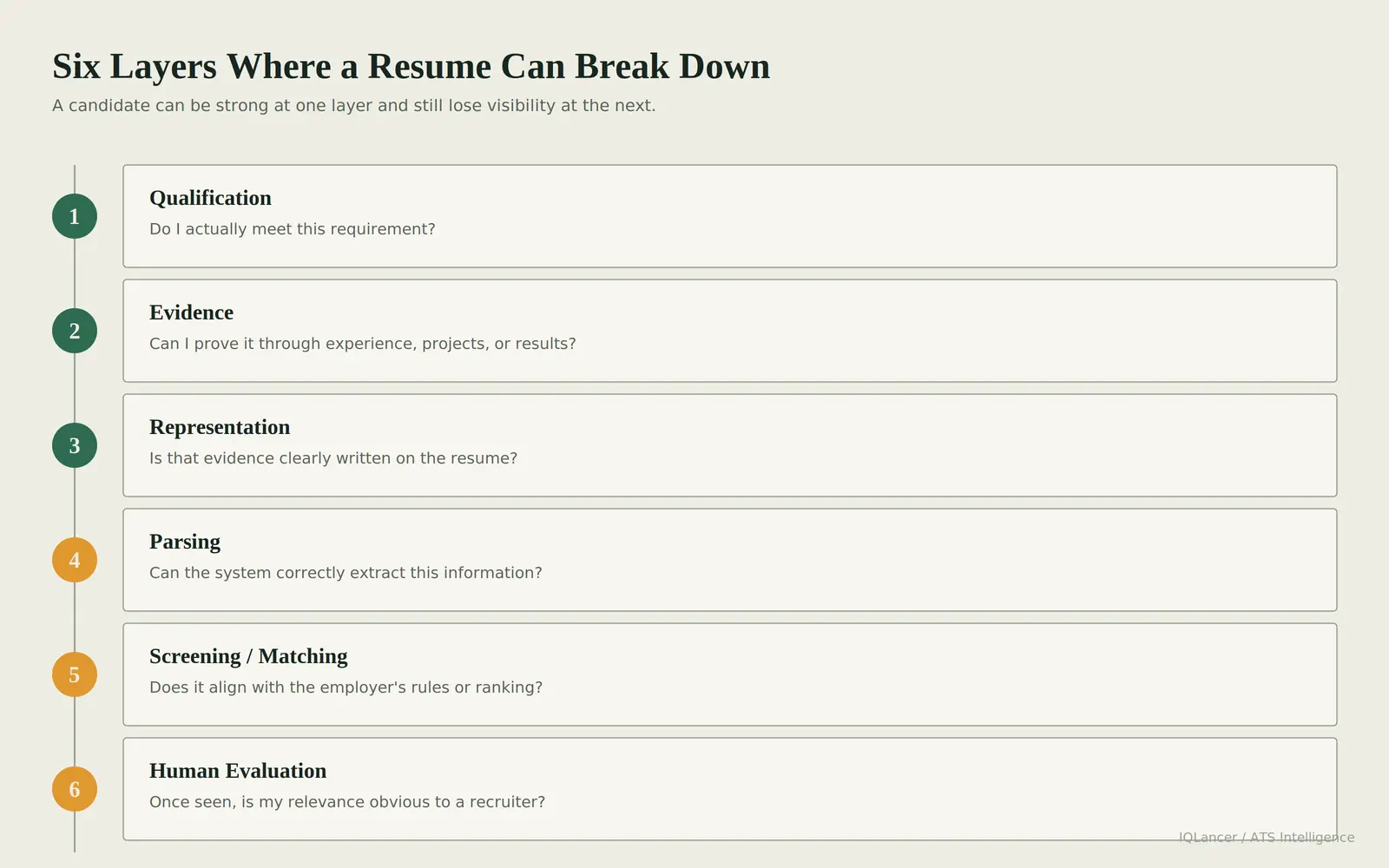
Understanding the sequence matters because “ATS rejected me” gets blamed on the wrong stage more often than not.
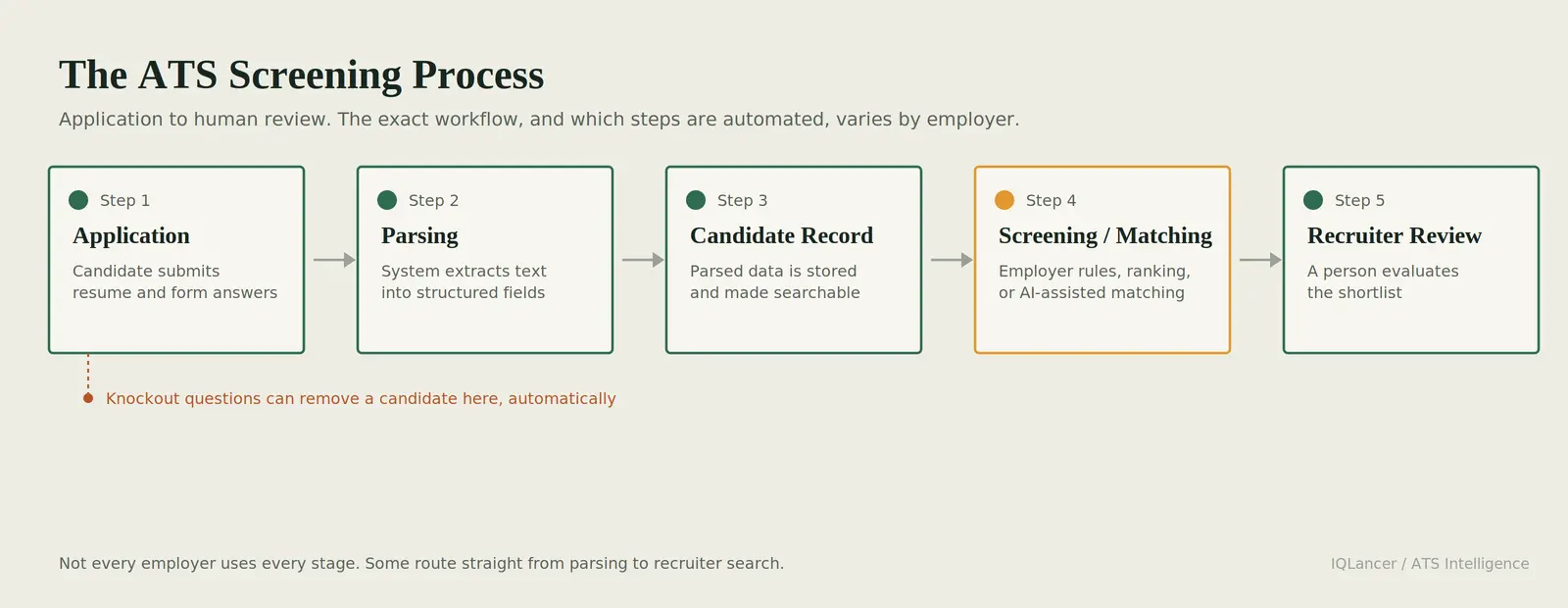
The ATS screening process typically looks like this: application submitted → parsing and information extraction → candidate record created → employer-configured screening, search, or matching → recruiter review.
Not every employer uses every stage, and the technology involved ranges from a basic applicant database to AI-assisted semantic matching layered on top of it. Some companies run simple keyword filters. Others run tools that understand “software developer” and “software engineer” as the same thing. There is no single universal algorithm behind “the ATS,” which is the first reason a blanket explanation for rejection rarely holds up.
Why ATS Rejects Resumes or Fails to Surface Them
This is the section worth reading slowly, because the causes split into categories that require different fixes. A resume can fail to advance because of a genuine qualification gap, an evidence gap, unclear representation of real experience, a parsing failure, or an employer-specific screening rule the candidate has no visibility into. The one place true automatic rejection reliably happens, with no human involved, is knockout questions: work authorization, required certifications, minimum years of experience.
Fail one of those and the system can remove you instantly, sometimes within minutes of applying. Beyond that stage, the picture is softer than most advice suggests. A recruiter survey found the large majority report their systems don’t automatically reject resumes for content or formatting; instead, match scores prioritize who a human looks at first, and low scores can bury a resume rather than delete it.
So when a resume goes nowhere, it’s worth separating three different problems: something the system couldn’t read, something the system read but didn’t rank highly, or something a human read and didn’t find convincing.
ATS Resume Mistakes IT Candidates Should Check
Not every mistake below applies to every resume. Check the ones that plausibly touch yours.
Vague technology mentions. Listing “cloud experience” instead of naming AWS, Azure, or GCP specifically forces a reader (human or system) to guess. Why it matters: specific terminology is what both matching logic and recruiters search for. Fix: name the actual platform, service, and what you did with it.
Skills claimed without evidence. A skills list with no supporting detail elsewhere on the resume reads as unverified. Fix: back every claimed core skill with at least one line of context showing where you used it.
Generic job titles that don’t reflect scope. “IT Professional” or “Engineer” with no specialization buries relevant signal. Fix: use the title that most accurately reflects the work, and clarify scope in the first bullet under it.
One resume sent to every role. A single generic resume applied to dozens of different job descriptions performs worse than a resume adjusted per role, because relevance to the specific posting is what’s being evaluated, not general competence.
Unclear employment dates or gaps. Ambiguous or inconsistent date formatting can create parsing errors and, separately, raises questions for a human reviewer if left unexplained.
Missing must-have requirements from the posting. If the job description states a requirement as mandatory and your resume doesn’t address it anywhere, that’s a qualification or representation gap, not an ATS problem, and no amount of formatting will fix it.
How ATS Resume Keywords Actually Work
The useful mental model is: job description → relevant requirement → candidate evidence → resume language. Not: job description → keyword → paste keyword into resume.
Take a posting that lists AWS, Terraform, and CI/CD as requirements.
Weak: “Worked on cloud projects.”
Stronger: “Automated AWS infrastructure provisioning with Terraform and integrated CI/CD workflows for application deployment.”
The second version isn’t stronger because it repeats keywords more often. It’s stronger because it shows what was actually done with each technology, which gives both a parser and a recruiter something concrete to evaluate. Using the exact terminology from a posting is expected and reasonable when it accurately describes your work; the mistake is treating keyword count as the goal instead of accurate description.
ATS resume keywords work as signals of relevance, not as a scoring formula you can max out by repetition. There’s no verified formula for how many times a term needs to appear, and chasing one produces resumes that read as copied rather than genuine.
Resume Parsing: What Can Go Wrong?
Resume parsing is the process of converting your document into structured data: name, dates, titles, skills, sections. Some formatting choices genuinely interfere with this. Text placed inside images or icons is often invisible to a parser entirely. Content inside text boxes can be skipped. Non-standard section headings (“My Journey” instead of “Experience”) can confuse field mapping.
Where the advice gets shaky is the absolute claims. “ATS cannot read two-column resumes” and “PDFs always fail” are both overstated as universal rules. Evidence is genuinely mixed here: some testing found modern parsers handling complex multi-column layouts cleanly, including graphics and unusual design elements, while other parsing tests found two-column layouts to be the most consistent source of reading-order errors, where a bullet from one column gets glued to a heading from another.
Similarly, PDF handling has improved substantially since older systems struggled with it, but PDFs exported from design tools rather than a word processor can still carry font-encoding issues that render as garbled text to a parser even though the file looks normal to a human. The honest takeaway: the outcome depends on which specific system an employer uses, which nobody outside that company can verify from the outside. A single-column layout in a standard, non-designed PDF or .docx removes the risk without costing you anything.
The Resume-to-Job Description Gap
This is where diagnosis gets practical. Instead of asking “do I have this keyword,” map each requirement to what you can actually prove.
| Job Requirement | Candidate Evidence | Resume Representation | Gap |
|---|---|---|---|
| AWS | 2 years production use | Experience section | None |
| Terraform | Personal project | Projects section | Moderate |
| Kubernetes | Course completed only | Certification | Weak hands-on evidence |
| Python | 3 years, multiple roles | Experience section | Strong |
The question that actually matters isn’t “do I have this keyword on my resume.” It’s “can I prove that I meet this requirement, and does my resume currently show that proof?” A requirement with weak or missing evidence isn’t a formatting problem you can fix with a template change. It’s a gap that needs either a project, a more honest framing, or a decision that this particular role isn’t the right target yet.
Why Listing Technical Skills Isn’t Enough
There’s a real difference between claiming a skill and demonstrating it.
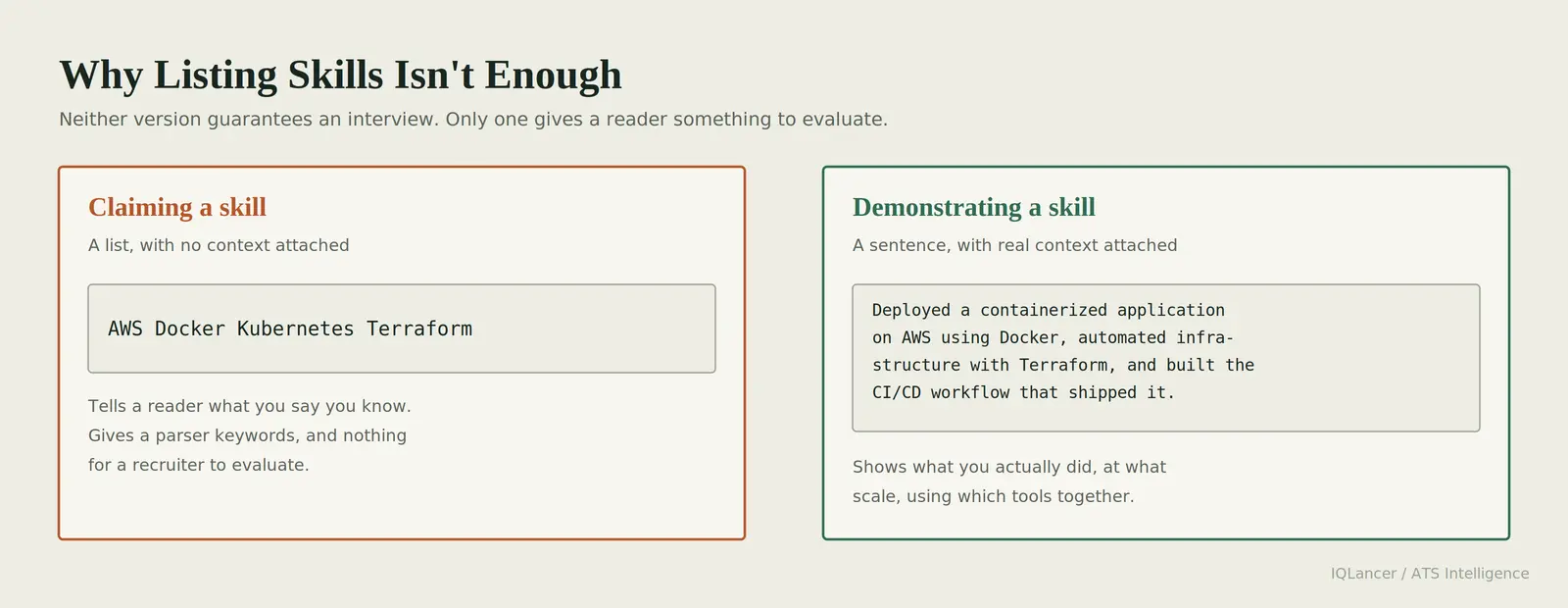
Claiming: AWS | Docker | Kubernetes | Terraform
Demonstrating: “Deployed a containerized application on AWS using Docker, automated infrastructure provisioning with Terraform, and implemented CI/CD workflows.”
A skills list tells a reader what you say you know. A sentence with context tells them what you actually did, at what scale, with what tools together. This matters more in IT hiring specifically, because most technical roles require combining tools, not using them in isolation, and a skills list can’t show that combination. None of this guarantees an interview. It just gives a human reviewer, and a semantic matching system, something real to evaluate instead of a list to take on faith.
Where Projects and Certifications Fit Into ATS Screening
Projects function as evidence when professional experience is limited or when you need to prove a specific capability the job requires. The useful structure is Project → Technology → Action → Outcome → Target Role: what you built, what you used, what you actually did, what resulted, and how it connects to the role you’re applying for.
Certifications support a profile but shouldn’t be treated as automatic proof of hands-on competence. A certification shows you studied the material. It doesn’t show you applied it under real conditions. Recruiters and hiring managers generally weigh certifications as a supporting signal rather than a substitute for demonstrated experience, which is why a certification paired with even a small project carries more weight than the certification alone.
Is Your ATS Score Actually Predicting Your Job Application Outcome?
Third-party resume scoring tools are popular, and they’re not worthless, but they’re not what most people assume either. No third-party checker has access to the actual parsing engine a specific employer uses; they approximate it using their own models, which means the same resume can score meaningfully differently across tools.
Some major ATS platforms, Greenhouse among them, don’t expose a match score to candidates at all, so any percentage a third-party tool shows you is a proxy, not something the employer has seen. There’s also no universal passing threshold. What a score can reasonably tell you: whether your resume covers the obvious terminology from a posting, and whether basic parsing issues exist. What it can’t tell you: whether you’ll get an interview, or how a specific employer’s actual system will treat your resume.
How to Diagnose Your Resume Before Applying Again
- Choose one target role instead of optimizing for “IT jobs in general.”
- Extract every requirement listed in the job description, word for word.
- Separate must-have requirements from nice-to-have ones.
- Map each important requirement to genuine evidence you can point to.
- Identify where the evidence is missing, weak, or unclear.
- Improve resume representation of the evidence you actually have, truthfully.
- Check the document for parsing risk: single column, standard fonts, no text-in-images.
- Review every application-stage question and eligibility field carefully, since these are the one place true automatic rejection happens.
- Apply.
A Practical ATS Resume Check for IT Candidates
- Role fit: Does this role genuinely match my background, or am I stretching?
- Requirements: Have I addressed the important requirements I actually meet?
- Technical skills: Are the relevant technologies clearly named, not implied?
- Evidence: Does the resume show how I used each skill, not just that I have it?
- Projects: Do any projects fill a gap where professional experience is thin?
- Keywords: Is the terminology accurate to my work, not stuffed in?
- Parsing: Is the structure simple enough that nothing could get lost?
- Accuracy: Could I defend every line of this resume in an interview?
- Application: Have I answered the required screening questions correctly?
Conclusion
The goal was never to trick a piece of software. It’s to make your genuine qualifications easier to identify, understand, and evaluate for the specific role you want. Why ATS rejects resumes isn’t a single mechanism you can defeat with the right template or keyword count. It’s the outcome of several separate steps, and the strongest resume isn’t the one with the most keywords. It’s the one that clearly connects role requirements to real evidence, represents that evidence accurately, and survives the parsing and human review stages without losing anything along the way. Diagnose your resume against a specific role before you send the next application. That’s a more useful question than asking what the ATS did.