Full Stack Development is not simply “knowing a frontend framework and a backend framework.” It means being able to take a requirement and carry it through the interface, the API, the database, authentication, testing, and deployment and explain every decision made along the way.
Most guides on how to become a full stack developer stop at a list of technologies. This one goes further: it explains what employers actually verify, what “job-ready” really means in practice, which stack to choose and why, what projects prove real capability versus tutorial-following, and how AI-assisted coding is reshaping expectations in 2026.
If you’re serious about this developer career path, this is the intelligence you need before you start building.
What Does a Full Stack Developer Actually Do?
The title “Full Stack Developer” gets used loosely, so it’s worth being precise about the actual work before anything else, since employers judge candidates against real responsibilities, not against a job title.
A Full Stack Developer typically works across a practical lifecycle: a requirement comes in, gets translated into frontend UI, connects through an API, hits backend business logic, reads and writes to a database, passes through authentication and validation, gets tested, gets deployed, and then gets monitored in production. In practice this looks like:
- Frontend development : Building interfaces, managing state, handling forms and user input
- Backend development : Writing business logic, structuring APIs, handling authorization
- Database work : Designing schemas, writing queries, managing relationships and indexes
- Authentication : Implementing login, sessions, and token-based access control
- Testing and debugging : Verifying behavior and diagnosing failures across the stack
- Deployment : Getting the application running somewhere other than a local machine
- Monitoring and maintenance : Keeping an existing system healthy, not just building new features
Full Stack does not mean expert-level mastery of every technology in this list. It means enough working competence across the stack that you can own a feature end to end without handing it to three different specialists. Most working full stack developers still lean noticeably stronger on one side (frontend or backend) and that’s normal and expected.
Full Stack Developer vs. Frontend, Backend, and Software Engineer
Job titles are inconsistent across the industry, so understanding how “Full Stack Developer” differs from adjacent titles matters more for a job search than any technical skill alone.
| Role | Primary Focus | Typical Daily Work | Entry Bar |
|---|---|---|---|
| Frontend Developer | UI, UX, client-side logic | Building components, styling, state management, accessibility | Strong JS/TS, one framework, CSS depth |
| Backend Developer | Server logic, data, APIs | API design, database work, business logic, performance | One backend language, SQL, API design |
| Full Stack Developer | Both sides + integration | Feature ownership across UI, API, DB, and deploy | Working competence on both sides, not necessarily expert on either |
| Software Engineer | Broader systems/engineering practice | Could be frontend, backend, or full stack plus stronger emphasis on architecture, scale, and engineering process | Varies widely by company; often used interchangeably with Full Stack at smaller companies |
Company size changes this significantly. At an early-stage startup, “Full Stack Developer” and “Software Engineer” are often the same job. At a large enterprise, Full Stack Developers may sit on a specific product team while Software Engineer implies a broader, more architecture-focused track. Do not assume any employer defines these terms identically always read the actual responsibilities in a posting rather than the title alone.
Do You Need a Degree to Become a Full Stack Developer?
Because this is one of the most common blockers people self-impose before even starting, it deserves a direct, evidence-based answer rather than motivational hand-waving.
| Pathway | Status |
|---|---|
| Computer Science / Software Engineering degree | Preferred at many mid-size and large companies; not strictly required everywhere |
| IT / Computer Engineering degree | Helpful but not essential provides foundational CS concepts |
| Coding bootcamp | Helpful but not essential useful for structure and accountability, not a guarantee of hiring |
| Self-taught / online learning | Viable, but requires the candidate to independently produce equivalent portfolio evidence |
No universal rule holds across every employer. Large enterprises and regulated industries more often filter by degree at the resume-screening stage. Startups and small product teams generally weight projects, code quality, and interview performance more heavily than the credential itself.
What is consistent: whichever pathway you take, you are expected to eventually demonstrate the same practical capability a degree does not exempt you from being able to build, debug, and explain a real application.
Realistic Pathways: Beginners, Career Switchers, and Specialists
Where you’re starting from changes both the sequence and the realistic timeline, so it helps to be explicit about which situation you’re actually in before following a generic roadmap.
- Complete beginners / students: Start with the fundamentals (HTML, CSS, JavaScript) before touching any framework. Skipping this step is one of the most common causes of shallow, unmaintainable projects later.
- Non-IT graduates / career switchers: The learning curve is steeper for foundational programming concepts, but transferable skills (domain knowledge, communication, prior professional experience) can be a differentiator mention them explicitly in interviews.
- Frontend Developers adding backend: Focus on server-side fundamentals, databases, and API design; you already have UI and JavaScript fluency working in your favor.
- Backend Developers adding frontend: Focus on component architecture, state management, and modern CSS layout; your API and data-modeling instincts transfer directly.
- Freelancers: Client work often already forces some full stack exposure the gap is usually in structured testing, security practices, and deployment discipline rather than raw coding ability.
Avoid any roadmap promising “full stack developer in 90 days.” Multiple 2026 industry sources put realistic full-time timelines in the range of roughly 4–12 months to reach a job-ready baseline, and part-time learners should expect longer timelines vary by prior experience, hours invested per week, and how rigorously projects are built rather than just tutorials followed. Treat any specific number as an estimate, not a guarantee.
What Does “Job-Ready” Actually Mean for a Full Stack Developer?
This is one of the most misunderstood parts of the journey “job-ready” gets conflated with “has watched enough tutorials,” when employers are actually looking for observable, demonstrable evidence.
A job-ready junior Full Stack Developer should be able to show, not just claim, capability such as:
- Building a frontend interface from a written requirement, not a copied design
- Consuming and reasoning about third-party or self-built APIs
- Writing backend logic that handles real business rules, not just CRUD boilerplate
- Designing and querying a relational database, including relationships and basic optimization
- Implementing authentication and authorization correctly
- Validating input and handling errors gracefully instead of letting the app crash
- Writing at least some meaningful tests (not necessarily full coverage)
- Debugging an unfamiliar bug in their own or someone else’s code
- Using Git professionally branches, pull requests, resolving merge conflicts
- Deploying an application so someone other than the developer can access it
- Understanding basic security practices (password hashing, input sanitization, HTTPS)
- Explaining why they made specific architecture decisions, not just what they built
- Modifying and extending an existing codebase they didn’t originally write
Not every employer expects every item at the same depth a startup may prioritize deployment and ownership; a larger company may prioritize code quality and testing discipline. But a candidate who can’t speak to most of this list with real examples is not yet job-ready, regardless of how many frameworks appear on their resume.
Build vs. Know: The Distinction That Actually Separates Candidates
Knowledge and practical capability are frequently confused on resumes, and this gap is one of the most common reasons technically “qualified” candidates still don’t get hired.
| Knowing | Being Able To |
|---|---|
| React | Build and maintain a real, evolving React application |
| SQL | Design schemas, write joins, use indexes, and troubleshoot slow queries |
| REST | Design a coherent API and consume one reliably, including error states |
| Git | Work with branches, pull requests, and resolve actual merge conflicts |
| Docker | Containerize an application and get it running reliably |
| AWS | Deploy an application and troubleshoot it when something breaks in production |
This distinction should shape how you approach every stage below: the goal at each step isn’t to “learn” a technology in the abstract, but to reach the point where you can build something real with it, break it, and fix it yourself.
Which Full Stack Technology Stack Should You Learn?
Choosing a stack causes real paralysis for beginners because the internet presents dozens of “correct” combinations the goal here is to explain how to choose one coherently instead of collecting technologies.
Three commonly viable ecosystems in 2026:
JavaScript / TypeScript Stack
- Frontend: React or Next.js ·
- Backend: Node.js (Express, NestJS, or Hono) ·
- Database: PostgreSQL
This is currently the most requested combination across job postings, largely because it lets one language (JavaScript/TypeScript) span the entire stack, reducing context-switching for both learners and teams.
Python-Oriented Stack
- Frontend: React (or another frontend framework) ·
- Backend: Python (FastAPI or Django) ·
- Database: PostgreSQL
Strong fit if you’re also interested in data-adjacent or AI-integration work, since Python dominates those areas.
Java Enterprise Stack
- Frontend: React or Angular
- Backend: Java / Spring
- Database: PostgreSQL or MySQL
More common in large enterprises, government contracting, and regulated industries with longer-lived, larger codebases.
These are not the only valid combinations Ruby on Rails, Go, and PHP-based stacks remain viable in specific markets and companies. The right choice depends on target job postings in your region, your existing skills, and your long-term interest (e.g., AI integration favors Python; enterprise stability favors Java). Pick one, go deep, and resist the urge to “collect” frameworks before you’re job-ready in any single one.
How to Choose Your Stack Using Real Job Data (Hiring Intelligence Method)
Rather than guessing at what to learn, this IQLancer method uses actual hiring signals so your learning time maps directly to what employers are asking for right now.
- Collect 20–30 relevant Full Stack job postings for your target location or remote market.
- Extract the recurring technologies across all of them.
- Separate requirements into Must Have, Preferred, and Nice to Have based on how postings phrase them.
- Identify the dominant frontend ecosystem in your sample.
- Identify the dominant backend requirement.
- Identify the dominant database requirement.
- Identify recurring deployment/cloud requirements (AWS, Docker, CI/CD, etc.).
- Select one coherent stack based on what actually recurs.
- Build projects using that exact stack.
- Reassess every few months as you gain foundational competence requirements shift.
A frequently recurring technology is a signal, not a guarantee that it’s universally required. If React appears in 70% of postings you collected, it’s fair to say React is widely requested in your sample; it is not accurate to say React is mandatory for every full stack role everywhere.
Full Stack Skills: What to Actually Learn
Every layer below matters for a different reason to employers, and it’s worth understanding why each one is evaluated, not just that it’s expected.
HTML : Semantic structure, forms, and basic accessibility aren’t optional extras; poorly structured markup causes real accessibility and SEO problems that employers do care about in production apps.
CSS : Responsive design, Flexbox, and Grid are how real interfaces get built across device sizes; weak CSS fundamentals show up immediately in take-home tests and portfolio review.
JavaScript : Variables, functions, objects, arrays, the DOM, async programming (promises, async/await), modules, and error handling form the backbone of both frontend and Node.js backend work. This is the single most load-bearing skill in a JavaScript-based stack.
TypeScript : Increasingly the default rather than an optional extra on production teams in 2026, because static typing catches whole categories of bugs before code runs, which matters enormously as codebases grow past a handful of files. Beginners should add it once comfortable with core JavaScript, not before.
Frontend Frameworks : React remains the most widely requested choice across current postings, with Next.js increasingly expected as the standard way to build production React applications (server-side rendering, routing, and edge functions built in). Vue and Angular remain viable, particularly Angular in enterprise contexts. Learn one primary frontend ecosystem deeply rather than sampling all of them shallowly depth is what gets evaluated in interviews and code review, not breadth.
Backend Development
Backend skills exist because someone has to enforce business rules, guard data, and make sure the frontend has something reliable to talk to and this is where a large share of rejection reasons actually originate.
Core backend fundamentals to build real competence in:
- HTTP fundamentals methods, status codes, headers
- REST API design resource modeling, versioning, predictable responses
- Authentication and authorization sessions, cookies, and tokens where relevant
- Input validation and structured error handling
- API security basics
- Common backend ecosystems: Node.js, Python, Java, C#, PHP, and Go.
As with frontend, do not try to learn all of them. Depth in one backend ecosystem is worth far more to an employer than shallow familiarity with five. A candidate who can design, secure, and troubleshoot APIs in one language will out-interview a candidate who has “touched” six languages superficially.
Databases
Database skills are frequently underweighted by beginners relative to frontend frameworks, even though weak database understanding is one of the most common gaps employers report in interviews.
Relational Databases (PostgreSQL, MySQL): Understand tables, relationships, primary and foreign keys, indexes, constraints, transactions, normalization, migrations, and basic query optimization. SQL fundamentals underpin broad employability across almost every stack combination, including ones that also use a NoSQL database.
NoSQL (MongoDB): Useful for document-style data and rapid prototyping, but learning MongoDB does not remove the need to understand relational concepts many production systems use both, and interviewers routinely probe relational schema design regardless of which database a candidate lists.
APIs and System Integration
Understanding how the pieces of a full stack application actually talk to each other is what separates someone who can build isolated components from someone who can build a working system.
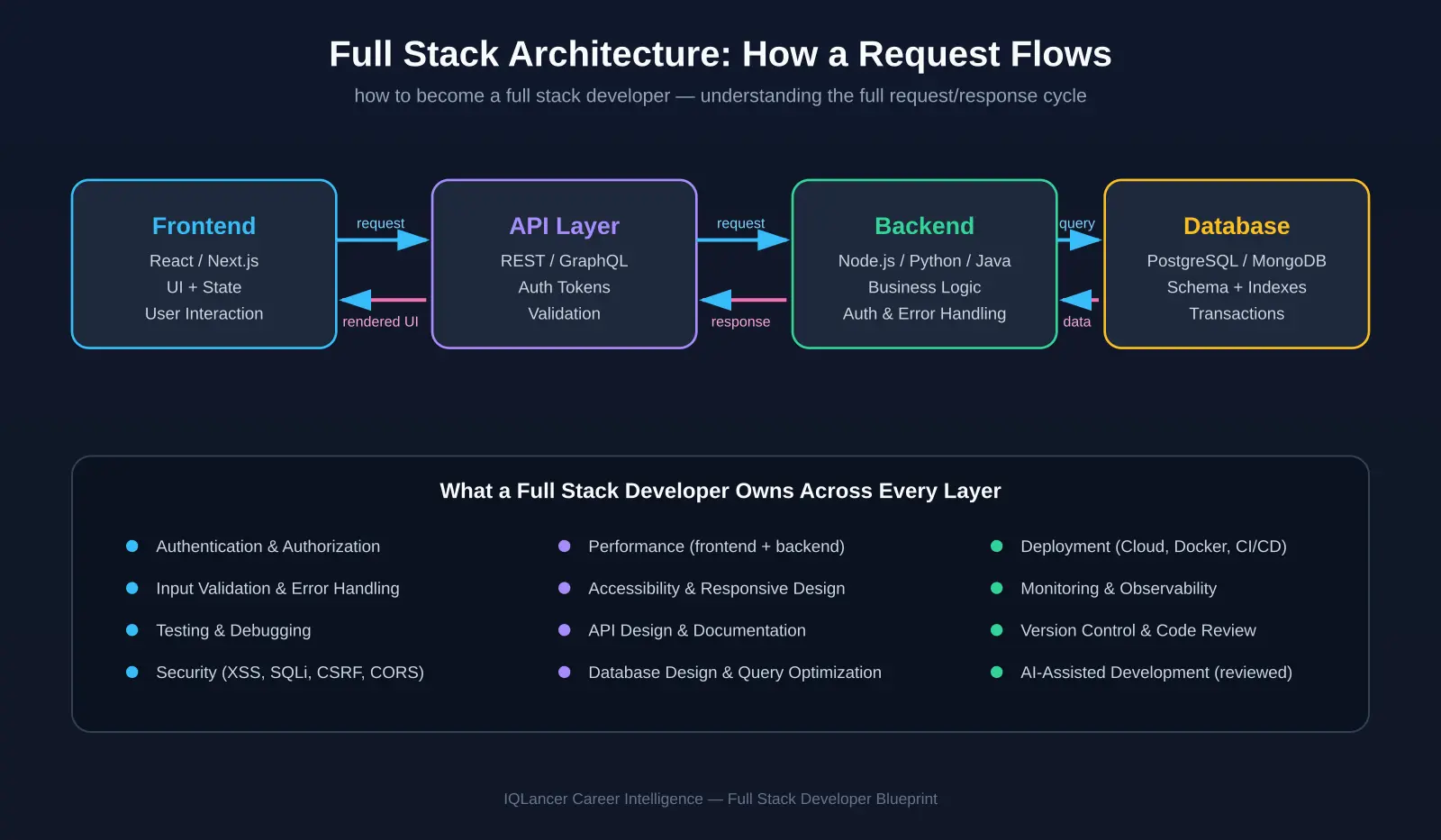
The typical request flow:
Frontend → API Request → Backend → Business Logic → Database → API Response → Frontend
Core concepts to master: HTTP, REST, JSON payloads, HTTP methods and status codes, authentication on API requests, input validation, structured error handling, and consuming third-party APIs reliably (including handling failures and rate limits). Being able to explain this full round-trip clearly in an interview is a strong, low-cost signal of real understanding.
The Full Stack Developer Roadmap
A full stack developer roadmap should be a progression of capabilities, not a checklist of technology names the difference between the two is exactly what separates a job-ready candidate from someone who has “covered” a syllabus.
| Stage | What to Build | What It Proves | What Not to Learn Yet |
|---|---|---|---|
| HTML + CSS | A responsive static site | Layout and structure fundamentals | Frameworks |
| JavaScript | Interactive DOM-based app | Logic, events, async handling | TypeScript (until comfortable with JS) |
| Git + GitHub | Structured repo with commit history | Version control discipline | Advanced CI/CD |
| Frontend Framework | A multi-page app with state and routing | Component architecture | A second frontend framework |
| Backend | A REST API with real business logic | Server-side reasoning | Microservices |
| Database | A schema-backed app with real relationships | Data modeling | Database sharding/scaling |
| APIs + Auth | A full app with login and protected routes | End-to-end integration | OAuth provider building |
| Testing | Unit + basic integration tests | Reliability mindset | 100% coverage obsession |
| Deployment | A live, publicly accessible app | Production readiness | Kubernetes (unless targeting DevOps-heavy roles) |
| Production Projects | A portfolio-grade, documented application | Job-ready evidence | Chasing every new framework |
The Web Development Roadmap: Four Levels of Readiness
Completing tutorials moves you through content; it does not automatically move you between these levels, which is why so many self-taught developers plateau despite finishing course after course.
- Beginner: Can follow a tutorial and understand what each line does, but struggles to build something new without a reference.
- Intermediate: Can build a known type of application (e.g., a CRUD app) mostly independently, with occasional lookups.
- Job-Ready: Can take an ambiguous requirement, build a full-stack solution, debug it, deploy it, and explain the decisions made; the bar described in the Job-Ready section above.
- Production-Ready: Job-Ready capability plus experience maintaining a live system under real constraints handling edge cases, monitoring, and incidents that only show up once real users are involved.
Each level requires genuinely different practical evidence moving up is not a matter of consuming more content, it’s a matter of building, breaking, and fixing real things.
Software Engineering Fundamentals
This is not a data-structures-and-algorithms article, but a reasonable baseline of software engineering fundamentals is expected at every career stage, and skipping it shows up quickly in code review.
Relevant fundamentals: basic data structures and algorithmic thinking, object-oriented programming concepts, some functional programming ideas (immutability, pure functions), clean code practices, modularity, separation of concerns, and consistent error handling. At the junior level, expectations are modest can you reason about time complexity at a basic level and write maintainable, non-tangled code? At senior levels, this expands into architectural judgment and trade-off reasoning, covered further in the System Design section below.
Git and Professional Development Workflow
Professional development means working inside a team’s process, not simply pushing solo projects to a personal GitHub and this is one of the most overlooked gaps between hobbyist and professional-grade work.
Core competencies: branching strategies, opening and reviewing pull requests, resolving real merge conflicts (not just avoiding them), writing clean commit messages, basic issue tracking, and participating in code review both giving and receiving feedback. Even solo learners can simulate this by opening pull requests against their own practice repos and reviewing their own past code critically.
Testing and Debugging
Testing and debugging matter because production software fails in ways tutorials never demonstrate, and the ability to diagnose failure is itself a hireable skill separate from writing new features.
Cover unit testing (isolated logic), integration testing (components working together), and at least conceptual familiarity with end-to-end testing. Pair this with structured debugging practices and basic logging. Expectations scale with experience entry-level candidates are not expected to have expert-level test architecture skills, but should be able to write meaningful tests for their own code and use logs to trace a bug rather than guessing.
Security Fundamentals
A Full Stack Developer isn’t expected to be a cybersecurity specialist, but secure-by-default habits are now a baseline expectation rather than an advanced topic, especially given how often insecure code makes it to production.
Practical fundamentals: authentication and authorization correctness, password hashing (never storing plaintext), secure session/token handling, input validation, and awareness of SQL injection, XSS, CSRF, and CORS misconfiguration. Add secrets management (never hardcoding credentials), basic dependency vulnerability awareness, and defaulting to HTTPS. These aren’t theoretical they show up directly in code review and in take-home assessments.
Accessibility
Accessibility is a professional expectation in frontend work, not a specialized add-on reserved for accessibility consultants.
Core practices: semantic HTML as the foundation, keyboard navigation support, properly labeled forms, awareness of screen reader behavior, and appropriate (not excessive) use of ARIA attributes. This doesn’t require an accessibility certification; it requires building the habit of checking your own interfaces against these basics by default.
Performance
“Works on my laptop” and “performs reliably for real users” are two different bars, and the second one is what employers actually care about once an application ships.
- Frontend: page load performance, bundle size awareness, lazy loading, image optimization, and familiarity with Core Web Vitals where relevant.
- Backend: API latency, efficient database queries, proper indexing, and caching strategies.
- Application-wide: the ability to identify bottlenecks and understand basic monitoring signals rather than guessing where slowness comes from.
System Design (At the Right Level)
System design gets introduced far too early or far too abstractly in most roadmaps the right approach is to scale the depth to career stage rather than front-loading senior-level concepts on day one.
- Junior level: Client-server architecture, how APIs and databases relate, and basic caching/scalability awareness.
- Mid-level: Modular architecture, service boundaries, reliability considerations, and how data actually flows through a system.
- Senior level: Architecture trade-offs, scalability and availability decisions, observability, and where relevant distributed systems concepts.
A junior candidate is not expected to design a distributed system in an interview; they are expected to reasonably explain how their own project’s pieces fit together.
Cloud and Deployment
There’s a meaningful gap between “the application works locally” and “the application is deployed and maintainable,” and closing that gap is one of the highest-leverage things a junior candidate can do for their portfolio.
Practical fundamentals: hosting basics, domains and HTTPS, environment variables (never hardcoded config), a basic CI/CD pipeline, Docker for containerization, core cloud platform concepts (AWS, GCP, or Azure pick one to start), and basic monitoring once deployed. A deployed, publicly accessible project with a real URL is disproportionately valuable evidence compared to a project that only runs on the developer’s own machine.
Observability Basics
Observability sounds like an advanced-engineering topic, but a basic working vocabulary is expected even at entry level, because “how do you know when something breaks in production” is a fair interview question for any full stack role.
At a Full Stack level, understand the practical differences between logs (discrete events), metrics (aggregated numbers over time), monitoring (watching those metrics), and alerts (automated notification when something crosses a threshold). Depth here should match the role junior candidates need conceptual fluency, not enterprise observability-platform experience.
AI-Assisted Development: What It Changes and What It Doesn’t
This section is essential for anyone entering the field in 2026–2027, because AI coding tools have shifted from optional experiment to daily-use infrastructure across the industry and that shift carries real risk alongside real productivity gains.
Where AI genuinely helps: code generation for boilerplate, debugging assistance, documentation drafting, test scaffolding, rapid prototyping, refactoring suggestions, and accelerating code review. Research on developer productivity in 2026 found that the large majority of professional developers now use an AI coding assistant regularly, with meaningful though not universal productivity gains reported (Infosecurity Magazine).
Where the risk actually is: multiple independent 2026 security studies found that a substantial share of AI-generated code estimates across different testing methodologies range roughly from a quarter to nearly half contains confirmed security vulnerabilities when tested against standard vulnerability categories (Veracode, Cloud Security Alliance research).
A specific and now well-documented risk is “package hallucination” or slopsquatting AI tools inventing plausible-but-nonexistent package names, which attackers then register with malicious code, waiting for a developer’s assistant to suggest that exact name again (ActiveState, AI Magicx). Other documented risks include architecturally subtle flaws that pass basic scans, developers over-trusting AI output without review, and difficulty explaining code the developer didn’t actually write themselves.
The core principle for a job-ready Full Stack Developer: AI-assisted development is a genuine productivity skill worth building deliberately. It is not a substitute for the software engineering fundamentals, security awareness, and debugging ability covered throughout this article if anything, those fundamentals matter more now, because someone still has to catch what the AI gets wrong before it reaches production.
Employers increasingly expect candidates to be comfortable using AI tools and capable of critically reviewing, testing, and taking responsibility for what those tools produce.
Project Intelligence: What to Build at Each Stage
“Build 3–5 projects” is not useful advice on its own what matters is what each project actually proves about your capability, so projects should be selected deliberately by maturity level rather than picked at random.
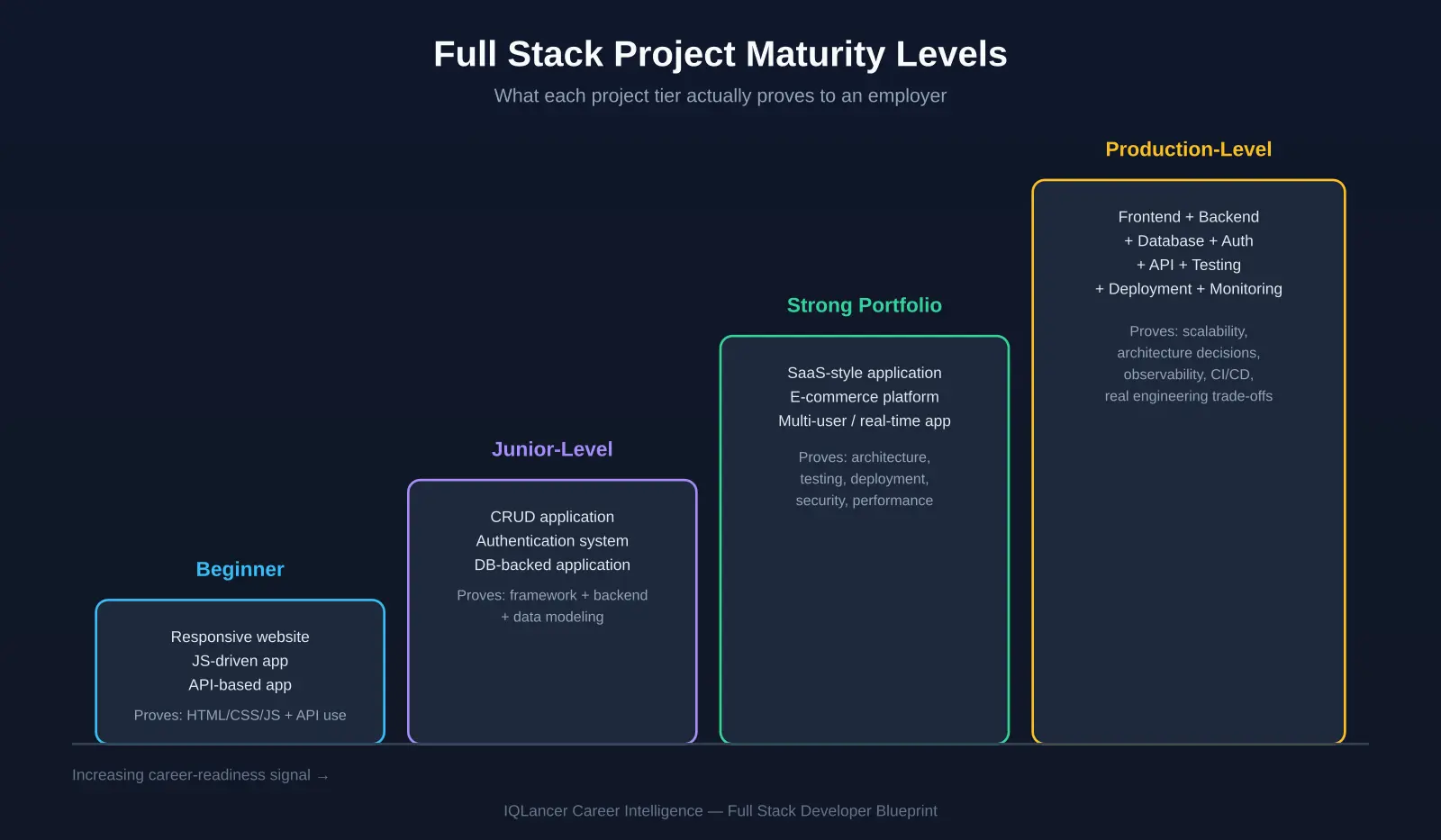
Beginner projects : A responsive static website, a JavaScript-driven interactive app, or a simple API-consuming app.
- Proves: HTML/CSS/JS fundamentals and basic API usage.
Junior-level projects : A CRUD application, an authentication system, a database-backed app with real relationships.
- Proves: framework competence, backend logic, and data modeling.
Strong portfolio projects : A SaaS-style application, an e-commerce platform, a multi-user application, or a real-time feature (chat, live updates).
- Proves: architecture thinking, integration across the full stack, and handling more complex state.
Production-level projects : Ideally combine frontend, backend, database, authentication, API design, some testing, deployment, and basic monitoring in one cohesive system.
- Proves: the full end-to-end capability employers are actually screening for.
Complexity alone does not prove professional-grade work a complicated project with no tests, no deployment, and no documentation proves less than a simpler project that is fully deployed, documented, and explainable.
Evaluating Your Own Projects Before Employers Do
Most self-taught developers move past tutorial projects only when they start honestly grading their own work against the standard employers actually apply.
| Area | Question to Ask |
|---|---|
| Functionality | Does it solve a real problem, or just replicate a tutorial? |
| Code Quality | Is it maintainable and readable by someone else? |
| Database | Is the schema sensible, with real relationships? |
| Security | Are common vulnerabilities (injection, XSS, weak auth) addressed? |
| Testing | What is actually tested, and how meaningfully? |
| Performance | What happens under realistic, non-trivial usage? |
| Deployment | Is it usable by someone outside the developer’s own machine? |
| Documentation | Could another developer understand and extend it? |
Portfolio Intelligence
A portfolio entry should demonstrate engineering decisions, not just the fact that something was built this is the difference recruiters and hiring managers are actually screening for.
A strong Full Stack portfolio typically includes: public GitHub repositories with clear READMEs, basic architecture diagrams, visible source code, a documented database design, API documentation, some evidence of testing, a live deployment link, screenshots, an explanation of key technical decisions, security considerations addressed, performance considerations, and honestly stated known limitations. Listing “built a project” says little; being able to walk through why you chose a given database schema, authentication approach, or deployment target says a great deal.
Real Experience Alternatives
Without professional experience, candidates can still build credible evidence of capability through several recognized paths though these are not automatically treated as equivalent to real client or team experience, and shouldn’t be presented as if they are.
Freelance projects, internships, open-source contributions, volunteer development work, contract gigs, serious (non-tutorial) personal projects, and hackathon participation can all demonstrate real capability. Real client or team experience; where requirements are ambiguous, stakeholders push back, and code has to survive contact with other developers carries more weight than a solo tutorial project, even a well-built one.
Where possible, seek out at least one experience involving another person’s requirements or another developer’s code review.
Certifications: A Realistic View
Certifications are frequently oversold in generic career content, so it’s worth being direct: for Full Stack Developer roles specifically, certifications are usually a secondary signal rather than the primary hiring factor.
Projects, demonstrable coding ability, and real (even non-traditional) experience typically carry more weight in Full Stack hiring than a certification alone.
Where certifications can help: cloud provider certifications (AWS, Azure, GCP) can serve as a secondary, evidence-adjacent signal particularly for candidates whose portfolio already demonstrates deployment work the certification then formalizes. There is no strong case for building an elaborate certification roadmap purely to check boxes; time is generally better spent on a stronger, more deployable project.
Current Employer Expectations
Based on a review of live 2026 job postings and multiple technical skills analyses, a consistent core set of requirements recurs across Full Stack Developer listings, though specific weighting varies by company and seniority (DEV Community posting review, Edstellar):
Recurring across postings: JavaScript, TypeScript, React (frequently paired with Next.js), Node.js, REST API design, SQL/PostgreSQL, Git, testing fundamentals, cloud platform familiarity, Docker, CI/CD awareness, authentication implementation, and Agile team experience.
Rough experience-tier expectations (these vary meaningfully by employer and should be treated as general patterns, not fixed rules):
- Entry level: Credible in one frontend framework and one backend runtime, plus a database; able to ship a feature with guidance.
- 1–3 years: Independently designs and builds features from database schema through UI; growing debugging and code review ability.
- 3–5 years: Makes technology and architecture trade-off decisions; mentors junior developers; owns larger features with less oversight.
- 5+ years: Role shifts toward architecture, technical direction, and ownership of system-level decisions rather than individual feature delivery.
How to Read a Job Description (IQLancer Hiring Intelligence Method)
Job descriptions are one of the richest, most underused sources of hiring intelligence available to candidates, and reading them systematically turns vague anxiety about “am I ready?” into a concrete gap analysis.
- Collect 20–30 relevant Full Stack postings for your target role and location.
- Extract the technologies that recur most frequently.
- Separate language into Must Have, Preferred, and Nice to Have.
- Note the experience requirements stated.
- Identify the dominant stack across your sample.
- Identify skills that show up repeatedly that you currently lack.
- Compare that gap list honestly against your current capability.
- Build (or extend) projects specifically targeting genuine gaps not just interesting new tech.
- Reassess every few months as your skills and the market both evolve.
Learning Timeline: Realistic Expectations by Starting Point
Timelines should be treated as planning estimates, not guarantees, since actual pace depends heavily on hours invested per week and whether projects are built rigorously or just followed along with.
Multiple 2026 sources converge on a rough range: full-time, focused learners commonly reach a job-ready baseline in approximately 4–8 months; part-time learners (roughly 10–15 hours weekly) should plan for closer to 12 months (Scrimba, Kunal Ganglani). Genuine proficiency beyond the initial job-ready bar typically develops over the following 1–3 years of real-world work. Career switchers and non-IT graduates should expect the earlier end of the timeline to take longer, since foundational programming concepts take more time to internalize than for candidates coming from an adjacent technical background.
Full Stack Developer Salary
Compensation figures vary substantially across sources depending on methodology (base-only vs. total comp, self-reported vs. posting-derived, and regional mix), so treat any single number as a data point rather than a guarantee, and always check location-specific data for your market.
Across multiple 2026 U.S. sources, entry-level Full Stack Developer compensation commonly clusters in roughly the $70,000–$120,000 range depending on region, company size, and whether the figure includes total compensation (SalaryExpert, PayScale, ResumeGeni). Mid-level developers (roughly 3–5 years) commonly fall in the $90,000–$150,000 range, and senior-level Full Stack Developers (8+ years) are reported anywhere from roughly $140,000 up to $280,000+ at the top end for large tech companies and high-cost markets (Glassdoor, Built In).
Key factors driving this spread: years of experience, geographic location (major tech hubs pay meaningfully more), technology stack (TypeScript and cloud-deployment skills reportedly command a premium), company size and industry (finance and energy sectors reported some of the highest medians), and remote-work arrangements.
Salary data is genuinely fast-changing always check current, region-specific sources before using any figure to negotiate or set expectations.
Rejection Intelligence: Why Full Stack Candidates Get Rejected
Understanding why candidates get rejected is more actionable than any generic list of skills to learn, because most rejection reasons trace back to specific, fixable gaps rather than a lack of raw talent.
| Problem | Why It Happens | How Employers Interpret It | What to Do Instead |
|---|---|---|---|
| Tutorial-only projects | Learner stayed inside guided instructions | Can’t build independently | Build one project from a self-written requirement, no tutorial |
| Shallow knowledge across too many technologies | Collected frameworks instead of going deep | No real depth to interview against | Commit to one stack and go deep |
| Weak JavaScript fundamentals | Jumped to React before mastering JS | Framework use looks copy-pasted | Solidify vanilla JS before frameworks |
| Weak backend understanding | Focused disproportionately on UI | Can’t reason about server-side logic | Build a real API with actual business rules |
| Weak database knowledge | Treated the database as an afterthought | Can’t design or troubleshoot data layers | Practice schema design and query writing deliberately |
| No deployment experience | Never took a project past localhost | Unproven in a real environment | Deploy every serious project publicly |
| No testing | Skipped tests to move faster | Signals risk in production code | Add meaningful tests, even a modest suite |
| Poor Git workflow | Used Git only to “save” code | No evidence of team readiness | Practice branches, PRs, and resolving conflicts |
| Poor GitHub documentation | Assumed the code speaks for itself | Reviewer can’t evaluate quickly | Write clear READMEs and architecture notes |
| Weak debugging ability | Relied on AI or Stack Overflow without understanding | Can’t function independently under pressure | Practice debugging unfamiliar code deliberately |
| Copy-paste projects | Followed tutorials without adaptation | Can’t defend design choices in interview | Modify, extend, or rebuild parts independently |
| Can’t explain architecture | Built without understanding why | Looks like surface-level knowledge | Practice explaining every major decision out loud |
| Resume lists tech without evidence | Listed skills without backing projects | Reads as keyword stuffing | Tie every listed skill to a specific, checkable project |
| Can’t modify their own project later | Built once, never returned to it | Suggests fragile understanding | Revisit and extend old projects periodically |
ATS Intelligence: Keywords Need Evidence Behind Them
Applicant Tracking Systems reward keyword presence, but a keyword with no supporting evidence does not survive human review so the goal is connecting each term to something concrete and checkable.
Common categories appearing across current postings: JavaScript, TypeScript, React, Next.js, Node.js, REST API, SQL, PostgreSQL, MongoDB, Git, GitHub, Docker, AWS, Azure, CI/CD, Testing, Authentication, Microservices, HTML, CSS, and Agile.
The method: Keyword → Actual Capability → Evidence.
Weak: “REST API” listed alone with no context. Stronger: “Designed and integrated REST APIs with authentication, validation, error handling, and database operations” backed by a specific, checkable project link.
These are illustrative examples of how to frame a resume bullet, not claims about any specific candidate’s actual achievements adapt the structure to what you genuinely built.
The Developer Career Path
Career progression for a Full Stack Developer is rarely a single fixed ladder; it varies by company size, individual interest, and market conditions but a common general pattern looks roughly.
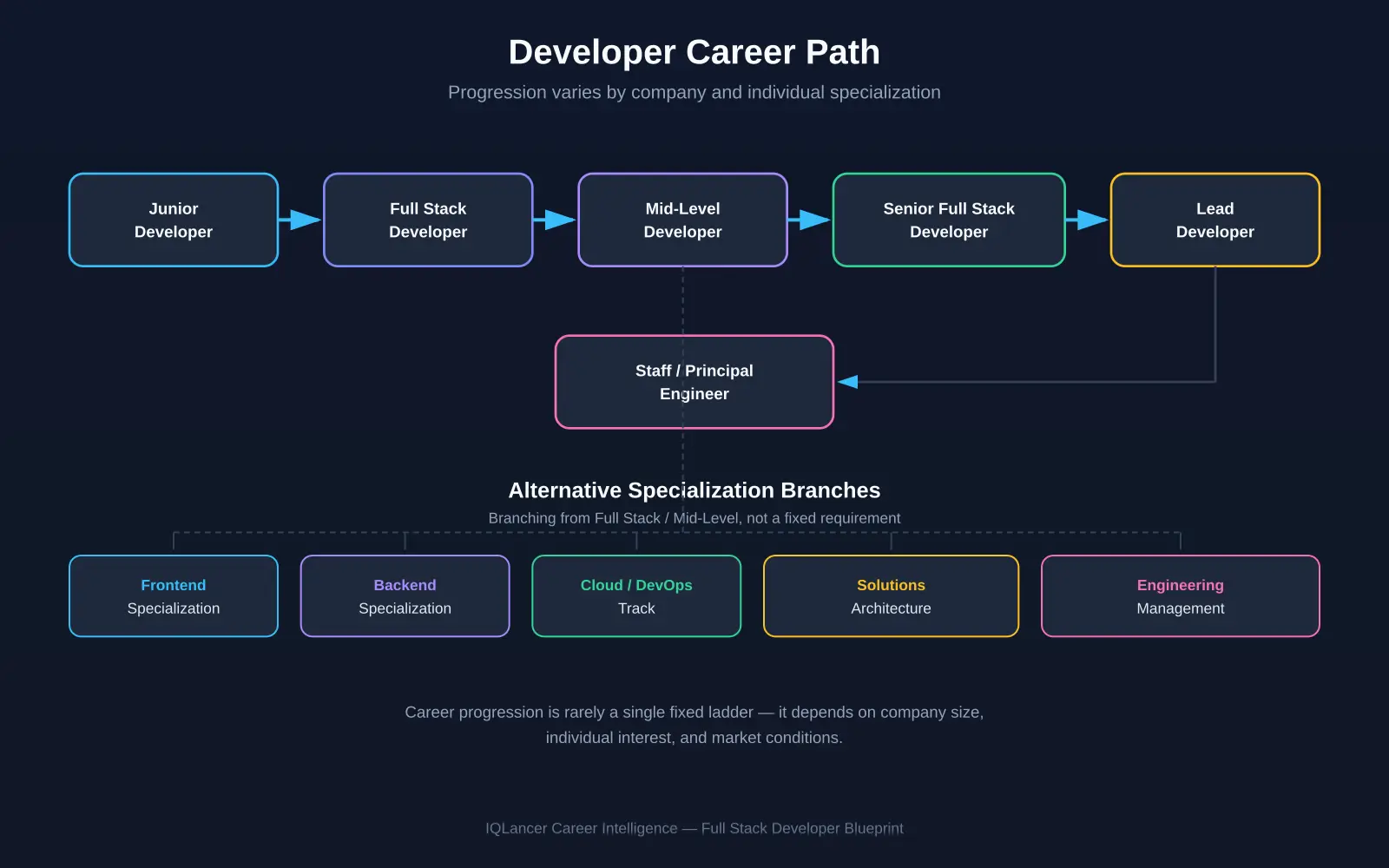
Common alternative branches from this same starting point: frontend specialization, backend specialization, cloud/DevOps focus, Solutions Architecture, or a shift into Engineering Management. None of these paths is inherently “better” they represent different trade-offs between depth, breadth, technical focus, and people leadership, and the right one depends on what kind of work you find genuinely engaging several years in.
The Final Practical Test
If you follow this roadmap seriously, here is the measurable bar for job-readiness: before calling yourself job-ready for a Full Stack Developer role, you should be able to build a full-stack application from a written requirement, explain every major architecture decision you made in it, deploy it somewhere publicly accessible, debug an unfamiliar failure in it under time pressure, secure it against common vulnerabilities, test its core logic meaningfully, and maintain it.
That mean, you can still confidently extend or modify it weeks or months after first building it. If you can do all seven on at least one real project, you have crossed from “has studied full stack development” into genuinely job-ready territory.
Final Thoughts
Learning how to become a full stack developer is less about memorizing a list of frameworks and more about building real, defensible evidence of capability across the entire stack frontend, backend, database, security, testing, and deployment. The candidates who get hired aren’t necessarily the ones who know the most technologies; they’re the ones who can build something real, explain every decision behind it, and maintain it under real conditions.
Choose one coherent stack, build toward the job-ready bar defined above, and let your projects not your resume’s keyword list do the talking. The full stack developer roadmap never really ends, but the path to your first real offer is more concrete than it looks from the outside.