Only about 1 in 4 candidates in one candidate-reported study of 335 resolved onsite interviews ended with an offer (25.1%). That study covers technical roles in general, not just Data Analysts, and it is not a universal pass rate, but it shows how selective late-stage interviews can be.
A candidate can write technically correct SQL and still perform poorly in a case study. The query may be right while the question behind it was wrong, the metric was loosely defined, or the result was never connected to a decision. A case study is designed to expose that gap.
It shows whether someone can frame an ambiguous problem, define what to measure, prioritize hypotheses, analyze rigorously, communicate clearly, respond to challenge and recognize uncertainty. IQLancer explains the employer’s side of that exchange: what the candidate does, what the interviewer observes and what hiring signal results.
What Is a Data Analyst Case Study Interview?
A Data Analyst case study interview gives a candidate a business problem and assesses how they structure, investigate and communicate a solution.
Formats vary. In one common version, a take-home assignment pairs a business problem with a dataset and ends in a recommendation presented to a panel. Other versions are live discussions, or give no dataset at all, so the candidate must say what data they would need. One interview-prep guide describes the exercise as less about tools and more about how you think, prioritize and communicate under ambiguity.
| Format | What the employer can observe most directly |
|---|---|
| Live | Reasoning, clarification, adaptability, communication |
| Take-home | Analytical depth, documentation, validation, synthesis |
| Presentation | Storytelling, recommendation, communication, follow-up handling |
| No dataset | Problem framing, data requirements, hypothesis structure |
These are common tendencies, not universal rules. Every company measures success in a case interview differently, and many combine formats.
What Are Employers Actually Evaluating?
Employers can use case studies to observe whether candidates define the business problem, choose relevant metrics, validate evidence and connect findings to decisions.
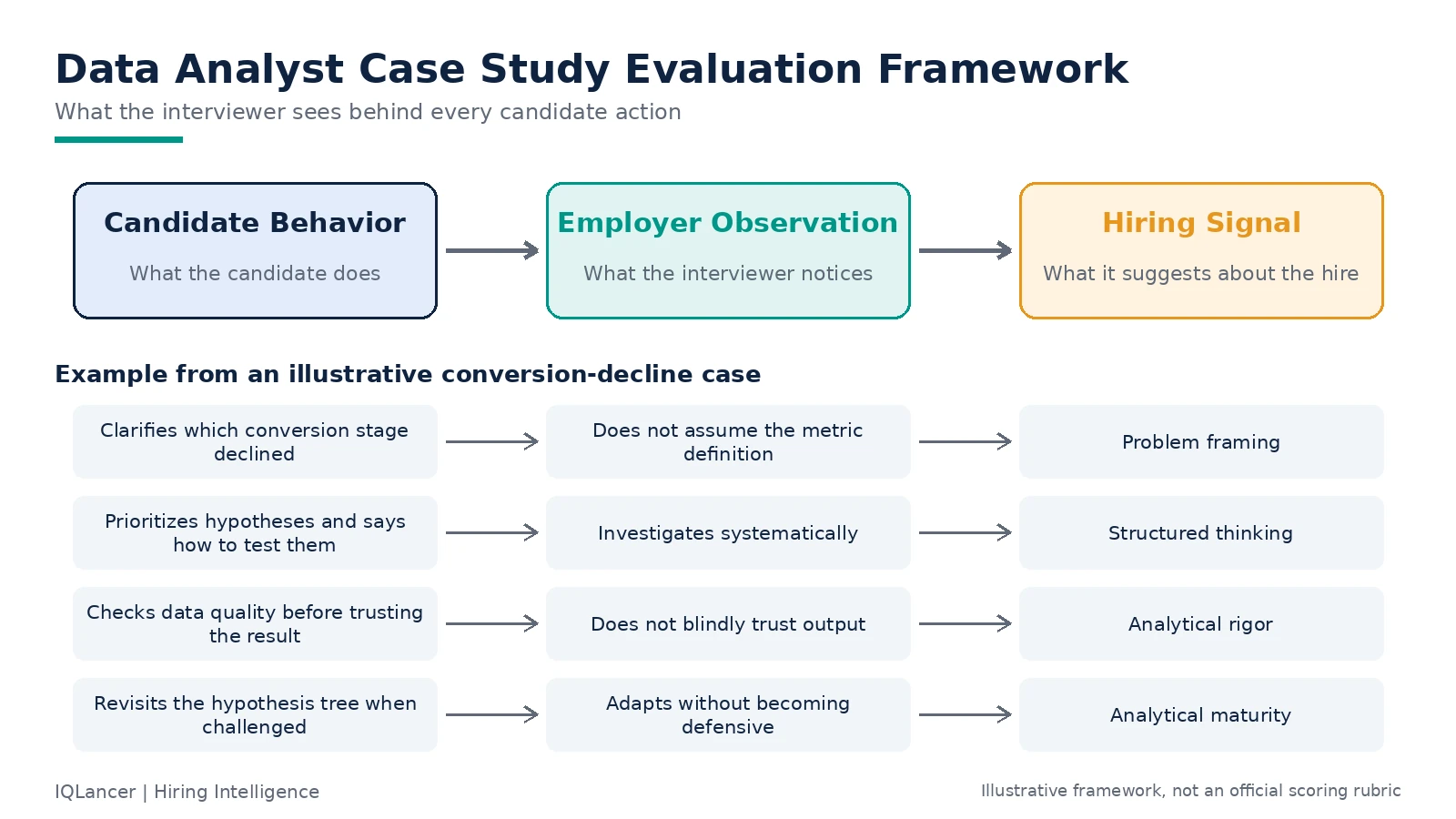
Treat this as a practical framework, not an official scoring rubric. Weighting varies by employer, role, seniority, case format and business function.
Published rubrics point in a similar direction: one platform lists seven dimensions that include logical reasoning, assumptions and communication that anticipates stakeholder questions, and Cornell’s career services lists adaptability when new information appears among case evaluation criteria.
How Employers Evaluate Problem During Data Analyst Case Study Interview ?
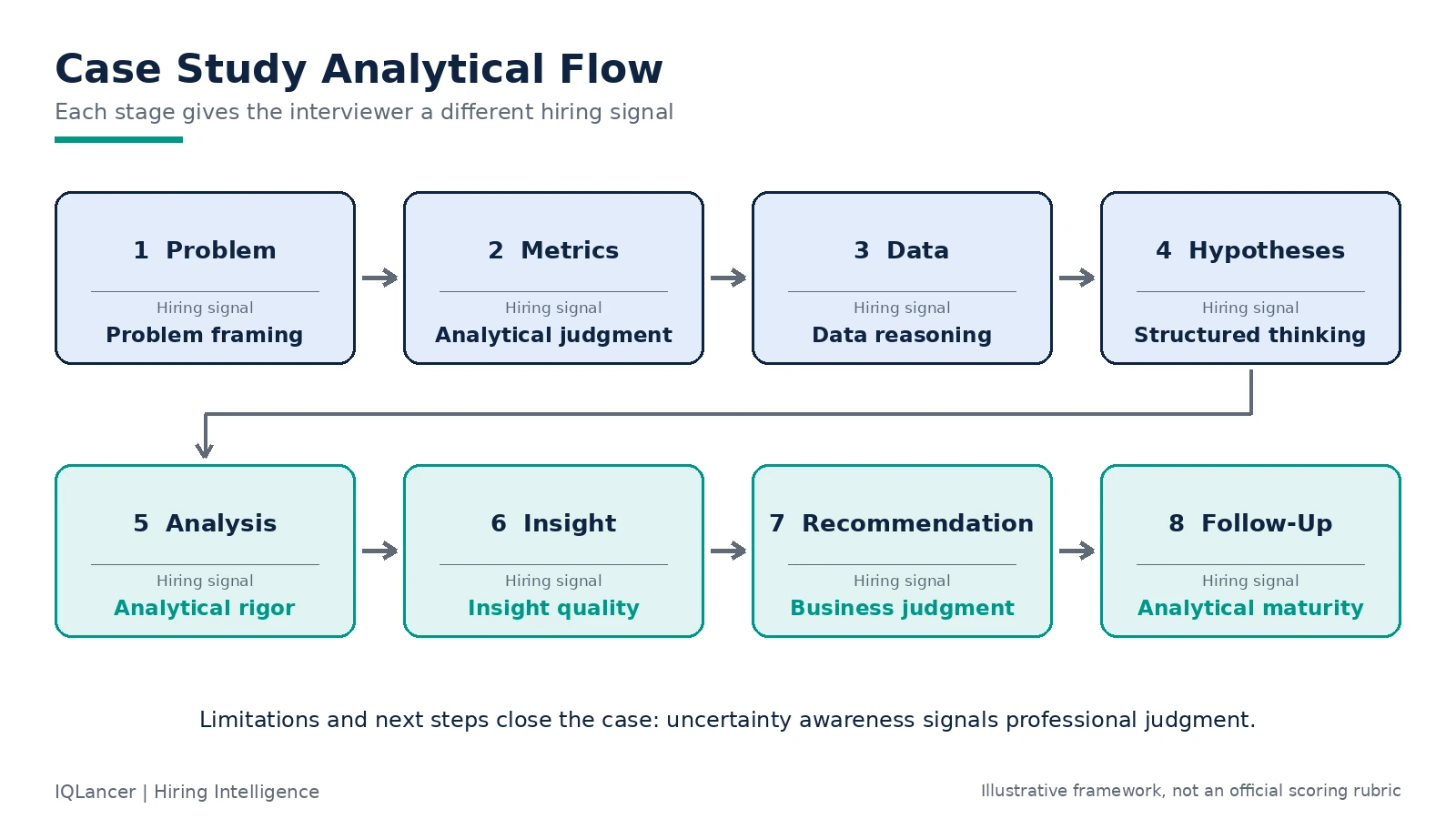
In a Data Analyst case study interview, employers watch how candidates define the problem, select evidence, test hypotheses and judge findings, because each stage reveals a different hiring signal.
Framing and Metric Selection
Starting SQL immediately can be a weak signal because it suggests the candidate assumes the problem is already well defined. Useful clarification covers what exactly changed, the business objective, what the metric means, the baseline, the period, the relevant segment and the decision the analysis must support.
Definitions matter more than they appear. A drop in friend requests could mean requests sent or requests accepted, and a decline can also be relative or absolute.
- Candidate behavior: asks clarifying questions.
- Employer observation: the candidate understands ambiguity.
- Hiring signal: structured problem framing.
Metric selection separates two questions: “What can I measure?” and “What should I measure to answer this business question?” Strong answers name a primary metric, supporting metrics, the denominator, the time period, relevant segments and, where appropriate, guardrail metrics that stop a fix from damaging something else. A former interviewer’s grading notes say strong candidates are specific about metric definitions, timeframes and success criteria.
Take “conversion declined.” Which conversion? From which stage to which? For whom, and over what period? The distinction changes the business response. A fall in visit-to-signup points toward acquisition or landing experience. A fall in cart-to-payment points toward checkout. Different owners, different fixes.
Data Selection and Hypothesis Formation
Employers may watch whether a candidate knows what evidence the question requires before asking for every dataset. For “Why did conversion decline?”, relevant data might include traffic, funnel stages, device, geography, acquisition channel, customer segment, product version, time and transaction status. The signal is whether the candidate connects the business question to the evidence required. Segmenting by platform, location and user type is a common way to locate a change.
Hypothesis formation shows the same discipline.
Weak: “Maybe traffic changed, maybe pricing changed, maybe the website broke, maybe customers changed.”
Stronger: “These are the most plausible explanations given the business context, and here is how I would distinguish between them.”
One guide notes that candidates who jump to product hypotheses before checking whether the data is valid lose marks on structure, and recommends grouping causes and ranking them. The interviewer may be evaluating prioritization, logical reasoning, testability, use of business context and willingness to revise assumptions.
Analytical Rigor and Evidence Quality
Technical correctness means the query runs and returns what it was asked for. Analytical rigor means the candidate knows whether it was asked the right thing. A correct query that counts sessions when the question concerns users is technically fine and analytically misleading.
Rigor shows up as validating data, understanding grain, checking anomalies, segmenting appropriately, choosing relevant comparisons, checking assumptions, verifying surprising findings, separating correlation from causation and stating limitations. A good first check is whether the change is real or a data quality issue, such as a changed metric definition.
Evidence Quality
- Weak: “The chart looks unusual.”
- Better: “The decline is concentrated in mobile users.”
- Stronger: “The decline is concentrated among new mobile users at the payment stage while other segments remain comparatively stable.”
Stronger evidence is specific, relevant, validated and connected to the business question. Even so, it does not automatically prove causation. Knowing that is where analytical maturity shows.
Insights and Business Judgment
The progression runs from data, to pattern, to insight, to business implication, to decision. Using a hypothetical example:
- Observation: “Mobile conversion fell.”
- Insight: “The decline is concentrated among new mobile users at the payment stage.”
- Implication: “The payment stage deserves investigation because the decline is not uniform across the funnel.”
- Recommendation: “Investigate the mobile payment experience and check whether a recent product or technical change affected this segment.”
This example does not prove a real cause. Observation is not insight, insight is not causal proof, and analysis is not a decision.
Business judgment asks what decision the analysis supports, who will use it, what trade-offs exist, what evidence is missing and what happens next. Guides repeatedly frame the task this way: interviewers want to see a finding translated into a business recommendation, not just reported as numbers, which is why one source calls the exercise a decision-making interview with data attached. A strong recommendation is proportionate to the evidence.
Communication, Follow-Up Questions and Adaptability
Communication here is more than presentation skill. Employers may observe whether a candidate prioritizes important findings, avoids needless technical detail, explains assumptions, defends conclusions and adapts when new information appears. Assumptions placed early help: interviewers report that assumptions buried until the end can look like improvisation.
What Happens When the Interviewer Challenges Your Assumption?
- Candidate: “Traffic quality caused the conversion decline.”
- Interviewer: “Traffic quality was unchanged.”
- Weak: the candidate swaps in a new explanation without reasoning.
- Strong: the candidate revisits the hypothesis tree, says which branches remain, and names the evidence to check next.
The interviewer can now observe adaptability, intellectual honesty, structured reasoning and confidence without rigidity. This matters because pushback is a normal part of case interviews, and interviewers use it to see how candidates respond to guidance and new information.
What Does a Case Study Reveal That a Technical Test Cannot?
A technical assessment shows whether someone can manipulate and query data. A Data Analyst case study interview can additionally reveal how the candidate decides what problem to solve, what to measure, what evidence to request, which hypotheses to test, what the evidence supports and what the business should do next. Technical tests are not less valuable. They measure a different layer, and many candidates over-index on SQL and underestimate the case study.
Strong vs Weak Case-Study Signals
| Dimension | Weak Signal | Strong Signal |
|---|---|---|
| Problem | Starts analyzing immediately | Clarifies objective |
| Metrics | Lists popular KPIs | Chooses decision-relevant metrics |
| Data | Requests everything | Prioritizes evidence |
| Hypotheses | Random possibilities | Testable, prioritized explanations |
| Analysis | Runs queries mechanically | Validates and interprets |
| Insight | Reports numbers | Explains business meaning |
| Recommendation | Generic action | Evidence-linked action |
| Uncertainty | Overclaims | States limitations |
| Communication | Explains everything | Prioritizes relevant findings |
| Follow-up | Becomes defensive | Reassesses reasoning |
Does Case-Study Evaluation Change With Seniority?
| Junior | Mid-Level | Senior |
|---|---|---|
| Structures the problem | Handles greater ambiguity | Frames complex business problems |
| Chooses sensible metrics | Prioritizes investigations | Connects analysis to strategy |
| Interprets findings | Makes evidence-based recommendations | Evaluates trade-offs |
| Communicates clearly | Handles stakeholders | Influences decisions |
| Validates assumptions | Defends reasoning | Anticipates risks and uncertainty |
Expectations vary by company and seniority, and the difference is not simply more tools. As seniority rises, employers may weigh ambiguity, business context, prioritization, trade-offs, stakeholder influence and decision impact more heavily. For the broader path, see [INTERNAL LINK OPPORTUNITY: Data Analyst Career Blueprint / How to Become a Data Analyst].
One Data Analyst Case Study: What the Employer Is Evaluating at Each Step
Illustrative scenario, not real company data: “Monthly conversion has declined. Investigate what happened and recommend what the business should do next.” Any findings below are hypothetical.
Step 1: Clarify
Candidate: confirms which conversion fell, between which stages, for which users, over what period, and against what target. Employer observes: the candidate does not assume the problem. Signal: problem framing.
Step 2: Define Metrics
Candidate: names visit-to-purchase rate as primary, stage-by-stage rates as supporting, and average order value as a guardrail. Employer observes: can distinguish useful metrics from available ones. Signal: analytical judgment.
Step 3: Request Data
Candidate: asks for funnel counts by device, channel and new vs returning users, plus release and campaign dates, not “all the data.” Employer observes: understands what evidence is necessary. Signal: data reasoning.
Step 4: Form Hypotheses
Candidate: groups explanations (tracking change, traffic mix, a product or technical change, pricing or promotion, seasonality) and ranks them, checking tracking first because it is cheap to rule out. Employer observes: investigates systematically. Signal: structured thinking.
Step 5: Analyze
Candidate: verifies definitions and grain, then segments. Hypothetically, the decline concentrates among new mobile users at payment. Employer observes: does not blindly trust output. Signal: analytical rigor.
Step 6: Interpret
Candidate: “This shows where the decline is, not why. It fits a payment problem, but also a shift in the mix of new mobile users.” Employer observes: separates observation from explanation. Signal: insight quality.
Step 7: Recommend
Candidate: proposes reviewing the mobile payment flow and release log before changing pricing or marketing. Employer observes: understands business implications and proportionality. Signal: business judgment.
Step 8: Handle Follow-Up
Interviewer: “No release touched that flow.” Candidate: reopens the hypothesis tree and proposes checking payment failure rates and acquisition mix instead. Employer observes: adaptability and intellectual honesty. Signal: analytical maturity.
Step 9: State Limitations
Candidate: notes the data is observational, small segments can be noisy, and confirming a cause needs further testing. Employer observes: understands uncertainty. Signal: professional judgment.
Why Strong Candidates Can Still Perform Poorly in Case Studies
- Jumping into analysis before defining the problem: the interviewer cannot tell whether the work answers the right question.
- Choosing metrics without reasoning: measurement judgment stays invisible.
- Generating hypotheses without prioritization: the investigation looks unfocused.
- Treating correlation as causation: it suggests overconfidence in thin evidence.
- Reporting observations instead of insights: the analysis stops before the useful part.
- Making recommendations stronger than the evidence: it undermines trust in the conclusions.
- Becoming defensive when challenged: it hides the adaptability the interviewer is looking for.
How Case-Study Performance Fits Into the Overall Hiring Decision
A case study is generally one source of evidence, not necessarily the whole decision. One hiring manager quoted by Exponent calls the take-home often the round that distinguishes the final candidate, but that is one perspective, not a rule.
Depending on the employer, other evidence may include work experience, technical assessments, communication, stakeholder experience, domain knowledge, behavioral interviews and project evidence. No universal weighting exists.
See What Recruiters Look for in IT Candidates for broader expectations. Case studies earn their place by producing observable evidence of analytical and business reasoning.
How Should Candidates Prepare for This Type of Assessment?
Useful preparation means practising ambiguous business problems, metric selection, clarifying questions, hypothesis formation, data interpretation, recommendation quality, explaining assumptions and defending conclusions.
Projects and case studies do different jobs. Projects demonstrate what you can build, as covered in Data Analyst Projects. Case studies show how you reason about a business problem under assessment.
FAQs
What does a Data Analyst case study interview test?
It tests how a candidate frames a business problem, chooses metrics, selects evidence, validates analysis and recommends action. Technical skill matters, but the format mainly reveals reasoning and judgment under ambiguity.
What do employers look for in a Data Analyst case study?
Employers may look for clear problem framing, decision-relevant metrics, prioritized hypotheses, validated findings, proportionate recommendations and honest limitations. Emphasis varies by employer, role and seniority.
Is a Data Analyst case study more about SQL or business thinking?
Both matter, but they are different layers. SQL shows data handling. The case adds metric judgment, interpretation and decision thinking. Some cases involve no code at all.
Do Data Analyst case studies always include a dataset?
No. Some provide data, while others give only a scenario and test whether the candidate can state what data they would need and why.
How are take-home Data Analyst case study interview evaluated?
Reviewers typically look at analytical depth, documentation, validation and synthesis, often followed by a panel presentation with questions. Criteria differ by company.
Can someone give the correct answer and still perform poorly?
Yes. Interviewers may care less about the final answer than whether the reasoning was structured and the conclusion matched the evidence. Rigorous thinking is often valued over a single right answer.
How important is communication in a Data Analyst case study Interview ?
Very important, because it is how reasoning becomes visible. Employers can observe prioritization, clarity about assumptions and how a candidate responds to follow-up questions.
Final Thoughts
A Data Analyst case study interview is not simply a test of whether a candidate can query data. It can reveal how they move from an ambiguous problem to a business objective, metrics, evidence, hypotheses, analysis, insight and a decision.
The strongest candidates show technical ability and also judgment: what matters, what the evidence supports, what remains uncertain and what the business should do next. From the employer’s perspective, that combination is the signal being sought.
When later interview rounds are selective, knowing what each answer signals matters. Once you understand what the interviewer is actually evaluating, you can stop guessing at the “right” answer and start showing the reasoning behind it.