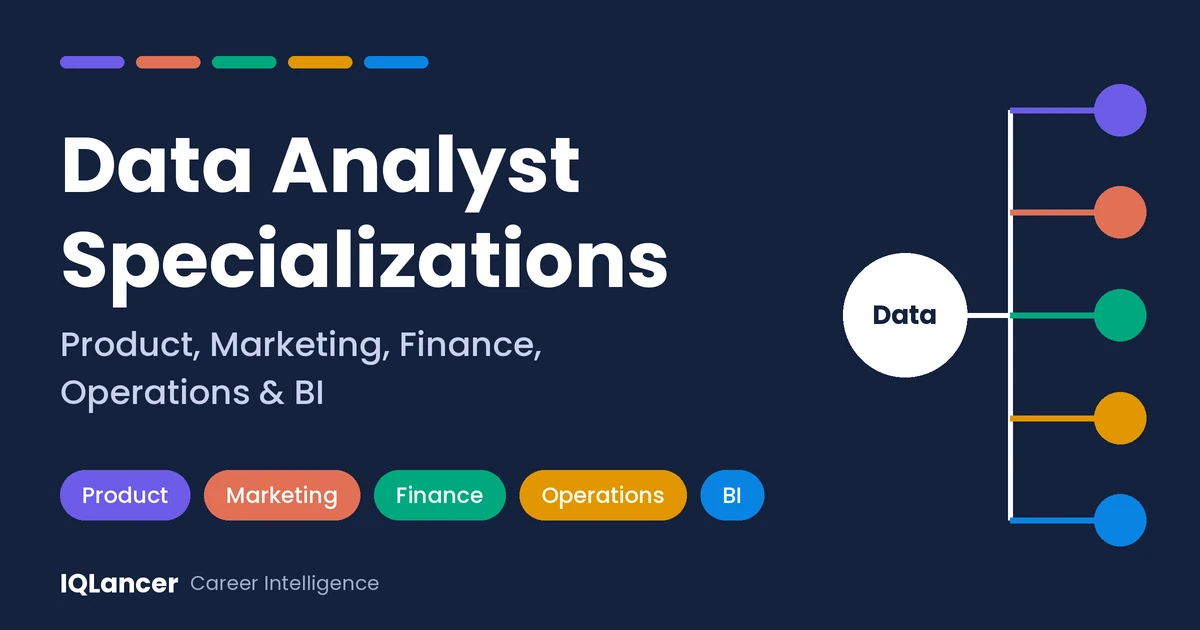
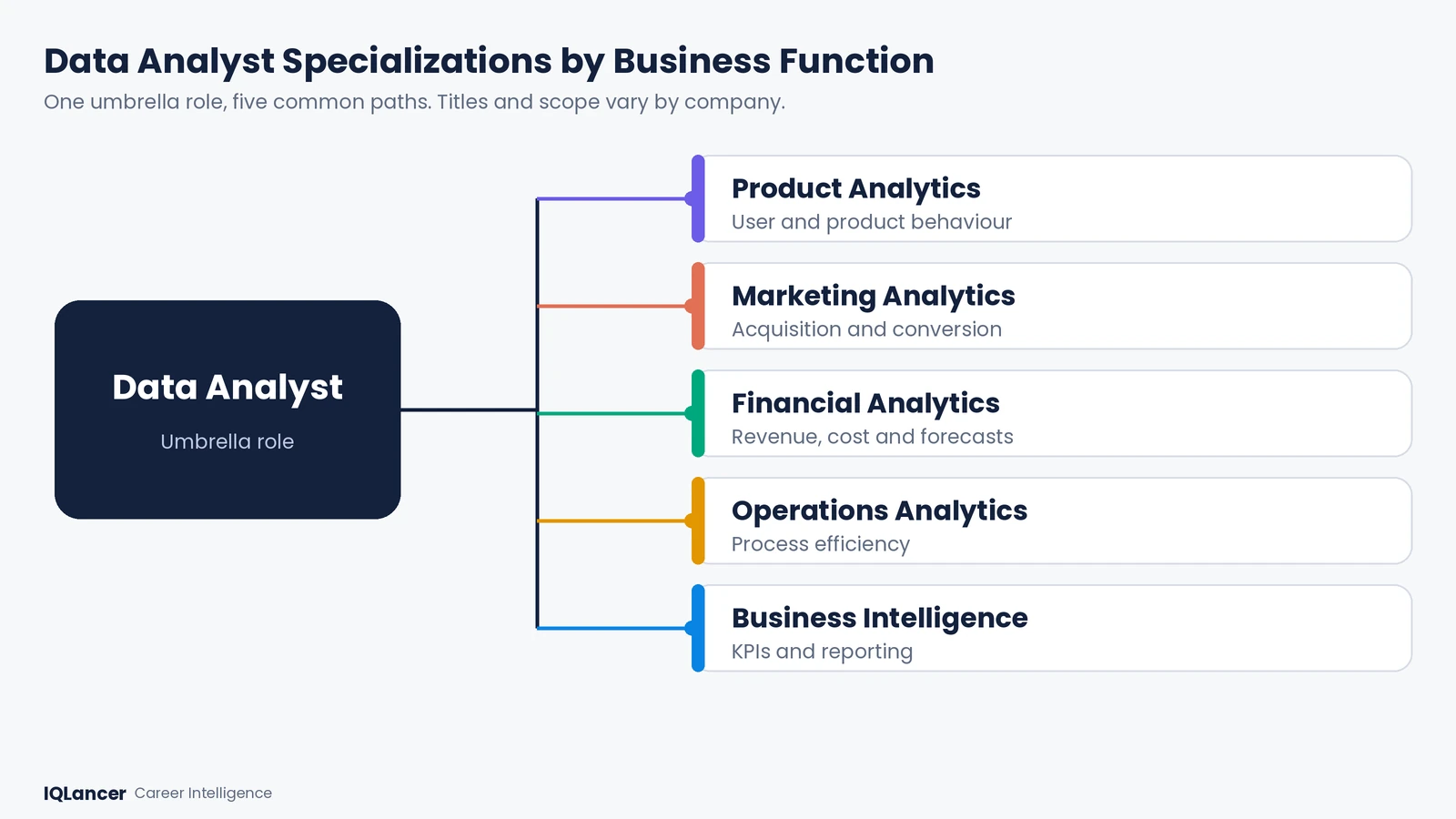
Data Analyst is an umbrella and the work under it changes with the business function.
- A Product Analyst may study how users move through an app.
- A Marketing Analyst may study which channels bring customers who convert.
- A finance-focused analyst may study why revenue missed its forecast.
- An Operations Analyst may study where a process slows down.
- A BI Analyst may maintain the KPIs and reports a company uses to track performance.
IQLancer guide hosted by Yale School of Management Career Development advises readers to focus on the job description rather than the title. We explains the main data analyst specializations, the business problem each one solves and how to recognize them in a real job description. If you are still building your foundation, start with how to become a Data Analyst.
What Are Data Analyst Specializations?
Specializations in data analytics are business-function focuses, such as product, marketing, finance, operations or BI, that shape the questions, data and decisions an analyst handles.
A general Data Analyst gathers, organizes and interprets data to support decisions. Randstad India describes the role as applicable across industries such as finance, healthcare and IT. The Data Analyst specialization narrows that work to one business function, so the analyst learns that function’s metrics, vocabulary and decision cycles.
Titles differ between organizations for structural reasons.
- The Yale-hosted guide notes that larger tech companies tend to define and separate roles, while startups and smaller teams use broader titles where responsibilities overlap.
- IBM lists Data Analyst and BI Analyst as separate roles, says their responsibilities overlap, and calls role ambiguity a common challenge for data teams.
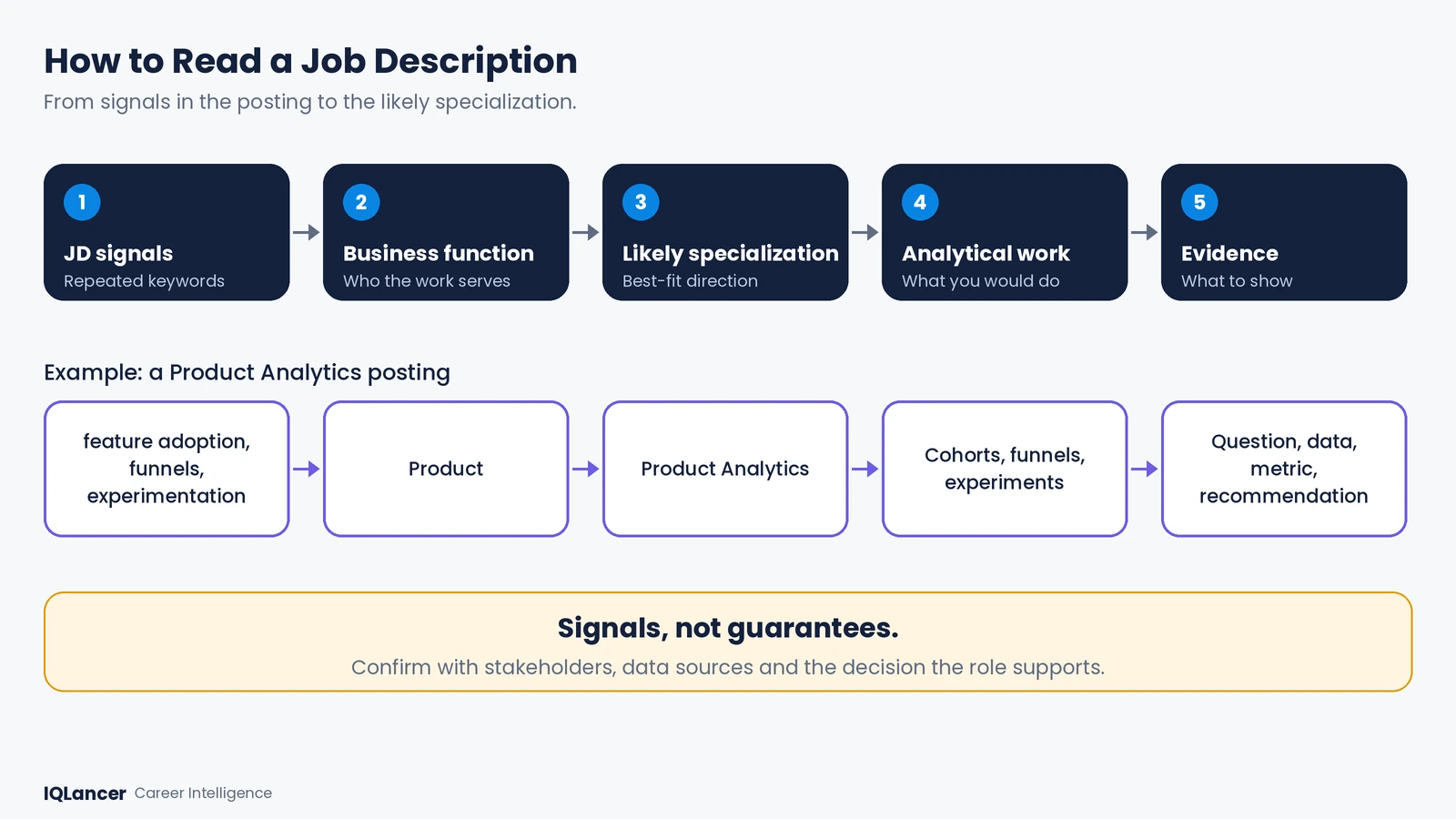
So every specialization below is a common pattern, not a fixed definition. One framework runs through the article:
Tools matter less than where an analyst sits in that chain.
How Data Analyst Specializations Differ
In this profession to become data analyst specializations, they differ mainly in the business question answered, the data used, the stakeholders served and the decision supported, not in core analytical method. The table shows common patterns, not universal boundaries.
| Specialization | Main Business Question | Typical Data | Stakeholders | Common Analytical Work |
|---|---|---|---|---|
| Product | How do users behave in the product? | Event and product data | Product, UX, Engineering | Funnels, retention, experiments |
| Marketing | What drives acquisition and conversion? | Campaign and customer data | Marketing, Growth | Attribution, segmentation, conversion |
| Finance | How is financial performance tracking? | Revenue, cost and budget data | Finance, Leadership | Forecasting, variance, profitability |
| Operations | Where is the process inefficient? | Workflow and operational data | Operations, Supply Chain | Bottlenecks, efficiency, capacity |
| BI | What is happening across the business? | Cross-functional data | Leadership, Departments | KPIs, dashboards, reporting |
- A product question is answered with event data and ends in a product decision.
- A finance question is answered with budget and revenue data and ends in a planning decision.
- SQL appears in every row, but it is pointed at a different problem. In smaller teams, one person may cover several rows.
Product Analyst / Product Analytics
A Product Analyst studies how people use a digital product, using funnels, retention and feature adoption to help teams decide what to build or fix.
What Does a Product Analyst Do?
The work centres on how users move through a product onboarding funnels, retention cohorts, feature adoption and experiments. One published Product Analyst posting lists A/B tests, onboarding funnels, retention cohorts and consistent metric definitions among its duties, and asks for SQL, event-based data experience and a BI tool. It is one example, and scope varies by employer.
What Questions Does Product Analytics Answer?
Why do users drop off during onboarding? Which early actions separate retained users from churned ones? Did a redesigned checkout improve conversion, or did seasonality explain the change?
Who Does a Product Analyst Work With?
Mainly product managers, engineers, designers and growth teams. The DataTalks.Club role guide adds that teams need a defined event set before they can trust funnels or activation metrics, so reviewing tracking plans can be part of the job even when engineers build the events.
What Data Does a Product Analyst Use?
Event and telemetry data from the product, user and account records, and experiment assignments. Typical metrics include activation, retention, engagement and conversion.
What Evidence Shows Product Analytics Ability?
A clear chain a business question, the event data behind it, a defined metric, an analysis and a recommendation a product team could act on.
An onboarding drop-off, for example, becomes a step-level funnel and a proposal to change one screen. The general logic of Data Analyst project evidence applies, but the product domain is what makes it product-specific.
Marketing Analyst / Marketing Analytics
A Marketing Analyst measures how campaigns and channels attract, convert and retain customers, using attribution, segmentation and cost metrics to guide where marketing money goes.
Marketing analytics covers campaign performance, acquisition, conversion, segmentation and attribution. Cost metrics such as CAC (customer acquisition cost) and ROAS (return on ad spend) are common, and retention matters where the team owns the customer lifecycle. A sample job description from a recruiting firm lists campaign ROI, CAC and conversion tracking, segmentation, A/B test evaluation and dashboards. A published marketing posting asks for multi-touch attribution support and insights on channel mix and budget allocation.
Questions Marketing Analysts Answer
Which channel brings customers who convert at a lower cost? Which customer segment responds to an email campaign? How should next quarter’s budget be split across channels?
Stakeholders
Marketing managers, growth teams, sales, CRM or lifecycle teams and, in some organizations, product.
Data Context
Campaign and ad-platform data, web analytics, CRM and customer records, and conversion and channel data. The recruiter sample above describes collecting data from digital, CRM and sales platforms.
Evidence
A campaign question, the relevant data, a segmentation or attribution analysis and a recommendation, such as shifting budget toward the channel with the lower cost per converted customer.
Financial Analyst / Financial Analytics
Financial analytics uses data to explain and forecast revenue, cost and profitability, but not every Financial Analyst role is a Data Analyst role.
Among data analyst specializations, finance is one where title and work can diverge widely. Financial analytics covers revenue, costs, margins, budgets, forecasts, variance and financial KPIs. An FP&A (financial planning and analysis) posting on Built In LA describes monthly budgeting, variance analysis, a rolling business model and dashboards for finance leadership.
Questions Financial Analytics Can Answer
Why did actual revenue differ from forecast? Which product line has the weakest margin? How would a headcount change affect next quarter’s costs?
Stakeholders
Finance and FP&A teams, senior leadership such as the CFO, and commercial or operations teams affected by budgets and forecasts. The Built In LA posting mentions supporting corporate finance leadership and partnering with strategy, product and operations.
Financial Analyst vs Financial Analytics
Indeed’s list of analyst types treats Financial analyst and Data analyst as separate entries. It describes financial analysts as people who study financial history to produce projections, explore investment opportunities and work closely with accounting teams. FP&A postings, such as one from NAFFCO, can also include financial modelling, month-end close support and compliance with accounting standards.
None of that is automatically Data Analyst work. A role leans toward financial analytics when the emphasis is on querying and analysing financial or operational datasets, building dashboards and explaining performance drivers. Read the responsibilities, not the title.
Operations Analyst / Operations Analytics
An Operations Analyst uses process and workflow data to find delays, inefficiencies and capacity gaps, then recommends changes that improve speed, cost or reliability.
Operations analytics covers process performance, bottlenecks, capacity, logistics, supply chain, SLA and turnaround metrics, and resource utilization. One Built In posting lists identifying process bottlenecks, analysing process performance and KPI data, proposing improvements and documenting procedures. Another posting with the same title, from Built In, centres on batch-processing support and SLA compliance for an IT platform. The title stretches widely.
Questions Operations Analysts Answer
Where is the process creating delays? Are we staffed for next month’s volume? Why did turnaround time rise after a system change?
Stakeholders
Operations managers, supply chain and logistics teams, process owners and senior management. A posting from an EV-charging company describes running operations reviews with senior management around KPIs and SLA breaches.
Evidence
A process problem, the operational data that describes it, a bottleneck or efficiency analysis and a recommendation, such as rebalancing staffing at the step where work queues up.
Business Intelligence (BI) Analyst
A BI Analyst turns cross-functional data into dashboards, KPIs and recurring reports so leaders can monitor business performance and decide from consistent metrics.
What Does a BI Analyst Do?
Simplilearn’s role guide lists dashboard and report development, KPI and metric design, data modelling and stakeholder communication as core areas. IBM says BI analysts draw on databases and data warehouses, prepare market and financial reports, and build interactive dashboards. Dashboards are the visible output. Behind them sit metric definitions, data models and interpretation, so BI is not only dashboard building.
What Questions Does BI Answer?
What is happening across revenue, churn and operational KPIs this month? Do sales and finance report the same number for the same metric? Which region is off target?
Who Uses BI Analysis?
Leadership, department heads and functional teams such as sales, finance and operations.
BI Analyst vs Data Analyst
The overlap is real. IBM says BI analyst responsibilities overlap with data analysts but focus more on business impact. A university career page from Binus says BI analysts usually own dashboard and reporting infrastructure end to end, rather than one-off analyses. Randstad India lists business intelligence analyst as a type of data analyst. Treat these as tendencies. Some Data Analyst postings ask for dashboards and KPIs, and some BI postings ask for deep investigation.
Data Analyst Specialization vs These Specializations: What Actually Changes?
A Data Analyst specialization changes five things the business question, stakeholder, data context, metrics and decision supported, while core analytical skills stay largely the same.
Here is how those five dimensions differ across the main specializations:
| Specialization | Business question | Stakeholder | Data context | Metrics | Decision supported |
|---|---|---|---|---|---|
| Product | Why are users dropping during onboarding? | Product, UX, Engineering | Event and product usage data | Activation, retention, feature adoption | What to build, fix or prioritize |
| Marketing | Which acquisition channel produces stronger conversion? | Marketing, Growth | Campaign, web and customer data | CAC, conversion rate, ROAS | Where to spend budget and whom to target |
| Finance | Why did actual revenue differ from forecast? | Finance, FP&A, Leadership | Revenue, cost and budget data | Variance, margin, forecast accuracy | How to plan budgets and allocate resources |
| Operations | Where is the process creating delays? | Operations, Supply Chain | Workflow and operational data | Turnaround time, capacity utilization | Which process or staffing level to change |
| BI | What is happening across business KPIs? | Leadership, Department heads | Cross-functional data | Company KPI set, metric consistency | How leaders monitor performance and intervene |
Take one shared skill, SQL. A Product Analyst uses it to find where users leave onboarding. A finance-focused analyst uses it to compare actual revenue with forecast. The skill is the same, but the problem, the audience and the decision are different.
Across data analyst specializations, the tools overlap while the questions do not. That is why the business question is the fastest way to tell one specialization from another.
These are common patterns, not fixed definitions. The Yale-hosted guide notes that responsibilities vary by company, team and title, so confirm the specialization from the listed responsibilities rather than the title alone.
How to Choose a Data Analyst Specialization
Choose a Data Analyst specialization by the business problem you enjoy solving, such as user behaviour, campaigns, finances, processes or KPIs, not by title popularity.
This is a decision framework for data analyst specializations, not a ranking or a universal career recommendation. Match what you enjoy to the work each path involves:
| If you enjoy… | Consider | A question you would work on |
|---|---|---|
| User behaviour and product decisions | Product Analytics | Why are users dropping during onboarding? |
| Customers, campaigns and growth | Marketing Analytics | Which acquisition channel converts better? |
| Financial performance and business numbers | Financial Analytics | Why did actual revenue differ from forecast? |
| Processes and efficiency | Operations Analytics | Where is the process creating delays? |
| KPIs, dashboards and cross-functional reporting | BI | What is happening across business KPIs? |
No option here is best or easiest. Demand, pay and entry requirements vary by company, industry and location. Three checks make the choice more reliable:
- Read several postings for each path. Titles vary between companies, so the Yale-hosted guide advises focusing on the job description rather than the title.
- Look at your existing background. Experience in finance, marketing or IT operations may already give you domain context for a matching path.
- Compare postings in your own target segment. In India, titles and scope differ across IT services companies, product companies, startups, BFSI and SaaS.
How to Identify a Data Analyst Specialization From a Job Description
Look for repeated business-function signals in the responsibilities, such as funnels, attribution, variance, SLAs or KPIs, then confirm them against the stakeholders and data named.
| Signals in the job description | Likely direction | Work usually behind it |
|---|---|---|
| Feature adoption, retention, funnels, experimentation | Product Analytics | Cohorts, funnel diagnosis, experiment analysis |
| Campaign performance, attribution, acquisition, conversion | Marketing Analytics | Channel comparison, segmentation, budget guidance |
| Forecasting, variance, revenue, budget | Finance-focused analytics | Actual-versus-plan analysis, driver explanation |
| Process efficiency, capacity, logistics, SLA | Operations Analytics | Bottleneck and workload analysis |
| KPI, dashboard, reporting, business performance | BI | Metric definitions, dashboards, recurring reporting |
These are signals, not guarantees. The Yale-hosted guide tells readers to focus on the job description because it shows what the company expects. Evaluate the whole description with three checks:
- Who does the role work with?
- Which data sources does it name?
- What decision does the output support?
A posting titled Data Analyst that stresses KPI definitions, dashboards and training users on reports points toward BI. One that stresses experiments and event data points toward product. A posting titled Operations Analyst may turn out to be IT service operations, as the Built In example above shows. A finance posting full of modelling and month-end close may not be data analysis at all.
Once you have a direction, ATS resume requirements for Data Analysts covers how postings feed screening.
Can You Move Between Data Analyst Specializations?
Often, yes. A move usually combines a shared analytical foundation, new domain knowledge and evidence of solving that function’s problems, though no transition is guaranteed.
The pattern is a core analytical foundation, plus domain knowledge, plus relevant business context, plus evidence of solving that type of problem. The Yale-hosted guide notes that industry familiarity helps analysts ramp up faster and recommend better solutions.
Some plausible paths for data analyst specializations, none of them automatic:
- Data Analyst → Product Analyst: needs event data, product metrics and experiment analysis.
- Marketing Analyst → Product or Growth analytics: funnel and conversion thinking carries over, and product behaviour data is the new part.
- Operations Analyst → BI Analyst: KPI tracking carries over, and dashboarding and data modelling may be the gap.
- BI Analyst → broader Data Analytics: the shift is from recurring reporting toward open-ended questions.
- Financial analytics → Data or Business analytics: financial domain knowledge is the asset, and broader data querying may be the gap.
Whether a move is easy depends on the employer, the seniority and the evidence you can show.
What Skills Transfer Across Data Analyst Specializations?
Core analytical skills such as querying, interpretation, visualization, statistics and communication transfer across specializations, while domain knowledge, meaning each function’s metrics, vocabulary and decisions, changes.
SQL or another way of querying data, basic statistics and the habit of turning a vague question into a measurable one apply everywhere. So does clear communication with non-technical stakeholders. Data quality matters in every function, and IBM reports that CDOs cite accuracy, integrity, completeness and consistency among the top barriers to using enterprise data.
Depth varies by path. Product roles often lean on experimentation statistics, finance roles on spreadsheet modelling and BI roles on data modelling in BI tools. None of these tools is mandatory everywhere to become data analyst specializations. The Yale-hosted guide says Python or R is worth prioritizing mainly when the posting lists it.
Data Analyst Specializations at a Glance
The five data analyst specializations differ by focus, typical questions, stakeholders and domain context, as summarized below, though individual employers may draw these lines differently.
| Specialization | Main Focus | Typical Questions | Main Stakeholders | Domain Context |
|---|---|---|---|---|
| Product | User and product behaviour | Adoption, retention, funnels | Product, Engineering | Product |
| Marketing | Acquisition and growth | Conversion, attribution | Marketing, Growth | Marketing |
| Finance | Financial performance | Revenue, cost, forecast | Finance, Leadership | Finance |
| Operations | Process efficiency | Bottlenecks, capacity | Operations | Operations |
| BI | Business visibility | KPIs, reporting | Leadership, Functions | Business |
Frequently Asked Questions
What are the main types of Data Analyst roles?
The main data analyst specializations are Product, Marketing, Financial, Operations and BI analytics, each focused on a different business function.
What is the difference between a Data Analyst and a Product Analyst?
A Product Analyst is often a Data Analyst focused on user behaviour, funnels and experiments, and the roles overlap.
Is a Marketing Analyst a Data Analyst?
Sometimes. It shares core data analyst work, applied to campaigns and customers, and Randstad India lists it as a type.
What is the difference between a BI Analyst and a Data Analyst?
They overlap. BI Analysts focus more on KPIs, dashboards and business performance, and IBM notes the overlap.
Is a Financial Analyst a Data Analyst?
Not automatically. Indeed lists both as separate roles, while FP&A roles often emphasize budgeting, forecasting and modelling.
Can a Data Analyst move into Product Analytics?
Often, though not automatically. The usual gap is domain knowledge: event data, product metrics and experiment analysis.
Which Data Analyst specialization fits a finance background?
Financial analytics is usually the closest fit among data analyst specializations, since it builds on your existing finance knowledge.
Do all Data Analyst roles require Python?
No, not all data analyst specializations require Python; the Yale-hosted guide says it matters mainly when the posting lists it.
Final Thoughts
There is no single version of the Data Analyst career. In every one of the data analyst specializations covered here, the business function sets the problem, and the problem shapes the data, metrics, stakeholders, analytical work and decisions. Product Analytics, Marketing Analytics, Financial Analytics, Operations Analytics and BI all sit under one umbrella, but the data analyst career paths they lead to differ more in context than in core skills.
Titles overlap and companies define them differently, so a title alone tells you little. Don’t choose an analyst role based only on the title. Read the job description and identify the business problem the role is expected to solve.
To go further, explore IQLancer’s Career Intelligence guides on Data Analyst projects and what recruiters look for in IT candidates.
Stay ahead of the IT job market. IQLancer publishes Career Intelligence on IT career paths, hiring expectations, ATS requirements and career transitions. Follow IQLancer to get new guides as they are published.