Most Cloud Engineer resumes list technologies. Fewer of them show what the candidate actually did with those technologies, and that gap is usually what separates a resume that reads clearly from one that reads like a skills inventory. An ATS resume for cloud engineer roles has to do two jobs at once present information in a format that parses cleanly, and connect each cloud platform or service to a real responsibility a recruiter can evaluate. IQLancer walks through that second, harder part: how to translate cloud experience into resume language that is both machine-readable and recruiter-credible, using a practical framework rather than invented scoring rules.
What Does an ATS Resume for a Cloud Engineer Need to Show?
A Cloud Engineer resume needs to connect the platform used to the specific service, the responsibility performed, and the environment it supported, because listing a platform name alone tells a reader almost nothing verifiable.
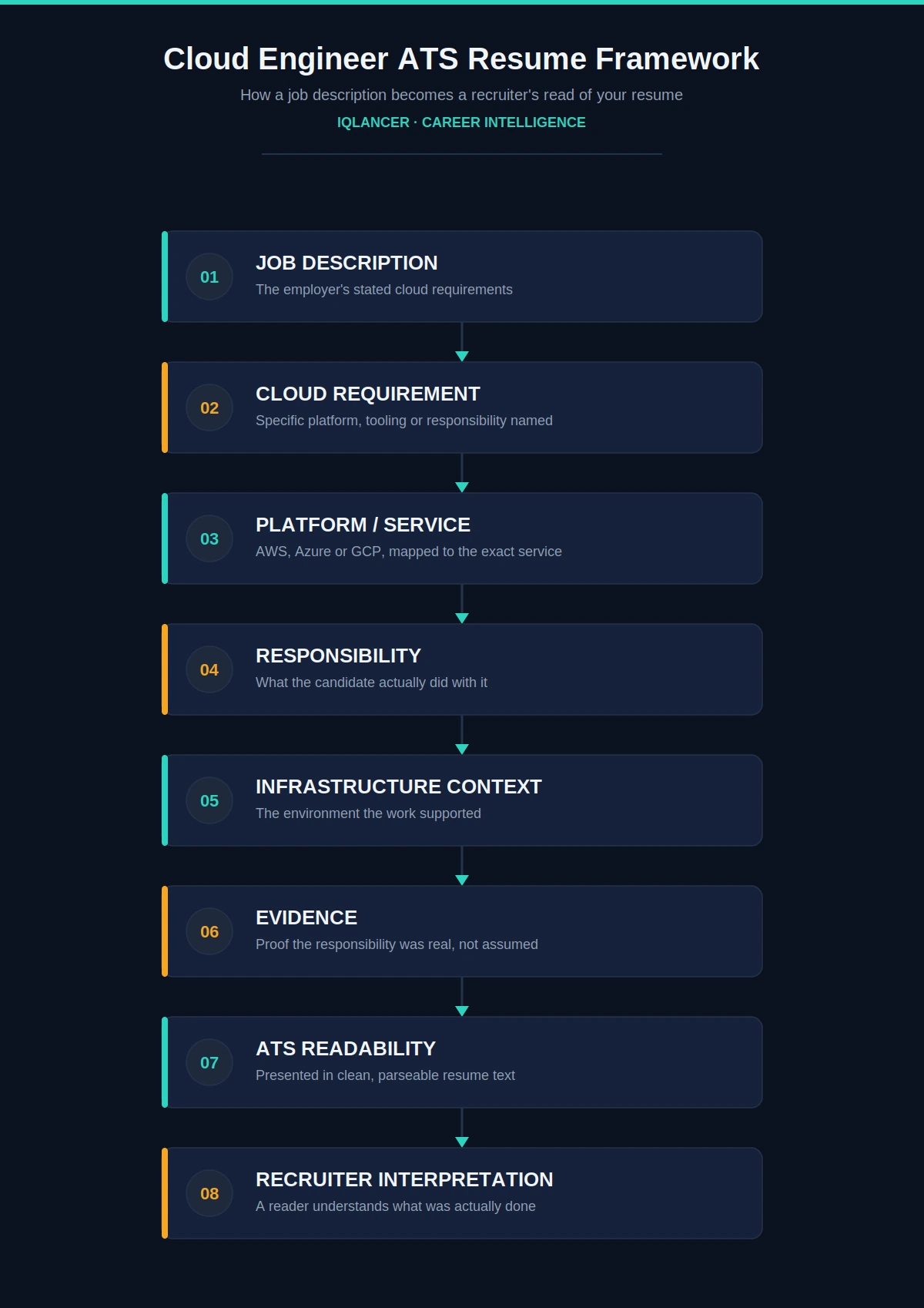
There is a useful chain to keep in mind when building an ATS resume for cloud engineer positions:
Technology (AWS) → Service (EC2, VPC) → Context (production compute or networking infrastructure) → Responsibility (provisioning, configuration, scaling, troubleshooting) → Evidence (what the candidate specifically did).
A line that reads “AWS, Azure, Terraform, Kubernetes, Docker” gives a reader technology exposure with no context attached. It does not say whether the candidate provisioned infrastructure, maintained it, or simply used services someone else configured. Compare that to a line that reads “Provisioned and maintained AWS EC2 and VPC infrastructure supporting a production application environment.”
The second version still contains the keywords a search or parser would look for, but it also tells a recruiter what role the candidate played. This is the core distinction an ATS resume for cloud engineer roles needs to make consistently: technology mentioned is not the same as responsibility demonstrated.
How to Translate a Cloud Engineer Job Description Into Resume Requirements
Every Cloud Engineer job description can be broken into a short list of resume-relevant requirements once generic language is stripped away, and mapping it deliberately avoids missing what actually matters to that employer.
Recent postings for Cloud Engineer and adjacent platform roles consistently name a similar core set of areas even when the seniority or industry differs. A senior cloud engineering role at Morgan Stanley calls for strong hands-on experience across AWS and Azure, with practical GCP exposure, expert-level Terraform, strong Kubernetes operations across EKS, AKS or GKE, and strong security fundamentals including IAM, RBAC, encryption and secrets management (Morgan Stanley Senior Cloud Engineer posting).
A Cloud Engineer role at BlackRock asks candidates to demonstrate experience with cloud networking resources such as VPCs, VNets and security groups, alongside Terraform, CI/CD tooling and container orchestration with Docker and Kubernetes (BlackRock Cloud Engineer posting). Patterns like these are common, not universal, so a resume should still be built around the specific job description in front of the candidate rather than this general shape.
A simple extraction method works for most postings:
| Job Description Requirement | Resume Interpretation | Evidence to Show |
|---|---|---|
| AWS/Azure/GCP infrastructure | Relevant platform and services actually used | What infrastructure was provisioned or managed |
| Cloud networking | VPC/VNet, subnets, routing, DNS, connectivity | Actual networking responsibility, not just familiarity |
| Infrastructure as Code | Terraform, Bicep, CloudFormation | What was provisioned or automated with it |
| IAM/security | Access controls, RBAC, security configuration | What the candidate configured or maintained |
| Monitoring | CloudWatch, Azure Monitor, or similar tooling | What was monitored or investigated |
| Migration | Cloud migration or modernization work | Candidate’s actual contribution to the migration |
The candidate should prioritize the requirements that match both the target role and their own real experience. A requirement that appears in the posting but was never part of the candidate’s actual work should not be added just because it is present in the job description.
How Cloud Engineer Responsibilities Should Appear on a Resume
A responsibility only becomes useful on a resume once it is written as something the candidate did, in a specific environment, rather than as a general duty attached to the job title.
Compare these two representations of the same underlying work:
- Weak: Responsible for AWS infrastructure.
- Better: Managed AWS infrastructure supporting application workloads, including compute provisioning, VPC networking, IAM access controls, and CloudWatch monitoring.
The second version communicates more because it names the services involved and the type of infrastructure supported, which gives a recruiter something concrete to evaluate against the target role. This pattern holds across responsibility categories relevant to an ATS resume for cloud engineer roles:
- Provisioning: naming the compute or storage service and what environment it supported, not just “provisioned infrastructure.”
- Networking: specifying VPC/VNet, subnet design, or connectivity work rather than “worked with networking.”
- Security and access: naming IAM, RBAC, or specific access control work rather than “handled security.”
- Automation: naming the IaC tool and what it provisioned, not just listing “Terraform” as a skill.
- Monitoring and troubleshooting: naming the tool and what kind of issue was investigated.
- Migration: describing what part of the migration the candidate contributed to.
- Cost and governance: describing actual tagging, budgeting, or resource cleanup work, not a general cost-consciousness statement.
None of these need invented numbers. A responsibility described accurately, without a metric attached, is still more useful than a vague duty statement with no metric and no specificity either.
Cloud Engineer Resume Keywords: What Should You Actually Include?
Cloud engineer resume keywords should come from two sources at once: the target job description and the candidate’s actual hands-on experience, because a keyword with neither behind it adds noise rather than signal.
A practical way to organize Cloud engineer resume keywords :
- Platform keywords: AWS, Azure, Google Cloud, used only for platforms the candidate has real experience with.
- Infrastructure and service keywords: the specific compute, storage, database, networking, and identity services actually used, rather than the platform name alone.
- Infrastructure automation: Terraform, CloudFormation, Bicep, Ansible, or similar tools, listed only where genuinely used.
- Cloud-native technologies: Kubernetes, Docker, containers, or serverless services, where relevant to the role.
- Operations: monitoring, logging, incident response, troubleshooting, and reliability work.
- Security and governance: IAM/RBAC, secrets management, security controls, and compliance-related implementation.
- Automation and scripting: Python, PowerShell, Bash, or similar languages used for infrastructure automation.
A resume does not need every technology in every category. Adding tools the candidate has not actually used, purely because they appear frequently in postings, is keyword stuffing rather than optimization, and it tends to surface as a gap in a technical screen even if it survives initial parsing. There is also no reliable basis for ranking AWS, Azure, and GCP against each other on a resume; the right platform to emphasize is the one the target role and the candidate’s real experience both point to.
Why Cloud Platform and Service Depth Matter More Than Platform Names Alone
A platform name on its own signals exposure, while naming the specific services and what was done with them signals depth, and recruiters reviewing an ATS resume for cloud engineer roles are usually trying to tell those two apart.
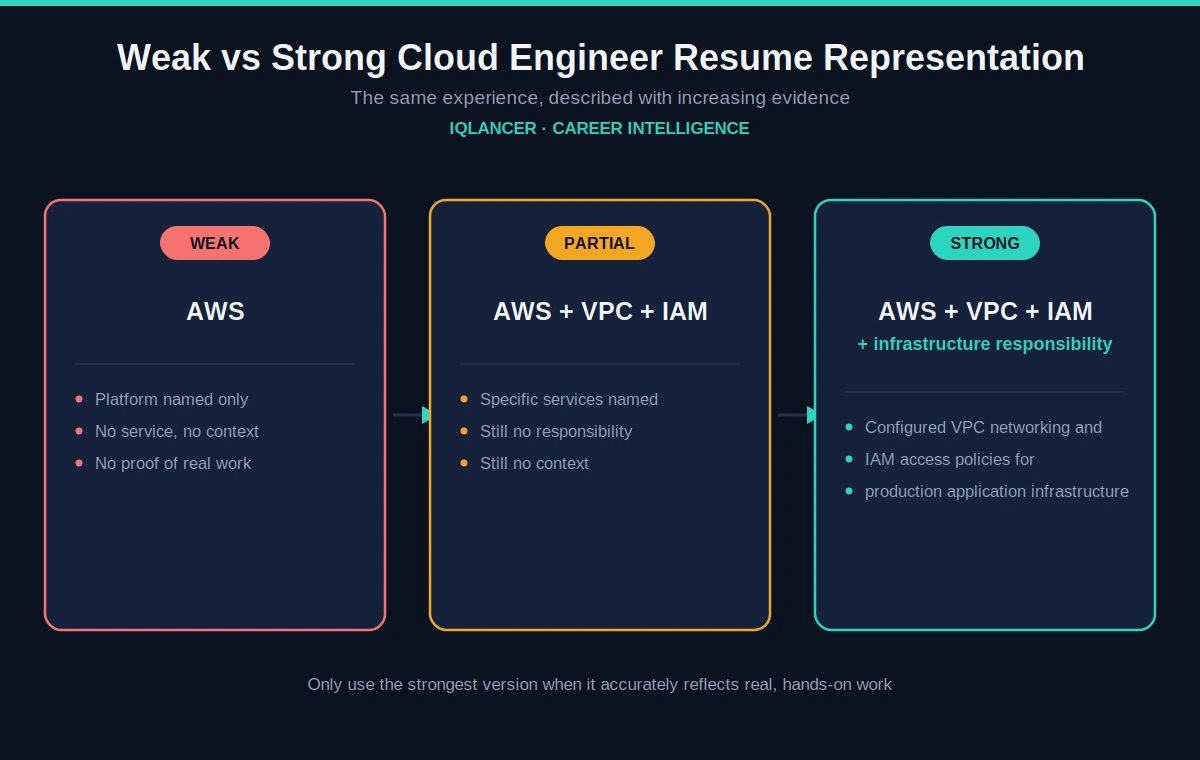
“AWS” alone could mean anything from a single training exercise to years of production infrastructure ownership. A line such as “AWS: EC2, VPC, IAM, CloudWatch, used for provisioning, networking, access management and monitoring of production workloads” gives a reader a meaningfully different picture, provided it accurately reflects what the candidate did. There is a real difference between:
- Platform exposure: used the platform in a course, lab, or limited capacity.
- Service familiarity: understands what a service does and has configured it in a non-production setting.
- Hands-on implementation: has personally built or configured the service for a real environment.
- Operational responsibility: maintains, troubleshoots, or scales the service as part of ongoing work.
- Ownership: designs, architects, or is accountable for how the service is used across a system.
An ATS cannot independently verify which of these levels is true. That verification happens later, in screening calls and technical interviews, which is exactly why the resume language should match the actual level of experience rather than the strongest-sounding phrase available.
How to Represent Cloud Networking, Security and Infrastructure Context
Networking and identity work read as stronger evidence on a Cloud Engineer resume when they are tied to a specific responsibility rather than listed as familiarity with a concept.
Networking language that adds context:
- VPC/VNet design and subnet structure
- routing and DNS configuration
- load balancing setup
- VPN or private connectivity work
- security groups or NSGs
Identity and security language that adds context:
- IAM policy or RBAC configuration
- least-privilege access implementation
- secrets management
- security control configuration tied to a specific requirement
Bad: Knowledge of VPC and IAM.
Better: Configured VPC networking and IAM access policies for application infrastructure, including subnet design and least-privilege access boundaries.
The second version only belongs on a resume if it reflects work the candidate actually did. Overstating networking or security ownership is one of the more common gaps that surfaces in a technical interview, since these areas tend to get probed directly.
How to Show Cloud Operations, Migration, Reliability and Cost Responsibilities
Operational experience strengthens an ATS resume for cloud engineer roles when it is described as a specific contribution rather than a general claim of involvement.
This section is not a guide to how migration, reliability engineering, or FinOps work; it is about representing genuine experience in these areas clearly.
Weak: Worked on cloud migration.
Stronger: Supported migration of application workloads to AWS, including infrastructure configuration, connectivity validation, and post-migration monitoring.
The same pattern applies to production support, incident troubleshooting, availability work, backup and disaster recovery involvement, and cost or governance tasks such as tagging and resource cleanup. Each becomes more useful once it names what the candidate specifically contributed, within an environment the reader can picture. Claims here should only be included if true; a resume that implies ownership of reliability or cost decisions the candidate did not actually hold tends to create friction rather than credibility once the interview goes into detail.
How to Write Cloud Engineer Resume Bullets for ATS and Recruiter Review
A Cloud Engineer resume bullet reads clearly to both an ATS and a recruiter when it follows a consistent structure: action, cloud technology or service, responsibility, context, and evidence or outcome.
Examples across common responsibility areas:
- Provisioned and maintained AWS EC2 and S3 infrastructure supporting a production web application.
- Configured VPC networking, including subnet design and security groups, for a multi-tier application environment.
- Implemented IAM policies and role-based access controls for infrastructure supporting three internal engineering teams.
- Built and maintained Terraform modules to provision compute, storage, and networking resources across development and staging environments.
- Configured CloudWatch dashboards and alerts to monitor application and infrastructure health.
- Supported migration of legacy application workloads to Azure, including connectivity validation and post-migration monitoring.
- Investigated and resolved infrastructure-related incidents affecting application availability, documenting root cause and remediation steps.
Where a measurable result genuinely exists (a reduction in provisioning time, a specific number of resources managed, an incident resolution timeframe), it strengthens the bullet. Not every bullet needs a number, and a bullet with an invented metric is worse than one without any metric at all.
What Makes a Resume ATS-Friendly for a Cloud Engineer?
Formatting choices affect whether the content on a Cloud Engineer resume can be parsed accurately, separately from whether the content itself is strong.
Practical guidance that applies specifically to a technical resume like this one: use conventional section headings (Experience, Skills, Education), keep job titles and dates consistent and clearly formatted, use a standard bullet structure rather than nested formatting, and keep technology names spelled the way they commonly appear in job postings (AWS, not “Amazon’s cloud platform”).
Formatting guides built around how parsers actually behave generally recommend avoiding headers, footers and multi-column layouts, since parsers can misread or drop contact information and other content placed in those elements (resume formatting guidance for ATS parsing). Complex visual elements such as tables, text boxes, or information embedded inside images carry similar risk, since some systems extract that content out of order or not at all.
This does not mean every ATS behaves identically ATS Resume Mistakes IT Professionals Make or that any single formatting mistake guarantees rejection. It means conventional, text-based formatting is generally safer than heavily designed layouts when the resume needs to be read by both software and a person reviewing it afterward.
ATS Optimization vs Keyword Stuffing on a Cloud Engineer Resume
ATS optimization means presenting genuinely relevant experience so it is easy to identify and accurately represented; keyword stuffing means adding technologies without evidence or relevance behind them, and the difference is usually visible in a single sentence.
Keyword stuffing:
AWS, Azure, GCP, Terraform, Kubernetes, Docker, Jenkins, Python, IAM, VPC, CI/CD, monitoring, security, automation.
ATS optimization:
Provisioned AWS infrastructure with Terraform, configured VPC networking and IAM policies, and supported CloudWatch monitoring for a production application environment.
The second version contains fewer distinct keywords but communicates far more, because each term is anchored to a specific action and environment. This is the version that reads well to both a parser scanning for relevant terms and a recruiter trying to understand what the candidate actually did, and it is the pattern an ATS resume for cloud engineer roles should be built around throughout, not just in one section.
Practical Example: Cloud Engineer Job Description to Resume Requirements
The following job description is fictional and created only to demonstrate the mapping process described earlier in this article.
Fictional JD excerpt: “Looking for a Cloud Engineer with hands-on AWS experience, including EC2, VPC, and IAM. Must have experience with Terraform for infrastructure provisioning, CloudWatch for monitoring, and troubleshooting production infrastructure issues.”
| JD Requirement | Resume Keyword | What the Resume Should Demonstrate |
|---|---|---|
| AWS infrastructure | AWS, EC2 | Actual compute services managed |
| Networking | VPC | Actual subnet, routing, or security group work |
| IAM | IAM | Access policy or role configuration handled |
| Terraform | Terraform | What was provisioned or automated with it |
| Monitoring | CloudWatch | What was monitored or investigated |
Sample bullets derived from this fictional JD:
- Provisioned and maintained AWS EC2 instances supporting a production application environment.
- Configured VPC networking, including subnet design and security groups, for application infrastructure.
- Implemented IAM roles and policies to manage access across engineering teams.
- Built Terraform modules to automate provisioning of compute and networking resources.
- Configured CloudWatch monitoring and investigated infrastructure-related incidents.
Keyword presence is not evidence of experience on its own. A resume that copies this table’s keywords without the candidate having done the underlying work will not hold up past an initial screen.
Fictional ATS-Friendly Cloud Engineer Resume Example
The example below is fictional and illustrates structure, not a template to copy verbatim. Any figures shown are labeled as fictional example metrics.
1. Professional Summary
Cloud Engineer with 2 years of experience provisioning and maintaining AWS infrastructure for production application environments, including networking, access management, and monitoring.
2. Skills
AWS (EC2, VPC, IAM, S3, CloudWatch), Terraform, Linux, Python, Bash, Git, CI/CD
3. Experience
Cloud Engineer, [Company], [Dates]
- Provisioned and maintained AWS EC2 and S3 infrastructure supporting a production web application (fictional example).
- Configured VPC networking, including subnet design and security groups, for a multi-tier application.
- Implemented IAM roles and least-privilege access policies for three internal engineering teams.
- Built and maintained Terraform modules to automate infrastructure provisioning across staging and production environments.
- Configured CloudWatch alerts and investigated infrastructure-related incidents, reducing average investigation time (fictional example metric).
4. Projects
Personal AWS project: built a three-tier application environment using EC2, VPC, and IAM to practice production-style infrastructure design.
5. Education
B.Tech, Computer Science, [University], [Year]
6. Certifications
AWS Certified Cloud Practitioner (optional, include only if relevant to the target role)
This structure works because each line connects a platform, a service, a responsibility, and a context, which is the same chain described earlier in this article applied consistently from top to bottom.
ATS Resume for Cloud Engineer With No Experience: What Should Freshers Show?
A fresher building an ATS resume for cloud engineer roles should represent labs, academic projects, and personal projects honestly, without describing them as if they were production experience.
Useful categories to draw from: cloud labs, academic projects, personal cloud projects, internships, and certifications with hands-on components. The key distinction to keep clear throughout the resume is:
Production experience (maintaining live infrastructure supporting real users) vs. project experience (building something independently or as part of coursework) vs. lab practice (working through guided exercises in a training environment).
Bad for a fresher with only project work: Managed production AWS infrastructure.
Better: Built an AWS-based application environment using EC2, VPC, and IAM as part of a personal cloud project.
A certification demonstrates that a candidate has studied a platform’s concepts; it does not by itself demonstrate operational experience. Listing a certification alongside a project that applied its concepts is more convincing than listing the certification alone.
How Cloud Engineer Resumes Should Change With Experience Level
The emphasis of an ATS resume for cloud engineer roles shifts as a candidate’s actual responsibility grows, and each level should be represented differently rather than padded to look more senior.
Fresher: emphasize projects, labs, internships, certifications, and foundational hands-on work, described honestly as project or lab experience.
Junior (roughly 1 to 3 years): emphasize operational responsibilities actually held, infrastructure changes made, troubleshooting performed, automation built, and the specific services managed day to day.
Experienced: emphasize ownership of infrastructure decisions, architecture contribution, production responsibility, migration work, reliability and security involvement, governance, and mentoring or technical leadership where applicable.
These levels apply the same way regardless of whether the underlying experience is with AWS, Azure, or another platform, or whether it spans one year or several; the resume language should track actual responsibility rather than years of tenure alone.
Common Cloud Engineer ATS Resume Problems
- Listing cloud platforms without services. Correction: name the specific services actually used under each platform.
- Listing services without responsibilities. Correction: attach what was done with each service, not just its name.
- Copying the job description directly. Correction: rewrite requirements in the candidate’s own words, backed by real experience.
- Adding technologies never actually used. Correction: remove anything that cannot be discussed in detail during an interview.
- Mixing project and production experience. Correction: label each clearly so a reader is not misled about scope.
- Using generic Cloud Engineer bullets. Correction: tie each bullet to a specific platform, service, and context.
- Hiding important information in complex formatting. Correction: use plain, single-column, text-based formatting for critical details.
- Overloading the skills section. Correction: keep it to technologies genuinely relevant to the target role.
- Using unrelated cloud keywords. Correction: only include terms present in the target JD or the candidate’s real experience.
- Writing responsibilities without evidence. Correction: describe what was actually built, configured, or maintained.
IQLancer Cloud Engineer ATS Resume Audit
IQLancer evaluates a Cloud Engineer resume against ten practical criteria rather than assigning an arbitrary numerical ATS score.
- Job Match: Does the resume reflect the target job description?
- Platform Clarity: Are the relevant cloud platforms clearly identified?
- Service Depth: Are important services named where relevant, not just the platform?
- Responsibility: Does the resume explain what the candidate actually did?
- Infrastructure Context: Can a reader understand the environment being described?
- Evidence: Is there credible proof of hands-on work?
- Experience Accuracy: Are production, project, internship, and lab experience clearly distinguished?
- ATS Readability: Can the information be parsed and understood cleanly?
- Keyword Relevance: Are keywords relevant to real experience rather than stuffed?
- Recruiter Interpretation: Can a recruiter quickly understand what the candidate actually worked on?
This is an analysis framework IQLancer applies to a resume, not a guaranteed ATS pass rate or score.
IQLancer Final Checklist ATS Resume for Cloud Engineers
- Target job description reviewed
- Relevant cloud platform identified
- Relevant services included
- Infrastructure responsibilities explained
- Networking/security represented where relevant
- IaC/automation represented where relevant
- Monitoring/troubleshooting represented where relevant
- Production, project, and lab experience distinguished
- Keywords match genuine experience
- No keyword stuffing
- Standard, readable resume structure used
- Important information is machine-readable
- Bullets communicate responsibility and evidence
- No unsupported claims
FAQ For ATS resume for cloud engineer
What keywords should a Cloud Engineer put on a resume for ATS?
Keywords should come from the target job description matched against real experience: the relevant platform (AWS, Azure, or GCP), the specific services used, IaC tools, and operational terms like monitoring or troubleshooting, each tied to actual work rather than listed alone.
How do I make an ATS resume for a Cloud Engineer?
Start from the target job description, map its requirements to services and responsibilities the candidate has genuinely handled, write bullets that connect platform, service, context, and evidence, and use conventional, text-based formatting.
Can a fresher create an ATS resume for a Cloud Engineer role?
Yes. Freshers can represent labs, academic projects, and personal projects clearly, distinguishing them from production experience rather than overstating their scope.
Should AWS, Azure, or GCP be listed separately on a Cloud Engineer resume?
List the platform or platforms the candidate has genuine experience with, matched to the target role. There is no universal ranking between them; relevance to the job description matters more.
Is a PDF resume ATS-friendly?
This depends on the specific application system. Text-based PDFs generally extract more reliably than image-based or heavily designed PDFs, and a simple single-column layout with standard headings, saved as a text-based PDF or DOCX, tends to parse more reliably than complex designs (ATS-friendly resume formatting guidance). No format is guaranteed to work identically across every system.
Should I include Terraform and Kubernetes on a Cloud Engineer resume?
Only if the candidate has genuinely used them. Both appear frequently in current Cloud Engineer job descriptions, but relevance to real experience matters more than matching every term in a posting.
How many pages should a Cloud Engineer resume be?
One page generally suits candidates with limited professional experience; two pages can be appropriate for candidates with several years of documented, distinct responsibilities. Length should reflect genuine content rather than a fixed rule.
Conclusion
A strong ATS resume for cloud engineer roles is not built by adding more cloud keywords. It is built by consistently connecting platform to service, service to responsibility, responsibility to infrastructure context, and context to evidence the candidate can actually speak to in an interview. That chain, applied through every section from the summary to the final bullet, is what makes a resume both machine-readable and genuinely useful to a recruiter.
IQLancer’s role, as a Career Intelligence platform, is to help candidates see where that chain is missing a link in their own resume before an employer does.
1 thought on “ATS Resume for Cloud Engineer: Keywords, Format & Proof”