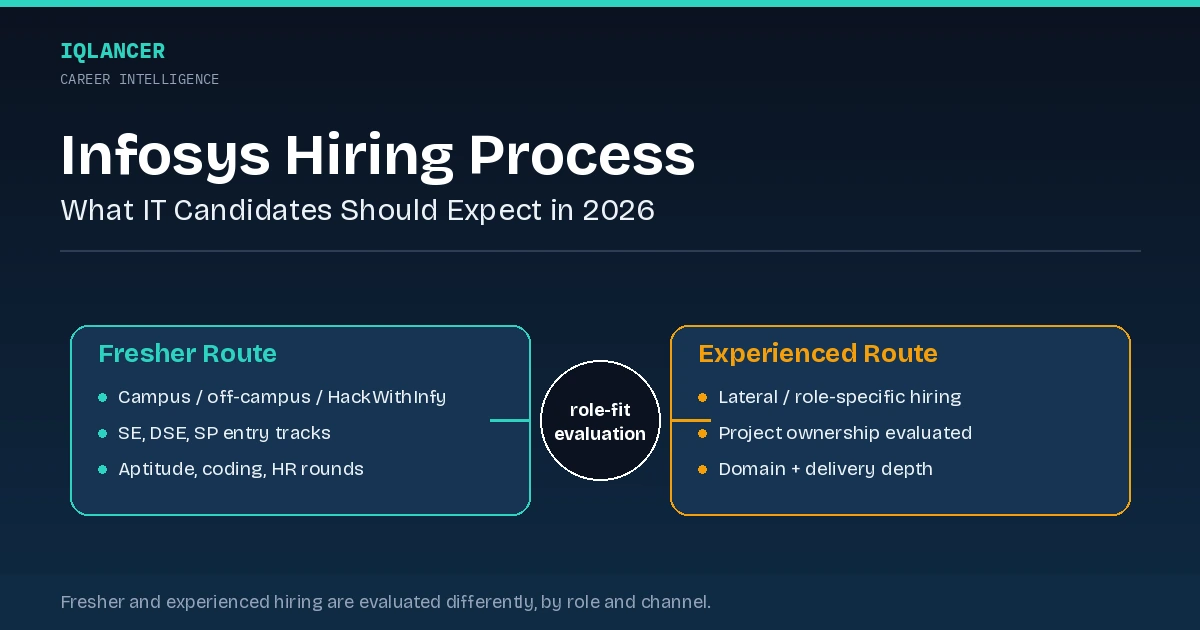
If you are preparing to apply to Infosys, the first mistake to avoid is assuming there is one process to prepare for. Infosys hires through several parallel routes, and what you will be evaluated on depends heavily on whether you are a fresher or an experienced professional, which role and specialization you are targeting, and which hiring program or channel you enter through (Infosys Careers).
IQLancer article walks through what current evidence shows about how Infosys hires, how that differs by experience level and role, what skills and projects actually matter, and what you should check before you apply. Where information is officially confirmed by Infosys, that is stated plainly. Where it comes from candidate reports or preparation communities, that is labeled clearly, so you can tell the difference between a hiring fact and a shared experience.
How the Infosys Hiring Process Works
Infosys structures its careers site around three distinct audiences: graduates, experienced professionals, and interns, each with separate application journeys and separate expectations (Infosys Careers – Graduates; Infosys Careers – Experienced Professionals). This matters because it confirms, from Infosys’ own structure, that graduate hiring and lateral hiring are not the same funnel with different labels. They are different evaluations built around different evidence.
Within graduate hiring alone, Infosys uses more than one channel. Candidates can enter through on-campus drives at partner institutions, through off-campus drives open to eligible batches, or through HackWithInfy, a national coding competition that can lead to pre-placement interview opportunities for Specialist Programmer and other specialist roles, along with internship opportunities (Infosys Careers – HackWithInfy). Which channel you enter through can influence which roles and interview formats you encounter, so the honest starting point is: identify your channel first, then prepare for that channel’s likely evaluation, rather than preparing for a generic “Infosys process” you found online.
Infosys Hiring Process for Freshers
Infosys resumed large-scale campus recruitment after a roughly two-year pause and set a target of 15,000 to 20,000 fresher hires by March 2026, with new recruits largely entering as Digital Specialist Engineers (Sakshi Post). More recent coverage indicates Infosys hired over 20,000 freshers in FY26 and is planning a similar intake for FY27, even as its total headcount contracted in the same period, pointing to a deliberate strategy of refreshing entry-level talent while controlling overall workforce costs (People Matters).
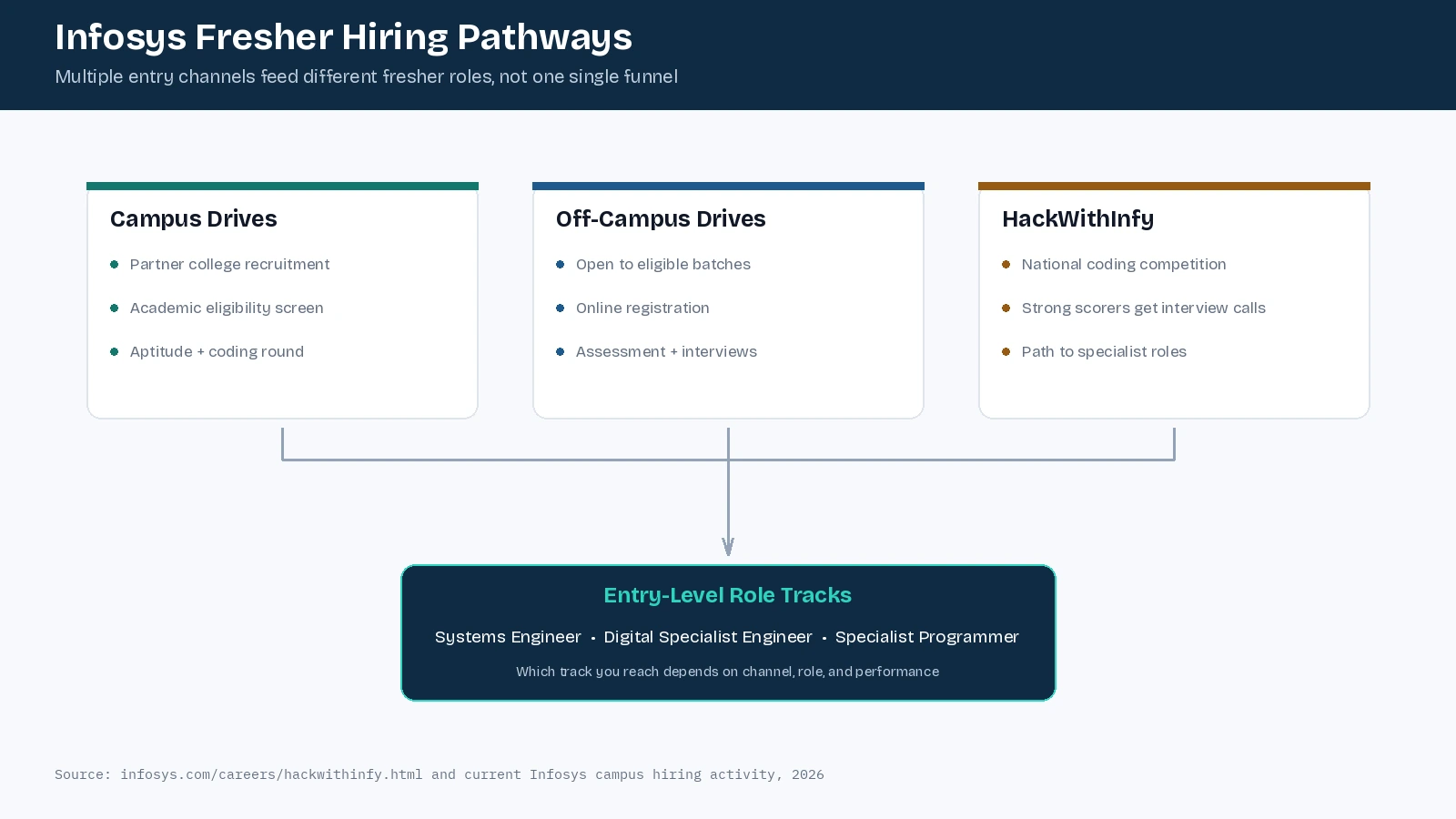
For most freshers, this means a mix of routes rather than one uniform test:
- Campus drives, run through partner colleges, typically screening on academic eligibility, an aptitude and coding assessment, and interviews.
- Off-campus drives, open to a wider pool of eligible graduates from recent batches.
- HackWithInfy, a competitive programming track that can shortcut candidates directly into specialist-role interviews for strong performers.
Candidate-reported experiences describe assessments that commonly include reasoning, verbal ability, and a coding or pseudocode component, followed by technical and HR interviews (PrepInsta). These reports are useful for expectation-setting, but they are self-reported and vary by year, drive, and role, so treat exact round counts, timings, and cut-offs as indicative rather than fixed.
Infosys Hiring Process for Experienced IT Professionals
Experienced hiring works differently. Infosys’ own experienced-professionals page emphasizes reskilling, internal learning platforms, and its status as a certified Top Employer, rather than a standardized test funnel (Infosys Careers – Experienced Professionals). In practice, this means the burden of proof shifts from aptitude and coding-round performance toward what you have actually built, owned, and delivered.
For lateral candidates, preparation should center on being able to explain your role in specific projects in detail: what you owned end-to-end, what technology decisions you made and why, how you handled production issues, and what measurable outcome resulted. A resume line that only names technologies will not carry the same weight as a resume line, and matching interview narrative, that shows ownership and impact.
Applicants who want to apply and want to know about the real TCS hiring process in 2026-27.
Infosys Hiring Tracks and Roles Candidates Should Know
Current fresher hiring activity references several distinct entry tracks, most commonly:
- Systems Engineer (SE), generally the largest-volume entry track, focused on application development, testing, and maintenance.
- Digital Specialist Engineer (DSE), positioned around specialized digital, cloud, data, and AI/ML work, and cited as the primary role for the 2026-27 large-scale campus intake (Sakshi Post).
- Specialist Programmer (SP), a coding-intensive track, with strong performers in HackWithInfy able to reach pre-placement interviews for this and related specialist roles (Infosys Careers – HackWithInfy).
Beyond these, candidate and prep-community sources reference a “Power Programmer” style outcome tied to top HackWithInfy performance (GeeksforGeeks). Because exact track names, eligibility, and compensation bands shift between cycles and are inconsistently reported across third-party sites, treat any specific number you see for a given track as unverified until you see it in your own offer communication or an official Infosys notice.
What Skills Does Infosys Look for in IT Candidates?
Knowing the hiring stages is not enough. The more important question is whether your current technical skills match the role you are targeting.
Core fundamentals that show up consistently across entry-level and mid-level engineering evaluation include programming proficiency in at least one mainstream language, data structures and algorithms, object-oriented concepts, SQL, and the ability to reason through problems out loud, not just arrive at an answer.
Role-specific skills vary meaningfully by track. A candidate targeting a data or AI-adjacent role should expect more emphasis on Python, data handling, and increasingly generative AI concepts such as retrieval-augmented generation and LLM-based application design, given Infosys’ active investment in its Topaz AI-first suite and AI-linked hiring (Infosys Topaz). A candidate targeting cloud or DevOps-adjacent roles should expect more weight on Linux, containers, CI/CD, and cloud fundamentals.
The practical takeaway: do not try to learn every technology on a generic list. Identify your target role, then build depth in the fundamentals plus the specific stack that role actually uses.
| Target Role | Skills to Investigate | What Candidates Should Be Able to Demonstrate |
|---|---|---|
| Software Engineer | Programming, DSA, OOP, SQL, APIs | Build and explain working software |
| Data Analyst | SQL, Python, analytics, visualization | Analyze data and explain a business recommendation |
| Data Engineer | Python, SQL, ETL, cloud, data platforms | Build and explain a reliable data pipeline |
| DevOps Engineer | Linux, Git, CI/CD, Docker, Kubernetes, cloud | Automate a build-to-deploy pipeline |
| Cloud Engineer | Cloud services, networking, IAM, containers | Design and deploy cloud infrastructure |
| AI Engineer | Python, ML/GenAI, APIs, deployment | Build and explain a deployed AI application |
| Cybersecurity | Networking, Linux, security fundamentals | Identify, investigate, and explain a security issue |
This table is a practical preparation guide based on current role patterns and market signals. It is not an official Infosys skills requirement.
What Projects Should You Build Before Applying to Infosys?
A generic instruction to “build two or three projects” does not tell you what to build or why. What matters is whether a project gives an interviewer concrete evidence of a skill tied to the role you want.
- Software Engineering: a production-style application with a backend/API layer, a real database, basic authentication, some automated tests, and an actual deployment, not just code that runs locally.
- Data Analyst: a project involving real or realistic messy data, SQL-based analysis, a visualization layer, and a written business recommendation drawn from the numbers.
- DevOps: a project that touches Linux, containerization with Docker, a CI/CD pipeline, cloud deployment, and basic monitoring or logging.
- Cloud: a project demonstrating cloud architecture decisions, networking and IAM configuration, deployment, and monitoring.
- AI: a project involving a machine learning or generative AI component, API integration, some form of evaluation of output quality, and deployment to a real, usable interface.
| Project Type | Skills Demonstrated | Relevant Roles |
|---|---|---|
| Deployed full-stack app | Backend, database, auth, testing, deployment | Software Engineer, DSE |
| Data cleaning + analysis + dashboard | SQL, Python, visualization, business reasoning | Data Analyst |
| Automated data pipeline | ETL, cloud, orchestration | Data Engineer |
| Containerized CI/CD pipeline | Docker, CI/CD, cloud deployment | DevOps Engineer |
| Deployed GenAI application | LLM integration, evaluation, APIs | AI Engineer |
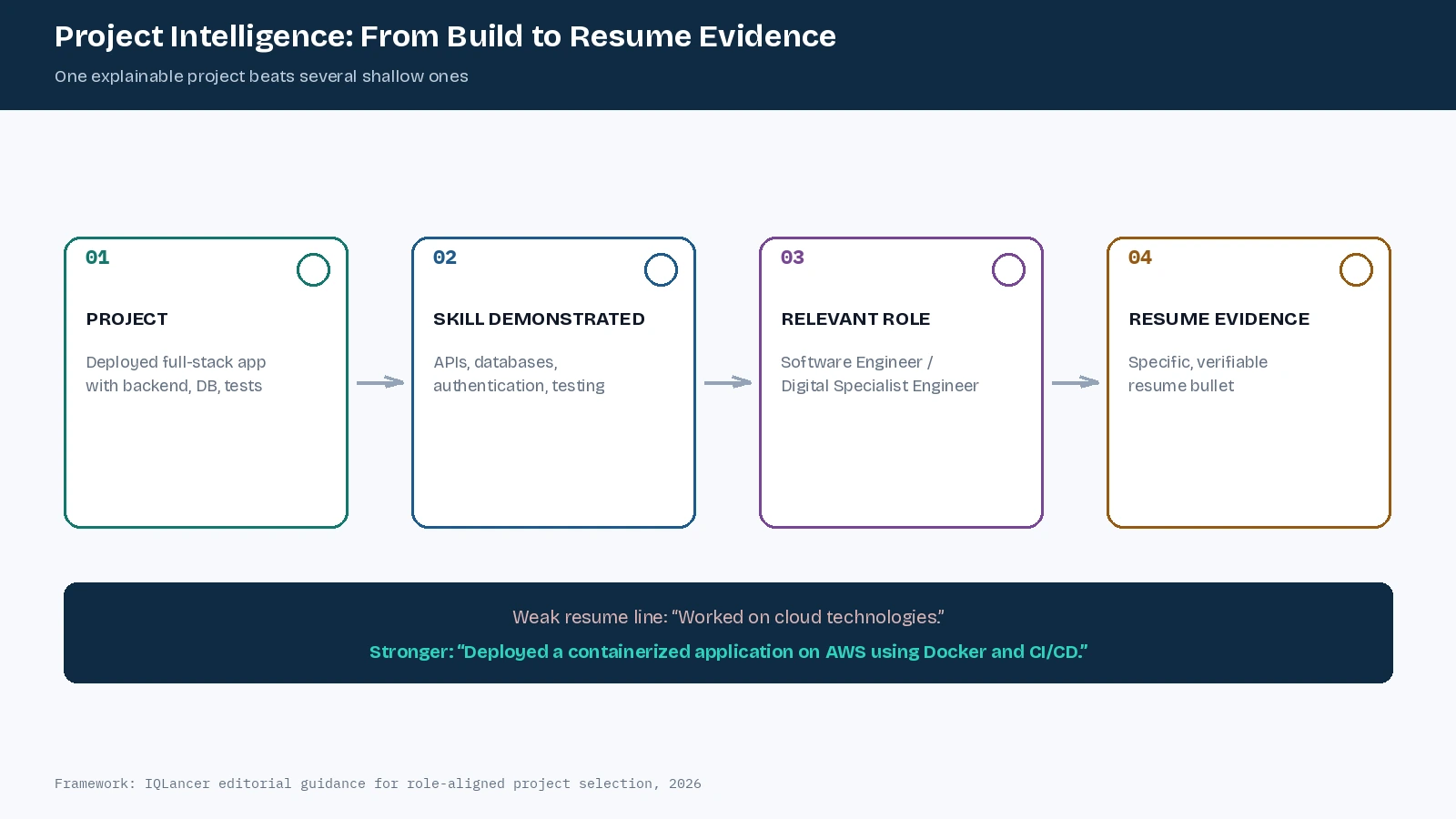
The chain that matters is: project reveals a skill, the skill maps to a role, and the resume turns that into evidence an interviewer can question you on. One project you can explain in depth, including what broke and how you fixed it, is generally more convincing than several shallow projects you cannot defend under follow-up questions. No project guarantees an offer; it only strengthens the evidence behind your application.
How Preparation Should Change With Experience
This is a practical candidate-preparation framework, not an official Infosys hiring policy. Use it to prioritize your prep time, not as a checklist Infosys itself has published.
| Experience | What to Demonstrate | Preparation Priority |
|---|---|---|
| 0–1 year | Fundamentals and potential | DSA, SQL, CS fundamentals, one solid project, clear communication |
| 1–3 years | Applied, hands-on capability | Project ownership, chosen tech stack depth, troubleshooting, resume-to-JD alignment |
| 3–5 years | Independent delivery | Production experience, architecture understanding, measurable impact |
| 5+ years | Leadership and judgment | Technical leadership, domain expertise, stakeholder communication, delivery ownership |
As experience grows, interviews shift from “can you solve this problem” toward “what have you actually owned and what would you do differently.” Preparing the same way at five years of experience as you did at zero years typically under-sells what you actually bring.
Do You Need Certifications for Infosys Jobs?
Current evidence does not support treating any single certification as a hard, universal requirement across Infosys hiring. Certification value depends heavily on the target role and, more importantly, on whether it is backed by demonstrable practical work.
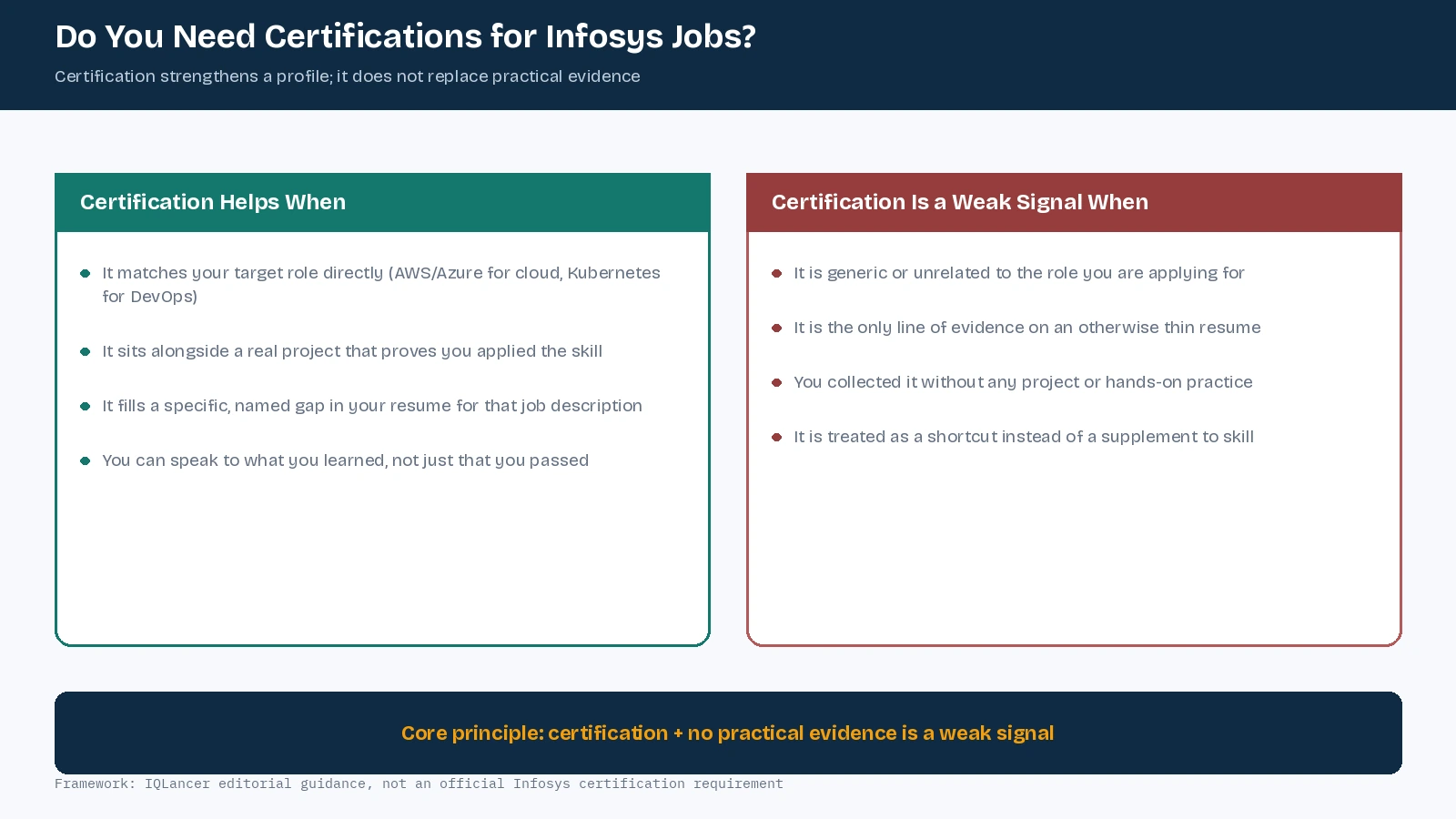
Certification can strengthen a profile when it is directly relevant to the target role (an AWS or Azure certification for a cloud role, a Kubernetes credential for DevOps, a recognized security certification for cybersecurity) and when it sits alongside a project or work history that proves you can actually apply what was tested. Certification is far less useful when it is generic, unrelated to the role, or the only line of evidence on an otherwise thin resume.
The core principle worth remembering: certification without practical evidence is a weak signal. A certificate tells an interviewer you passed a test. A project or work history tells them you can do the job. The strongest resumes use certification to support practical evidence, not to replace it.
How AI Is Changing the Skills Infosys Candidates Need
The honest answer is not “everyone must learn AI.” It is that AI is changing what “relevant experience” looks like for a growing share of roles, while many traditional engineering roles are becoming AI-assisted rather than AI-defined.
Infosys has publicly built its current strategy around Infosys Topaz, its AI-first suite of services, and references a workforce of more than 250,000 “AI-aware” employees (Infosys Careers; Infosys Topaz). In January 2026, Infosys extended its Topaz platform through a collaboration with AWS that applies generative AI, via Amazon Q Developer, to internal functions including software development, recruitment, and testing (PR Newswire). This signals that AI literacy, understanding how these tools are used in delivery, testing, and even hiring, is becoming a baseline expectation rather than a specialist add-on.
At the market level, Naukri’s JobSpeak data for June 2026 showed AI-related hiring in India’s IT sector up 16% year-on-year even as overall IT job listings fell 3%, with AI and machine learning roles up 25% across all tracked sectors (TechRepublic). A separate foundit report found AI, cloud, and cybersecurity together driving roughly 65% of tech hiring demand, with AI-first roles making up more than 30% of new tech demand (YourStory).
The practical distinction for candidates: an AI Engineer or GenAI-focused role will expect real depth, building and evaluating retrieval-augmented generation systems, working with vector databases, and understanding deployment and cost tradeoffs. A traditional software, data, or QA role increasingly expects working familiarity with AI-assisted tools in the delivery workflow, without requiring model-building expertise. Knowing which category your target role falls into should guide how much AI-specific depth you actually need.
What to Expect in the Infosys Assessment and Interviews
Depending on the hiring route, candidates may encounter some combination of an online assessment covering reasoning, verbal ability, and coding or pseudocode; a role-specific coding round for specialist or digital tracks; a technical interview covering core computer science subjects, your projects, and your resume; and an HR or behavioral discussion (PrepInsta; Infosys Careers – HackWithInfy).
Not every candidate goes through every stage in the same order, and formats change between cycles. Candidate reports consistently emphasize that interviewers probe how well you can explain your own projects rather than only testing memorized theory, so being able to walk through a project’s design decisions in plain language matters more than reciting definitions.
How to Align Your Resume With an Infosys Job Description
A resume that lists technologies without evidence reads the same as every other resume in the pile. The stronger approach follows a simple chain: identify the required skill in the job description, identify your own evidence for that skill, then write a resume bullet that states the evidence, not just the skill name.
Weak: “Worked on cloud technologies.”
Stronger: “Deployed a containerized application on AWS using Docker and a CI/CD pipeline.”
The second version tells an interviewer exactly what to ask you about, and gives you a concrete story to tell. This matters regardless of whether Infosys or any employer uses an automated applicant tracking system to pre-screen resumes; specific, verifiable claims read better to both software and humans than vague ones.
What Candidates Should Check Before Applying
Before you apply to any Infosys opening, confirm the role, the required experience level, the location and any relocation expectation, the technology stack named in the job description, and which recruitment channel you are actually applying through.
Infosys maintains an official recruitment-fraud advisory warning that it never asks for money at any stage of hiring, that its recruitment team corresponds only from @infosys.com addresses, and that it never requests bank account, card, or similar financial details from candidates (Infosys Recruitment Fraud Alert). If you receive an unsolicited offer, an interview request tied to a payment, or communication from a generic email domain claiming to represent Infosys, treat it as a red flag and verify directly through Infosys’ official careers site before responding.
Common Mistakes Candidates Make
- Preparing for an outdated version of the process instead of checking what applies to your specific drive and role.
- Assuming every Infosys role, fresher or experienced, follows the same evaluation.
- Memorizing answers instead of being able to reason through a problem live.
- Listing technologies on a resume that you cannot explain or defend in an interview.
- Building several shallow projects instead of one project you can discuss in real depth.
- Collecting certifications unrelated to the role you are actually targeting.
- Ignoring the specific job description in favor of a generic, one-size-fits-all resume.
- Failing to clearly explain your individual contribution on team projects.
- Trusting unofficial recruitment messages or unverified job links instead of Infosys’ own career channels.
Infosys Hiring Process Preparation Checklist
- Identify which route you are entering through: campus, off-campus, HackWithInfy, or lateral.
- Confirm the specific role and its required experience level from the actual job description.
- Build or refine one project that maps directly to your target role.
- Practice explaining that project’s decisions and failures out loud, not just its features.
- Strengthen core fundamentals: DSA, SQL, and CS basics for freshers; production and architecture depth for experienced candidates.
- Only pursue certifications that are directly relevant to your target role.
- Rewrite resume bullets around evidence, not just tool names, matched to the job description.
- Verify every recruitment communication through Infosys’ official careers channels before sharing personal information.
Frequently Asked Questions
Does Infosys have one standard hiring process for everyone?
No. Infosys runs separate pathways for graduates, experienced professionals, and interns, and freshers alone can enter through campus drives, off-campus drives, or HackWithInfy, each with different formats.
What roles do fresher candidates typically enter through?
Current activity most commonly references Systems Engineer, Digital Specialist Engineer, and Specialist Programmer tracks, with Digital Specialist Engineer cited as the primary role for the large-scale 2026-27 campus intake.
Is a certification required to get hired at Infosys?
No official Infosys source confirms a universal certification requirement. Certifications can help when they are relevant to the target role and backed by practical project evidence.
How is Infosys hiring being affected by AI?
Infosys has built its current strategy around its Topaz AI-first suite and reports a large AI-aware workforce, and broader Indian IT market data shows AI-related hiring growing even as overall IT job postings have softened. This affects AI-specialist roles most directly, while raising baseline AI-literacy expectations across other engineering roles.
What should freshers focus on before applying?
Core fundamentals (DSA, SQL, CS basics), at least one project that demonstrates a specific, explainable skill, and a resume aligned to the specific job description rather than a generic template.
How is experienced hiring different from fresher hiring?
Experienced hiring weighs project ownership, production experience, and measurable impact far more heavily than aptitude-test performance, which matters more at the fresher stage.
How can I verify that an Infosys job offer or interview request is genuine?
Confirm the communication is from an @infosys.com address, was never conditioned on any payment, and cross-check the opportunity directly on Infosys’ official careers site before sharing personal or financial information.
Does building more projects improve my chances?
Not automatically. A small number of projects you can explain in real depth, tied clearly to your target role, tends to be more convincing than several shallow projects you cannot defend under questioning.
Conclusion
Understanding the Infosys hiring process is only the first step. Candidates should align their skills, projects, experience, and resume with the specific role and current hiring route they are targeting, rather than preparing for a generic version of “the Infosys process” that may not apply to their situation. That alignment, more than any single test score, is what current evidence suggests actually separates strong applications from average ones. IQLancer will continue tracking Infosys’ hiring signals and related IT hiring intelligence as they evolve, so candidates can prepare against current reality instead of outdated assumptions.
Applicants who want to apply and want to know about the real TCS hiring process in 2026-27.
1 thought on “Infosys Hiring Process: What IT Candidates Should Expect in 2026-27”