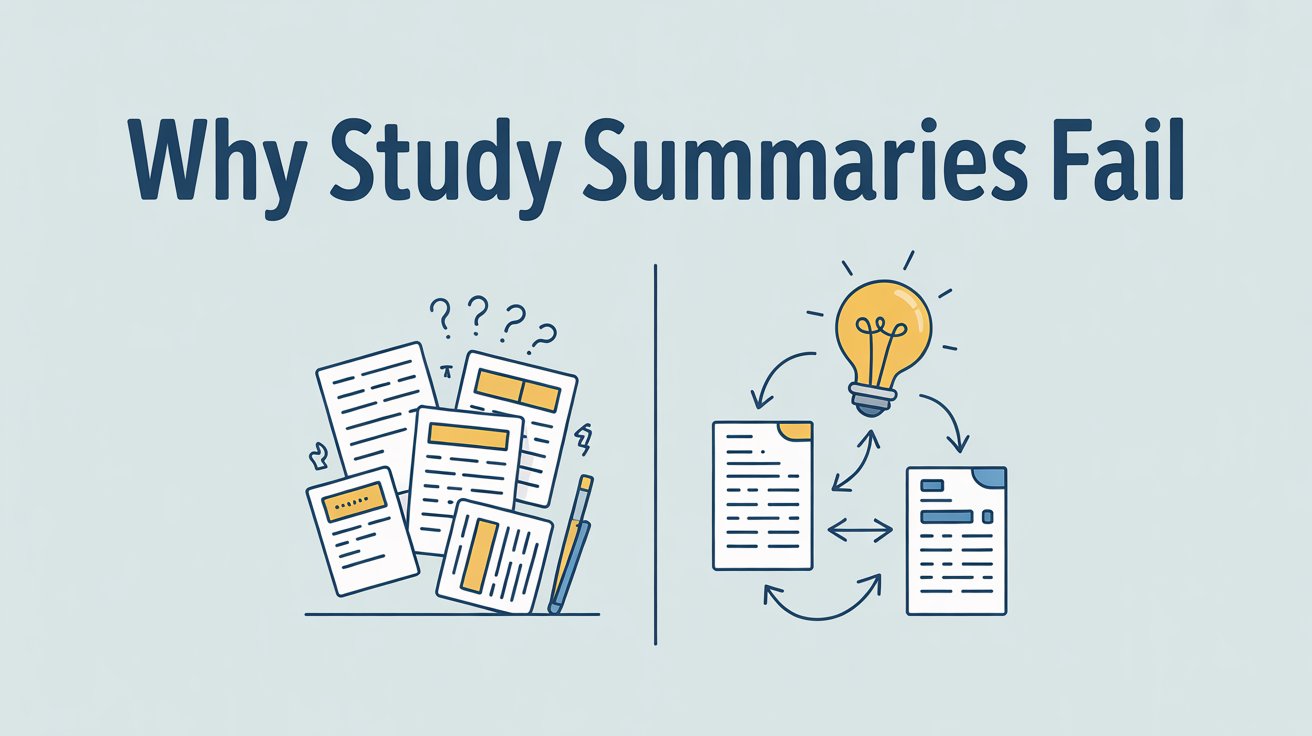
Many students create summaries to prepare for exams. They read textbooks, watch lectures, and write down key information in shorter form. This method feels productive and organized.
However, most students later realize they cannot recall important details. They struggle during tests. They forget concepts they thought they understood. Understanding why this happens is crucial if you want to solve it effectively.
The problem is not lack of effort. The problem is that study summaries miss key points.
This happens because most summaries focus on copying information rather than understanding it. Students write down facts but do not process them deeply. They condense text without identifying what truly matters. As a result, they create learning gaps that hurt their performance.
This article explains why study summaries miss key points. It shows common study summary mistakes. It provides practical methods to fix these problems and close learning gaps.
Why Study Summaries Miss Key Points
Study summaries miss key points because students treat summarizing as a copying task. They read a paragraph and write a shorter version. They focus on reducing word count instead of identifying core concepts.
This creates shallow summaries. A shallow summary contains facts but lacks understanding. It includes surface-level information without deeper connections. Students write what they see, not what they understand.
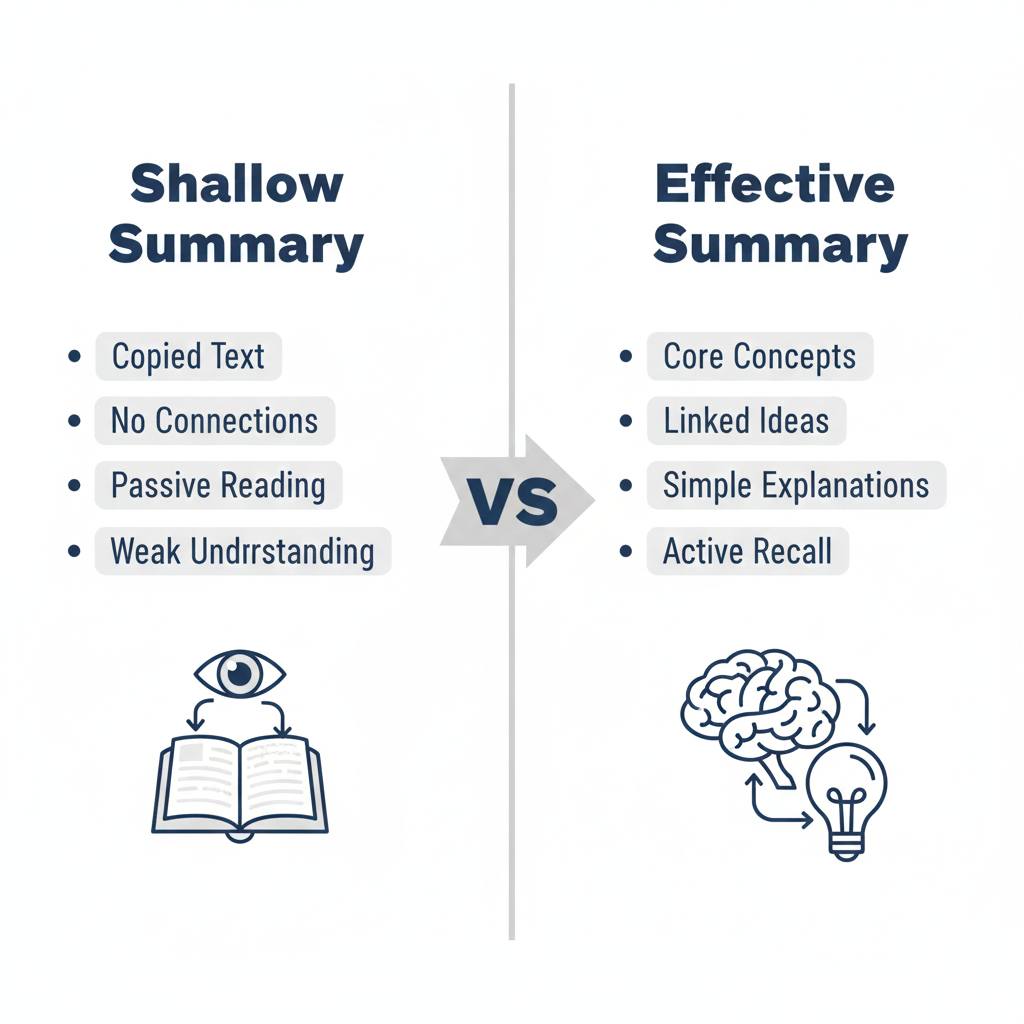
Students also copy the structure of the original text. They follow the same order and use similar phrasing. This makes them feel they understand the material. In reality, they are just reorganizing words without genuine comprehension.
Another reason is speed. Students rush through material to cover more content. They summarize entire chapters in one sitting. This speed prevents deep thinking. Your brain requires processing time to distinguish essential concepts from supporting details. Without this time, study summary mistakes multiply.
For example, a student reads: “Photosynthesis converts light energy into chemical energy stored in glucose.” Their summary says: “Photosynthesis makes glucose from light.” This seems correct. However, the summary misses the energy conversion concept that light energy converts to chemical bonds in glucose, the actual mechanism that matters for cellular respiration.
In economics, a student writes “supply and demand affect price” but misses why elasticity matters or how market equilibrium shifts. This problem is closely related to why study notes feel useful but fail in exams, even when they look organized. The summary contains true statements but lacks the conceptual depth needed for real understanding.
Common Mistakes in Study Summaries
Students make these common study summary mistakes that create lasting learning gaps.
Copying Text Verbatim
Many students copy sentences directly from textbooks or slides. They modify a few words but retain the original structure. This feels like summarizing but requires no understanding. Copying activates no cognitive processing. Your brain records words without building understanding.
When you copy text, you create no mental connections. You do not think about meaning. You do not process information. This is why copied summaries fail during exams.
Ignoring Key Concepts
Students often summarize details instead of concepts. They list specific details—dates, names, locations—without noting the principles that explain them.
For instance, in history, students list events and dates. They miss the causes, effects, and patterns that explain why events happened. These concepts are what exams actually test.
Making Summaries Too Short
Some students believe shorter is always better. They reduce paragraphs to single sentences. They eliminate context and connections. This creates fragmented knowledge.
A summary should be concise but complete. It must include enough information to trigger full understanding later. Too-short summaries create knowledge gaps because they lack sufficient detail.
Not Connecting Ideas
Good learning requires connections between concepts. Students often summarize each paragraph separately. They treat each topic as isolated information. They do not show how ideas relate to each other.
Without connections, knowledge remains scattered. The brain cannot build a coherent understanding. This makes recall difficult during exams.
Summarizing Without Understanding
Students sometimes summarize material they do not fully understand. They copy words and hope to figure it out later. This creates summaries filled with technical terms without meaning.
If you cannot explain something in simple words, you do not understand it. Summarizing unclear material reinforces confusion rather than learning.
Skipping Examples and Applications
Examples help cement understanding. Applications show why concepts matter. Many students skip these in summaries because they seem less important than definitions. This is a major mistake in how students approach their notes.
Examples provide context. Applications create relevance. Without them, concepts remain abstract and forgettable.
How Shallow Summaries Create Learning Gaps
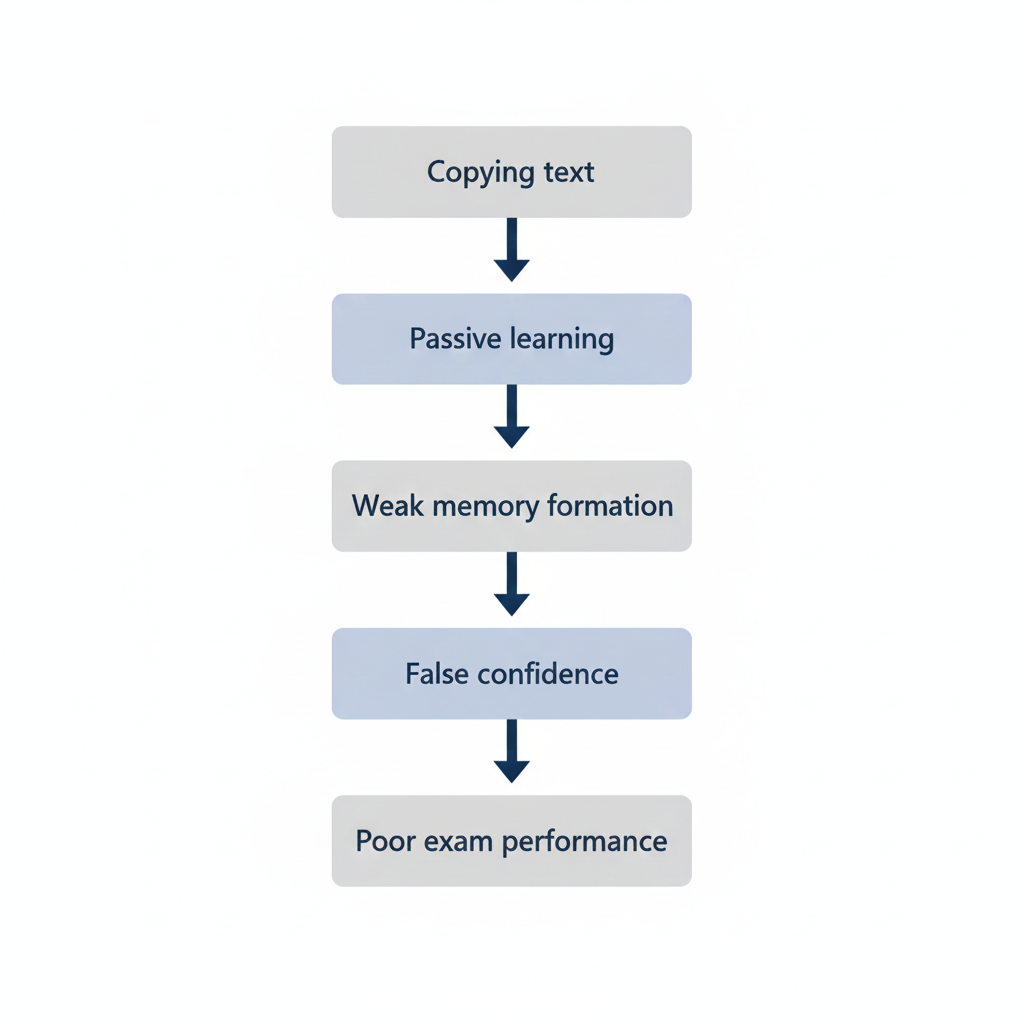
Shallow summaries do not fail all at once. They slowly weaken understanding by breaking how memory, recall, and application are supposed to work together.
Weak Memory Formation
Inadequate notes create comprehension gaps through multiple mechanisms. First, they fail to engage active thinking. When you copy or lightly paraphrase text, your mind operates in passive mode, transcribing without processing meaning. Passive learning produces weak memory traces.
False Confidence
Second, weak notes do not test understanding. You can create a summary that sounds correct without truly comprehending the material. Many students mistake familiarity for understanding, which explains why students confuse familiarity with understanding. Later, when you review this summary, you assume you know it. You move forward with false confidence. The gap in understanding remains hidden until exam day.
Poor Exam Performance
Third, these summaries lack retrieval cues. A retrieval cue is information that helps you remember related knowledge. Surface-level summaries contain isolated facts. When you try to recall one fact, nothing else comes to mind. You cannot reconstruct the full picture.
Fourth, shallow summaries prevent application. Real understanding means using knowledge in new situations. Summaries that focus on memorization do not prepare you for application questions. You know facts but cannot solve problems.
Wasted Time and Overconfidence
Fifth, they create overconfidence and waste valuable time. Students believe organized summaries equal mastery. They don’t realize these notes can’t support deep recall until exam day. Meanwhile, hours spent creating ineffective summaries could have been used for proven learning methods. The opportunity cost creates additional understanding gaps across all subjects.
How to Fix the Problem: Active Learning Methods
These methods fix common study summary mistakes and strengthen your actual understanding.
Method 1: Use Active Recall While Summarizing
Do not write summaries while reading. Instead, follow these steps:
- Read a section completely without taking notes
- Close the book or stop looking at the screenshot.
- Write what you remember in your own words
- Check the original material for gaps
- Rewrite your summary to include missing key points
This method forces active thinking. It reveals what you actually understand versus what you only recognized.
Method 2: Transform Information
Change the format of information rather than just shortening it:
- Convert paragraphs into diagrams
- Turn processes into flowcharts
- Change lists into tables or matrices
- Explain concepts as if teaching a younger student
Transformation requires understanding. You cannot change format without knowing what information truly means.
Method 3: Ask Questions Instead of Making Statements
Turn your summaries into questions and answers:
- Read the material
- Identify the most important concepts
- Create questions that test these concepts
- Write answers from memory
- Verify accuracy with the source material
Question-based summaries prepare you directly for exams. They also reveal mistakes in your notes immediately.
How to Fix the Problem: Teaching-Based Methods
Method 4: Connect to Prior Knowledge
For each concept you summarize:
- Identify how it connects to something you already know
- Find similarities or differences with other concepts
- Determine why this concept exists or matters
- Consider real-world applications or examples
Write these connections in your summary. They become powerful retrieval cues later.
Method 5: Teach Using Simple Language (Feynman Technique)
Teaching reveals gaps that silent reading never shows. This approach, called the Feynman Technique, forces complete understanding:
- Create your initial summary
- Explain the topic out loud to someone (or to yourself)
- Use the simplest possible language—as if teaching a 12-year-old
- Note where your explanation breaks down or gets confusing
- Return to source material for those weak areas
- Teach again until you can explain without hesitation
If you cannot explain something simply, you do not truly know it. Teaching exposes every gap in your understanding and forces you to fill them.
Better Alternatives to Traditional Summaries
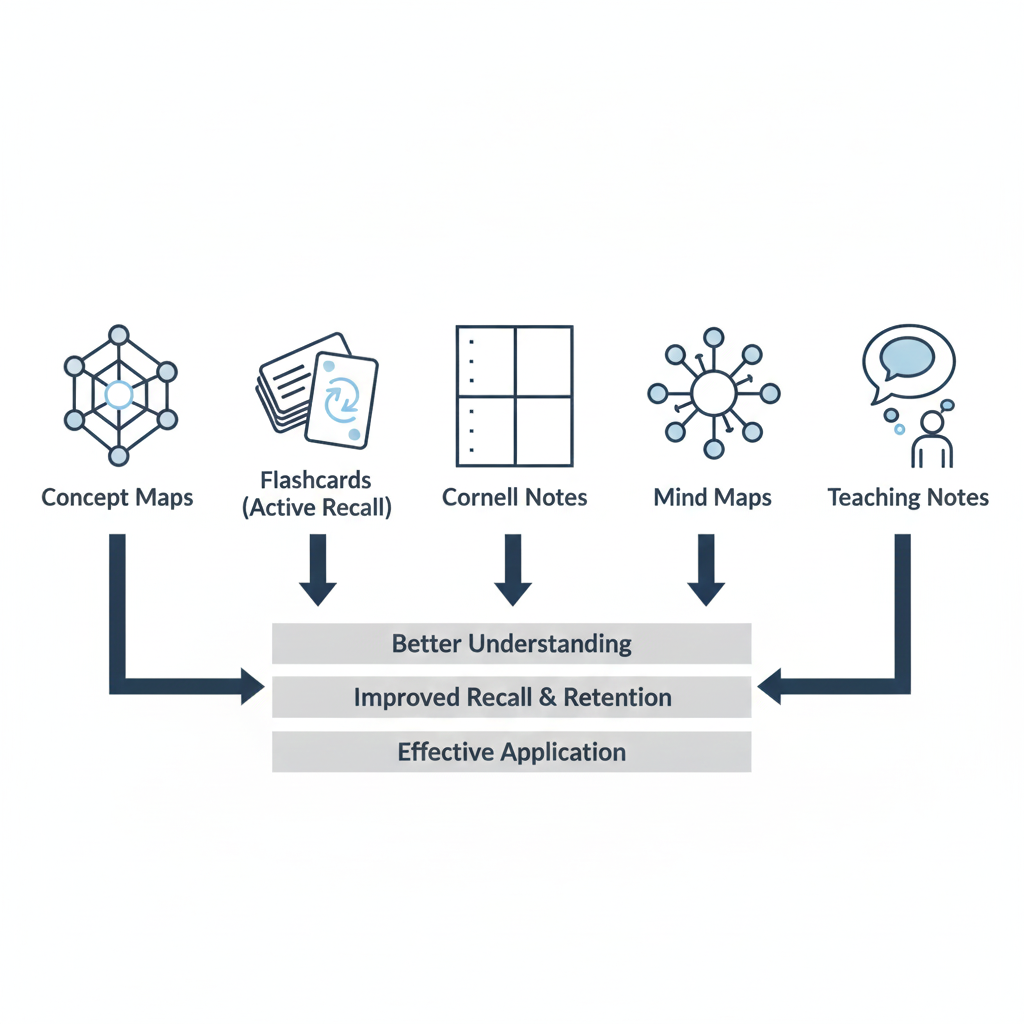
If traditional summaries create learning gaps, the solution is not better summarizing but better study methods that force understanding and recall.
Concept Maps
Start with your central concept. Draw connecting lines to related ideas, labeling each relationship. This visual format makes knowledge structure explicit.
This format makes connections clear. It shows how knowledge fits together. It also makes errors in understanding visible. If you cannot connect a concept, you need to study it more.
Flashcards with Active Recall
Flashcards force active retrieval with every review session, unlike passive summary reading. The front contains a question or prompt. The back contains the answer. You test yourself repeatedly.
This creates strong memory through retrieval practice. Unlike passive summaries, flashcards require active recall every time you review.
Cornell Notes System
Divide your page into three zones: a large right area for class notes, a narrow left margin for questions you write afterward, and a bottom strip for summarizing main points during review. This triple-pass system prevents passive copying.
This structure forces you to process information multiple times in different ways. It prevents the copy-paste approach that creates surface-level summaries.
Mind Maps
Place your main concept in the page center. Draw branches radiating outward for major subtopics. Each branch splits further into supporting details, creating a tree-like structure that mirrors how ideas actually connect. Colors, symbols, and images enhance memory.
Mind maps engage both logical and creative thinking. They make weak understanding obvious. Empty or weak branches show where understanding is incomplete.
Teaching Notes
Create notes as if you are writing a lesson plan to teach someone else. Include examples, analogies, and potential student questions. Explain why concepts matter and how to apply them.
Teaching notes require deep understanding. They eliminate surface-level summarizing. They also prepare you to explain concepts during exams.
When to Use Each Method
Use concept maps for subjects with interconnected ideas (biology, history, economics). Choose flashcards for memorization-heavy content (vocabulary, formulas, dates). Apply Cornell notes during live lectures when you need structured note-taking. Try mind maps for brainstorming and big-picture understanding. Create teaching notes when preparing to explain complex processes or theories.
If you want a structured way to apply these fixes, here’s a guide on how to summarize notes without losing meaning.
What to Do Next
Start by reviewing your current study summaries. Identify which common mistakes you make most often. Pick one method from this article to try first.
For your next study session, do not create traditional summaries. Choose an alternative approach. Use concept maps, flashcards, or teaching notes. Test yourself without looking at materials.
After one week, compare your recall using new methods versus old summaries. Notice where gaps in understanding have closed. Adjust your approach based on what works best for your subjects and learning style.
Remember that better summaries take slightly more time initially. However, they save time overall. You review less frequently because you remember more. You perform better on exams because understanding is deeper.
When you fix how you summarize, you close learning gaps and retain what actually matters—not just what looks organized on paper.
Effective studying is not about writing more notes. It is about understanding what matters and testing that understanding repeatedly.