AI Engineering in 2026 is not the same job it was two years ago. Today’s AI engineer is closer to a production software engineer who happens to work with models and APIs than to a researcher training networks from scratch a shift confirmed by Neural Concept’s analysis of how AI engineers integrate pre-trained models into reliable, user-facing systems.
Learning how to become an AI engineer now means more than experimenting with an AI API in a notebook. It means understanding data, machine learning fundamentals, deployment, and evaluation well enough to ship something that survives contact with real users. The IQlancer breaks down exactly what that requires: the skills employers verify, the machine learning roadmap that builds real competence, the certifications worth pursuing, and the mistakes that get otherwise qualified candidates rejected.
What Does an AI Engineer Actually Do in Practically?
Job titles in this field are inconsistent, but the underlying work is not. Understanding the real day-to-day responsibilities matters because it tells you what to practice, not just what to memorize and it’s the first thing an interviewer will probe.
An AI engineer builds software systems that use machine learning models often large language models (LLMs) accessed through APIs, sometimes custom-trained models to perform a task inside a product. Neural Concept describes this plainly: an AI engineer integrates pre-trained models such as GPT or Claude through APIs, then makes the resulting system reliable enough to serve real users. That “reliable enough” clause is the entire job. It covers data preparation, prompt and system design, retrieval pipelines, evaluation, API development, deployment, monitoring, and cost control not just calling a model and shipping a demo.
A realistic AI engineering workflow looks like this:
Business Problem
      ↓
Data (collection, cleaning, labeling)
      ↓
Model / LLM (selection, fine-tuning, or prompting)
      ↓
Evaluation (accuracy, relevance, safety, cost)
      ↓
Application (API, UI, integration)
      ↓
Deployment (containerization, scaling, versioning)
      ↓
Monitoring (drift, latency, cost, failure modes)
Every stage produces work an interviewer can ask about. A candidate who can only speak to the “Model / LLM” stage because their experience is limited to prompting an API will struggle in interviews that probe evaluation methodology or deployment decisions. That gap is one of the most common reasons AI engineering candidates get rejected, covered in detail later in this article.
In startups, one AI engineer often owns the entire pipeline above. At larger companies, the role narrows one engineer might specialize in reducing inference latency, another in distributed training, another in retrieval architecture, according to the breakdown in DataExpert’s 2026 AI engineering career guide. Knowing which slice of the pipeline a specific job posting emphasizes is part of reading a job description correctly a skill covered later in the ATS Intelligence section.
AI Engineer vs ML Engineer vs Data Scientist vs Generative AI Engineer
Job titles overlap heavily in this field, and understanding where they genuinely differ rather than assuming they’re identical helps you target the right preparation and avoid applying to roles that don’t match your actual strengths.
Employers use these four titles inconsistently, and Neural Concept notes that LinkedIn’s Jobs on the Rise 2026 report even lists “AI engineers, also referred to as machine learning engineers” as effectively one title in some listings. Still, the center of gravity differs by role, and reading a job description with these distinctions in mind helps you evaluate fit before you apply.
| Dimension | AI Engineer | ML Engineer | Data Scientist | Generative AI Engineer |
|---|---|---|---|---|
| Core focus | Building usable AI-powered applications on top of existing models | Building and operationalizing the training pipeline for custom models | Finding signal in data, testing hypotheses, exploring what’s possible | Building on top of LLMs specifically: RAG, fine-tuning, agents |
| Primary skills | APIs, software engineering, prompt/system design, evaluation, deployment | Feature engineering, hyperparameter tuning, ML infra, model metrics | Statistics, experimentation, SQL, exploratory analysis, communication | RAG pipelines, vector databases, tool calling, agent orchestration |
| Typical output | Production application or feature | Trained, deployable model | Insight, report, or prototype model | LLM-powered product feature or agent workflow |
| Entry requirement | Strong software engineering + working ML knowledge | Strong ML fundamentals + engineering discipline | Strong statistics/math + some programming | Software engineering + applied LLM tooling |
| Common transition | Software engineer → AI engineer | Data scientist or SWE → ML engineer | Statistics/analytics → data science | AI/ML engineer → GenAI specialist |
The overlap is real: a mid-size company might post “AI Engineer” for what is functionally an ML engineer role, and a startup might use “ML Engineer” for what is functionally an AI engineer role. KORE1’s staffing data makes this concrete; it flags large comp gaps between platforms like ZipRecruiter (which captures postings where “AI” was simply added to an existing title) and Built In (which captures funded companies hiring for genuine production AI work). Read the responsibilities section of a posting, not just the title, before assuming what the job requires.
Is AI Engineering a Strong Career Path for 2026–2027?
Before investing months of preparation, it’s worth grounding the decision in verifiable labor-market evidence rather than hype because the honest answer is “yes, with real qualifications attached,” not “everyone should do this.”
The clearest, most durable evidence comes from government labor statistics rather than marketing copy. The U.S. Bureau of Labor Statistics projects that computer and information research scientists the closest official occupational category to AI/ML engineering will grow substantially faster than the average occupation through 2034, with a median annual wage of $140,910 for the category. The broader computer and information technology field is projected to add roughly 317,700 openings per year through 2034. Adjacent data roles are growing even faster: data scientist employment is projected to grow 33.5% from 2024 to 2034, the fourth-fastest-growing occupation tracked by the BLS.
This growth is driven by enterprise AI adoption, generative AI integration into existing software, and demand for engineers who can deploy and operate AI systems not by AI replacing every job or guaranteeing every candidate a six-figure offer. Independent analysis of nearly 1,000 live AI engineer postings by AI Shipping Labs found employers consistently prioritizing RAG, LLM integration, Python, cloud infrastructure, and deployment skills over deep research or fine-tuning expertise evidence that this is fundamentally a production engineering discipline, not a research one.
That said, career outlook data describes an occupation, not a guarantee for any individual candidate. Growth projections say the number of roles is expanding; they say nothing about how competitive any single opening will be, and demand is concentrated in candidates who can demonstrate production-level skill, not just AI familiarity.
Degree Requirements: What’s Actually Required vs Preferred
Education requirements vary more than most career articles admit, and being specific about what’s required versus merely preferred prevents both unnecessary self-disqualification and unrealistic expectations.
Required (for most employers):
- A bachelor’s degree in a technical field is the norm. LHH’s hiring guide lists a bachelor’s or master’s in computer science, data science, or a related field as a typical baseline for AI/ML engineer roles, alongside 2–5 years of experience for mid-level postings.
Preferred (varies by employer and seniority):
- Computer Science, Artificial Intelligence, Machine Learning, or Data Science degrees are the most common preferred fields.
- A master’s degree strengthens candidacy for research-adjacent or senior roles but is rarely a hard gate for applied engineering positions.
- A PhD is preferred, sometimes required, specifically for research-focused roles at labs and large tech companies not for typical applied AI engineering roles.
Helpful but not essential:
- Mathematics, Statistics, Physics, or Engineering degrees provide a strong quantitative foundation and are commonly accepted alternatives.
- Self-taught pathways are increasingly viable. Skillcrush’s 2026 guide notes that companies increasingly focus on practical skills, projects, and problem-solving ability rather than formal education alone, and that a strong portfolio can substitute for a traditional degree pathway at many employers.
No single degree is universally required. What is consistent across nearly every job description researched for this article is a demand for demonstrable, applied competence through a degree, a portfolio, or both.
Can Career Switchers and Non-IT Professionals Become AI Engineers?
This is one of the most common questions from working professionals, and the honest answer requires separating what transfers automatically from what has to be built from scratch because overselling the timeline sets people up for frustration.
Yes, but the path differs meaningfully by starting point:
- Software developers / backend engineers have the largest head start. They already have programming discipline, Git workflows, and API experience. Their gap is almost entirely in machine learning and GenAI-specific concepts RAG, embeddings, evaluation, model behavior.
- Data scientists and data analysts bring strong statistics and modeling intuition but often need to build software engineering discipline: production code quality, APIs, testing, deployment, and version control at a level academic or analytics work rarely requires.
- Data engineers already understand pipelines and infrastructure, which transfers directly to the “Data” and “Deployment” stages of the AI engineering workflow, but usually need to build modeling and evaluation skills.
- Mathematics and statistics graduates have the theoretical foundation for the “Mathematics” and “Machine Learning” skill categories below but typically need significant programming and systems-building practice.
- Complete beginners and non-CS graduates face the steepest but not impossible path. They need to build programming fundamentals before layering on machine learning, which materially extends the realistic timeline.
Whatever the starting point, do not expect a 30-, 60-, or 90-day transformation. This is a technically demanding field, and treating any advertised “fast track” with skepticism will save wasted effort later.
AI Engineer Skills: What Employers Actually Verify
A skills list without context is just a keyword dump. What matters is what each skill demonstrates, how employers verify it, and what evidence proves you have it which is the difference between a resume that survives screening and one that doesn’t.
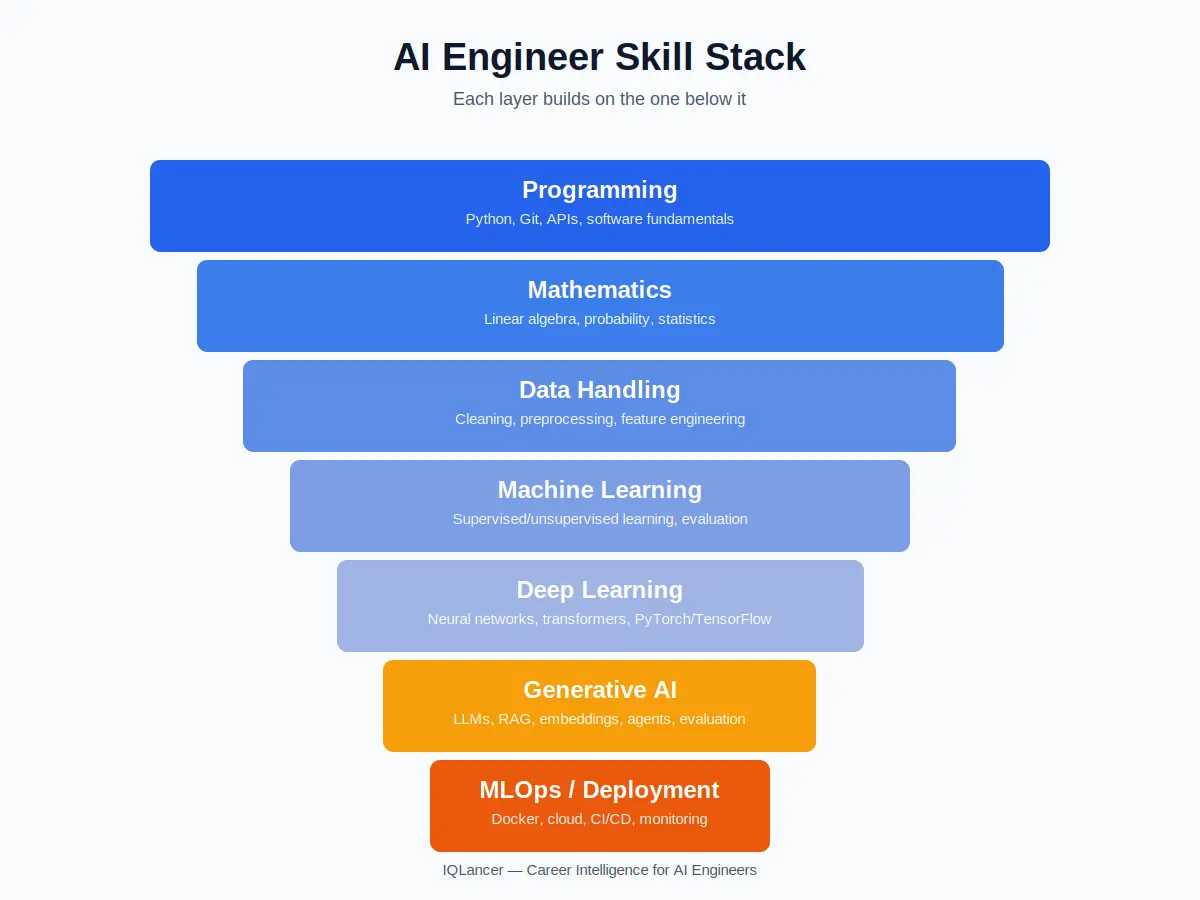
Programming
What it is: Python is the dominant language in AI engineering 365 Data Science’s analysis of 903 Glassdoor postings found Python required in 71% of AI engineer listings, well ahead of Java at 22%. Version control (Git), API design, and general software engineering fundamentals (testing, code review, modular design) round out the category.
Why employers care: An AI engineer who can’t write maintainable, tested code will produce systems that break in production, regardless of how well the underlying model performs.
How to practice it: Build projects with proper repository structure, write unit tests for data pipelines and model wrappers, and contribute to or review open-source code.
How to demonstrate it: A GitHub profile with readable commit history, README documentation, and CI checks not just a folder of notebooks.
Mathematics
What it is: Linear algebra (vectors, matrices, embeddings), probability, statistics, and enough calculus to understand gradients and optimization.
Why employers care: These concepts explain why models behave the way they do. Why a model overfits, why an embedding similarity metric works, why a learning rate matters. This depth is not required for every AI engineering role, but roles closer to model training and evaluation weight it more heavily than roles focused purely on application-layer LLM integration.
Do not exaggerate the requirement: Most working AI engineers use applied statistics and probability daily; few derive backpropagation from scratch on the job. Understand the concepts deeply enough to reason about model behavior, not necessarily to prove theorems.
How to demonstrate it: Explain a model’s evaluation metrics and their trade-offs clearly in an interview or a project README. This is a more convincing signal than a transcript.
Data
What it is: Data collection, cleaning, preprocessing, feature engineering, and data quality assessment.
Why employers care: Model quality is bounded by data quality. Every job description reviewed for this article listed data handling as a core responsibility, not a side skill.
How to demonstrate it: Document data cleaning decisions and their impact on model performance in a project showing before/after data quality metrics is far more convincing than simply stating “cleaned the dataset.”
Machine Learning
What it is: Supervised and unsupervised learning, model evaluation, model selection, overfitting/underfitting, and feature engineering.
Why employers care: This is the conceptual foundation underneath every AI application, including LLM-based ones understanding evaluation, bias, and generalization applies whether you’re training a classifier or evaluating a RAG pipeline.
How to demonstrate it: A classification or regression project with a documented evaluation methodology (not just an accuracy number) shows you understand what “good” means for a given problem.
Deep Learning
What it is: Neural network fundamentals, transformer architecture, and hands-on experience with PyTorch or TensorFlow.
Why employers care: Even engineers who never train a model from scratch need to understand transformer-based architectures well enough to reason about context windows, tokenization, and model limitations.
How to demonstrate it: A project that fine-tunes or adapts an existing model, with documented performance before and after.
Generative AI
What it is: LLM fundamentals, embeddings, vector databases, retrieval-augmented generation (RAG), prompt engineering, function/tool calling, AI agents, model evaluation, and guardrails.
Why employers care: AI Shipping Labs’ analysis of ~1,000 job postings found RAG and LLM integration among the most consistently requested skills, and Neural Concept’s data lists LangChain, RAG, and PyTorch as the most frequently listed skills across current postings.
Critical distinction: Calling an AI API is not the same as understanding AI engineering. A basic API wrapper sends a prompt and returns a response. A properly engineered AI application handles retrieval quality, evaluates output against defined criteria, manages cost and latency, defends against prompt injection, and degrades gracefully when the model fails. This distinction is covered in depth in the dedicated Generative AI section below.
MLOps / Deployment
What it is: Docker, APIs, cloud platforms, CI/CD, model monitoring, and ML lifecycle management.
Why employers care: A model that works in a notebook and a model that works in production are different engineering problems. DataExpert’s 2026 guide notes that by 2026 the role increasingly requires a “systems-first mindset” deployment, monitoring, and cost management, not just model building.
How to demonstrate it: Deploy at least one project end-to-end with a live endpoint, containerization, and basic monitoring. This single piece of evidence differentiates candidates more than any other item on this list.
The Machine Learning Roadmap: A Practical Progression
A roadmap is only useful if it tells you what you should be able to build at each stage, not just which course to take next because courses measure completion, and employers measure capability.
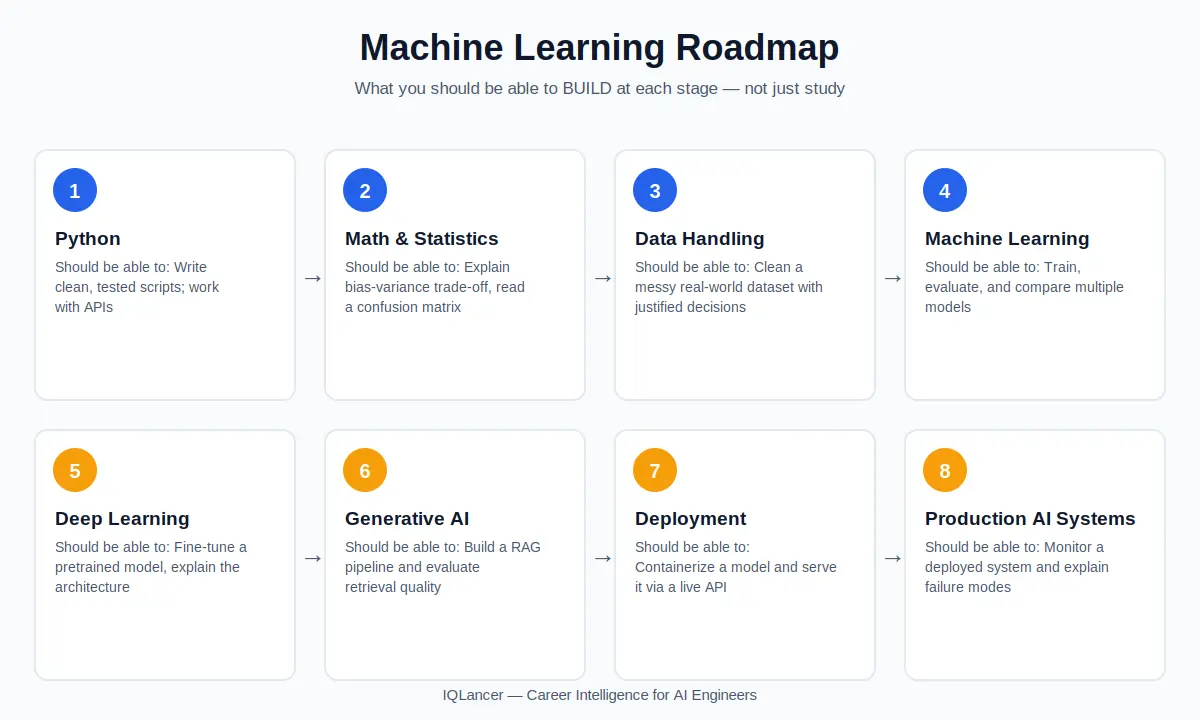
This is a competence ladder, not a list of courses to complete. A candidate who can honestly check off the parenthetical capability at each stage has a portfolio that survives technical interviews. A candidate who has only watched videos covering each stage does not.
Should You Learn Generative AI to Become an AI Engineer?
Generative AI dominates current hiring conversations, but treating it as a shortcut around ML fundamentals is one of the most common and most damaging mistakes candidates make.
Yes, generative AI is now core to the role but it builds on, rather than replaces, machine learning fundamentals. Employer demand backs this up: DataCamp’s 2026 skills guide notes that frameworks like LangChain and LangGraph have become standard for building agentic applications, and that GenAI and agentic workflows are now the higher-priority focus for most AI engineers, ahead of traditional reinforcement learning work.
The topics that matter within generative AI:
- LLMs and embeddings : Understanding how models represent meaning numerically, which underlies retrieval and search.
- Vector databases : Pinecone, Weaviate, and similar systems that store embeddings for retrieval.
- RAG (retrieval-augmented generation) : Grounding model outputs in retrieved documents rather than relying purely on the model’s parametric knowledge.
- Fine-tuning : Adapting a pretrained model to a specific task or dataset.
- Tool/function calling and AI agents : Enabling models to invoke external functions or APIs to complete multi-step tasks.
- Evaluation and guardrails : Measuring output quality and preventing unsafe or off-target responses.
The critical distinction employers are watching for: A basic AI API wrapper sends a user’s input to a model and displays the response, this is achievable in an afternoon and demonstrates almost nothing.
A properly engineered AI application includes a defined evaluation set with measurable quality criteria, retrieval that’s been tuned and tested, cost and latency budgets, and guardrails against misuse or prompt injection. A 2026 hiring guide from AY Automate puts this bluntly: “A clean GitHub repo with eval traces, cost dashboards, and a postmortem tells you everything” that a polished demo cannot. Interviewers are increasingly trained to probe for exactly this gap.
AI Tools and Frameworks: What to Actually Learn
Not every tool deserves equal attention. Classifying tools by how central they are to the job prevents the common mistake of spreading study time too thin across dozens of frameworks.
Core (learn these first):
- Python, Git, Docker
- PyTorch or TensorFlow (pick one deeply rather than both shallowly)
- Scikit-learn
- A vector database (Pinecone, Weaviate, or similar)
- A cloud platform (AWS, Azure, or GCP pick one aligned with your target employers)
Useful (learn once core skills are solid):
- Hugging Face (model hosting and fine-tuning)
- LangChain or LlamaIndex (RAG and agent orchestration)
- MLflow (experiment tracking)
- FastAPI or similar (serving models via APIs)
Specialized (learn on demand, tied to a specific role or project):
- Kubernetes (for engineers working on large-scale infrastructure)
- LangGraph (for multi-agent orchestration)
- Distributed training frameworks (for roles training large custom models)
Learning every framework in this list before applying to jobs is a common and costly mistake, covered in the Common Mistakes section below. Depth on the core tools, demonstrated through a working project, outperforms shallow exposure to a long tool list in nearly every hiring conversation.
AI Certifications: What They Prove and What They Don’t
Certifications are a structured signal, not a substitute for capability and treating them as interchangeable with real project experience is a mistake that experienced recruiters catch quickly.
Certification value is real but bounded. It demonstrates structured knowledge and gives non-technical hiring managers a baseline signal, but it does not substitute for a working portfolio. A candidate with several certificates and no meaningful projects should not be assumed more employable than a candidate with one well-documented, deployed system.
| Certification | Who it’s for | What it demonstrates | Cost / Format | Note |
|---|---|---|---|---|
| AWS Certified AI Practitioner | Beginners, non-technical-adjacent roles | Foundational AI/ML and AWS AI service concepts | ~$150, 90 min, no prerequisites | Best entry point on AWS |
| AWS Certified Machine Learning Engineer – Associate (MLA-C01) | Engineers with ~1 year of SageMaker/AWS ML experience | Ability to implement and operationalize ML workloads in production | ~$150, 130 min | Replaced the retired ML – Specialty exam |
| Microsoft Azure AI Fundamentals (AI-900) | Complete beginners | Core AI workload and ethics concepts | ~$99, 45–60 min | Good starting point on Azure |
| Azure AI Engineer / AI Apps and Agents Developer (AI-103) | Engineers building AI-powered apps on Azure | Designing and implementing AI solutions with Azure AI services | ~$165 | Replaced AI-102, which retired mid-2026 |
| Google Cloud Professional Machine Learning Engineer | Engineers with GCP experience | Ability to design, build, and productionize ML models on GCP | ~$200, 2 hours, 50–60 questions | Considered one of the more technically rigorous cloud ML certs; valid 2 years |
| AWS Certified Generative AI Developer – Professional | Experienced engineers building production GenAI apps | LLM integration, RAG design, and responsible GenAI deployment on AWS (e.g., Bedrock) | ~$300, 180 min | High-momentum credential given enterprise GenAI adoption |
Hiring relevance: Certifications function best as verified baseline signals in a market where many applicants overstate AI experience on a resume. They also matter more in enterprise environments already standardized on a specific cloud platform.
Limitations: Certifications test structured, syllabus-defined knowledge. They do not verify your ability to debug a failing production pipeline, make architectural trade-offs under ambiguity, or handle an evaluation dataset that doesn’t match textbook conditions the things technical interviews actually probe.
When to pursue one: After you already have at least one working project, not before. A certification paired with a deployed project is a stronger signal than either alone.
AI Certification Roadmap
Certifications should support your preparation, not replace the work of actually building things.
Programming Fundamentals
      ↓
ML Fundamentals
      ↓
Hands-On Projects  ← build real evidence before certifying
      ↓
Cloud / AI Certification  ← now the exam validates skills you already have
      ↓
Production AI Projects
      ↓
Advanced Specialization
Pursuing a certification before you can build anything results in credential inflation without capability exactly the pattern recruiters have learned to discount, as covered in the Rejection Intelligence section.
AI Engineering Project Intelligence
“Build 3–5 projects” is advice without substance. What matters is what each project demonstrates, what tools it uses, and what evidence you produce alongside it, because a recruiter evaluating 200 resumes needs a reason to stop scrolling.
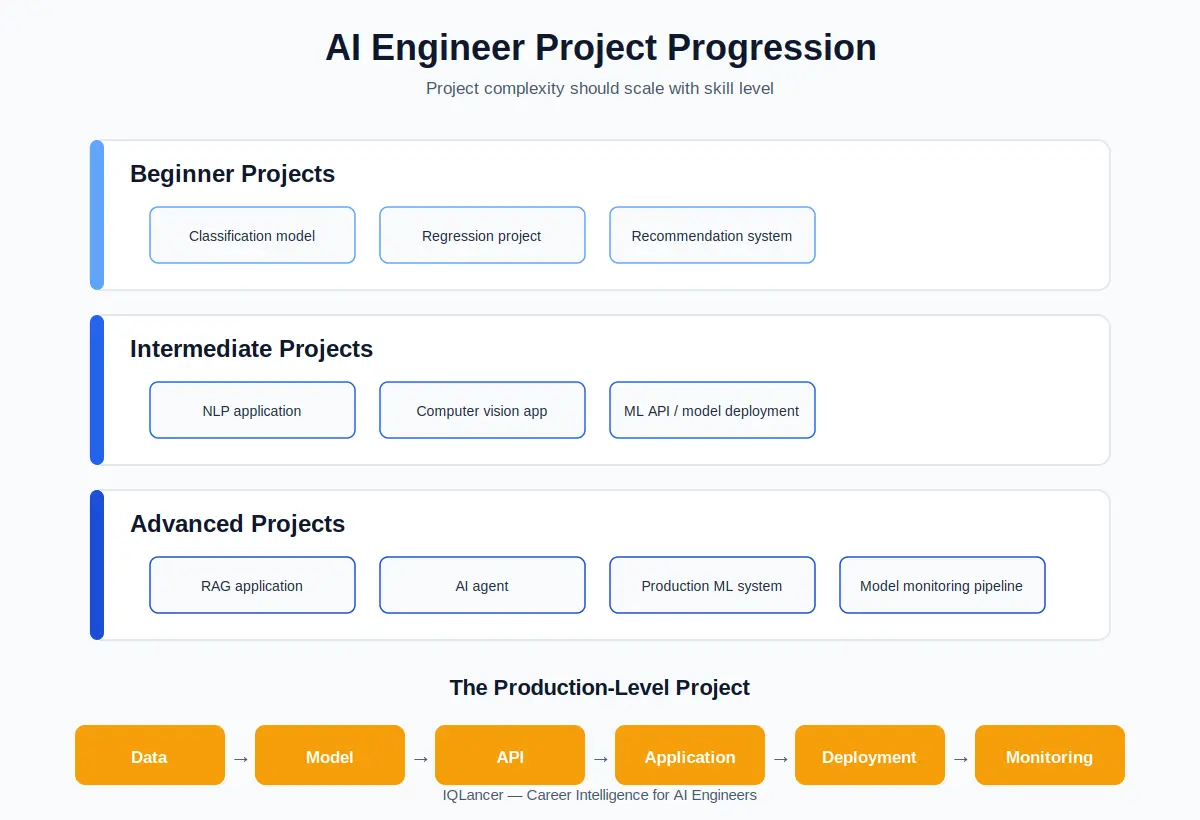
Beginner Projects
Examples: a classification model on a public dataset, a regression project predicting a real-world value, a simple recommendation system.
- Demonstrates: core ML workflow data prep, training, evaluation.
Intermediate Projects
Examples: an NLP application (sentiment analysis, summarization), a computer vision application, a model served through a REST API, a basic model deployment project.
- Demonstrates: the ability to turn a model into something usable by other software.
Advanced Projects
Examples: a RAG application over a real document set, an AI agent that completes a multi-step task, a production-style ML system with logging, a model monitoring pipeline, a deployed cloud AI application.
- Demonstrates: the systems-level thinking that separates mid-level candidates from junior ones.
The Production-Level Project
Every serious candidate should build at least one complete system that mirrors the real AI engineering workflow end to end:
Data → Model → API → Application → Deployment → Monitoring
This single project, done thoroughly, is worth more in an interview than five shallow tutorials.
For every project, document:
- What you built and why
- Tools and architecture involved
- Skills demonstrated
- A GitHub repository with a clear README
- An architecture diagram
- Model evaluation results and methodology
- API documentation
- A live deployment link where possible
- Screenshots or a short demo
- Performance metrics
- Technical decisions and trade-offs
- Known limitations and planned improvements
Avoid copying GitHub projects wholesale. Interviewers routinely ask candidates to explain a design decision behind their own project an inability to answer specifically is one of the fastest ways to lose credibility in a technical interview.
The AI Engineer Portfolio
A portfolio is not a list of finished courses it’s evidence that you can build, evaluate, deploy, and explain a working system, which is a fundamentally different (and much stronger) signal.
A strong AI Engineer portfolio should contain:
- A GitHub profile with organized, documented repositories
- Architecture diagrams for at least one non-trivial project
- Clean, readable source code with tests
- A README that explains the problem, approach, and results not just installation instructions
- Documented model evaluation with real metrics
- API documentation for any served model
- A live deployment or demo link
- Explicit discussion of trade-offs and limitations
The distinction employers are trained to look for: “Completed an AI course” is a claim about time spent. “Built, evaluated, deployed, and documented an AI system” is a claim about capability and only the second one survives a technical follow-up question.
What Employers Actually Look For
Employer expectations shift meaningfully by seniority, and applying to a role without understanding which tier it falls into wastes both your time and the recruiter’s.
Based on current job description patterns across sources including LHH, AI Shipping Labs, and 365 Data Science:
Entry-level: Python proficiency, ML fundamentals, at least one deployed project, familiarity with a cloud platform, coursework or certification in ML/AI. Degree commonly expected but not universally required if the portfolio is strong.
Mid-level (2–5 years): Production experience integrating LLMs into applications, RAG or agent-building experience, MLOps familiarity (Docker, CI/CD), independent ownership of features, cross-team collaboration.
Senior-level (5+ years): Architectural decision-making, cost and latency optimization at scale, mentoring, AI safety and guardrail design, strategic input into AI adoption decisions, and often team or project leadership.
Job Description Analysis: What Current Postings Actually Require
Rather than guessing at requirements, this section draws on published analyses of real job postings with each source’s sample size and method stated explicitly, since generalizing one company’s posting into an industry-wide rule is a common and misleading shortcut.
- 365 Data Science analyzed 903 AI engineer job postings from Glassdoor US and found Python required in 71% of listings, with Java present in 22% notably higher than in other data-related roles, reflecting AI engineering’s proximity to enterprise software engineering.
- AI Shipping Labs analyzed roughly 1,000 AI engineer postings from Built In across Berlin, Amsterdam, London, Los Angeles, and New York in January 2026, narrowed to 889 unique roles after deduplication. The analysis found AI engineering is primarily backend-driven nearly half of AI-first roles explicitly required backend skills, about a third mentioned frontend skills, and roughly a fifth expected full-stack capability.
- Neural Concept’s review of current postings found LangChain, retrieval-augmented generation, and PyTorch as the most frequently listed individual skills, with postings concentrated in large companies across IT, retail, consulting, education, and finance.
Methodology caveat, stated plainly: these samples are drawn from specific job boards and regions; they are directionally useful but not a census of every AI engineering role globally. Treat the patterns as strong signals, not universal law and always cross-check against the specific postings for your target companies.
Experience Requirements by Career Stage
Freshers / 0–1 years: Expect entry-level roles to weigh portfolio and fundamentals heavily since there’s little production history to evaluate. A degree plus 1–2 well-documented deployed projects is a realistic bar.
1–3 years: Candidates are expected to have shipped at least one production feature involving ML or GenAI, independently not just supported a team effort.
3–5 years: This is where Interview Kickstart’s 2026 salary analysis notes the sharpest compensation jump occurs, driven by scarcity of engineers with real production ML experience at this level. Expect ownership of architecture decisions, not just implementation.
5+ years: Senior expectations include mentoring, cross-functional leadership, and increasingly AI safety, cost governance, and infrastructure decisions at scale.
Adjacent entry paths and what transfers:
- Software Engineer → AI Engineer: Programming and systems skills transfer fully; ML/GenAI concepts are the gap to close.
- Backend Engineer → AI/GenAI Engineer: API and infrastructure skills transfer directly; the gap is model behavior, evaluation, and prompt/RAG design.
- Data Scientist → AI Engineer: Modeling and statistics transfer; the gap is production software engineering discipline.
- ML Engineer → AI Engineer: Model training and MLOps transfer almost completely; the gap, if any, is applied LLM/GenAI-specific tooling.
- Data Engineer → AI/ML roles: Pipeline and infrastructure skills transfer directly; the gap is modeling and evaluation.
Realistic Learning Timelines
Timelines below are planning estimates based on typical preparation patterns, not guarantees actual pace depends heavily on prior background, hours available per week, and how much of the roadmap above is already covered.
| Starting point | Realistic timeline to a credible entry-level portfolio |
|---|---|
| CS/IT graduate with programming experience | Several months, focused primarily on ML/GenAI concepts and one production-level project |
| Software developer (non-ML background) | Roughly 4–8 months, layering ML fundamentals and GenAI skills onto existing engineering strength |
| Data professional (analyst/scientist) | Roughly 4–8 months, with emphasis on software engineering and deployment discipline |
| Career switcher from a non-technical field | Realistically 9–18 months, building programming fundamentals before layering ML on top |
| Complete beginner | 12+ months is a more honest planning horizon than any shorter promise |
No credible path compresses this into 30, 60, or 90 days for a role that current job postings treat as requiring genuine software engineering and ML competence.
AI Engineer Salary: What the Data Actually Shows
Salary figures for AI engineers vary widely by source because different platforms measure different slices of the market and presenting a single number without that context is misleading.
U.S. base salary, by source (2026):
- Glassdoor reports a median base around $142,000–$173,000 depending on the reporting period, with a typical range roughly $114,000–$180,000.
- Built In shows a higher average around $184,757, reflecting a more senior, tech-company-heavy respondent pool.
- Levels.fyi puts median total compensation (including equity) in the $155,000–$244,000 range depending on the sampling window, skewing toward large, well-funded tech employers.
- The U.S. Bureau of Labor Statistics benchmarks the closest official occupational category, computer and information research scientists, at a $140,910 median.
By experience level (synthesized across Glassdoor, Built In, and Levels.fyi):
- Entry-level: roughly $115,000–$170,000 base
- Mid-level (3–5 years): roughly $140,000–$240,000 base
- Senior (5–8 years): roughly $220,000–$310,000 base, with total compensation frequently exceeding $340,000 at large tech companies once equity is included
- Staff / Principal: base commonly $250,000–$400,000+, with total compensation well above that at frontier AI labs
What drives the variance:
- Specialization : Engineers with production LLM/GenAI experience command a meaningful premium over generalist ML engineers, per multiple 2026 salary guides.
- Company tier : Frontier AI labs and large tech companies pay substantially above the broader market; equity is a large share of total compensation at senior levels.
- Location : The San Francisco Bay Area commands the highest premiums; remote roles have narrowed but not closed the geographic gap.
- Production experience vs theoretical knowledge : Candidates who can point to deployed, evaluated systems are consistently valued above candidates with equivalent years of purely academic or research experience.
Treat any single salary figure with caution. The honest summary across sources: expect a wide range depending on specialization, company, and location, and expect experience specifically production experience to be the single largest driver of where you land in that range.
Rejection Intelligence: Why AI Engineer Candidates Get Rejected
Understanding why qualified-looking candidates get rejected is more useful than another list of skills to learn, because it addresses the gap between having a skill and proving it convincingly.
| Rejection reason | Why recruiters reject it | What to do instead |
|---|---|---|
| Prompt engineering without fundamentals | Signals the candidate can operate a model but not reason about its failure modes or build the system around it | Pair GenAI work with ML fundamentals evaluation, data handling, model behavior |
| Tutorial-only projects | Every reviewer has seen the same five tutorial projects; they demonstrate following instructions, not independent problem-solving | Build something with a dataset, constraint, or use case you chose yourself |
| No deployment experience | A model that only runs locally proves nothing about production readiness | Deploy at least one project with a live, working endpoint |
| Weak Python fundamentals | Job postings require it at high rates (71% per 365 Data Science’s analysis); weak fundamentals surface immediately in technical screens | Practice software engineering, not just ML libraries testing, structure, readability |
| Weak ML understanding under an AI/GenAI title | GenAI-only candidates often can’t explain evaluation trade-offs when pressed | Build one project that requires genuine model evaluation, not just prompting |
| No evaluation methodology | “It works” is not evidence; interviewers ask “how do you know it works, and how well?” | Define and document evaluation criteria for every project |
| Certificates without projects | Reads as credential collection rather than capability | Build the project before or alongside the certification, not instead of it |
| Copying GitHub projects | Falls apart under any specific follow-up question about design decisions | Build original variations and be ready to explain every choice |
| Basic AI API wrappers presented as “AI engineering” | Doesn’t demonstrate the systems thinking the role actually requires | Add evaluation, guardrails, cost/latency awareness, and error handling |
| No software engineering discipline | Notebooks full of exploratory code don’t translate to production reliability | Practice writing modular, tested, documented code |
| No measurable project outcomes | Vague claims (“built a chatbot”) don’t differentiate a candidate | Quantify results accuracy, latency, cost per query, retrieval precision |
7 Common Mistakes AI Engineering Candidates Make
1. Trying to learn every AI framework at once. Candidates spread a few hours each across a dozen tools instead of building depth in the core stack. Recruiters see shallow familiarity with everything and mastery of nothing.
Do instead: pick the core tool list above and go deep before branching out.
2. Ignoring Python fundamentals in favor of AI tools. Candidates jump straight to LangChain or a fine-tuning tutorial without solid programming fundamentals underneath. This surfaces immediately in a live coding round.
Do instead: treat software engineering fundamentals as a prerequisite, not an afterthought.
3. Skipping machine learning fundamentals to focus only on GenAI. GenAI is the current headline, but interviewers routinely test whether a candidate understands evaluation, overfitting, and model behavior underneath the API call.
Do instead: build at least one traditional ML project alongside GenAI work.
4. Building only API wrappers and calling it AI engineering. This is the single most common gap identified across the sources reviewed for this article.
Do instead: add evaluation, retrieval quality tuning, and guardrails to every LLM project.
5. Ignoring deployment entirely. A model that only runs in a notebook signals unfinished work.
Do instead: deploy one project fully, even on a free-tier cloud service.
6. Collecting certifications instead of building a portfolio. Certifications without projects read as credential inflation to experienced recruiters.
Do instead: sequence projects before certifications, per the roadmap above.
7. Having no measurable outcomes to point to. Vague project descriptions don’t survive a technical interview.
Do instead: quantify every project’s results and be ready to defend the methodology behind those numbers.
The AI Career Path
Career progression in this field is not linear across every company, but a realistic default trajectory looks like this:
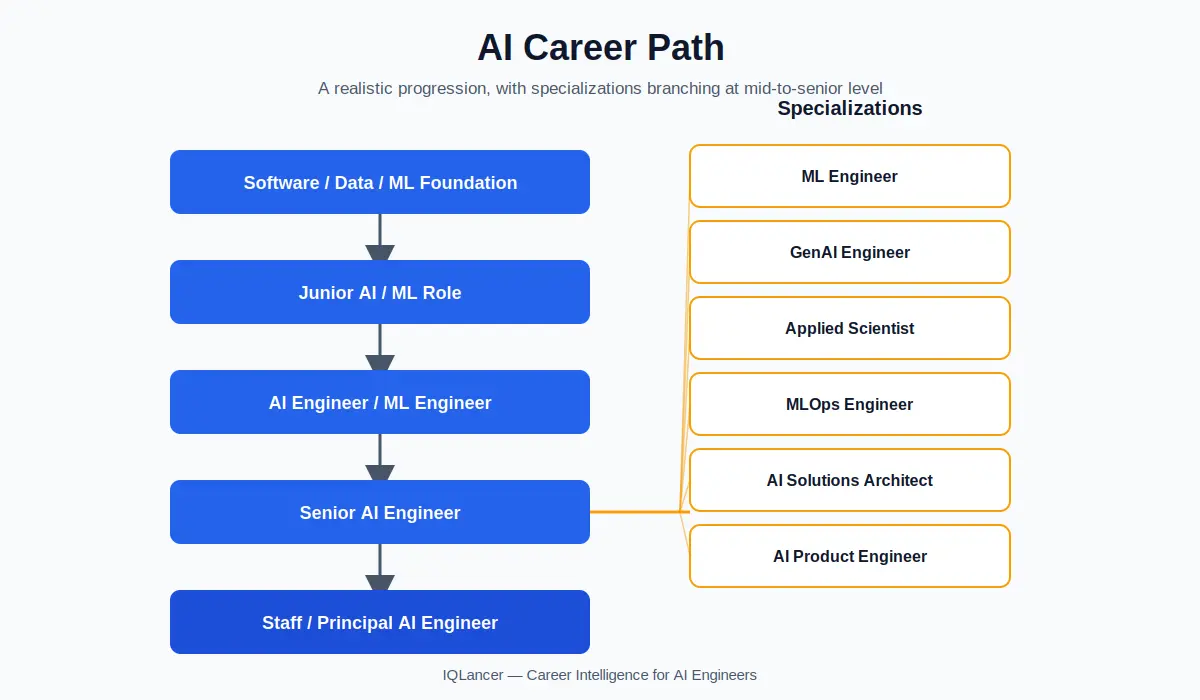
Alternative specializations branch off at the mid-to-senior level:
- ML Engineer : Deeper focus on model training and infrastructure
- GenAI Engineer : Specialization in LLM applications, RAG, and agents
- Applied Scientist : Research-adjacent roles at larger companies
- MLOps Engineer : Focus on deployment, monitoring, and infrastructure at scale
- AI Solutions Architect : Design-level, cross-team AI system architecture
- AI Product Engineer : Hybrid role bridging AI capability and product decisions
Career paths differ meaningfully between a startup (where one engineer might own the whole pipeline for years) and a large tech company (where specialization happens earlier). Neither path is objectively better; they suit different working styles and risk tolerances.
ATS Intelligence: Keywords and the Evidence Behind Them
Applicant tracking systems and resume screeners look for specific keywords, but a keyword alone without evidence is a weak signal that experienced reviewers discount quickly.
Common ATS keywords for AI engineer roles, drawn from the job description patterns discussed above, include: Python, Machine Learning, Deep Learning, PyTorch, TensorFlow, Scikit-learn, LLM, RAG, Embeddings, Vector Database, NLP, Computer Vision, Docker, Kubernetes, AWS, Azure, GCP, MLOps, MLflow, APIs, Model Deployment.
The mistake most candidates make: listing these as bare nouns. A resume line that just says “RAG” or “MLOps” provides no evidence and is functionally indistinguishable from every other resume with the same keyword.
A stronger approach model example, not a fabricated personal claim:
Instead of: “RAG” Write something like: “Built and evaluated a RAG pipeline using embeddings and a vector database, improving retrieval quality against a defined evaluation set.”
Instead of: “MLOps” Write something like: “Containerized and deployed a model to a cloud endpoint with monitoring for latency and drift.”
Every keyword category in the list above should be backed by one line of real, specific evidence from an actual project. This is the single highest-leverage resume change most candidates can make.
IQLancer AI Engineer Readiness Checklist
| Area | Importance | Self Assessment |
|---|---|---|
| Python | Critical | ☐ Beginner ☐ Comfortable ☐ Strong |
| Mathematics (linear algebra, probability, stats) | High | ☐ Beginner ☐ Comfortable ☐ Strong |
| Data Handling | Critical | ☐ Beginner ☐ Comfortable ☐ Strong |
| Machine Learning | Critical | ☐ Beginner ☐ Comfortable ☐ Strong |
| Deep Learning | High | ☐ Beginner ☐ Comfortable ☐ Strong |
| Generative AI (RAG, embeddings, agents) | Critical | ☐ Beginner ☐ Comfortable ☐ Strong |
| APIs | Critical | ☐ Beginner ☐ Comfortable ☐ Strong |
| Cloud (AWS / Azure / GCP) | High | ☐ Beginner ☐ Comfortable ☐ Strong |
| Deployment | Critical | ☐ Beginner ☐ Comfortable ☐ Strong |
| Git | Critical | ☐ Beginner ☐ Comfortable ☐ Strong |
| Docker | High | ☐ Beginner ☐ Comfortable ☐ Strong |
| MLOps | High | ☐ Beginner ☐ Comfortable ☐ Strong |
| Projects (deployed, documented) | Critical | ☐ 0 ☐ 1–2 ☐ 3+ |
| Portfolio (GitHub, README, live demos) | Critical | ☐ Missing ☐ Partial ☐ Strong |
| Software Engineering Fundamentals | Critical | ☐ Beginner ☐ Comfortable ☐ Strong |
Use this checklist honestly. Every row marked “Beginner” is a specific, addressable gap not a reason to abandon the path, but a clear next action.
Conclusion
Becoming an AI engineer is achievable, but it is not a shortcut into tech. It requires real programming ability, working machine learning fundamentals, and increasingly hands-on generative AI skills like RAG and agent design, backed by projects you can defend under questioning.
The candidates who get hired aren’t the ones with the most certifications or the longest tool list; they’re the ones who can point to something they built, evaluated, deployed, and can explain in detail. If you’re serious about how to become an AI engineer, treat this article as a starting checklist: assess your current skill stack honestly, follow the machine learning roadmap in order, build one complete production-style project before chasing certifications, and read job descriptions for evidence of what a role actually requires. That combination not hype about AI careers is what turns preparation into an offer.