Cybersecurity analyst job postings routinely ask for “3-5 years of experience” for what is technically an entry-level role, and most candidates respond by collecting certifications instead of asking what recruiters actually verify. That gap between what candidates do to prepare and what employers actually check is the real obstacle in this field not a lack of training resources.
Learning how to become a cybersecurity analyst means understanding that certifications open the door, but hands-on evidence logs you’ve analyzed, incidents you’ve investigated, tools you’ve configured is what gets you through it. The IQlancer breaks down the actual requirements: the technical skills employers test for, the certifications worth your money and time, the projects that prove capability, realistic salary data, and the specific reasons qualified-looking candidates get rejected.
No motivational filler just what you need to become competitive.
What Does a Cybersecurity Analyst Actually Do?
Before investing months into certifications and labs, it matters to understand what the job actually involves day to day, because the “hacker in a hoodie” image that draws people into cybersecurity is almost nothing like the real work, and misunderstanding the role leads to poor preparation.
A cybersecurity analyst’s core job is defensive, not offensive. The role centers on monitoring an organization’s systems for signs of compromise, investigating alerts to determine whether they represent real threats, and responding when something goes wrong. This is fundamentally an analytical, evidence-based job closer to being a detective who reviews logs and timelines than a person actively “hacking” anything.
Security monitoring and alert investigation. Analysts watch dashboards typically a SIEM (Security Information and Event Management) platform that aggregate log data from firewalls, endpoints, servers, and applications. Most alerts are false positives or low-severity noise. The analyst’s job is to triage: which alerts need immediate action, which need more investigation, and which can be closed. This alert-fatigue reality is one of the most underrepresented parts of the job in career-advice content.
Threat detection. Analysts look for indicators of compromise (IOCs) unusual login patterns, unexpected outbound traffic, known malicious IP addresses, abnormal process behavior and correlate them against known attacker techniques, often mapped to frameworks like MITRE ATT&CK.
Incident response. When a real incident is confirmed, analysts move into investigation, containment, and documentation. This means determining scope (what was accessed, when, how), isolating affected systems, and writing a clear incident report that both technical and non-technical stakeholders can understand.
Vulnerability management. Analysts run or review vulnerability scans, help prioritize which weaknesses get patched first based on exploitability and business impact, and track remediation to completion.
Security reporting and controls. Analysts document findings, report on the organization’s security posture to stakeholders, and help implement or tune security controls like firewall rules, access policies, and detection rules.
None of this requires to how to become a cybersecurity analyst “breaking into” anything. It requires pattern recognition, methodical investigation, clear written communication, and comfort working inside ambiguity because most days you are deciding whether something might be a problem, not confirming a dramatic breach.
Is Cybersecurity a Good Career in 2027 and Beyond?
Career decisions built on hype fade fast, so before recommending this path IQLancer looks at what the data actually shows about demand, pay, and risk rather than repeating the “always in demand” claim uncritically.
The U.S. Bureau of Labor Statistics projects information security analyst employment to grow 29% from 2024 to 2034 categorized as “much faster than average” against a roughly 3% average across all occupations with about 16,000 openings projected annually, driven by both new positions and the need to replace analysts who leave the field or retire.
The median annual wage was $124,910 as of May 2024, the most recent year of official federal data. This growth is tied to concrete, structural drivers rather than vague “cyberattacks are rising” language: expanding cloud adoption, a growing attack surface as more infrastructure moves online, new AI-related security challenges (from AI-powered attacks to securing AI systems themselves), and tightening regulatory requirements across industries like healthcare and finance.
At the same time, a fair account of the field in 2026 needs to include some nuance that most career-advice content skips. CyberSeek, the NIST- and CompTIA-backed workforce tracker, reported over 514,000 open U.S. cybersecurity positions in the year ending March 2026 demand is real and growing. But ISC2’s 2025 Cybersecurity Workforce Study based on more than 16,000 respondents notably stopped publishing its long-cited “global workforce gap” figure this year, explaining that critical skills shortages, not raw headcount, are now the more pressing constraint; 95% of surveyed professionals reported at least one skills gap on their team.
Separately, some organizations have simultaneously reported budget cuts, hiring freezes, and layoffs even during a period of high demand for security talent meaning “high demand” does not mean every employer is hiring freely or that entry-level roles are easy to land without preparation.
The honest takeaway: To become a cybersecurity analyst is a strong long-term career bet backed by real structural demand, not a guaranteed fast-track to a six-figure job. It rewards people who build demonstrable, current skills particularly around cloud security and AI-adjacent risk, which ISC2 and CyberSeek both flag as the fastest-growing skill areas over people who simply collect entry-level certificates and wait.
Do You Need a Specific Degree to Become a Cybersecurity Analyst?
This is one of the most common points of confusion for people evaluating this career, so it deserves a direct answer rather than a vague “it depends,” because the wrong assumption here can cost someone years of unnecessary schooling or, conversely, false confidence with no plan at all.
The BLS notes that information security analysts typically need a bachelor’s degree in a computer-science-related field along with related work experience, and that employers may prefer candidates with professional certification. That is a typical pathway, not a required one and it is important to separate the two.
Degrees that map well to this role:
- Cybersecurity or Information Security (most directly aligned, though still a newer degree category at many schools)
- Computer Science (strong technical foundation, but security itself often needs to be self-studied on top of it)
- Information Technology or Information Systems
- Networking or Telecommunications
- Electrical/Computer Engineering (less common, but the systems-level knowledge transfers)
What “preferred” means in practice: many job postings list a bachelor’s degree as “preferred” or default language carried over from generic HR templates, but a meaningful share of real hiring managers especially for SOC (Security Operations Center) and junior analyst roles will accept CompTIA Security+ plus demonstrated hands-on skill and a couple of years of general IT experience in place of a degree. This is more true at mid-size companies and MSPs (managed service providers) than at large regulated enterprises, defense contractors, or federal agencies, where a degree and/or security clearance requirements are harder to bypass.
Self-taught and non-traditional pathways are viable but harder to prove. Without a degree, the burden of proof shifts entirely onto certifications, hands-on labs, and a documented portfolio (covered later in this guide). This is not a shortcut; it is a different kind of work, trading classroom hours for lab hours and project documentation.
Can Non-IT Candidates Transition Into Cybersecurity?
Career switchers ask this constantly, and it deserves an honest answer rather than a motivational “yes you can” because entering from outside IT changes the timeline and the specific gaps a candidate needs to close.
Yes, non-IT and non-CS graduates can transition into cybersecurity; but realistically, not directly. Cybersecurity analyst work assumes baseline comfort with networking, operating systems, and how computer systems function, and that foundation rarely exists in candidates coming from fields like marketing, finance, teaching, or the military outside of technical roles.
The candidates who make this transition successfully almost always pass through an intermediate step first: IT support, help desk, network administration, or a related technical role, for six months to two years, before moving into a security-focused position.
That said, some non-IT backgrounds transfer real value. Candidates with legal, compliance, audit, or risk-management backgrounds often move well into GRC (Governance, Risk, and Compliance) or security-adjacent analyst roles, since regulatory literacy is a genuine asset there. Candidates from law enforcement or the military frequently transition well into incident response and forensics, where investigative discipline matters as much as technical depth. Writers and analysts from other fields sometimes find a fit in threat intelligence, where communication and pattern synthesis matter more than deep scripting ability.
The realistic prerequisite for a non-IT candidate: budget 6–18 months minimum before applying to analyst roles, spent building fundamentals (networking, Linux, Windows), and don’t skip the IT-support or help-desk step just because it feels like a detour for most people without a technical background, it is the fastest real path in, not a wasted step.
The Core Skills Employers Actually Evaluate
Employers do not hire based on a list of buzzwords on a resume they hire based on whether a candidate can perform specific tasks under realistic conditions, which is why this section explains what each skill means in practice, not just what it’s called.
Networking Fundamentals
- What it is: Understanding how data moves across networks TCP/IP, DNS resolution, HTTP/HTTPS traffic, VPNs, and how firewalls filter traffic.
- Why employers care: Nearly every security investigation starts with network traffic. If you can’t read a packet capture or explain why a connection to an unusual port matters, you can’t do the job.
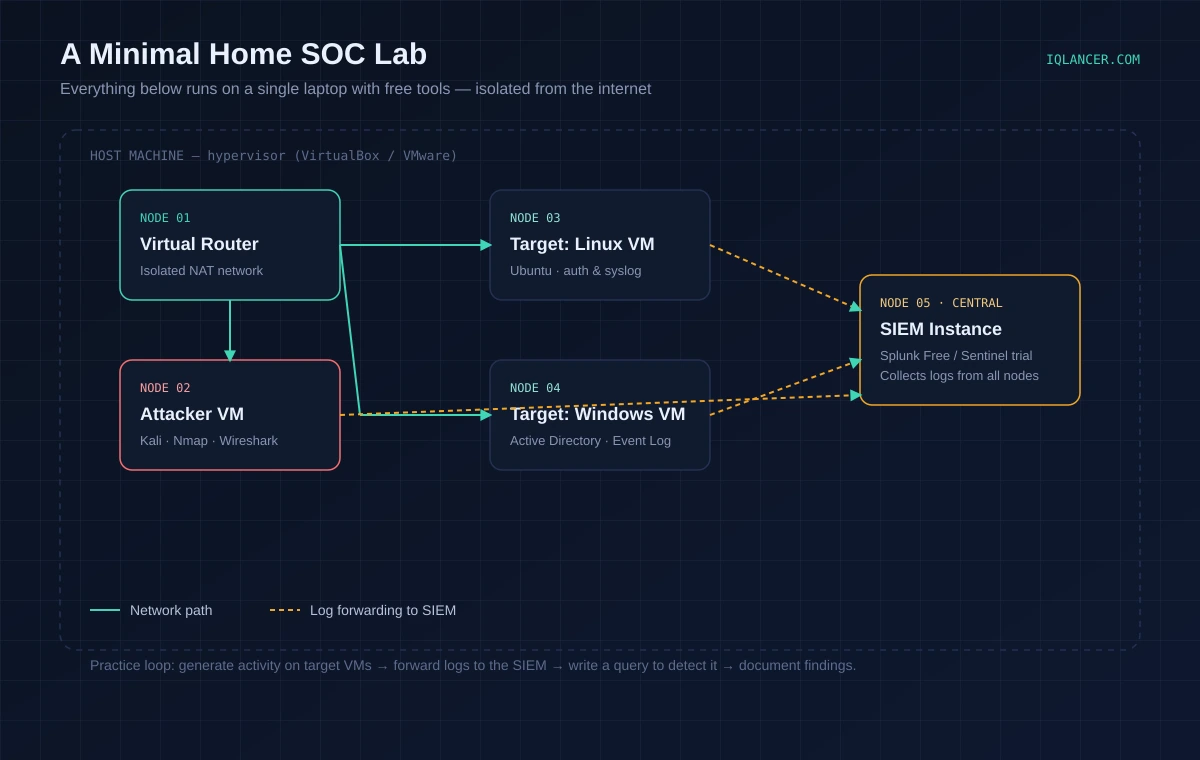
- How to practice it: Set up a home lab with a router, a couple of virtual machines, and Wireshark to capture and inspect real traffic. Study for CompTIA Network+ concepts even if you don’t sit the exam.
- How to demonstrate it: Document a lab exercise where you captured and analyzed traffic from a simulated attack (e.g., a port scan) and explain what you observed.
Linux
- What it is: Comfort with the command line, file permissions, process management, and log locations (
/var/log) on Linux systems. - Why employers care: Most servers, cloud infrastructure, and security tools run on Linux. An analyst who can’t navigate a Linux shell can’t investigate a compromised Linux host.
- How to practice it: Run a Linux VM (Ubuntu or Kali) and practice navigating logs, managing users and permissions, and using basic scripting to search log files.
- How to demonstrate it: Show a documented lab where you identified suspicious activity by reviewing Linux system or authentication logs.
Windows and Active Directory
- What it is: Understanding Windows security architecture, Active Directory (the identity and access system most enterprises run on), and Windows Event Logs.
- Why employers care: Most enterprise attacks including ransomware involve Windows endpoints and Active Directory compromise at some stage. Analysts who understand AD can spot privilege escalation and lateral movement.
- How to practice it: Build a small Active Directory lab in virtual machines and practice reviewing Windows Event Viewer logs for signs of failed logins, privilege changes, or unusual account activity.
- How to demonstrate it: Document an investigation of a simulated Windows event log (many free sample datasets exist for this) and explain your reasoning.
Security Fundamentals
- What it is: Core concepts including the CIA triad (confidentiality, integrity, availability), authentication vs. authorization, encryption basics, and how vulnerabilities are classified.
- Why employers care: These concepts are the shared vocabulary of the entire field every certification, every SIEM alert, and every incident report assumes fluency here.
- How to practice it: This is largely conceptual; CompTIA Security+ study materials cover it systematically, reinforced by applying it inside labs rather than memorizing definitions.
- How to demonstrate it: Interview readiness being able to explain these concepts clearly and apply them to a scenario, not just define them.
SIEM and Log Analysis
- What it is: Using a SIEM platform to search, correlate, and interpret logs from across an organization’s systems.
- Why employers care: This is the daily core of SOC and analyst work. Nearly every job posting lists SIEM experience as a requirement.
- How to practice it: Splunk offers a free tier suitable for home labs, and Microsoft Sentinel has a free trial through Azure. Practice writing search queries against sample log datasets and building basic detection rules.
- How to demonstrate it: A documented walkthrough showing a query you wrote, what it detected, and why it matters; this is one of the strongest portfolio pieces an entry-level candidate can have.
Threat Detection
- What it is: Recognizing indicators of compromise and distinguishing real threats from noise.
- Why employers care: Alert fatigue is real; employers need analysts who can triage efficiently without missing genuine incidents.
- How to practice it: Use free threat-intel resources and practice mapping observed behaviors to the MITRE ATT&CK framework, which is widely used across the industry as a common reference for attacker techniques.
- How to demonstrate it: Reference specific ATT&CK techniques when discussing lab findings; it signals fluency with the industry’s shared language.
Incident Response
- What it is: The structured process of investigating, containing, and documenting a security incident.
- Why employers care: How an analyst handles the first hour of a real incident can materially change the damage. Employers want evidence of methodical thinking under pressure, not panic.
- How to practice it: Follow the incident-response lifecycle outlined in NIST’s Computer Security Incident Handling Guide (SP 800-61) and apply it to tabletop exercises or simulated scenarios in your home lab.
- How to demonstrate it: A written incident report from a lab exercise following a real IR structure (timeline, scope, containment steps, root cause, recommendations) is one of the most persuasive artifacts a junior candidate can show.
Vulnerability Management
- What it is: Scanning systems for known weaknesses, prioritizing which need fixing first, and tracking remediation.
- Why employers care: Unpatched, known vulnerabilities remain one of the most common ways attackers gain initial access this is preventable work that materially reduces risk.
- How to practice it: Run Nessus Essentials (free for personal use, limited scope) or OpenVAS against your own lab machines and practice prioritizing findings by severity and exploitability.
- How to demonstrate it: A sample vulnerability assessment report showing what you scanned, what you found, and how you prioritized remediation.
Scripting (Python, PowerShell, Bash)
- What it is: Basic ability to automate repetitive tasks parsing logs, pulling data from APIs, or automating simple checks.
- Why employers care: Manual log review doesn’t scale. Even junior analysts benefit from being able to write a script that filters thousands of log lines down to the ten that matter.
- How to practice it: Learn just enough Python or PowerShell to parse a CSV or log file and flag entries matching a pattern; this doesn’t require software-engineering-level skill.
- How to demonstrate it: A small script in your GitHub portfolio that does something concrete, like flagging failed login attempts from a sample log file.
Cloud Security Fundamentals
- What it is: Understanding how identity, storage, and network security work differently in AWS and Azure compared to on-premises environments.
- Why employers care: This is the single fastest-growing skill area cited by both ISC2 and CyberSeek as organizations move workloads to the cloud, and it’s increasingly expected even at entry level.
- How to practice it: Use the free tiers of AWS or Microsoft Azure to explore identity and access management (IAM) settings, security groups, and basic monitoring tools like AWS GuardDuty or Azure Security Center.
- How to demonstrate it: Document a small cloud security exercise for example, configuring IAM least-privilege access or reviewing cloud security logs for anomalies.
Cybersecurity Tools: What to Actually Learn First
Beginners often try to learn every security tool they see mentioned online, which wastes time and produces shallow knowledge across the board rather than real competence anywhere the smarter approach is understanding which tools matter at which stage.
Foundational tools worth learning early:
- Wireshark packet capture and traffic analysis; essential for understanding network fundamentals
- Nmap network scanning; used constantly for reconnaissance and asset discovery
- Linux command line not a single tool, but the baseline skill underlying nearly everything else
Tools that show entry-level analyst readiness:
- Splunk or Microsoft Sentinel SIEM platforms; the two most commonly referenced in job postings
- Nessus vulnerability scanning
- Python or PowerShell for basic automation
Specialized tools to explore only after the basics are solid:
- Burp Suite web application security testing, more relevant to application security or penetration testing tracks than general SOC analyst work
- Endpoint Detection and Response (EDR) platforms like CrowdStrike or Microsoft Defender usually learned on the job since access typically requires enterprise licensing
What each tool demonstrates to an employer: Wireshark and Nmap show you understand networks at a packet level; a SIEM platform shows you can operate in a real analyst workflow; Nessus shows you understand the vulnerability lifecycle; scripting shows you can scale beyond manual work. You don’t need mastery of all of them you need working familiarity with the foundational and entry-level tiers, backed by evidence you’ve actually used them.
Cybersecurity Certifications: What They Prove and What They Don’t
Certifications are one of the most misunderstood parts of breaking into this field, largely because certification providers market them as job guarantees, when in reality they function as one signal among several that employers weigh.
CompTIA Security+ (SY0-701). The most widely requested entry-to-mid-level credential in the field CompTIA states it appears in the majority of cybersecurity job postings that specify a required credential. It’s vendor-neutral, covers five domains (general security concepts, threats and vulnerabilities, security architecture, security operations, and governance/risk/compliance), and consists of up to 90 questions in 90 minutes with a passing score of 750/900. CompTIA recommends candidates hold Network+ and have roughly two years of security-adjacent IT experience first, though this is a recommendation, not a hard prerequisite.
- Who it’s for: anyone entering the field, regardless of background.
- Limitation: it proves foundational knowledge, not hands-on capability pair it with labs.
ISC2 Certified in Cybersecurity (CC). A genuinely entry-level credential from ISC2 (the organization behind CISSP), designed for people with little to no prior security experience.
- Who it’s for: complete beginners who want a recognized credential before Security+ or in parallel with it.
- Limitation: less universally requested by employers than Security+, so treat it as a supplement, not a substitute.
Google Cybersecurity Certificate. A self-paced, project-based online program covering security fundamentals, Linux, SQL, and Python basics through Coursera.
- Who it’s for: self-taught candidates without an IT background who want a structured curriculum with built-in projects.
- Limitation: carries less individual weight with hiring managers than Security+, so it works best as a first step, not an endpoint.
CompTIA CySA+ (Cybersecurity Analyst). Directly targets the analyst role threat detection, SIEM use, incident response, and vulnerability management
making it one of the most role-relevant certifications available.
- Who it’s for: candidates who already have Security+ and roughly a year or more of hands-on exposure and want a credential that maps precisely to analyst-level job duties.
- Limitation: it assumes foundational knowledge already in place; jumping straight to CySA+ without that base is a common and costly mistake.
Microsoft security certifications (e.g., SC-200: Security Operations Analyst Associate). Vendor-specific but highly relevant if you’re targeting organizations running Microsoft Sentinel and the Microsoft security stack.
- Who it’s for: candidates targeting roles at organizations known to run Microsoft-centric security tooling.
- Limitation: narrower applicability outside Microsoft-heavy environments compared to vendor-neutral credentials.
Cisco certifications (e.g., CyberOps Associate). Relevant particularly for candidates coming from a networking background or targeting network-security-heavy SOC roles.
- Who it’s for: candidates with networking experience who want a security credential that builds on Cisco-specific knowledge.
- Limitation: like Microsoft’s track, it’s more valuable in environments that run Cisco infrastructure.
The one principle that matters across all of them: certification alone does not equal a job. Every certification provider will imply otherwise; every experienced hiring manager will tell you the opposite. Certifications get your resume past automated filters and signal baseline knowledge hands-on projects and interview performance are what actually close offers.
The Certification and Skills Roadmap: Why Order Matters
A common mistake is attempting certifications out of sequence jumping to CySA+ or even CISSP-adjacent material before establishing fundamentals which wastes study time on material that doesn’t stick without the right foundation underneath it.
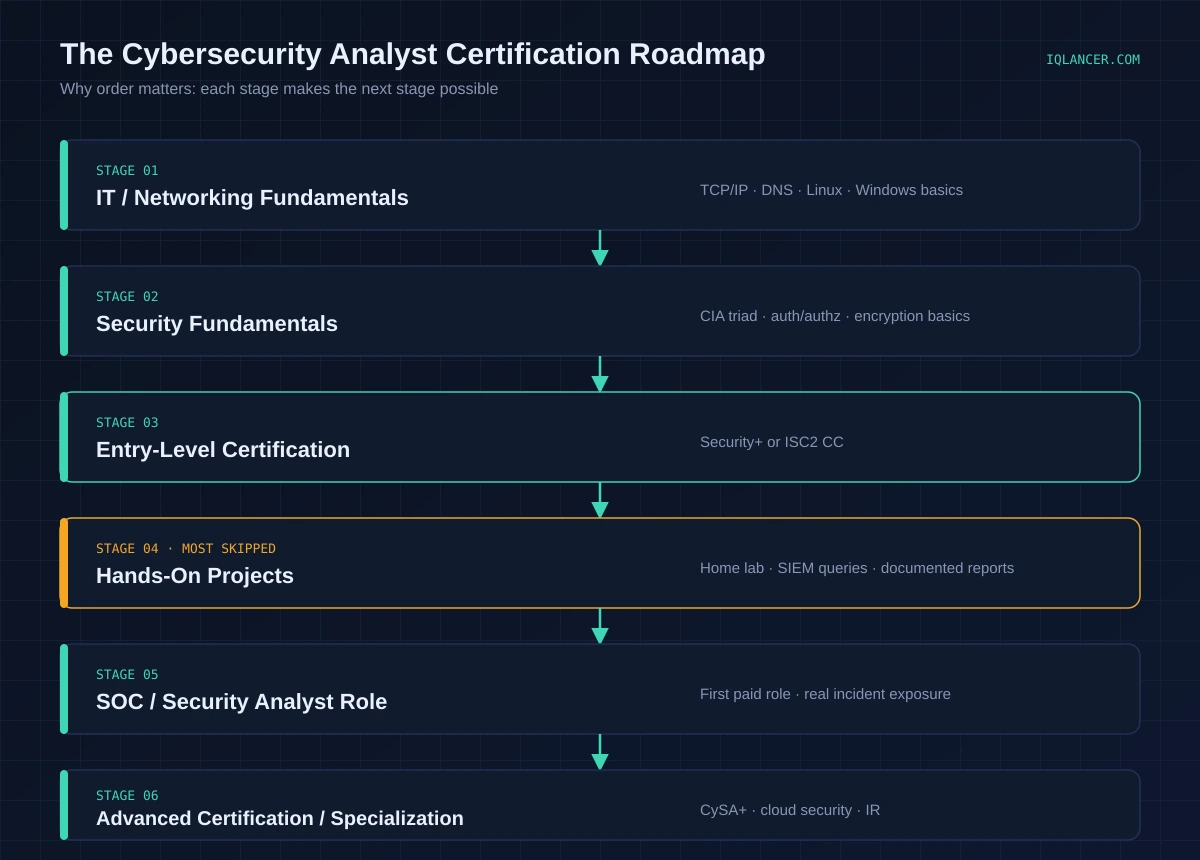
1. IT / Networking Fundamentals → Build comfort with how computers, networks, and operating systems actually work. This is the stage most career switchers try to skip, and it’s the stage that most determines long-term success.
2. Security Fundamentals → Learn the CIA triad, authentication/authorization, encryption basics, and common vulnerability types the shared vocabulary of the field.
3. Entry-Level Certification (Security+ or ISC2 CC) → Validate the fundamentals with a recognized credential that gets your resume through automated filters.
4. Hands-On Projects → This is the stage most candidates underinvest in. Build a home lab, analyze sample logs, document investigations. This is where “I studied cybersecurity” turns into “I can do cybersecurity work.”
5. SOC / Security Analyst Role → Apply for entry-level SOC Tier 1 or junior analyst positions. This is genuinely the most common on-ramp into the profession the volume of these roles, driven by the need for round-the-clock coverage, makes them the highest-probability entry point.
6. Advanced Certification / Specialization → Once inside the field with real experience, pursue CySA+, cloud security certifications, or specialization-specific credentials based on where your interest and the market are pointing.
Why this order matters: certifications studied without underlying fundamentals are memorized and forgotten quickly, and hands-on projects attempted without fundamentals produce confusion rather than confidence. Each stage exists to make the next stage possible.
Project Intelligence: What to Build and Why It Matters
Course completions and certifications tell an employer what you were exposed to; projects tell an employer what you can actually do which is why this section exists as one of the highest-leverage parts of any preparation plan.
Aim for a small number of well-documented projects rather than many shallow ones three to five thorough, clearly written projects consistently outperform a long, undocumented list.
Beginner projects:
- Network traffic analysis. Capture traffic in a home lab using Wireshark, simulate basic activity (like a port scan using Nmap against your own lab machine), and document what you observed in the capture.
- Linux security lab. Set up a Linux VM, configure user permissions and basic hardening, then document a review of authentication logs for suspicious activity.
- Basic vulnerability scanning. Run Nessus Essentials or OpenVAS against your own lab environment and produce a simple findings report with prioritized recommendations.
Intermediate projects:
- SIEM log analysis. Load sample or synthetic log data into Splunk’s free tier or Microsoft Sentinel’s trial, write search queries to identify specific patterns (like repeated failed logins from a single source), and document your methodology.
- Incident investigation. Using a publicly available sample dataset (several security training platforms provide these), walk through a simulated incident from initial alert to root-cause documentation.
- Threat detection lab. Map observed behaviors in your logs to specific MITRE ATT&CK techniques and explain the reasoning behind each mapping.
Advanced projects:
- Home SOC lab. Combine a SIEM, an intentionally vulnerable target machine (platforms like TryHackMe or Hack The Box offer these legally and safely), and a detection pipeline to simulate a miniature security operations environment end to end.
- Cloud security monitoring. Configure basic monitoring and alerting in an AWS or Azure free-tier environment, then document how you’d investigate an alert generated by that environment.
- Automated detection. Write a script that parses log data and automatically flags entries matching defined suspicious patterns demonstrating the scripting and threat-detection skills together.
- Incident response simulation. Run a full tabletop exercise against a simulated scenario, producing a complete incident report following NIST’s IR lifecycle structure.
For every project, document: what you built, which tools you used, what skills it demonstrates, and critically why it matters, explained in terms a hiring manager would recognize (e.g., “this demonstrates the log-triage skill a SOC Tier 1 role requires daily,” not just “I did a log analysis project”). Recruiters see hundreds of resumes; a documented project with clear reasoning is what makes someone stop scrolling.
Safe, Legal Practice Environments
All hands-on practice referenced in this guide should happen in environments built for it, both because it’s the professionally responsible approach and because attempting anything on systems you don’t own or have explicit authorization to test is illegal regardless of intent.
Stick to virtual machines on your own hardware, isolated test networks, and platforms specifically built for security training intentionally vulnerable applications like OWASP’s Juice Shop or DVWA, and legal practice platforms like TryHackMe and Hack The Box. Sample log datasets, publicly released for training purposes by security vendors and educators, are an easy and effective way to practice SIEM and log-analysis skills without needing production data. Everything in this “how to become a cybersecurity analyst “guide’s project section is designed to work within these boundaries.
Building a Portfolio That Proves Capability
There’s a real difference between listing “completed CompTIA Security+” on a resume and showing a hiring manager exactly what you can do and that difference is what a portfolio is built to close.
A strong cybersecurity analyst portfolio typically includes:
- A GitHub repository with your scripts, detection rules, and documented lab configurations
- Lab documentation showing setup, methodology, and findings for each project
- Sample incident reports written as if for a real stakeholder clear, structured, and non-technical-reader-friendly where appropriate
- Security investigation write-ups walking through your reasoning, not just your conclusions
- Detection rules or SIEM queries you’ve written, with explanations of what they catch and why
- Screenshots of dashboards, scan results, or findings (with any sensitive information redacted)
- Network diagrams for any lab environments you’ve built
- Vulnerability assessment reports from your own scanning exercises
The core distinction hiring managers make: “completed a course” is a claim about exposure; “demonstrated practical capability” is evidence of skill. A portfolio link in your resume that shows real documented work does more to differentiate you from other entry-level applicants than another certification badge.
What Employers Actually Look For
Understanding what’s written in a job description is only half the picture understanding what hiring managers actually weigh when comparing candidates is what turns applications into interviews.
| What candidates emphasize | What employers actually weigh more |
|---|---|
| Degree | Demonstrated skills and hands-on evidence |
| Certification count | Depth of understanding behind each certification |
| Course completion | A documented security lab or project |
| Resume claims (“skilled in SIEM”) | Evidence of that skill (a query you wrote, a finding you documented) |
This doesn’t mean degrees and certifications don’t matter they clear automated filters (ATS systems) and satisfy compliance requirements in regulated industries. But once a resume reaches a human reviewer, the comparison shifts toward evidence.
Reviewing current cybersecurity analyst and SOC analyst job postings consistently surfaces the same recurring requirement categories: networking fundamentals, Linux familiarity, SIEM experience, incident response exposure, core security concepts, growing expectations around cloud security, basic scripting, and threat detection knowledge.
These aren’t arbitrary they map directly to the daily responsibilities covered earlier in this guide, which is exactly why the skills and project sections above are structured around them.
Realistic Experience Expectations by Career Stage
Expectations shift meaningfully as you move through the field, and knowing what’s realistic at each stage prevents both underselling yourself early and overreaching before you’re ready.
Freshers / entry-level (0–1 years). Realistic titles: SOC Tier 1 Analyst, Junior Security Analyst, Security Operations Analyst, or an IT Support role with security responsibilities. Focus on alert triage, basic log review, and following established playbooks. This stage is about proving reliability and pattern recognition, not independent decision-making on complex incidents.
1–3 years. Titles shift toward Cybersecurity Analyst, SOC Tier 2 Analyst, or Security Analyst. Expect more independent investigation, deeper SIEM query-writing, and initial exposure to vulnerability management ownership rather than just scanning.
3–5 years. Senior Analyst, Incident Responder, or early specialization titles (Threat Intelligence Analyst, Cloud Security Analyst). This is typically where certifications like CySA+ or cloud-specific credentials pay off most, and where analysts begin mentoring junior team members.
5+ years. Security Engineer, Security Architect, Senior Incident Responder, or management-track roles (Security Manager). CISSP becomes relevant here; it formally requires five years of qualifying experience, which is why it functions as a mid-to-senior credential rather than an entry-level one.
Adjacent entry points worth considering if a pure analyst role isn’t immediately available: SOC Analyst, Security Operations Analyst, Junior Security Analyst, and IT Support roles with explicit security responsibilities all of these commonly serve as the first rung and are treated by employers as legitimate cybersecurity experience once you move to your next role.
How Long Does It Realistically Take?
Timelines vary enormously based on starting point, and treating any of the following as guarantees rather than planning estimates sets candidates up for frustration. These are reasonable ranges based on common patterns, not promises.
IT / networking background (e.g., help desk, network admin): Roughly 3–6 months to become analyst-ready, since networking and systems fundamentals are already in place. Focus time on Security+, SIEM familiarity, and a handful of documented projects.
CS / IT graduate with no security focus: Roughly 4–8 months. Technical fundamentals transfer well, but security-specific tools (SIEM, vulnerability scanners) and the analyst mindset still need to be built through labs.
Career switcher from a non-technical field: Realistically 12–18 months. This includes time spent in an intermediate IT role (help desk or similar) before transitioning fully into security-focused work.
Complete beginner with no IT or degree background: 18–24 months is a reasonable planning window, covering IT fundamentals, an entry-level IT role, security fundamentals, certification, and a documented project portfolio.
At each stage, the milestone to hit isn’t “finish a course” it’s “can I explain and demonstrate this skill in an interview.” That single test is a far more reliable timeline marker than any calendar-based estimate.
Cybersecurity Analyst Salary: What the Data Actually Shows
Salary figures for this role vary widely across sources due to differences in methodology, sample size, and how “cybersecurity analyst” is defined relative to adjacent titles like SOC analyst or information security analyst so rather than presenting one number as gospel, it’s worth showing the range and explaining why it moves.
The most authoritative single figure comes from the U.S. Bureau of Labor Statistics: a median annual wage of $124,910 for information security analysts as of May 2024 the broader occupational category the BLS uses, which includes cybersecurity analyst roles. Robert Half’s 2026 Salary Guide, a survey-based source drawing on employer and recruiter data rather than self-reported figures, places U.S. cybersecurity analyst pay between roughly $102,250 and $147,750.
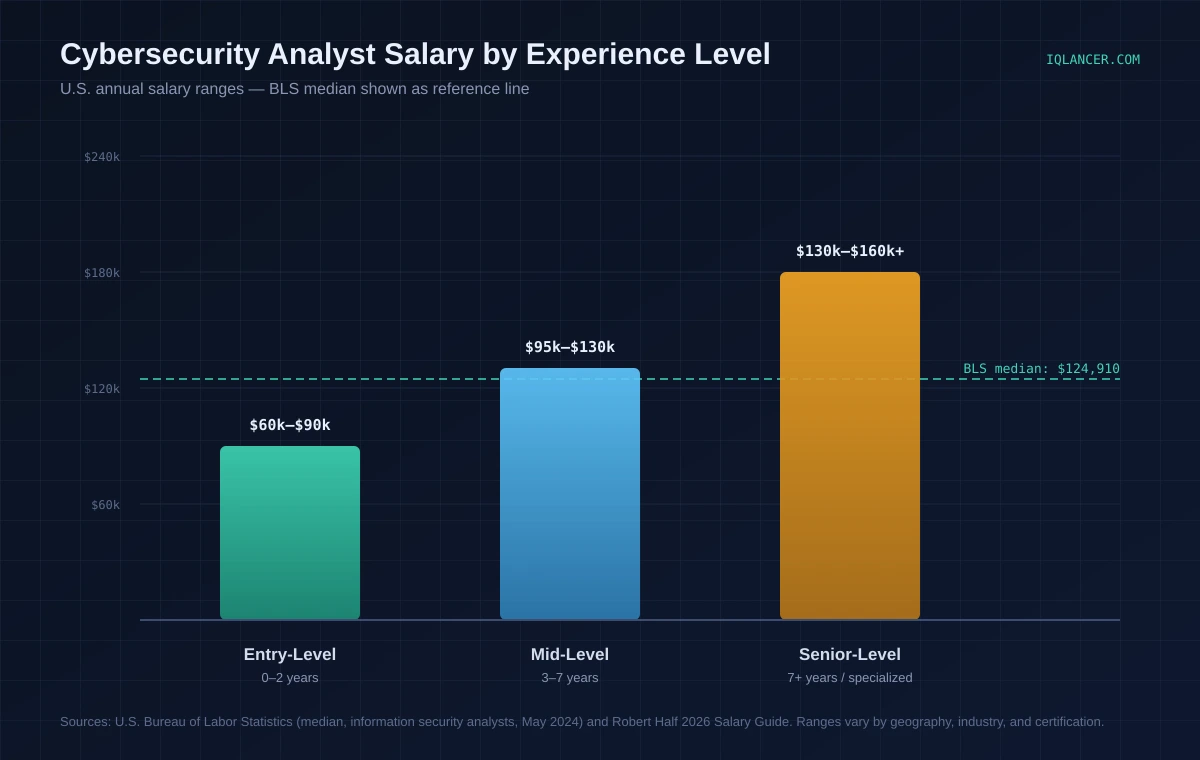
Breaking it down by experience level, using a synthesis of BLS, employer-survey, and job-board data:
- Entry-level: roughly $60,000–$90,000, with self-reported job-board averages sometimes running higher (into the $95,000–$100,000 range on platforms like ZipRecruiter) depending on how broadly “entry-level” is defined and whether the listing is really a Tier 1 SOC role or a more established junior analyst position.
- Mid-level (roughly 3–7 years): commonly cited in the $95,000–$130,000 range as analysts move into incident response ownership, threat analysis, and independent investigation work.
- Senior-level (7+ years, or specialized/architect tracks): typically $130,000–$160,000+, with cloud security, incident response leadership, and architecture-track roles often exceeding that range.
Factors that move pay meaningfully in either direction:
- Geography (major tech hubs and Washington D.C.-area federal-adjacent roles typically pay 15–30% above national averages);
- Industry (finance, defense, and pharmaceutical/biotech consistently rank among the highest-paying sectors);
- Certifications (Security+ and CySA+ tend to lift entry-to-mid pay, while CISSP which requires five years of experience is associated with some of the largest jumps at the senior level);
- Specialization (cloud security and incident response specializations often command a premium over generalist analyst roles); and
- Employer type (large enterprises and regulated industries generally pay more than small businesses, though they may also require clearances or degrees that smaller employers don’t).
The honest summary: don’t anchor your expectations to the highest number you find in a Google search. Use the BLS median and Robert Half’s employer-survey range as your realistic baseline, and treat outlier figures on self-reported salary sites as the upper edge of a wide distribution, not the norm.
Rejection Intelligence: Why Cybersecurity Analyst Candidates Get Turned Down
Understanding why qualified-looking candidates get rejected is more useful than another list of things to do, because most rejection reasons are specific, fixable patterns rather than vague “not enough experience” excuses.
Certification collecting without practical work. A resume listing five certifications and zero projects reads as someone who studies well but hasn’t proven they can apply it. Fix: for every certification, pair it with at least one documented project demonstrating the related skill.
Weak networking fundamentals. Analysts who can’t explain how DNS resolution works or read a basic packet capture struggle in technical interviews regardless of certifications held. Fix: don’t skip networking fundamentals to rush toward security-specific material; it’s the foundation everything else sits on.
No SIEM experience. This is one of the most frequently listed requirements in real job postings, and candidates without any hands-on SIEM exposure even in a free-tier home lab are immediately at a disadvantage. Fix: get into Splunk’s free tier or Microsoft Sentinel’s trial and build at least one documented log-analysis project.
No investigation experience. Candidates can define “incident response” in an interview but have never walked through an actual investigation from alert to resolution. Fix: complete at least one full simulated incident investigation, documented start to finish.
No security lab. A resume built entirely from coursework, with no evidence of independent, self-directed practice, signals passive learning rather than initiative. Fix: even a simple home lab, documented clearly, closes this gap.
Generic, template resumes. Resumes that list generic phrases like “detail-oriented team player with strong communication skills” without specific, quantifiable security work blend into the pile. Fix: replace generic language with specifics tools used, what you found, what you built.
Applying for advanced roles without foundational experience. Candidates who apply directly to mid-level or specialized roles without SOC or junior-analyst experience often get filtered out immediately, since employers use experience level as a fast screening signal. Fix: treat SOC Tier 1 or junior analyst roles as the legitimate, necessary first step, not something to skip.
Seven Common Mistakes Candidates Make
1. Trying to learn every tool at once. Candidates chase every tool mentioned in a YouTube video, ending up with shallow familiarity across dozens of tools instead of real competence in the handful that matter most at entry level. Recruiters can tell the difference in an interview within minutes.
- Do instead: master the foundational and entry-level tool tiers covered earlier before branching out.
2. Skipping networking and Linux fundamentals to rush toward “cybersecurity” content. It feels faster to jump straight into security tools, but without the underlying fundamentals, that knowledge doesn’t stick and shows up as shallow answers in interviews.
- Do instead: treat fundamentals as non-negotiable, even if it feels like a detour.
3. Certification stacking without hands-on proof. Multiple certifications without a single documented project signals memorization, not capability, to experienced hiring managers who’ve seen this pattern many times.
- Do instead: pair every certification with at least one related project.
4. Applying only to roles labeled “Cybersecurity Analyst.” This title-matching approach misses SOC Analyst, Junior Security Analyst, and IT Support-with-security-responsibilities roles that are legitimate, high-volume entry points into the same career.
- Do instead: widen the search to adjacent entry titles.
5. Underestimating soft skills, especially written communication. Analysts write incident reports constantly; candidates who can investigate well but can’t document findings clearly are a real liability employers actively screen for.
- Do instead: practice writing clear, structured investigation summaries, not just doing the technical work.
6. Ignoring cloud security entirely. Many entry-level candidates focus exclusively on on-premises skills while cloud security is flagged by ISC2 and CyberSeek as one of the fastest-growing skill demands in the field.
- Do instead: get at least basic hands-on exposure to AWS or Azure security fundamentals, even through free tiers.
7. Treating certifications as the finish line instead of a checkpoint. Some candidates pause all preparation the moment they pass an exam, when the certification was meant to validate readiness for the next phase hands-on projects and applying not signal the end of preparation.
- Do instead: keep building projects and applying immediately after certifying, while the material is fresh.
Cybersecurity Analyst vs. SOC Analyst vs. Security Engineer
These titles get used inconsistently across companies, which creates real confusion for candidates trying to figure out which roles to target so it helps to compare them directly on what the work actually involves.
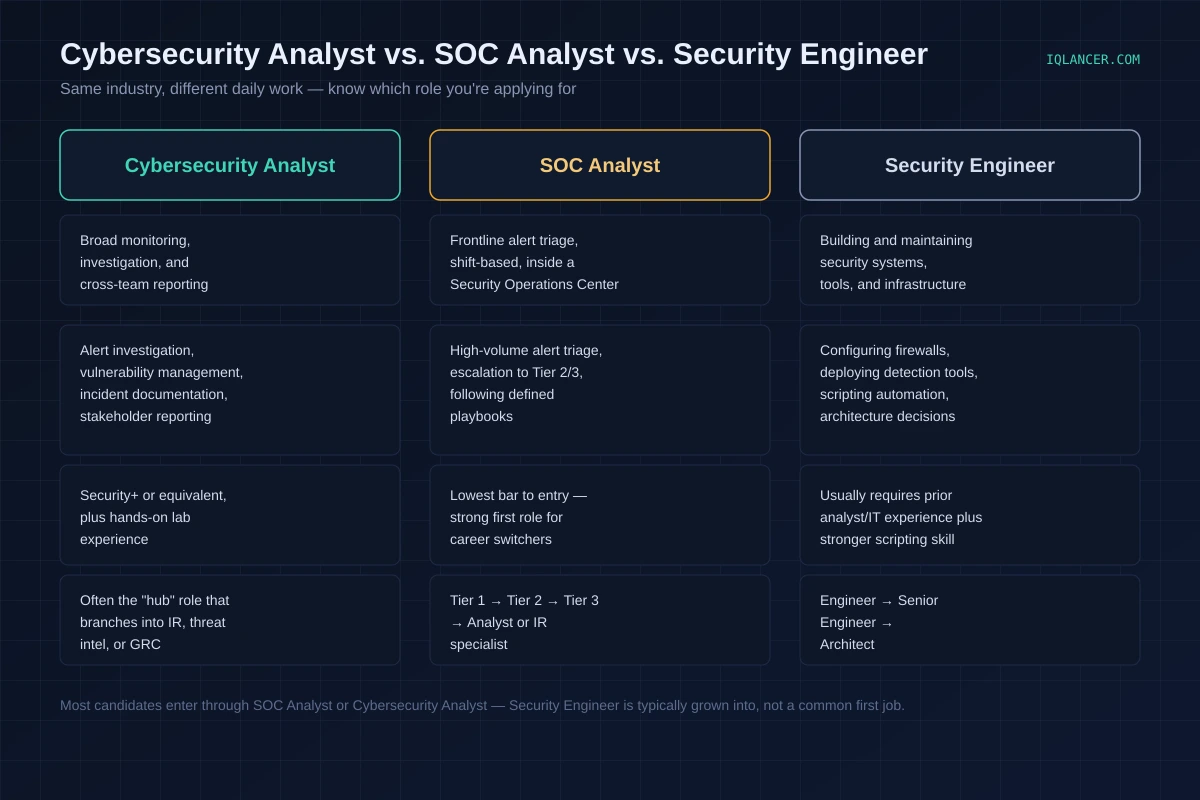
Where they overlap: all three require core security fundamentals, familiarity with SIEM tooling, and an understanding of common attack patterns.
Where they diverge: SOC Analyst work is typically the most process-driven and shift-based (including nights and weekends at many organizations, since threats don’t stop at 5 p.m.); Cybersecurity Analyst roles tend to carry more investigative ownership and cross-functional reporting; Security Engineer roles shift the emphasis from monitoring and responding toward building and maintaining the systems that make monitoring possible in the first place, and generally require stronger scripting and systems-administration skill.
For most people entering the field, SOC Analyst or Cybersecurity Analyst are the realistic starting points; Security Engineer is typically a role you grow into after gaining analyst-level experience, not a common first job.
Cybersecurity Career Path: Where This Role Leads
A cybersecurity analyst role isn’t a career destination on its own; it’s a hub that opens into several distinct specialization paths, and understanding those branches early helps with choosing which certifications and projects to prioritize.
The core progression:
IT / Networking → SOC Analyst / Junior Security Analyst → Cybersecurity Analyst → Senior Security Analyst → Security Engineer / Incident Responder / Threat Hunter → Security Architect / Security Manager
Alternative specializations that branch off from analyst experience:
- Cloud Security : Securing multi-cloud and hybrid environments; currently one of the fastest-growing and highest-paying specializations, per both ISC2 and CyberSeek data
- Application Security : Securing software and code, often overlapping with development teams
- Threat Intelligence : researching attacker groups, tactics, and emerging threats, often suited to candidates strong in research and written analysis
- Incident Response : Deep specialization in investigating and containing active security incidents
- Digital Forensics : Recovering and analyzing digital evidence, often intersecting with legal and law-enforcement work
- Security Engineering : Building and maintaining the technical systems and tooling that security teams depend on
- GRC (Governance, Risk, and Compliance) : less hands-on-technical, more policy- and audit-focused; a strong fit for candidates from legal, audit, or risk backgrounds
The practical implication: the projects and certifications you pursue as an analyst should be chosen with an eye toward the specialization you’re aiming at, not just toward passing the next exam. A candidate targeting cloud security should weight cloud labs and certifications higher; a candidate targeting incident response should prioritize IR-focused projects and CySA+ over vendor-specific credentials.
ATS Keyword Intelligence for Cybersecurity Analyst Resumes
Applicant Tracking Systems filter resumes before a human ever sees them, so understanding which terms consistently appear in real job postings and using them accurately, only where they reflect genuine experience materially affects whether a resume gets seen at all.
Based on the skill categories that recur across current cybersecurity analyst and SOC analyst postings, prioritize these terms where they honestly apply to your background:
Core technical categories: SIEM, SOC, Incident Response, Threat Detection, Vulnerability Management, Network Security, Log Analysis, Security Monitoring
Systems and platforms: Linux, Windows, Active Directory, Splunk, Microsoft Sentinel, Wireshark, Nmap
Cloud and identity: AWS, Azure, IAM (Identity and Access Management)
Scripting and automation: Python, PowerShell, Bash
Important guidance: never list a keyword you can’t speak to in an interview. ATS optimization gets a resume past the filter, but a hiring manager or technical interviewer will quickly expose keyword-stuffing that isn’t backed by real understanding and that damages credibility more than a slightly shorter resume would have.
IQLancer Cybersecurity Analyst Readiness Checklist
Use this as an honest self-assessment before applying broadly the goal isn’t perfection across every row, but a clear picture of where your genuine strengths and gaps are.
| Area | Importance | Self-Assessment |
|---|---|---|
| Networking fundamentals | Critical | Can you explain TCP/IP, DNS, and read a packet capture? |
| Linux | Critical | Can you navigate the command line and review system logs unaided? |
| Windows / Active Directory | High | Can you review Windows Event Logs and explain AD basics? |
| Security fundamentals | Critical | Can you explain the CIA triad and authentication vs. authorization clearly? |
| SIEM | Critical | Have you written real search queries in Splunk or Sentinel? |
| Incident response | High | Have you documented at least one full simulated investigation? |
| Vulnerability management | High | Have you run and prioritized findings from a real scan? |
| Scripting | Moderate | Can you write a basic script to parse or filter log data? |
| Cloud security | Growing / High | Do you have any hands-on AWS or Azure security exposure? |
| Projects | Critical | Do you have 3–5 documented, explainable projects? |
| Portfolio | Critical | Is your work visible somewhere a recruiter can actually see it (GitHub, personal site)? |
| Resume | Critical | Does it show specific evidence, not just generic claims? |
Conclusion
Learning how to become a cybersecurity analyst ultimately comes down to closing the gap between what you know and what you can prove. The field offers genuine, data-backed opportunity BLS projects 29% growth through 2034, and demand for cloud and AI-adjacent security skills is only accelerating but that opportunity goes to candidates who can demonstrate real capability, not just to candidates who hold the most certifications.
Build the fundamentals first, choose certifications deliberately rather than by collecting them, document hands-on projects that show your actual reasoning, and target realistic entry points like SOC Tier 1 or junior analyst roles rather than skipping straight to advanced titles.
Every section of this IQlancer guide points toward the same underlying test: could you sit in an interview and show, not just tell, what you can do. That is what separates candidates who get hired from candidates who stay stuck applying.