
Students try to study faster because they face time pressure, large syllabuses, and approaching exams. Productivity advice often suggests that faster coverage means better preparation. The assumption is simple: if you can finish more topics in less time, you will be ready for tests and perform better.
The real issue is not about effort. Speed reduces mental processing, not the amount of work you do. When you try to study faster, you cover material without understanding it. This leads to shallow studying, reading without thinking, finishing without learning.
This article explains why studying faster fails. It shows what happens when speed becomes the goal. It also provides practical fixes that improve learning without requiring more study hours.
What People Mean When They Say “Studying Faster”
When students say they want to study faster, they usually mean one of three things.
Some mean spending fewer hours on the same material. They want to finish a chapter in two hours instead of four. Others mean covering more pages or chapters in the same amount of time. They aim to finish ten pages instead of five in one session.
A third group means finishing topics or subjects quickly. They want to complete an entire unit in a day or a week instead of spreading it out.
All three definitions measure output. They focus on pages read, chapters finished, or hours saved. None of them measure whether understanding actually happened. This is the first problem with studying faster.
Why Studying Faster Feels Productive
Studying faster creates visible progress. You finish chapters, check off lists, and move through topics. These are completion signals. They create a sense that progress has been made.
Students use checklists, timers, and finished topic counts to track their work. These tools show movement. They give immediate feedback. Finishing feels good.
The brain also prefers speed and ease. Reading quickly requires less mental effort than thinking deeply. When something feels familiar, the brain assumes it is understood. This is not the same as actual understanding.
Speed feels productive because it creates the appearance of learning. It does not create learning itself.
This false sense of progress is the same illusion described in why learning feels easy but doesn’t stick.
Why Studying Faster Leads to Shallow Studying
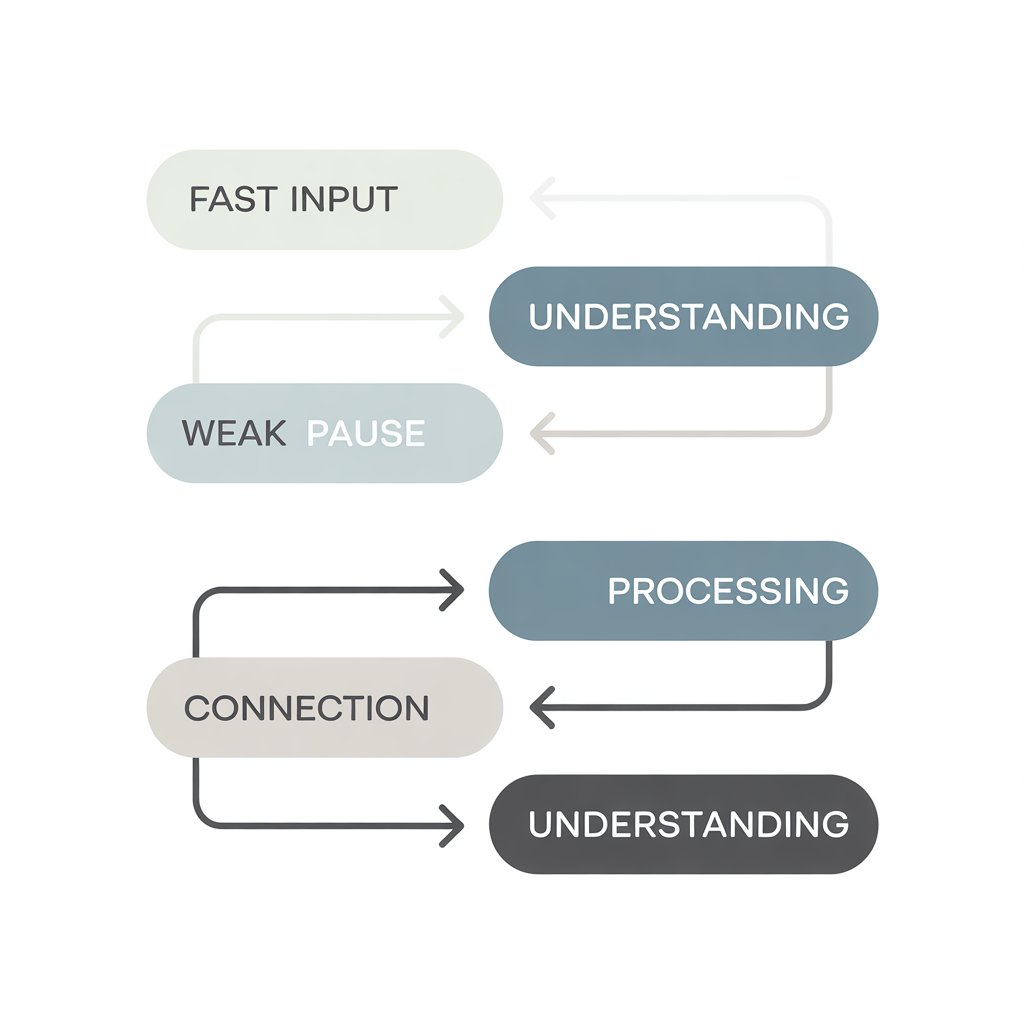
Studying faster breaks down the mental processes that build understanding. Three key problems occur when speed becomes the priority.
Reduced Processing Time
Fast studying leaves no time to think through ideas. You read a sentence, move to the next one, and keep going. There is no pause to ask what the sentence means or how it connects to what came before.
Understanding requires reflection. The brain needs time to connect new information to existing knowledge. When you rush, this does not happen. You take in words without building meaning.
Skipping Mental Effort
Speed encourages shortcuts. Instead of testing your understanding, you reread notes. Instead of recalling information from memory, you glance at summaries. Instead of explaining ideas in your own words, you underline them.
These actions feel like studying, but they do not strengthen memory. Recall and self-explanation require effort. Effort is what builds retrieval pathways. When you skip these steps, you avoid the work that creates learning.
This pattern closely matches what happens with passive methods, which is explained in detail in why passive studying leads to poor retention.
Surface-Level Pattern Recognition
When you study quickly, you recognize terms without knowing what they mean. You see a word or formula and think you understand it because it looks familiar.
You also memorize the structure of notes without understanding the logic behind them. You remember that a list has four points, but you cannot explain why those points matter or how they relate to each other.
This is pattern recognition, not comprehension. It breaks down as soon as you face a question that requires explanation or application.
What Happens When Learning Becomes Shallow
Shallow studying creates problems that appear later, usually during exams or when applying concepts. Three consequences are common.
Poor Recall During Exams
Familiarity does not equal retrieval. When you study quickly, you build recognition but not recall. During exams, you need to pull information from memory without hints.
Questions do not come with your notes attached. If you only recognized terms while reading, you cannot retrieve them under pressure. The information feels like it was there, but you cannot access it.
Inability to Apply Concepts
Problem-solving and explanation-based questions require understanding. You need to use concepts, not just repeat them.
Shallow studying leaves you stuck when questions ask you to apply ideas to new situations. You may recognize definitions, but you cannot use them. This is especially clear in subjects like math, physics, or logic, where application is the main skill being tested.
Needing Constant Revision
When learning is shallow, nothing sticks. You finish a chapter, move to the next one, and forget the first. A week later, you have to relearn the same material.
This creates a cycle of constant revision. You are always reviewing instead of building on what you already know. Cumulative understanding never develops. Each topic feels new, even after you studied it before.
The Core Mistake: Confusing Speed With Efficiency
Speed and efficiency are not the same thing. Speed measures how fast you finish something. Efficiency measures how well the result serves its purpose.
In studying, the purpose is not to finish material. The purpose is to understand and retain it. Efficiency depends on retention and transfer whether you can recall information later and apply it correctly.
Slower learning can be more efficient. If you spend more time on one concept and understand it completely, you do not need to relearn it. You save time later because the knowledge is usable. Fast studying that requires constant review wastes more time overall.
The core mistake is treating speed as the goal. The goal should be learning that lasts.
How to Fix the Problem Without Studying More Hours
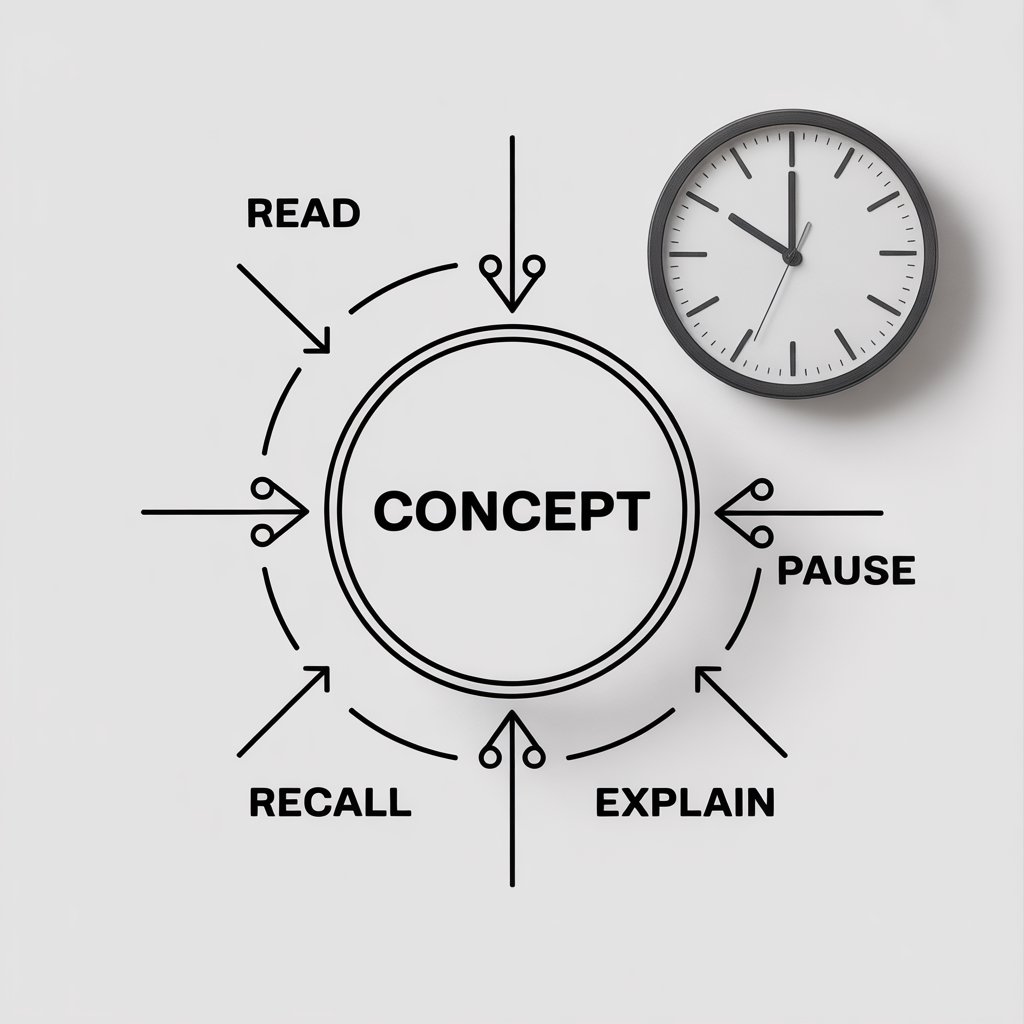
Fixing shallow studying does not require studying more hours. It requires changing how you use the time you already have. The focus shifts to mental pace, not total study time.
Define the Learning Goal Before Speed
Before starting a session, decide what understanding looks like. Is the goal to explain a concept without notes? To solve a problem correctly? To connect this idea to a previous topic?
A clear outcome gives you a target. It also tells you when to stop. You finish when you reach understanding, not when the page ends. This prevents rushing through material just to check it off a list.
Study in Smaller Concept Blocks
Break material into smaller units. Focus on one idea at a time. Do not move to the next idea until the first one is clear.
Smaller blocks create natural stopping points. They also make it easier to identify what you do not understand. When everything is mixed together, confusion spreads. When concepts are separated, problems become visible.
Add Short Recall Checks
After reading or listening, stop and ask yourself questions. What did this section explain? How does this idea relate to what I already understand? Can I describe it clearly using my own words?
Self-questioning forces retrieval. It shows whether understanding happened. If you cannot answer without looking back at notes, you have not learned it yet. This feedback is immediate and accurate.
Better Alternatives to Studying Faster
If speed does not work, what should you do instead? Three alternatives prioritize learning quality over coverage.
Studying With Intentional Pace
Intentional pace means planning pauses. After finishing a section, stop for a moment. Think about what you just read. Let the brain process before moving forward.
These pauses do not take long. Thirty seconds to one minute is enough. The pause gives the brain time to organize information and connect it to memory.
Prioritizing Understanding Over Coverage
Instead of finishing a chapter, focus on understanding key concepts. If you only complete half of a chapter but understand it completely, that is better than finishing the whole chapter without clarity.
Depth matters more than breadth. You can always cover more material later. You cannot retrieve information that was never understood.
Using Time as a Constraint, Not a Goal
Set a fixed amount of time for studying. Use that time to learn as deeply as possible. Do not set a goal to finish a certain number of pages or chapters.
This approach shifts the focus. Time becomes a boundary, not a target. The goal is understanding, and time limits how much you can understand in one session. This prevents rushing and keeps attention on quality.
When Speed Is Actually Useful
Speed is not always wrong. It has a place in studying, but only after understanding is built.
Speed works during review. If you already understand a concept, you can review it quickly to refresh memory. Familiarity with already-learned material allows faster processing.
Speed also works with familiar material. Once you have practiced a skill or reviewed a topic multiple times, moving through it quickly does not reduce understanding. You are reinforcing what you already know.
Speed should be a tool, not a strategy. Use it after understanding is in place, not as the method to build understanding.
A more effective approach is outlined in a simple study workflow that improves learning, which focuses on understanding rather than speed.
Next Steps
Stop using page count or chapters finished as progress markers. Stop setting study goals based on how fast you can cover material. Stop moving to new topics before testing whether you understood the previous one.
Start setting a learning outcome before each session. Start pausing after sections to recall information without notes. Start treating time as fixed and output as variable.
In your next study session, pick one concept from your syllabus. Write down what understanding that concept means. Study until you can explain it clearly without looking at your materials.