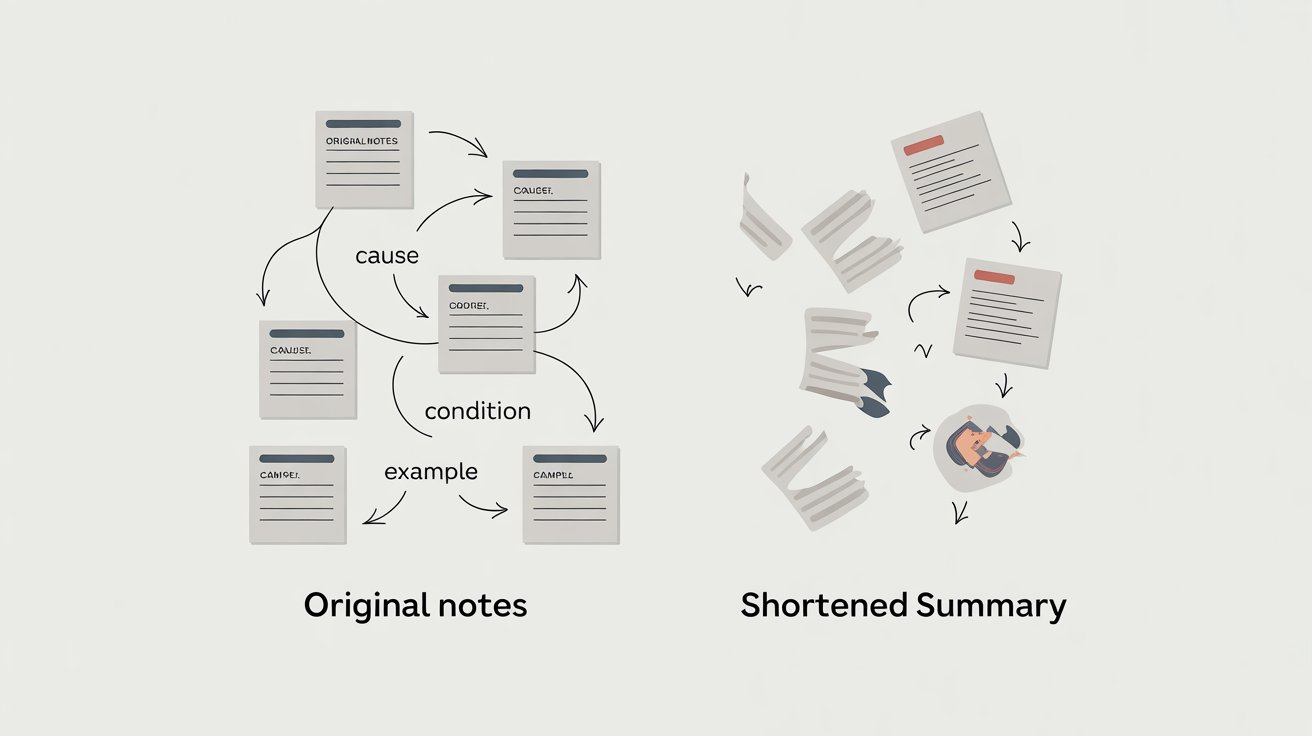
Students summarize notes because it feels productive. Shorter notes seem easier to review. The process creates the sense that material is being learned while being condensed.
But most summarizing methods fail in a specific way. They make notes shorter without preserving what the notes actually mean.
The result is a set of condensed notes that look organized but cannot be used. During revision, these summaries do not trigger understanding. During exams, they do not support recall or application.
The problem is not that summaries are too short. The problem is that meaning gets removed instead of compressed.
This happens because summarizing is treated as a sentence-shortening task rather than a meaning-preservation task. Students focus on reducing word count without identifying what must remain for the concept to stay intact.
This article explains why summarizing commonly fails, what causes the failure, and how to change the process so that summaries remain usable.
Why Most Students Lose Meaning When Summarizing Notes
Summarizing is treated as a reduction task. Students look at a paragraph and ask how to make it shorter. They cut sentences, remove examples, and condense explanations into fragments.
But meaning does not exist in individual sentences. It exists in the relationships between ideas. A definition depends on the conditions that limit it. An explanation depends on the cause-effect sequence that structures it. A method depends on the order of steps and the reasons behind them.
When these relationships are removed, the summary becomes a list of disconnected claims. Each claim may be technically accurate, but the structure that made them understandable is gone.
This is why summaries often feel complete when written but unusable during review. The core ideas remain, but the logic that connects them has been stripped away. Without that logic, the summary cannot recreate understanding.
The process prioritizes brevity over clarity. Students assume that shorter notes are better notes. But a summary that saves space while destroying comprehension has failed its purpose.
This breakdown explains why study summaries miss key points, even when students believe they have captured the most important information.
What Actually Causes Poor Summaries
The specific procedural mistakes students make while summarizing that cause meaning to be removed instead of preserved.
Reducing sentences without identifying the core idea
Most students begin summarizing by looking at a sentence and trying to make it shorter. They remove adjectives, combine clauses, and cut repeated information.
But shortening a sentence does not mean extracting its meaning. The shortened version often keeps surface details while losing the main claim.
For example, a sentence explaining how a process works might be reduced to a list of steps. The steps remain, but the explanation of why they produce the result is removed. The summary becomes a procedural fragment instead of a concept.
The mistake is starting with sentence structure instead of meaning. Summarizing should begin by identifying what the sentence is trying to explain. Only then can unnecessary wording be removed.
Treating all information as equal
Students often summarize by reducing everything proportionally. Definitions, explanations, and examples are all shortened by the same amount.
But not all information has the same function. A definition establishes what something is. An explanation shows why it works. An example illustrates application. These elements do not carry equal weight.
When treated equally, summaries lose hierarchy. Core ideas get the same space as supporting details. The result is a flattened structure where nothing stands out as central.
Effective summaries require distinction. Core ideas must remain complete. Supporting details can be reduced or referenced briefly. Examples can often be removed entirely if the concept is clear without them.
Summarizing before understanding the material
Many students summarize while reading or immediately after. They assume that familiarity with the material is enough to condense it accurately.
But recognition is not comprehension. A student may recognize terms and follow sentence-level logic without understanding how the concept fits together as a whole.
When summaries are created without full comprehension, they become structural copies. The student reproduces the outline of the explanation without processing what it actually means. The summary looks organized but lacks the internal logic needed to reconstruct the idea.
Summarizing should occur after understanding is confirmed. If a concept cannot be explained without referring to the original notes, it is not ready to be summarized.
What Happens When Your Summaries Lose Meaning
The weak summaries affect recall, exam performance, and the ability to apply concepts during real study and testing situations.
Difficulty recalling concepts during exams
Summaries are supposed to make retrieval easier. But when meaning is lost, summaries fail to trigger full explanations.
A student reads a summarized point and recognizes it as familiar. But the recognition does not lead to recall. The logic that connects the summary back to the full concept is missing.
This forces the student to rely on memorization instead of understanding. They must remember exact wording because the structure that would allow reconstruction is no longer available.
This mirrors why study notes feel useful but fail in exams, when notes are optimized for recognition instead of recall and application.
False confidence during revision
Weak summaries create the illusion of preparedness. They look complete. They cover the material. They feel easier to review than full notes.
But ease of review does not indicate understanding. A student can read through summaries quickly and feel that revision is progressing well. The material seems clear during review because recognition feels like comprehension.
The failure reveals itself only during testing, when application or explanation is required. The summaries that felt sufficient during revision do not support the cognitive tasks needed during the exam.
This false confidence is rooted in why students confuse familiarity with understanding, where recognition during review is mistaken for real comprehension.
Inability to apply concepts to questions or problems
Application requires more than recall. It requires understanding how a concept works and when it applies.
Summaries that lose meaning remove the conditions, exceptions, and relationships that make application possible. A student may remember the core claim but not the boundaries that define when it is valid.
This blocks problem-solving. Questions that require applying the concept to a new situation cannot be answered because the logic needed for transfer is missing. The student knows the summary but cannot use it.
How to Summarize Notes Without Losing Meaning
When you change the summarizing process so notes remain compact while preserving the ideas, relationships, and logic required for understanding.
Identify the core idea before writing anything
Summarizing should not start with sentence reduction. It should start with one question: what is this section trying to explain?
That answer becomes the anchor for the summary. Everything else is kept or removed based on whether it supports that explanation.
Before writing, state the core idea in one sentence using your own words. If you need to look back at the notes to do this, understanding is incomplete.
This step forces clarity and keeps the summary organized around meaning, not the original text order. It also exposes gaps in understanding before summarizing begins.
Separate core ideas from supporting details
Not all information in the notes needs equal space. Core ideas must remain intact, while supporting details can be reduced or briefly referenced.
A core idea is required for the concept to work. Supporting details explain or illustrate it but are not necessary for basic understanding.
For example, a definition is a core idea. An example using that definition is a supporting detail and can be shortened or removed if it adds no clarity.
This separation prevents over-reduction. When summaries focus on cutting length instead of preserving structure, essential meaning is lost.
Compress structure, not sentences
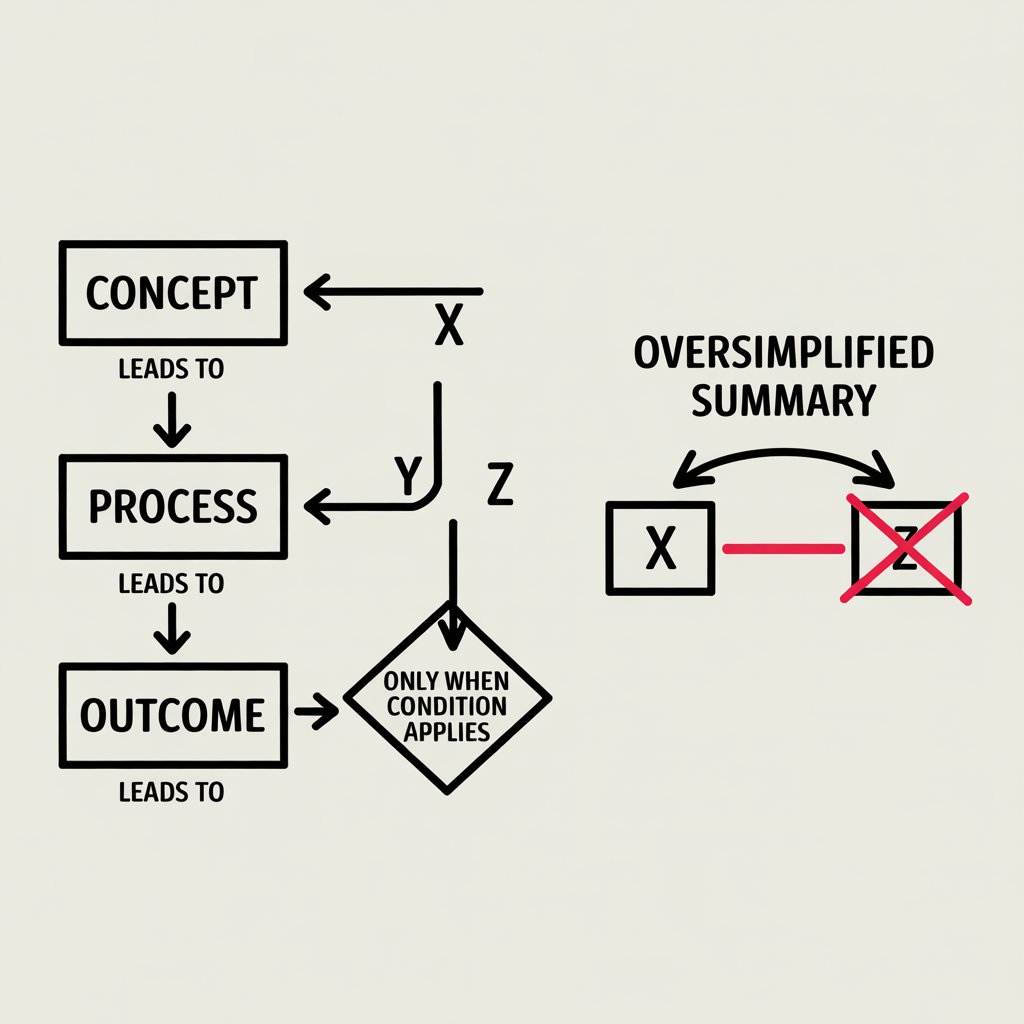
Meaning depends on relationships between ideas. Summaries that preserve these relationships remain usable. When they are removed, the summary becomes a list of fragments.
Instead of shortening sentences, preserve the logical structure. Use bullets, arrows, or short clauses to show connections. Keep cause–effect links, conditions, and exceptions visible.
For example, rather than reducing “X causes Y, which leads to Z under specific conditions” to “X causes Z,” keep the structure: “X → Y → Z (when conditions apply).”
This treats summarizing as restructuring, not deletion. The goal is a more compact version of the concept without losing the logic that makes it understandable.
Check summaries by reconstructing the idea
A summary is useful only if it can recreate understanding. The simplest test is reconstruction.
After writing a summary, close the original notes. Use the summary alone to explain the concept. If the explanation is complete, the summary works. If gaps appear, necessary information is missing.
This check should happen immediately after summarizing, while the material is still fresh enough to fix.
Reconstruction exposes whether a summary actually supports understanding or only appears organized. Many summaries pass visual review but fail functional testing.
Better Alternatives to Traditional Note Summaries
By summarizing the methods for making the changes, what to use instead, and why these alternatives preserve meaning better than traditional note reduction.
Concept-based summaries instead of paragraph reduction
Most students summarize by shortening each paragraph and combining the results.
A more effective approach is concept-based summarizing. Instead of working paragraph by paragraph, identify the core concept the section explains and summarize that directly.
This shifts the focus from text structure to meaning. The summary follows the logic of the idea rather than the order of the notes, which naturally removes redundancy.
Question-driven summaries
Summaries written as answers to questions are more usable than condensed text.
Before summarizing, write the key question the material addresses. Then write the summary as a direct answer.
This keeps the summary relevant. Each part exists to answer the question, not because it appeared in the notes.
It also improves retrieval. Recalling the question during review or exams helps trigger the answer, giving the summary a clear purpose.
One-page concept maps for dense topics
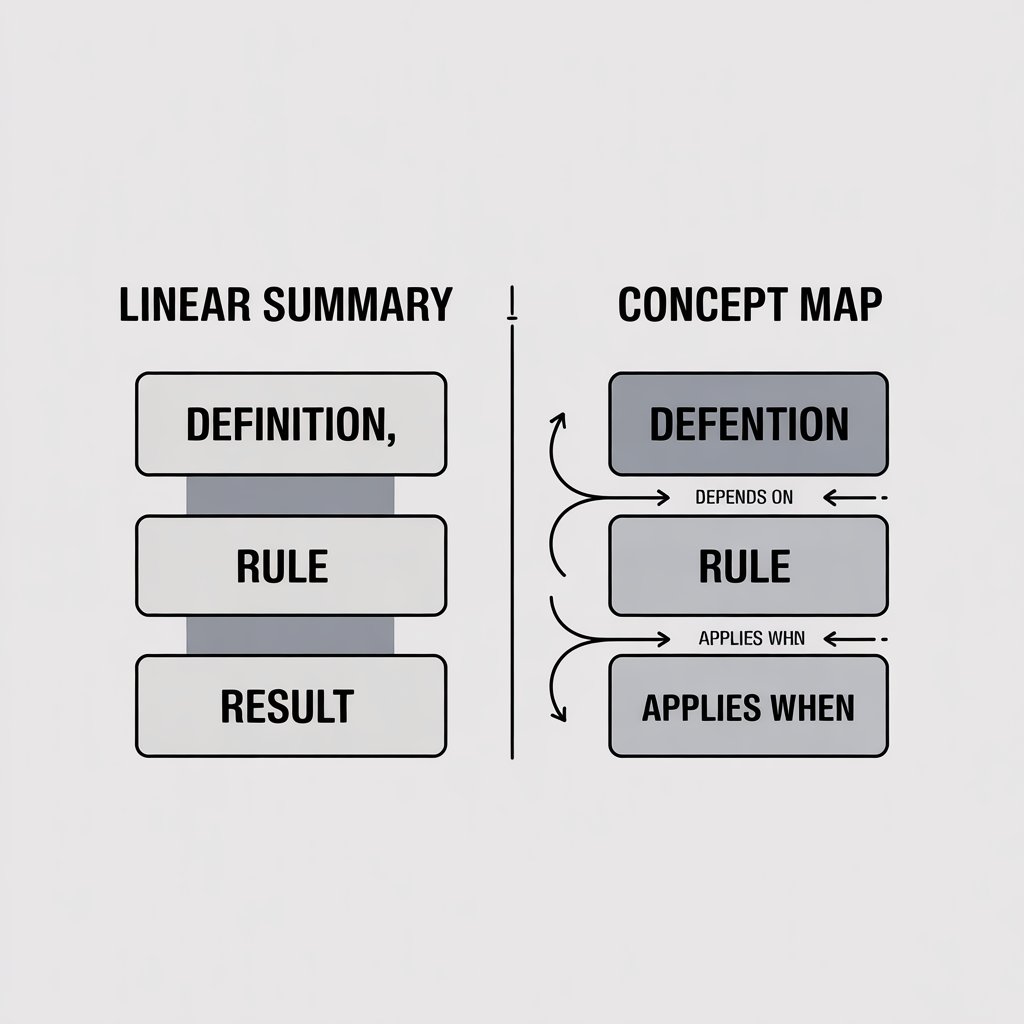
For complex material with many interconnected ideas, written summaries often fail because relationships are lost in linear text.
Concept maps preserve these relationships by placing ideas in relation to each other. Arrows show logic, groupings show categories, and conditions stay near the claims they modify.
The goal is function, not appearance. Use simple boxes, arrows, and short phrases. The value is in the structure.
This method works best when multiple concepts interact. For simple definitions or linear processes, written summaries remain clearer.
What to Stop Doing
Stop summarizing by paragraph. Stop shortening sentences without identifying meaning. Stop assuming that shorter notes are automatically better.
Start by identifying the core idea before writing. Start separating core claims from supporting details. Start checking summaries by reconstructing the concept.
Take one existing summary from recent notes. Close the original material and attempt to reconstruct the full explanation from the summary alone. If gaps appear, the summary has failed. Rewrite it using the methods explained here. Repeat the process until the explanation can be fully reconstructed without checking the original material.