The Cognizant Hiring Process varies by role, hiring route, location, and candidate profile, so there is no fixed sequence of rounds for everyone. Cognizant’s official hiring information states that candidates may not progress through every stage. IQLancer guide covers fresher, GenC, Analyst Trainee, campus, off-campus, and experienced hiring routes. It separates official Cognizant information, drive-specific requirements, and candidate-reported experiences. By the end, you’ll know which hiring route applies to you, what rounds and requirements to expect, and how to prepare effectively for Cognizant assessments, technical interviews, and HR discussions.
What Is the Cognizant Hiring Process?
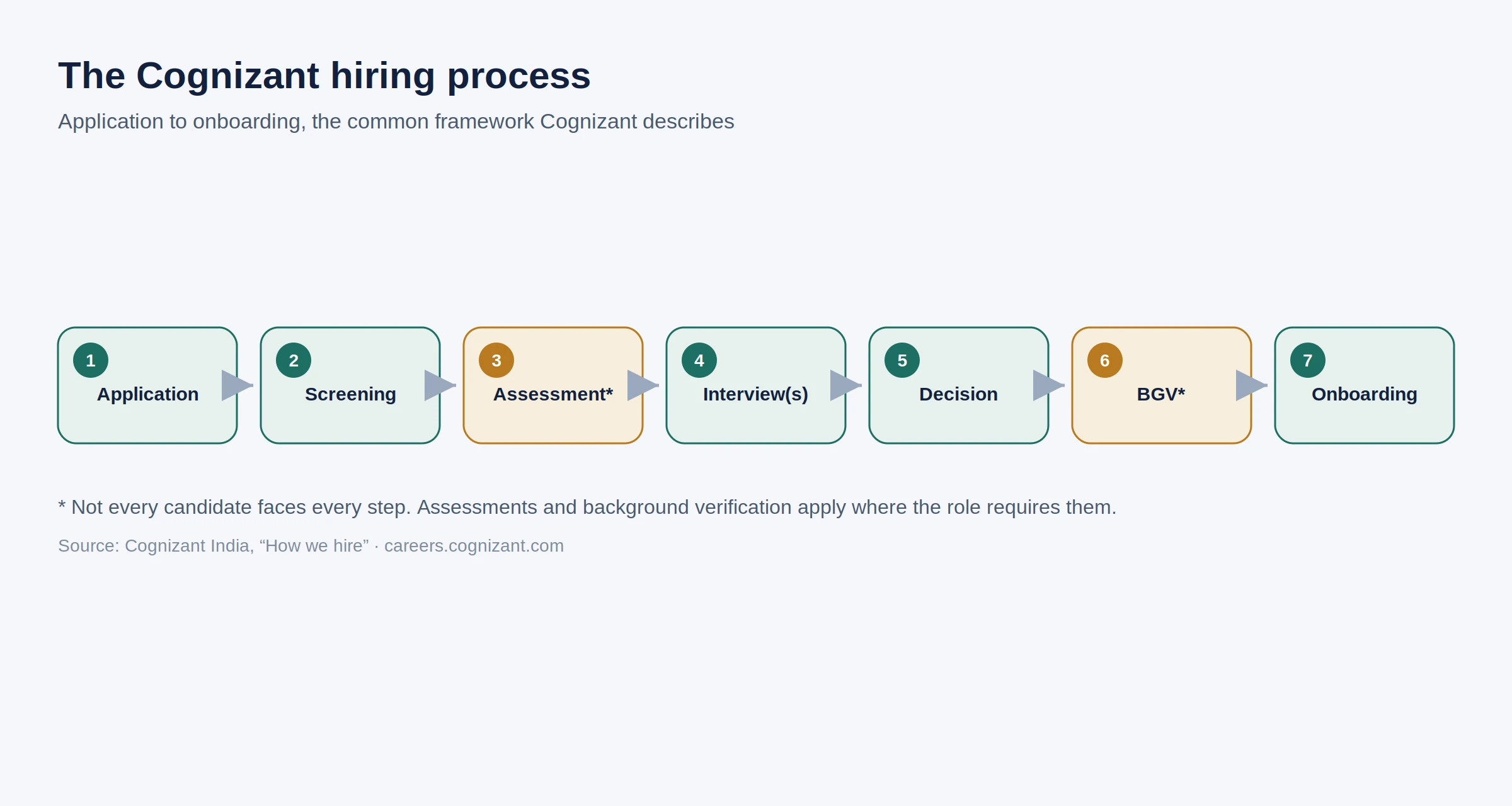
Cognizant hiring process follows a broad application-to-onboarding journey, although the exact steps and their order can vary by role, hiring route, and program. At a high level, the journey includes:
- Application : Applying for an open role or hiring program.
- Screening : Initial review of your application and qualifications.
- Assessment : Completing technical or other assessments where applicable.
- Interview : Participating in recruiter, hiring team, technical, or client interviews, depending on the role.
- Decision : The hiring team reviews the candidate’s potential fit for the role.
- Background verification : Completing verification requirements where applicable.
- Onboarding : Completing the required steps after selection.
Cognizant’s official How we hire page presents four visible stages:
- Apply to an open role
- Connect with a recruiter for an introductory call
- Demonstrate your skills through an interview with the hiring team, with technical assessments and/or client interviews for some roles
- Decision The hiring team reviews each candidate’s potential fit
Cognizant Hiring Process also states that this is only a preview of the process because requirements can vary by role and location, and not every candidate moves through every step.
Cognizant Hiring Routes: Freshers, Professionals, Campus and Off-Campus
The table below summarises how these routes generally differ. It represents the structure of each route, not a guaranteed sequence for every candidate within it.
| Hiring route | Typical candidate | Entry point | Possible assessment | Interview |
|---|---|---|---|---|
| Campus (GenC) | Final-year or recently graduated students | University placement drive | Aptitude, communication and/or technical assessment | Hiring-team interview, format set by the drive |
| Off-campus (GenC / Analyst Trainee) | Graduates from eligible batches, any college | Open application on Cognizant careers or a drive-specific portal | Similar assessment stages as campus, drive-dependent | Virtual or in-person, per drive instructions |
| Experienced / lateral hiring | Professionals applying to a specific job requisition | Cognizant careers job listing | Technical assessment where the role requires it | Recruiter screen, hiring-team interview, sometimes a client interview |
| Specialised programs (Finance Excellence, B-School Accelerator) | CAs, MBA/B-School graduates | Program-specific application | Program-specific evaluation | Program-specific panel |
Cognizant Hiring Process for Freshers
The Cognizant Hiring Process for freshers commonly includes GenC and other fresher hiring drives, but eligibility, assessment content, and interview formats can vary by the specific program, role, batch, and hiring route.
Cognizant’s official GenC program page provides information about its fresher hiring pathway, while individual drives determine the applicable eligibility and selection requirements.
Depending on the drive and role, the selection process may include application and document screening, followed by assessments covering areas such as communication, aptitude, and technical skills. Candidates who meet the required criteria may then progress to interviews with the hiring team. Cognizant communicates the applicable process and requirements for each hiring opportunity.
Because eligibility criteria such as minimum academic percentage, degree stream, and graduating batch can change between hiring drives, candidates should verify the requirements listed for their specific opportunity rather than rely on previous-year criteria.
Cognizant GenC Hiring Process
The Cognizant GenC hiring process follows a structured pathway for early-career candidates, with selection stages and onboarding timelines that can vary by hiring drive and role.
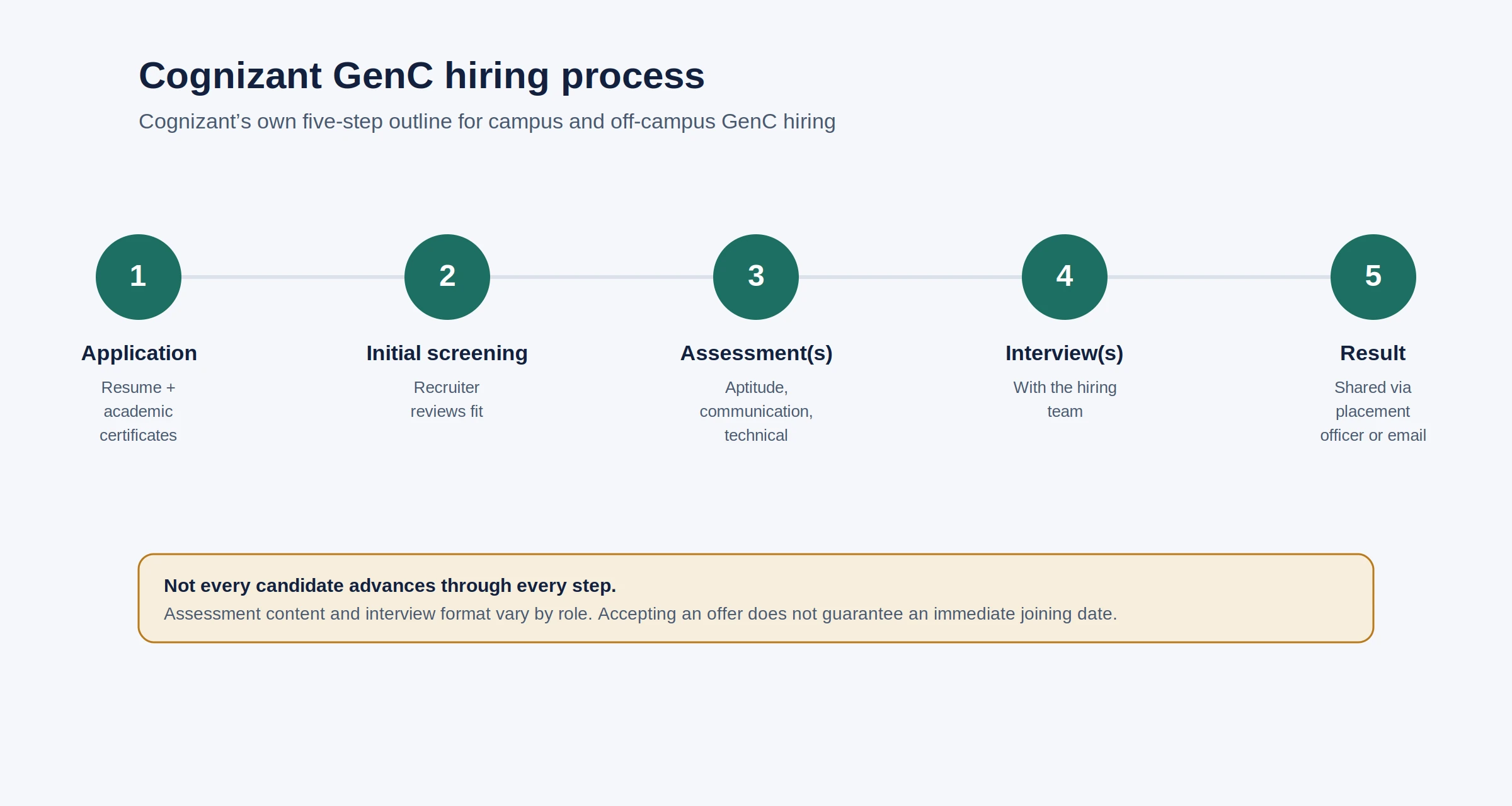
Generation Cognizant, or GenC, is Cognizant’s structured hiring and development pathway for early-career talent in India. The official GenC program page describes the program as combining role-based skilling with real project exposure. It also includes an upskilling track and a Digital Honors Program for eligible GenCs seeking progression into more advanced roles. Cognizant states that the program does not include service bonds.
GenC Application Status and Onboarding
GenC candidates can track their application through Cognizant’s GenC candidate platform, where applicable. Candidates should use the platform and official communication channels to monitor updates rather than rely solely on informal information about application status.
Receiving and accepting a GenC offer does not necessarily mean the candidate will receive an immediate joining date. Cognizant states that GenC onboarding takes place in batches based on business demand and other factors. Therefore, the date of joining may be communicated separately after the offer is accepted, with Cognizant providing updates as the onboarding date is finalised.
What is the Cognizant Analyst Trainee hiring process?
The Cognizant Analyst Trainee hiring process is a specific fresher recruitment route within Cognizant’s broader early-career hiring framework. Its eligibility, assessment pattern, degree requirements, and other conditions can vary by recruitment drive.
Analyst Trainee openings have appeared across different business and technology areas, including Digital Workspace Services, Multicloud, Information Technology, Integrated Smart Operations, SAP FICO, and SaaS Cloud. However, these roles are not governed by one universal set of eligibility criteria.
The exact requirements can change between drives. Recruitment notices have specified different graduating batches, degree types, academic percentage requirements, arrears rules, assessment stages, interview formats, and other eligibility conditions.
Why Analyst Trainee Eligibility Can Differ
Candidates should not assume that an eligibility condition from an older Analyst Trainee drive applies to a current opening. For example, one recruitment notice may target specific graduating batches and three-year undergraduate programs, while another may establish different requirements for commerce graduates or particular business tracks.
Similarly, conditions such as the number of registrations allowed, mandatory assessments, interview format, work-experience requirements, location, and compensation can be specific to an individual recruitment drive.
The key takeaway: Analyst Trainee is a drive-specific fresher hiring route, not a single standardized Cognizant hiring process with permanent eligibility rules. Candidates should verify the current requirements against the relevant recruitment notice or Cognizant’s GenC program page before preparing or applying.
Cognizant Hiring Process for Experienced Candidates
The Cognizant Hiring Process for experienced candidates is usually tied to a specific job requisition, so the number of rounds, assessments, and interview format can vary by role, experience level, technology, business unit, and client.
How Experienced Hiring Works
Experienced candidates generally apply for a specific opening on Cognizant’s careers site. The process may then include:
- Application and screening: Recruiters review the candidate’s experience, technical skills, domain background, and qualifications against the job requirements.
- Recruiter or HR screening: A recruiter may discuss experience, role expectations, availability, compensation, and other relevant details.
- Technical interview: Candidates may meet with a technical interviewer or hiring panel to discuss their skills, previous projects, technologies, and problem-solving approach.
- Technical assessment: Some roles may include a coding test, technical assessment, or other skills evaluation.
- Managerial or hiring-team interview: Depending on the position, candidates may have an additional discussion focused on project experience, responsibilities, leadership, or role fit.
- Client interview: Client-facing roles may include a separate client discussion, depending on the engagement and role requirements.
- Decision and offer: After the applicable interviews, the hiring team reviews the candidate and communicates the outcome. Selected candidates may then proceed through offer, background verification, documentation, and onboarding requirements.
Why the Number of Rounds Varies
There is no single interview sequence for every experienced Cognizant candidate. Candidate-reported experiences on Glassdoor describe different combinations of technical, managerial, recruiter, and client discussions. These reports are useful for understanding possible experiences but should not be treated as Cognizant-wide requirements.
For example, a support-focused position may involve a different evaluation process from a senior architecture or specialized technology role. Client involvement can also change the interview structure for client-facing positions.
The key takeaway: Experienced candidates should prepare against the specific Cognizant job requisition, rather than assume that every experienced hire follows the same number of interview rounds. The job description, recruiter communication, and role-specific instructions are the most relevant sources for determining what to expect.
What Are Cognizant’s Hiring Requirements?
Cognizant hiring requirements vary by job, hiring program, experience level, and location; there is no single eligibility checklist that applies to every Cognizant position. Candidates should therefore verify the requirements for the specific opening or recruitment drive they are applying to.
Cognizant Requirements for Freshers
For freshers, Cognizant’s official GenC information states that candidates apply with a resume and required academic certificates. Individual recruitment drives may add specific eligibility conditions, including:
- Minimum academic percentage
- Eligible degree or education stream
- Graduating batch
- Arrears or backlog requirements
- Required assessments
- Role-specific eligibility conditions
- Additional documents requested during registration
These conditions can change between recruitment drives. Analyst Trainee and other fresher recruitment notices may therefore have different eligibility criteria even when the roles fall within the broader early-career hiring framework.
Cognizant Requirements for Experienced Candidates
For experienced professionals, the specific Cognizant job description is the primary requirements document. Depending on the position, it may specify:
- Required years of experience
- Technical skills and technologies
- Domain or industry experience
- Education requirements
- Certifications
- Project or client experience
- Location and work model
- Role-specific responsibilities
Therefore, candidates should not rely on a generic “Cognizant eligibility” or technology-based checklist when applying. The requirements listed in the specific job requisition or recruitment notice should be treated as the relevant eligibility criteria for that application.
How Cognizant Assessments Work ?
Cognizant assessments vary by hiring route, role, and program and may evaluate communication, aptitude, technical skills, or job-specific capabilities. Not every candidate takes every type of assessment.
Cognizant’s official GenC program page states that assessments can cover communication skills, aptitude, and technical skills depending on the role. This means the assessment pattern for a fresher hiring drive may differ from the evaluation used for an experienced professional applying to a specific technical position.
Common Cognizant Assessment Areas
Depending on the hiring route and role, candidates may encounter:
- Communication assessment : Evaluates relevant communication skills.
- Aptitude assessment : May cover areas such as logical reasoning, quantitative aptitude, or related capabilities.
- Technical assessment : Tests technical knowledge relevant to the role or hiring program.
- Coding assessment : May be included for software and development positions.
- Role-specific evaluation : Can focus on technologies, tools, domain knowledge, or other skills specified by the position.
How to Prepare for Cognizant Assessments
The most reliable preparation approach is to combine three sources of information:
- Hiring route : Identify whether you are applying through campus, off-campus, GenC, Analyst Trainee, or experienced hiring.
- Specific job description or recruitment notice : Check the skills, technologies, eligibility requirements, and assessment information stated for that opening.
- Program instructions : Follow any assessment details or preparation guidance provided by Cognizant for the specific hiring drive.
This approach is more reliable than preparing from a generic Cognizant assessment pattern because the assessment content can change between roles and hiring routes.
What are the Stages of Cognizant Interview Process ?
The Cognizant interview process can include recruiter screening, technical or hiring-team interviews, managerial discussions, and client interviews, depending on the role and hiring route.
Cognizant’s official How we hire page states that candidates may interview with the hiring team and that some roles may also require technical assessments and/or client interviews. Cognizant also notes that its hiring process can vary by role and location, meaning these stages should not be treated as mandatory for every candidate.
Common Cognizant Interview Stages
Depending on the position, candidates may encounter:
- Recruiter or screening discussion : Initial conversation about experience, qualifications, availability, and role requirements.
- Technical interview : Discussion of technical skills, technologies, projects, and problem-solving relevant to the position.
- Hiring-team interview : Evaluation of the candidate’s experience and potential fit for the role.
- Managerial or behavioral interview : May focus on project ownership, communication, teamwork, responsibilities, and workplace scenarios.
- Client interview : May be included for roles where client involvement is part of the hiring process.
- HR or final discussion : May cover areas such as compensation, location, joining timeline, and other employment details.
Cognizant Interview Preparation by Role
Cognizant interview preparation should be based on the target role, job description, and required technology stack rather than a universal list of interview questions.
Software and Developer Roles
Prepare core programming fundamentals, the programming language and frameworks named in the job description, debugging approaches, your own project experience, and general problem-solving skills.
Data Roles
Focus on SQL proficiency, core data concepts, analytics tools specified in the job description, project experience, and the ability to explain data findings in a clear business context.
Cloud and DevOps Roles
Prepare cloud fundamentals for the platform named in the role, such as AWS or Azure, along with infrastructure-as-code, automation, CI/CD concepts, and troubleshooting scenarios based on real or documented deployments.
QA and Testing Roles
Focus on testing fundamentals, relevant automation frameworks, test-case and test-scenario design, debugging approaches, and the testing tools or technologies specified in the job description.
Analyst and Non-Technical Roles
Prepare analytical reasoning, structured problem-solving, communication skills, relevant business or domain knowledge, and the specific tools or capabilities listed in the job posting.
These preparation categories represent role-relevant areas to prepare, not a guaranteed list of questions that every Cognizant interviewer will ask. Candidates should use the specific job description and hiring instructions to determine which skills require the most preparation.
How to Read a Cognizant Job Description Before Applying
A Cognizant job description is the most specific source for understanding the skills, experience, responsibilities, and working conditions required for a particular opening. Before applying, read it in this order:
- Mandatory requirements : Identify the qualifications and skills explicitly required for the role. These should receive the highest priority in your preparation and application.
- Preferred requirements : Separate “preferred” or “nice-to-have” skills from mandatory requirements so you know what can strengthen your profile without treating it as essential.
- Named technologies : Note the programming languages, frameworks, platforms, tools, and certifications mentioned in the posting.
- Experience requirements : Check the stated experience range and compare it with your actual professional experience.
- Domain context : Identify the industry, business function, project type, or domain knowledge relevant to the position.
- Location and work model : Confirm the stated location and whether the role is remote, hybrid, or office-based before applying.
How This Should Change Your Preparation
For example, imagine a fictional Cognizant posting for “Data Engineer, Hybrid, Pune” that lists Python and SQL as mandatory skills, Airflow and AWS as preferred skills, requires 4–6 years of experience, mentions healthcare-claims data, and specifies a hybrid work model.
A candidate reviewing this posting should:
- Prioritise Python and SQL examples in their resume and interview preparation.
- Prepare project examples that demonstrate relevant data-engineering experience.
- Review Airflow and AWS because they are preferred skills.
- Understand the healthcare-related domain context where relevant to the role.
- Confirm that the stated experience requirement matches their background.
- Check whether the Pune hybrid work arrangement is suitable before applying.
This example is fictional and illustrative only. Requirements should always be taken from the live job description for the specific opening on the Cognizant careers site.
The practical rule is simple: use the job description to decide what to highlight on your resume, what to prepare for the interview, and whether the role actually matches your profile before applying.
Campus vs Off-Campus Cognizant Hiring
Cognizant campus and off-campus hiring differ mainly in how candidates enter the process, receive communication, and manage applications, while the assessment and interview stages can vary by drive.
Cognizant Campus Hiring
Campus hiring is coordinated through the participating college or university’s placement process. The placement officer or placement cell may communicate information about:
- Drive eligibility and registration
- Assessment dates and logistics
- Interview schedules
- Selection results
- Joining or onboarding updates
The exact eligibility criteria and selection stages depend on the specific Cognizant campus drive.
Cognizant Off-Campus Hiring
Off-campus hiring allows eligible candidates to apply directly for specific Cognizant opportunities. Cognizant’s GenC information describes off-campus opportunities for students from different colleges for specified streams, roles, and graduating batches.
Candidates applying through this route should monitor:
- The email address used during registration
- Application or recruitment updates
- Assessment instructions
- Interview communication
- The official GenC candidate platform, where applicable
Neither route should be treated as having a universally easier or harder selection process. The applicable eligibility criteria, assessments, interviews, and timelines depend on the specific recruitment drive.
For preparation, focus on the actual Cognizant hiring notice or program instructions associated with your application rather than assuming that campus and off-campus candidates follow an identical process.
What Happens After the Cognizant Interview Process?
After a Cognizant interview, the hiring team reviews the candidate’s fit for the role and may proceed with selection, documentation, background verification, and onboarding where applicable.
Cognizant Post-Interview Process
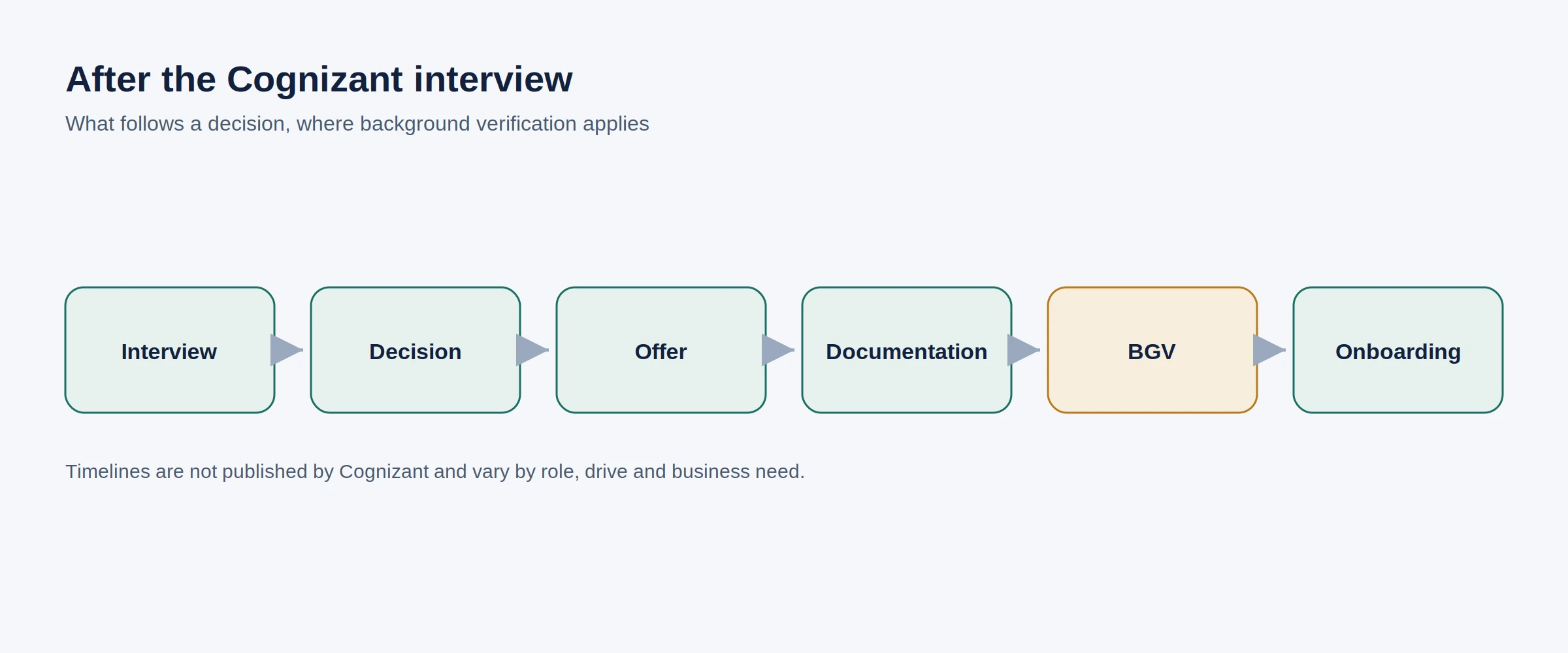
The exact sequence can vary by role and hiring route, but candidates may move through these stages:
- Hiring decision : The hiring team reviews the candidate’s interview performance and overall fit for the position.
- Offer : Selected candidates may receive an offer and instructions for the next steps.
- Documentation : Candidates may be asked to provide or verify required academic, identity, employment, or other documents.
- Background verification : Background checks may be conducted where applicable before onboarding.
- Onboarding : Candidates who complete the applicable requirements receive information about joining and onboarding.
How Long Does Cognizant Take After an Interview?
Cognizant does not publish one universal post-interview timeline that applies to every role. The time between interview, selection, offer, verification, and joining can therefore vary according to the position, hiring route, recruitment drive, and business requirements.
The practical takeaway: Do not assume that a delay after an interview or accepted offer automatically indicates a rejection. Candidates should rely on official Cognizant communication for their application status, offer, verification requirements, and joining date rather than an assumed timeline.
How Does Cognizant Background Verification Work?
Cognizant background verification checks information such as education, previous employment, and references, with additional checks depending on the role and applicable requirements.
According to Cognizant’s careers FAQ, background verification is conducted to validate information provided by candidates and help maintain the safety and security of Cognizant’s associates and clients.
What Does Cognizant Background Verification Check?
Depending on the position and applicable requirements, the process may include:
- Educational qualifications – Verification of degrees, certificates, and other academic information.
- Previous employment – Verification of employment history and relevant details provided by the candidate.
- References – Verification of references where applicable.
- Criminal history – A review may be conducted where legally permissible and applicable to the position.
- Credit history – Certain positions may require credit-history verification, with candidates notified when this applies.
- Pre-screening drug check – Some candidates may be asked to complete a pre-screening drug check where applicable.
Not every candidate undergoes every type of check. The verification requirements depend on the role, applicable laws, and position-specific requirements.
How Should Candidates Prepare?
Candidates should ensure that the information provided during the Cognizant hiring process is accurate and can be supported with appropriate documentation. Depending on the role, this may include degree certificates, academic records, previous employment documentation, and other requested information.
Cognizant’s Candidate Privacy Notice provides information about how candidate personal information is handled.
Where can I check my Cognizant application status?
Cognizant application status should be checked through the careers portal, registered email, or hiring-specific platform associated with your application route. The correct status channel depends on whether you applied through campus, off-campus, GenC, or an experienced-hire opening.
Cognizant Careers Portal
The official Cognizant Careers site is the primary place to search for current openings in India. Candidates can explore opportunities based on factors such as job category, location, and industry, then apply to the relevant position.
Where to Check Cognizant Application Status
The status-checking process can differ by hiring route:
- GenC candidates: Use the GenC candidate platform, where applicable, to monitor application-related updates.
- Campus candidates: Follow communication from the college placement officer or placement cell handling the Cognizant drive.
- Off-campus candidates: Monitor the registered email address used during the application or recruitment process.
- Experienced candidates: Monitor the email address and other official communication channels associated with the specific job application.
For GenC process-related questions, Cognizant also provides a GenC support portal. Campus candidates may need to contact their placement officer for questions specific to their college recruitment drive.
Cognizant Hiring in 2026: What Candidates Should Verify
Cognizant hiring requirements can change between recruitment drives, so candidates should verify the current 2026 opening instead of relying on older eligibility, salary, or deadline information.
What Candidates Should Verify
Before applying to a Cognizant opportunity in 2026, check:
- Graduating batch – Confirm that your graduation year is eligible.
- Education and degree stream – Check the exact degree or discipline required.
- Academic percentage – Verify the current minimum percentage, if specified.
- Backlog or arrears rules – Check whether current or previous arrears affect eligibility.
- Role and hiring route – Confirm whether the opening is for GenC, Analyst Trainee, experienced professionals, or another program.
- Application deadline – Use the deadline stated in the current recruitment notice.
- Location and work model – Check the specified work location and remote, hybrid, or office requirements.
- Compensation and other conditions – Verify current figures and conditions rather than relying on older recruitment articles.
Which Source Should You Trust?
For current eligibility and deadlines, candidates should prioritise the live Cognizant job opening or current recruitment communication. This may be the Cognizant careers site for direct applications or a verified college placement-cell notice for campus recruitment.
The practical rule: If an older article, social-media post, or previous recruitment document conflicts with the current Cognizant opening, use the current official recruitment information to determine your eligibility and application requirements.
How to Identify Fake Cognizant Recruitment Offers
Cognizant does not charge candidates recruitment fees, and candidates should verify unexpected job offers through official Cognizant channels before sharing documents or making any payment.
Cognizant has published a fraud warning on its official notices page explaining that individuals may impersonate Cognizant employees and make false promises about recruitment or selection. Fraudulent documents can appear convincing and may use Cognizant’s logo, candidate information, job descriptions, and salary details.
Common Warning Signs
Treat an offer as suspicious when someone:
- Requests money for registration, interviews, training, verification, equipment, or selection.
- Promises a job in exchange for payment or guarantees selection without following a verifiable recruitment process.
- Uses only WhatsApp, Telegram, or other informal channels without providing verifiable official recruitment communication.
- Sends an offer letter that cannot be confirmed through an official Cognizant channel.
- Claims to represent Cognizant without verifiable credentials or provides contact details that cannot be independently confirmed.
- Pressures you to act quickly or discourages you from verifying the offer.
How to Verify a Cognizant Job Offer
Before paying money or sharing sensitive documents, compare the offer with the current information on Cognizant’s official careers and notices pages. Candidates should verify the recruiter, job opening, communication channel, and recruitment instructions independently rather than relying only on information provided in the suspicious message.
Cognizant states that it does not charge a fee at any stage of recruitment and has not authorised agencies or partners to collect recruitment fees on its behalf.
If you suspect recruitment fraud, Cognizant provides reporting instructions and relevant contact channels through its official notices page. The page provides separate reporting information for general recruitment fraud and certain campus or fresher-related offers.
The key rule: Never pay someone to secure a Cognizant job. Verify the opportunity through Cognizant’s official recruitment channels before proceeding.
Official Cognizant Process vs Candidate-Reported Experiences
Different sources carry different levels of reliability, and this guide has separated them throughout. The table below summarises how to weigh each type.
| Information type | What it tells you | How to interpret it |
|---|---|---|
| Official Cognizant source | Company-stated process and policy | Highest confidence, applies broadly |
| Job listing | Requirements for that specific requisition | Specific to that role, not company-wide |
| Recruitment-drive document | Eligibility and process for that drive | Do not generalise beyond that drive or batch |
| Candidate-reported experience | What one candidate went through | Useful for texture, not a guaranteed template |
IQLancer Cognizant Hiring Process Checklist
- Read the mandatory and preferred skills in the job description
- Prepare a resume aligned to that specific role
- Prepare assessment topics based on the role and route, not a generic list
- Prepare a clear explanation of your own projects
- Prepare role-specific interview topics from the categories above
- Track official communication through the correct channel (placement officer, registered email, or candidate platform)
- Verify recruitment authenticity before sharing documents or payment details
Frequently Asked Questions
What is the Cognizant hiring process?
The Cognizant hiring process varies by role, hiring route, and location. Depending on the opening, candidates may go through screening, assessments, interviews, a hiring decision, background verification, and onboarding.
Is the Cognizant hiring process the same for every role?
No. Cognizant states that its hiring process can vary by role and location, and not every candidate necessarily moves through every stage.
What is the Cognizant hiring process for freshers?
Freshers may enter through GenC, campus recruitment, or specific off-campus drives. Eligibility, assessments, and interview stages depend on the particular program and recruitment drive.
What is the GenC hiring process?
Cognizant describes the GenC process through application, initial screening, assessment, interview, and result stages. The exact requirements and communication can vary by hiring route and drive.
What is the Cognizant Analyst Trainee hiring process?
Analyst Trainee is a specific fresher hiring route. Its eligibility criteria, assessment pattern, degree requirements, and other conditions can vary between recruitment drives, so candidates should verify the applicable notice.
Does Cognizant conduct technical assessments?
For some roles, yes. Cognizant states that technical assessments may be required depending on the position and hiring requirements.
What are Cognizant’s hiring requirements?
There is no single eligibility checklist for every Cognizant position. Requirements such as education, experience, technical skills, academic criteria, and other conditions are defined by the specific job listing or recruitment drive.
How can I check my Cognizant application status?
Use the communication channel associated with your application route. This may include the GenC candidate platform, campus placement communication, or the registered email and official recruitment channels used for an experienced or off-campus application.
Does Cognizant charge any recruitment fee?
No. Cognizant states that it does not charge candidates a fee at any stage of recruitment and warns candidates about fraudulent recruitment offers requesting payment.
Does receiving a Cognizant offer guarantee immediate joining?
Not necessarily. For GenC candidates, Cognizant states that onboarding takes place in batches based on business demand and other factors, so accepting an offer does not necessarily mean an immediate joining date.
Conclusion
The Cognizant Hiring Process varies by role, hiring route, experience level, and recruitment drive, so there is no single round structure that applies to every candidate.
Whether you are applying through GenC, an Analyst Trainee drive, campus placement, off-campus hiring, or an experienced job requisition, start by identifying the exact opportunity and checking its current eligibility, requirements, deadlines, and instructions.
The most reliable preparation comes from the live Cognizant job description or current recruitment notice, supported by official Cognizant communication. Avoid treating older articles, candidate experiences, or generic interview-round lists as universal requirements.
Ultimately, prepare for the specific role and hiring route you are applying to, because that is where the relevant skills, eligibility conditions, assessments, and interview expectations are defined.