The Accenture hiring process is not one fixed sequence of rounds that every applicant experiences in the same order. Accenture’s own careers FAQ states plainly that the number of interviews depends on the role, and that only some roles include an online assessment.
Freshers and experienced candidates often enter through different hiring routes, and technology roles are evaluated against the specific skills named in the job requisition rather than a single company-wide test. IQLancer article walks through the Accenture hiring process using Accenture’s own recruiting information, current job postings, and candidate experiences that are clearly labelled as such, so you can understand the path that applies to the role you are actually targeting.
What Is the Accenture Hiring Process?
The Accenture hiring process is best understood as a framework of possible stages rather than a fixed script. Accenture’s official Recruiting and Hiring Process page describes its own process in six stages confirming receipt of your application, reviewing it against the role, reaching out if you are moving forward, meeting you through one or more interviews, assessing your skills where relevant, and offering you a role.
Accenture is explicit that the number of interviews depends on the role, and that some roles also include an online activity so recruiters can evaluate technical skills, natural strengths, or decision-making, though this assessment is only one part of the process and does not replace human interviews.
At a high level, the Accenture recruitment process can be mapped like this:
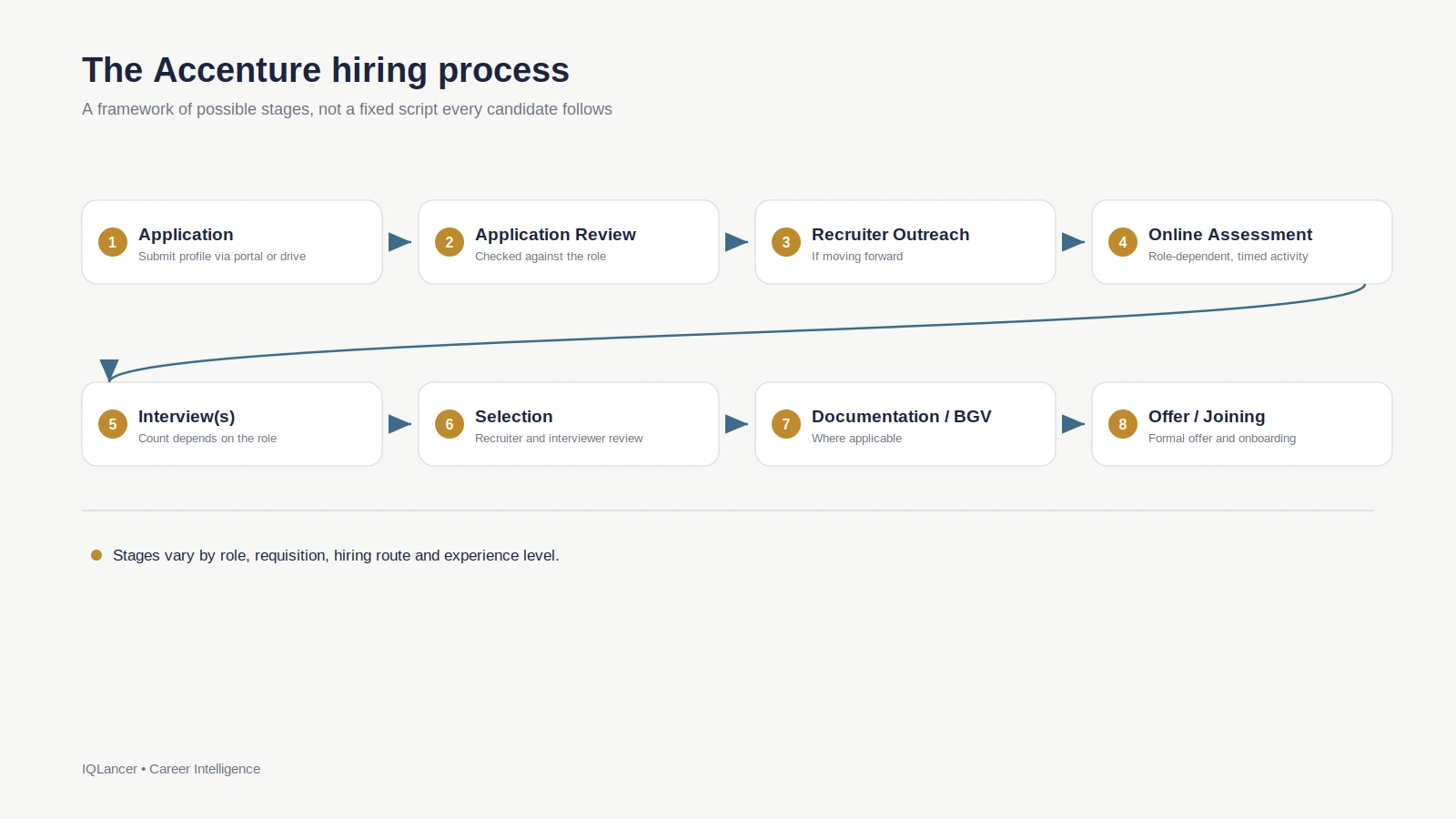
| Stage | What Happens | Applies To |
|---|---|---|
| Application | You submit your profile through the Accenture careers portal or a campus drive | All candidates |
| Application Review | Recruiters check fit against the specific requisition | All candidates |
| Recruiter Outreach | You are contacted if you are moving forward | Applicable candidates |
| Online Assessment | A coding or skills-based activity, timed and auto-scored | Role-dependent |
| Interview(s) | One or more conversations, number depends on role | All candidates, count varies |
| Selection | Recruiters and interviewers review results together | All candidates |
| Documentation/BGV | Document collection and background verification | Applicable candidates |
| Offer/Joining | Formal offer and onboarding | Selected candidates |
Keep this model in mind through the rest of the article: the Accenture hiring process is a sequence of possible checkpoints, and which ones apply to you depends on the role, the requisition, and the hiring route.
How the Accenture Recruitment Process Changes by Hiring Route
The Accenture recruitment process runs through three broad entry routes, and none of them guarantees a fixed number of rounds.
Campus / On-Campus
College placement drives run on a schedule set jointly by Accenture and the institution. Eligibility, assessment format, and interview structure are usually set for that specific drive. A drive at one campus may include a group discussion or communication round that another does not use.
Off-Campus
Off-campus applicants apply directly through the Accenture Careers job search page against a specific, currently open requisition. Application review, possible recruiter contact, and the interview structure are tied to that requisition rather than a generic “off-campus process.”
Experienced / Lateral
Lateral hiring is built around a specific job opening with defined experience and skill requirements. Recruiter screening, technical or skill-based interviews, and documentation or BGV generally follow, but the exact combination depends on the role and business need.
| Factor | Campus | Off-Campus | Experienced/Lateral |
|---|---|---|---|
| Entry point | College placement drive | Careers portal job posting | Careers portal or referral against a specific opening |
| Eligibility | Set by the drive | Set by the job description | Set by years of experience and required skills |
| Assessment | May be structured by the drive | Role-dependent | Role-dependent, often skills-based |
| Interview count | Varies by drive | Varies by role | Varies by role and seniority |
| Documentation/BGV | Usually before joining | Usually before joining | Usually before joining |
No single route can be said to always involve more or fewer rounds than another. The Accenture hiring process for each route is shaped by the specific requisition running at the time.
Accenture Recruitment Process for Freshers
The Accenture recruitment process for freshers typically starts with either a campus placement drive or an off-campus application against an entry-level requisition. Eligibility, such as minimum aggregate marks and educational background, is set per drive or job posting rather than as one universal rule, so always check the specific listing.
After the application stage, freshers may be asked to complete an online assessment. Accenture’s official guidance says these assessments are timed, typically taking 30 to 90 minutes, are completed in a coding environment, and are scored automatically against a validated threshold, as described on the Recruiting and Hiring Process FAQ. Candidates who clear the threshold move forward to interviews, which can include a technical discussion around fundamentals and projects, and in many reported cases a separate communication round.
Candidate reports show real variation in this fresher path. One candidate who interviewed at Accenture in early 2026 reported on Glassdoor a process that began with a program called “Go For Gold,” followed by a two-phase assessment on technical and verbal ability, then a short interview. This is an individual experience tied to a specific drive, not a confirmed universal sequence.
Because eligibility windows, assessment formats, and interview counts are set at the drive or requisition level, the safest approach for a fresher is to treat the current job posting or placement cell communication as the primary source of truth for that specific Accenture recruitment process for freshers, rather than relying on last year’s reported sequence.
ATS Resume for Data Analysts: Requirements, Keywords and Optimization
Accenture Recruitment Process for Experienced Candidates
The Accenture recruitment process for experienced candidates centers on a specific job requisition rather than a generic “experienced hiring” template. Recruiters evaluate an application against the exact years of experience, mandatory skills, and project background listed for that role, and current postings show real differences even within the same job title.
For example, current Custom Software Engineer requisitions on Accenture’s own listings ask for different minimum experience and mandatory skills, ranging from Salesforce Marketing Cloud to Workday Core HCM to specific ERP modules, depending on the client project behind the role. This is why “three years of experience” alone cannot define the interview process; the required technology matters more than the years-of-experience number by itself.
A typical lateral hiring path includes recruiter screening for fit and notice period, one or more technical or skill-based interviews tied to the mandatory skills in the posting, and in many cases a discussion with a manager about project ownership. Behavioral topics such as motivation, location, and compensation are commonly covered too, though not always in a separate, clearly labelled “HR round.” Documentation and background verification generally follow a positive interview outcome, ahead of a formal offer.
Candidate reports on Glassdoor add texture without replacing this picture. One candidate interviewing for a Java-related role in early 2026 described a first round on Java basics and coding, a second on Spring Boot and microservices, and an online test, a sequence that looks nothing like the four-stage aptitude-to-manager loop reported by another candidate interviewing in Greece around the same time. This difference is itself the evidence that experienced hiring follows the specific requisition rather than one fixed template.
Accenture Interview Process: What Can Happen After Shortlisting?
Once shortlisted, the Accenture interview process can draw from several possible evaluation layers below. Not every candidate goes through every layer, and the order can vary.
Technical / Skill Interview
Depending on the role, this can cover programming languages, a specific technology stack, cloud platforms, data engineering tools, test automation, or architecture decisions relevant to the requisition.
Project / Experience Discussion
Interviewers commonly ask candidates to walk through actual project responsibilities, technical decisions, problems they troubleshot, and how they collaborated with a team or client. One Glassdoor reviewer summed up a typical prompt as being asked to walk through their experience and previous projects in detail rather than answer generic definitions.
Managerial Discussion
Where a managerial round is part of the loop, it tends to focus on ownership, prioritization, how a candidate handles pressure, and past team or client situations, rather than pure technical depth.
Behavioral / HR Discussion
This can cover motivation for the move, communication style, relocation flexibility, notice period, and compensation expectations. Accenture’s official FAQ confirms that human discussion remains central to hiring decisions even where a technical assessment is used earlier.
Online Assessment / Activity
Accenture states that some roles include an online activity so recruiters can learn about technical skills, natural strengths, or decision-making. The official assessment FAQ explains that most assessments run 30 to 90 minutes, are completed in one sitting within a 72-hour window, and are scored automatically against a validated threshold. Not every assessment is a general aptitude test; treat “online assessment” and “aptitude test” as different things unless a source confirms otherwise.
Accenture Technology Roles and Why the Interview Process Can Differ
“Technology role” is too broad a label to predict a single interview format, because the required stack differs sharply from one requisition to the next, even under the same job title.
| Technology Role | What the Candidate May Need to Demonstrate |
|---|---|
| Custom Software Engineer | Programming language, framework, and platform skills named in the requisition |
| Data Engineer | Data pipelines, SQL, Python, and cloud/data-platform tools relevant to the posting |
| Cloud/Infrastructure | The specific cloud platform(s) and infrastructure tooling named in the role |
| QA/Test Automation | Testing methodology and automation tools listed for that project |
| SAP/Enterprise Applications | Depth in the specific ERP platform or module required |
| AI/ML | Programming fundamentals plus applied ML/AI project experience |
This is role preparation guidance, not a guaranteed interview structure. The reliable way to know what will be tested is to read the must-have and good-to-have skills on the exact requisition.
Accenture Interview Process for Custom Software Engineer
The Accenture interview process for Custom Software Engineer cannot be summarized as one fixed technical stack, since current postings under this title cover very different technologies. A requisition built around Workday Core HCM asks for a different skill set than one built around SAP Vendor Invoice Management or one focused on Salesforce Marketing Cloud. This variation also applies to Custom Software Engineering Associate postings, where minimum experience and mandatory skills again differ.
The more reliable preparation model:
Exact Job Description → Primary Technology in “Must Have Skills” → Required Experience → Project Evidence Matching That Technology → Technical Discussion → Managerial Discussion Where Applicable
Technologies seen across recent postings include Java and Spring, .NET, Salesforce, and SAP modules, but none should be assumed mandatory unless the specific job description names it. Preparing from the must-have skills on the posting you applied to is more reliable than a generic question list.
Accenture Interview Process for Data Engineer
The Accenture interview process for Data Engineer should also begin from the exact requisition rather than a generic Data Engineer curriculum. Current Data Engineer postings show real variation: some emphasize Databricks on Microsoft Azure, others focus on Python-first pipelines, and others center on Snowflake and DBT for a specific industry domain.
Areas that commonly appear across these postings, without being universal to all of them, include SQL, ETL or ELT pipeline design, Python, cloud data services on AWS, Azure, or GCP, data modeling, and orchestration tools such as Airflow. Minimum experience requirements also range widely, from around two years for some pipeline-focused roles to seven or more for architecture-heavy positions.
The purpose here is not a Data Engineer study guide, but to show the underlying logic: job requirement defines interview preparation. Two candidates applying for roles both titled “Data Engineer” in the same month can expect to be evaluated on different tools if their requisitions name different mandatory skills.
ATS Resume for Cloud Engineer: Keywords, Format & Proof
Accenture Recruitment Process for Freshers: On-Campus vs Off-Campus
The entry point changes practical details, not necessarily the stage count. On-campus, eligibility and scheduling are set by the drive, with communication through the placement cell alongside Accenture. Off-campus, a candidate applies directly on the careers portal against an open posting, with eligibility and interview structure tied to that role and communication direct from the recruiter or Workday. Neither route can be assumed to have fewer or more rounds; both follow the plan set for that drive or requisition.
What Happens After the Accenture Interview?
After interviews conclude, the Accenture hiring process typically moves through an outcome decision, document collection, background verification, an offer, and joining, though not every candidate experiences these in the same order or timeframe.
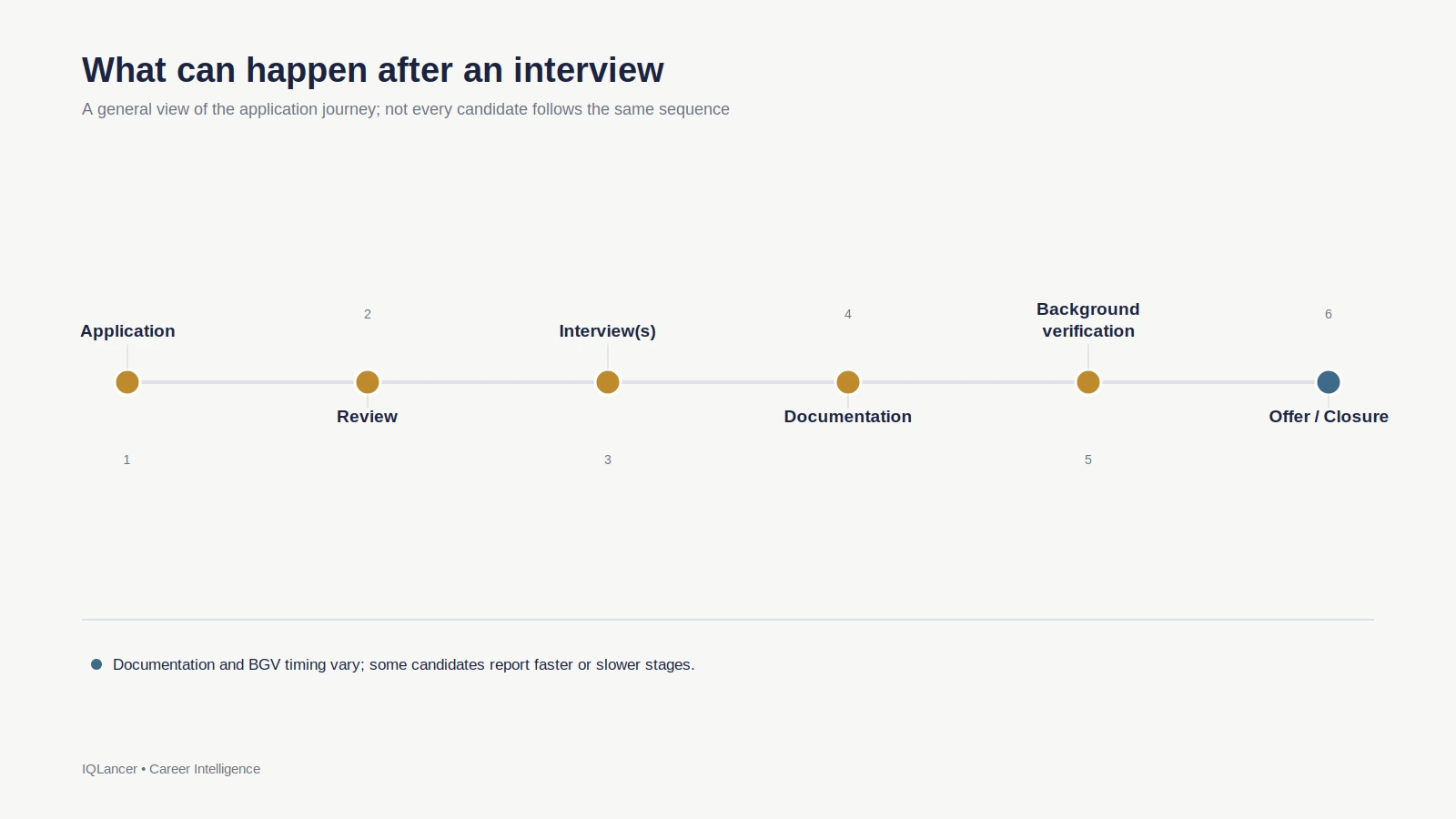
Interview Outcome → Document Request → Background Verification (BGV) → Offer → Joining
Candidate discussions on communities such as Fishbowl give a sense of this stage, though these remain individual reports, not official policy. Some candidates have described uploading documents through a Workday link shortly after a final round and then waiting for further contact. Others have discussed BGV taking additional time when an offer is revised for a different location, or a previous employer is slow to issue an experience letter.
None of this should be read as a confirmed Accenture-wide rule about timing. What it shows is that documentation and BGV are a real, commonly discussed stage, and being ready with relieving letters, experience letters, and salary slips in advance can help this stage move more smoothly.
How to Check Accenture Application Status
Accenture’s official channel for tracking an application is the candidate’s own account on the Accenture Careers portal, accessed through the Workday-based application system linked from the careers site. Status updates and next steps are also communicated by email or phone from an Accenture recruiter, and Accenture’s own guidance confirms that official communication will only come from an @accenture.com address, as stated on its scam-alert page.
To make status tracking easier, save the exact job title, requisition or job ID, application date, and the email address used. Accenture’s FAQ notes that turnaround depends on the role and business area, so a recruiter is the most accurate source for a specific case. Portal status labels are not fully documented in public Accenture materials, so this article will not attempt to define what every internal label means; if one is unclear, the recruiter listed on your application, not a third-party “status checker” tool, is the accurate source.
Accenture Careers Login and Hiring Portal
Two destinations matter here. The Accenture Careers site is where roles are searched and hiring information is published, including country-specific pages such as the India careers page. The actual login and application system runs on Workday, reached through the “Access Application” link from the careers site.
Apply and check status only through these official channels. Accenture does not ask for payment at any stage of recruitment, and any message requesting fees for equipment, training, or “processing” should be treated as fraudulent, per Accenture’s own scam warning. This article will not reproduce login instructions, since portal interfaces change; the current “Access Application” link is the reliable starting point.
Accenture Recruitment Process 2026: What Candidates Should Know
Job availability changes constantly, and the Accenture recruitment process 2026 candidates encounter is shaped by whichever requisitions are open when they apply, not a fixed annual plan. Requisitions close once filled, formats can be updated by the hiring team, and volume shifts with business demand.
A current job description on the Accenture careers portal takes precedence over any older article, including this one. If researching a specific 2026 drive, the requisition or drive announcement itself is the accurate source. Search interest around future batches reflects what candidates are searching for, not a confirmed Accenture commitment to a universal plan for that period.
What Recent Candidate Experiences Reveal About the Accenture Hiring Process
Candidate communities such as Glassdoor and Fishbowl are useful for understanding what individual applicants have gone through, but they should never be read as official Accenture policy.
What Accenture officially documents: the number of interviews depends on the role, some roles include an online assessment scored automatically against a validated threshold, and human interviews remain central to every hiring decision, as confirmed on Accenture’s official FAQ.
What candidates report: wide variation in the number of rounds, ranging from a short two-round loop to sequences involving an aptitude test, a technical MCQ, a technical interview, and a manager interview, as seen across multiple Glassdoor reports from candidates interviewing in different countries during 2026. Some also report friction after interviews, such as one applicant who described clearing two technical rounds before being told the position had been filled internally.
What cannot be generalized: a single candidate’s reported timeline or interview count cannot be treated as proof of how Accenture handles every application. Recent discussions show real variation in scheduling and post-interview communication, and that variation itself is the honest takeaway. You can also check out MostEdge Hiring Process 2026 Vadodara to get your perfect Job Role.
How Long Does the Accenture Hiring Process Take?
There is no single confirmed duration for the Accenture hiring process; Accenture’s own FAQ states turnaround depends on the role and business area, as noted on its Recruiting and Hiring Process page. Factors that can extend or shorten the timeline include pipeline volume for that role, interviewer availability, the 90-day assessment retake rule, documentation turnaround from a previous employer, and how quickly BGV completes.
Candidate-reported timelines vary accordingly, from a candidate who reported receiving an offer the same day as a second round, to another who described a campus process taking around three months before the interview stage. These are individual experiences; a candidate’s own recruiter is the accurate source for their specific timeline.
Accenture Hiring Process and Salary: What Candidates Should Know
Compensation depends on the specific role, seniority level, skills and certifications, and often location. This applies to search interest around a specific city’s pay, such as the Accenture hiring process Vadodara salary, as much as any other location; the accurate figure comes from the offer discussion tied to that requisition, not a generalized city-wide number.
Notice period and current compensation are commonly discussed during recruiter screening or a later conversation. Third-party salary estimator sites offer a general sense of market ranges, but they are not official Accenture guarantees, and figures vary by project, band, and location within the same job title. This article does not publish an invented salary range for any specific city, since no verified, current, city-specific figure was available at the time of research.
Why Can an Accenture Hiring Process Be Delayed or Change?
Several variables can affect timing or structure, and these should be read as possible explanations, not confirmed reasons for any individual delay:
- Changes to the requisition, including shifts in required skills or scope
- Business or client-side changes affecting project headcount
- Interviewer or panel availability
- Overall hiring volume for that business area
- Candidate-side factors, such as availability or delayed documentation
- Background verification timelines, especially when previous employers are slow to issue letters
- A role being paused or closed mid-process
The candidate account referenced earlier, of two technical rounds being completed before a role was reported filled, is a useful illustration of how a requisition-level change can affect an individual candidate, but it remains one reported case, not evidence of a systemic pattern.
How to Prepare for the Accenture Hiring Process
Rather than memorizing a generic list of “Accenture interview questions,” a role-first preparation approach tends to be more reliable, because the actual requisition drives what gets tested.
- Save the exact job description. Requisitions can be updated or closed.
- Identify mandatory skills. Separate “must have” from “good to have.”
- Match your resume to the requisition. Emphasize the specific tools named, not a generic skills list.
- Prepare your project explanations. Be ready to walk through real decisions and outcomes.
- Review role-specific fundamentals. Focus on the exact stack in the posting.
- Prepare behavioral examples. Have concrete stories for teamwork and problem-solving.
- Know your notice period and location details. Recruiters ask about both early on.
- Keep required documents ready. Relieving and experience letters, salary slips, and ID documents speed up BGV later.
This role-first method reflects how the Accenture hiring process actually works: the requisition, not a generic question bank, is the primary source of what will be evaluated.
IQLancer Accenture Hiring Process Checklist
- Identify the exact role and requisition ID
- Check eligibility for that specific posting or drive
- Read the complete job description before applying
- Apply through the official Accenture careers portal or your campus placement cell
- Save the requisition/job ID and application date
- Monitor your email and the Accenture careers portal for status updates
- Complete the assessment if one is requested, within the given time window
- Prepare role-specific technical areas based on the must-have skills
- Attend the interview(s) scheduled for your role
- Respond promptly to document requests
- Complete background verification if required
- Wait for official offer communication from an @accenture.com address
- Confirm joining details directly with your recruiter
FAQ For Accenture hiring process
1. What is the Accenture hiring process?
A framework of possible stages, application, review, assessment where applicable, interview(s), selection, documentation/BGV where applicable, and offer, with the exact combination depending on the role, per Accenture’s official FAQ.
2. What is the Accenture recruitment process for freshers?
Freshers apply through a campus drive or off-campus posting, may complete an online assessment, and then attend one or more interviews. The sequence depends on the drive or requisition.
3. What is the Accenture recruitment process for experienced candidates?
It centers on a specific job opening: recruiter screening, one or more technical interviews, often a managerial discussion, and documentation/BGV before an offer. It depends on the role and skills, not years of experience alone.
4. How many rounds are there in the Accenture interview process?
Accenture does not publish a fixed number; its FAQ states interview count depends on the role, and candidate reports show real variation, from two rounds to four or more.
5. What is the Accenture interview process for Custom Software Engineer?
It depends on the technology named in the requisition, since current postings cover different stacks such as Java, Salesforce, SAP, and Workday. Prepare from the exact job description.
6. What is the Accenture interview process for Data Engineer?
It depends on the tools named in the posting, ranging from Azure Databricks to Python-first pipelines to Snowflake and DBT. Prepare from the specific requisition, not a generic list.
7. How can I check my Accenture application status?
Through your account on the official Accenture Careers portal, and through recruiter communication, which will always come from an @accenture.com address.
8. Does Accenture conduct an online assessment?
For some roles. Accenture’s FAQ confirms assessments typically take 30 to 90 minutes and are scored automatically against a validated threshold. Not every role includes one.
9. How long does the Accenture hiring process take?
No confirmed universal timeline exists. Accenture states turnaround depends on role and business area; candidate reports range from about two weeks to several months.
Conclusion
There is no single Accenture hiring process that applies identically to every candidate. The most reliable way to understand your own path is to combine your hiring route, role, experience level, and specific requisition, then follow that through application, assessment or screening where applicable, interview(s), selection, documentation or BGV where applicable, and offer and joining. Candidates get further by understanding the specific hiring path tied to the role they are targeting than by preparing around a generic list of interview rounds, and by treating the current job description, not a general article, as the primary source once they have applied.