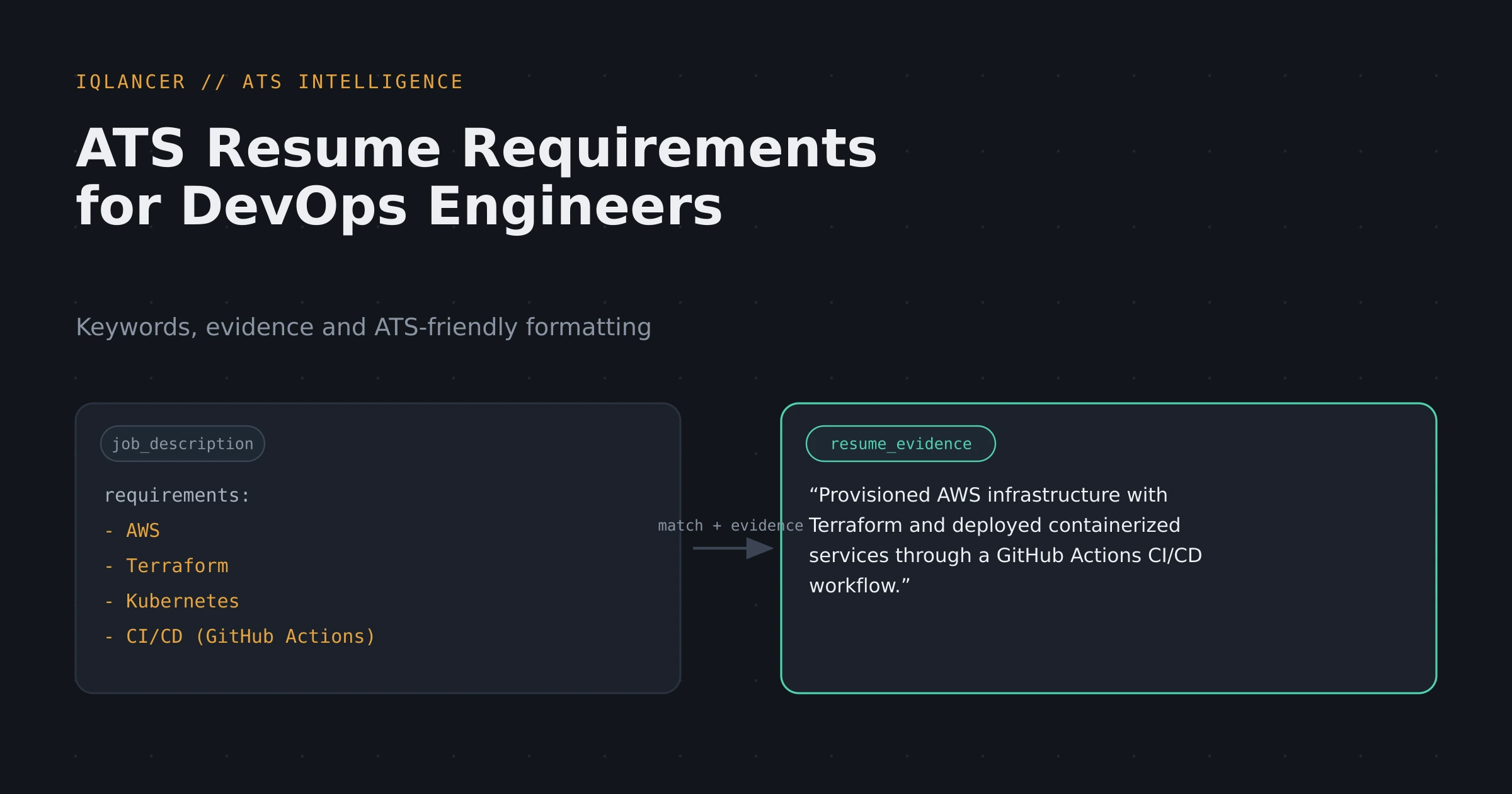
A DevOps resume is judged twice once by a system that searches and sorts text, and once by a person who decides whether the candidate can actually do the job described in the posting. Most advice on building an ATS resume for DevOps engineer stops at ‘add Kubernetes, Terraform and AWS, then use a clean format. That advice is not wrong, but it skips the harder question, how do you decide which of your own technologies and responsibilities belong on the page, and how do you write them so both the system and the recruiter can verify them?
IQlancer guide breaks that process down from reading a DevOps job description to , to identifying which requirements genuinely match your background, to representing that match in resume language that survives scrutiny in an interview.
What Does an ATS Resume Need to Show for a DevOps Engineer?
An applicant tracking system (ATS) is primarily a database and search tool. When creating an ATS Resume for DevOps Engineers, it’s important to understand that most platforms do not compute a hidden “score” against a job description on their own. Instead, they let recruiters search stored resume text for specific terms, filter by fields such as years of experience, and route applications to a queue.
Harvard Business School and Accenture’s 2021 “Hidden Workers” research found that qualified candidates are commonly screened out, but the dominant cause was rigid, recruiter-configured filters, such as degree requirements for roles that did not need one, rather than a system independently rejecting resumes for stylistic reasons.
For a DevOps resume, that means two things need to be true at once. The text needs to contain the terminology a recruiter or hiring manager will actually search for, in a format the system can extract cleanly. And the surrounding sentences need to show enough operational detail that a technical reviewer believes the claim. A resume that only satisfies the first condition tends to generate interviews the candidate cannot sustain past the first round.
How DevOps Job Descriptions Translate Into Resume Requirements
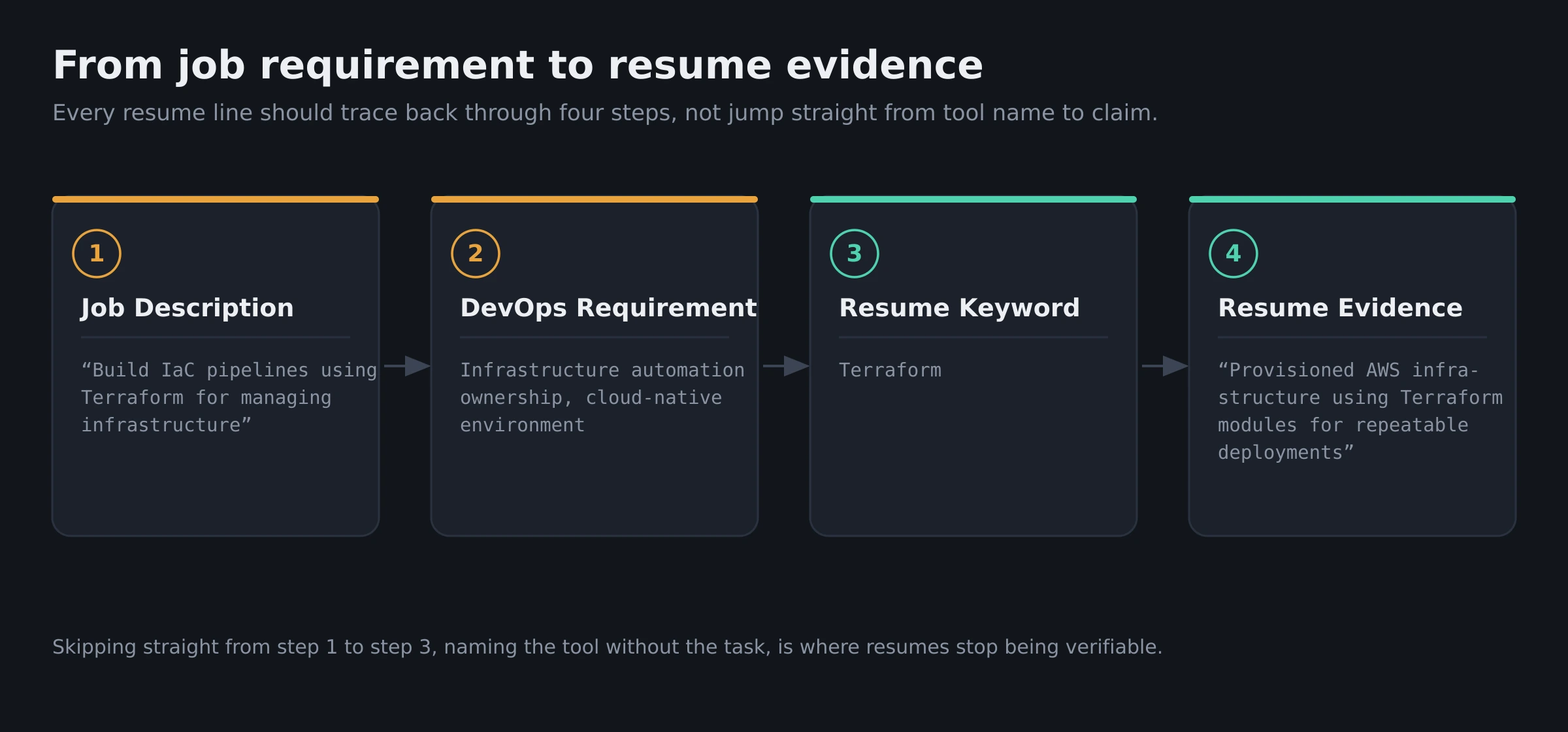
DevOps job postings rarely list requirements in resume-ready language. A posting might read “build infrastructure as code pipelines using Terraform or CloudFormation for managing and automating infrastructure” or “operate and optimize workloads on AWS and manage Kubernetes clusters,” patterns that appear across current listings for the role. To translate this into a resume, break each requirement into its component parts before writing anything:
- Technology – the specific tool or platform named (Terraform, Kubernetes, GitHub Actions).
- Task – what the posting says is done with it (provision infrastructure, manage clusters, build pipelines).
- Context – the environment implied (production, cloud-native, containerized).
- Your match – whether you have done this, in what capacity, and how recently.
Only after this breakdown should a term move onto the resume. A requirement that names a technology you have never used in any real capacity should not be added just because the posting mentions it; that step is covered later in this guide.
How DevOps Resume Requirements Change by Role Focus
“DevOps Engineer” is not one standardized technical profile. Job titles overlap heavily with platform engineering, site reliability engineering (SRE), and DevSecOps, and postings under the same title can emphasize very different work. Analysis comparing these roles notes that platform engineers concentrate on building the self-service infrastructure other developers consume, while SREs are measured primarily on reliability and incident response, even though both groups share tooling and vocabulary with generalist DevOps roles. For an ATS Resume for DevOps Engineers, the practical effect is that the same candidate history can be presented with different emphasis depending on which posting is being targeted.
Recognizable patterns worth watching for, without treating them as fixed categories:
- Cloud-focused DevOps – emphasis on AWS, Azure or GCP, IAM, networking, storage and cloud automation.
- Platform Engineering – emphasis on Kubernetes, internal developer platforms, and developer-experience tooling.
- CI/CD-focused roles – emphasis on Jenkins, GitHub Actions, GitLab CI and release automation.
- SRE-oriented roles – emphasis on observability, incident response, reliability and troubleshooting, with SLOs or SLIs only where the candidate genuinely worked with them.
- DevSecOps – emphasis on security scanning, secrets management, IAM and compliance controls inside CI/CD.
- Infrastructure-focused roles – emphasis on Terraform, Ansible, Linux administration and configuration management.
The target posting, not a generic DevOps template, should determine which of your own experiences get the most resume space.
DevOps Resume Keywords: Which Terms Should You Include, and How to Prioritize Them
Current DevOps postings cluster around a recognizable set of categories: cloud platforms (AWS, Azure, GCP), systems and scripting (Linux, Bash, networking), containers (Docker, Kubernetes), infrastructure as code (Terraform, Pulumi, CloudFormation), CI/CD (Jenkins, GitHub Actions, GitLab CI, Argo CD), automation and configuration (Ansible, Python), observability (Prometheus, Grafana, Datadog), and security (secrets management, vulnerability scanning). These groupings are consistent with the responsibility patterns described in current DevOps job description breakdowns and with the requirement lists in live postings.
Not every DevOps professional needs every category, and including all of them regardless of fit is where keyword strategy turns into keyword stuffing. A more useful filter sorts each candidate technology by two questions: does the target posting mention it, and have you genuinely used it?
- High priority – explicitly named in the target JD and genuinely used by the candidate.
- Supporting – relevant to the JD and genuinely used, but not central to the role.
- Contextual – adjacent experience that strengthens overall fit without being a headline skill.
- Exposure – real but limited familiarity (a course, a lab, a short trial) that should be labeled as exposure, not professional ownership.
- Do not add – anything in the JD or a competitor’s resume that you have not actually used.
This sorting step happens before any bullet gets written. Writing evidence-backed sentences for a “high priority” item is very different work from writing them for something in the “exposure” category, which the next two sections address directly.
How to Turn DevOps Technologies Into Resume Evidence
A tool name alone does not establish proficiency; it establishes only that the word exists somewhere in your history. The gap between “Kubernetes” as a listed skill and “managed Kubernetes deployments and troubleshooting in a production environment” as a demonstrated responsibility is the single biggest quality difference between resumes that generate interviews and resumes that generate rejections after a technical screen.
Build each bullet through this chain: technology, then task, then environment, then responsibility, then evidence or outcome.
- Weak: “Terraform, AWS, Kubernetes, Docker.”
- Better: “Used Terraform to provision AWS infrastructure for a containerized application.”
- Stronger, when true: “Automated AWS infrastructure provisioning with Terraform and deployed containerized services through a CI/CD workflow.”
The same pattern applies to monitoring and Linux experience, which are easy to understate. “Monitoring” alone tells a reviewer nothing; “configured Grafana dashboards and Prometheus alerts to track service latency and error rates” tells them what you actually built and what it was for. Do not manufacture a metric, an outage count, or a percentage improvement that you cannot defend if asked about it directly.
Production, Project and Lab Experience: How Should You Represent Them?
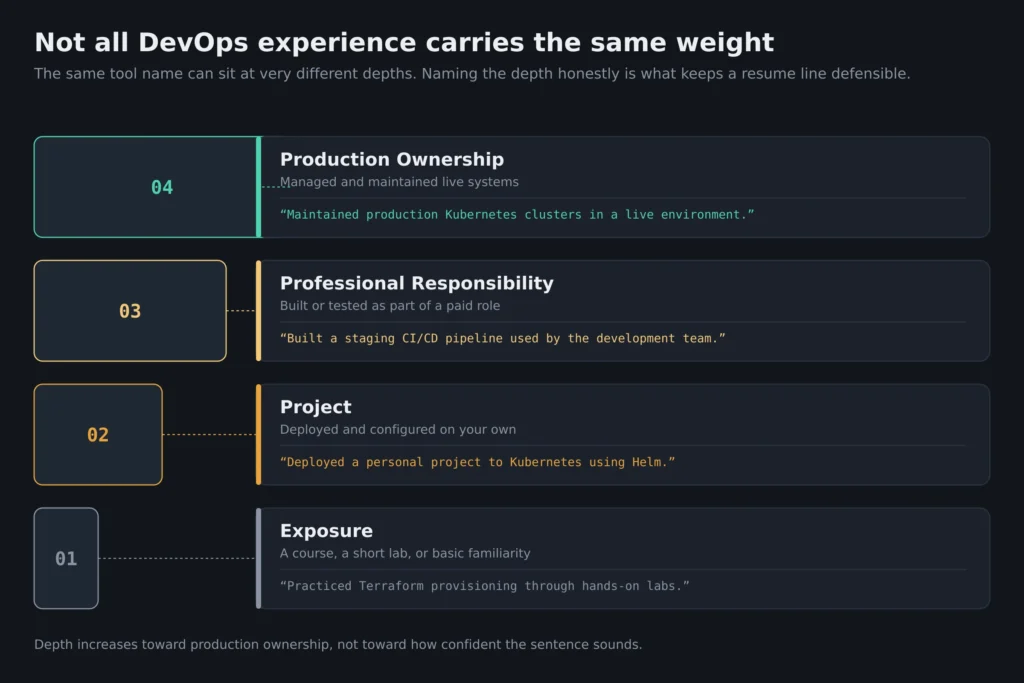
DevOps candidates often draw from more than one source of experience: employer production work, professional but non-production work, personal projects, and lab or course exercises. Each deserves a place on the resume, and conflating them is one of the fastest ways to lose credibility in a technical interview.
| Experience Type | Appropriate Language | Example |
|---|---|---|
| Production | Managed / maintained / automated | “Maintained production Kubernetes clusters supporting a multi-service application.” |
| Professional non-production | Built / implemented / tested | “Built a staging CI/CD pipeline used by the development team before production rollout.” |
| Personal project | Deployed / configured / automated | “Deployed a containerized personal project to Kubernetes using Helm and GitHub Actions.” |
| Lab / learning | Practiced / configured / explored | “Practiced Terraform provisioning and Kubernetes deployments through hands-on labs.” |
These verbs are starting points, not rules to apply mechanically; the actual scope of responsibility should always decide the wording. What matters more than the specific verb is the boundary itself: a lab should never be written as production, a personal project should never be attributed to an employer, and certification practice should never be described as operational ownership. A recruiter or interviewer who catches this mismatch will question everything else on the page.
How to Write DevOps Resume Bullets for ATS and Recruiters
With the evidence framework and the experience-type distinctions already established, the remaining work is applying both consistently across the resume. A useful bullet communicates what was done, how it was done, the context it happened in, and, where genuinely available, the result or purpose.
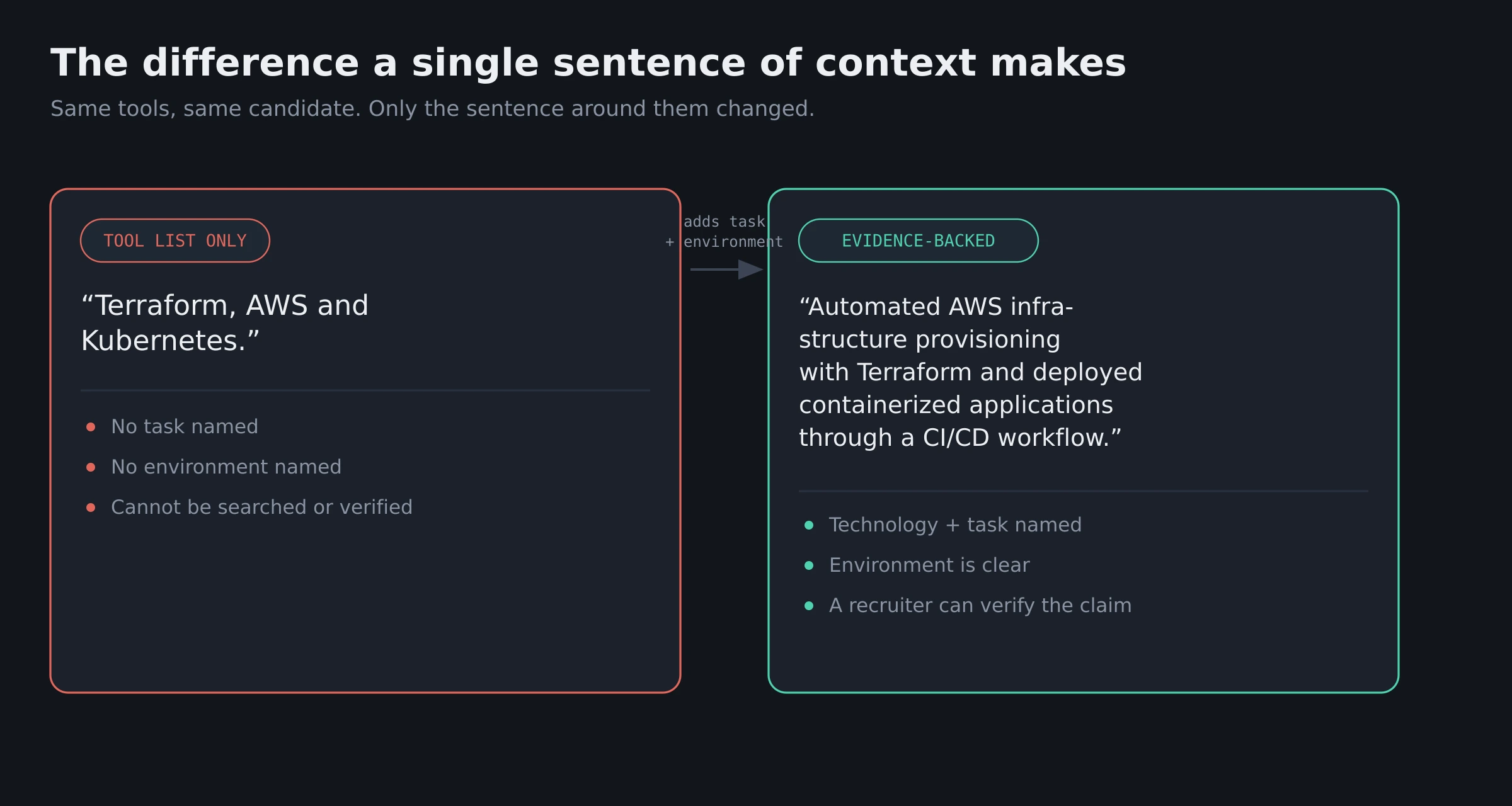
- Tool-only statement: “Terraform, AWS and Kubernetes.”
- Responsibility statement: “Used Terraform to provision AWS infrastructure and deploy containerized applications.”
- Evidence-backed statement: “Automated AWS infrastructure provisioning with Terraform and deployed containerized applications through a CI/CD workflow, reducing manual deployment steps for the team.”
Only the last version should include an outcome, and only if that outcome is something you can walk through in detail if asked. Never invent uptime figures, MTTR reductions, cost savings, deployment frequency, latency improvements, or infrastructure scale. If you do not have a real number, describe the responsibility and the system instead of filling the gap with a guessed statistic.
ATS-Friendly Formatting for a DevOps Resume
Formatting advice for ATS resumes is one of the more contested areas of job-search content, and the disagreement is worth naming rather than glossing over. One practitioner study testing resumes across popular builders found modern ATS platforms handling two-column layouts about as well as single-column ones, provided the underlying template controls reading order.
Enhancv’s testing on this question concluded that column count itself was never the real variable, reading order was. A separate benchmark that ran one resume through several layout variants found the opposite for at least some systems: the two-column version was flagged for a reading-order problem and scored lower than a single-column control, particularly on older, rule-based platforms still used in government and enterprise ATS deployments.
Because the evidence is mixed and depends on which ATS a given employer runs, this article will not claim that any single layout choice guarantees success or failure. What is consistent across the research is lower-risk practice regardless of platform:
- Use conventional section headings (Experience, Skills, Education) rather than creative labels.
- Keep dates in a consistent, standard format.
- Place contact information in the body of the document, not only in a header or footer some parsers skip.
- Avoid embedding critical text inside graphics, icons, or skill-rating bars.
- Keep the structure predictable enough that both a parser and a fast human read can follow it.
Note that ATS adoption itself is well documented: Jobscan’s tracking of Fortune 500 hiring practices reports that the large majority of major employers use some form of applicant tracking system, which is why format hygiene still matters even though no format choice by itself guarantees a result.
ATS Optimization vs Keyword Stuffing for DevOps Engineers
Legitimate ATS optimization for an ATS Resume for DevOps Engineers means using terminology that genuinely reflects the target role, keeping skills accurate, aligning the resume with the job’s actual requirements, formatting for readability, and backing claims with evidence all of which the sections above already cover in practice.
Keyword stuffing is a different behavior: repeating the same tool multiple times without adding information, listing technologies never used, copying phrases directly from the job description, hiding keywords in white text or tiny fonts, or building an oversized skills section meant to catch every possible search term. A keyword appearing somewhere on the page does not make a resume credible; a recruiter who searches for “Kubernetes” and finds it only in an unsupported list, with no bullet describing what was done with it, has little reason to trust the match.
From a DevOps Job Description to Resume: A Practical Example
FICTIONAL EXAMPLE. The following job description does not represent a real employer or posting.
“We are hiring a DevOps Engineer to support our containerized platform. Requirements: AWS, Terraform, Kubernetes, GitHub Actions, Docker, Linux administration, monitoring and alerting, and participation in incident response rotations.”
| Job Requirement | Resume Keyword | Candidate’s Actual Experience | Resume Evidence |
|---|---|---|---|
| AWS | AWS | Two years using AWS in a production role | “Managed AWS compute and storage resources supporting a production application.” |
| Terraform | Terraform | Used Terraform to provision AWS resources | “Provisioned AWS infrastructure using Terraform modules for repeatable deployments.” |
| Kubernetes | Kubernetes | Deployed and maintained Kubernetes workloads in production | “Maintained Kubernetes deployments and resolved pod-level issues in production.” |
| GitHub Actions | GitHub Actions | Built CI/CD workflows for the team | “Built GitHub Actions workflows to automate testing and container builds.” |
| Docker | Docker | Built and maintained container images | “Built and maintained Docker images used across the CI/CD pipeline.” |
| Linux administration | Linux | Day-to-day Linux server administration | “Administered Linux servers, including networking and process management.” |
| Monitoring and alerting | Monitoring, observability | Set up Grafana dashboards, no Prometheus experience | “Configured Grafana dashboards for service health monitoring.” |
| Incident response | Incident response | Assisted senior engineers during incidents, did not lead them | “Assisted in production incident response, including log review and root-cause investigation.” |
Two things are visible in this mapping. First, every line in an ATS Resume for DevOps Engineers stays inside what the candidate can defend, including the incident response row, which uses “assisted” rather than “led” because that is the true scope. Second, nothing was added for a requirement the candidate had no real experience with; there is no Prometheus bullet here because the candidate only used Grafana.
DevOps Engineer Resume Sample: Keyword-to-Evidence Mapping
The following is a compact, fictional resume section. It is not a template to copy directly; it demonstrates how the concepts above work together.
Professional Summary DevOps Engineer with 3 years of experience supporting containerized applications on AWS, including infrastructure automation with Terraform and CI/CD pipeline maintenance using GitHub Actions.
Technical Skills AWS (EC2, S3, IAM) · Terraform · Kubernetes · Docker · GitHub Actions · Linux · Grafana
Professional Experience DevOps Engineer, [Company], 2023 to Present
- Maintained Kubernetes deployments and resolved production pod-level issues alongside the platform team.
- Provisioned AWS infrastructure using Terraform, reducing manual configuration steps for new environments.
- Built and maintained GitHub Actions workflows for automated testing and container image builds.
- Assisted in production incident response, including log review, root-cause investigation and postmortem documentation.
Project Experience (clearly separated from employer work) Personal Kubernetes Cluster Project, 2022
- Deployed a multi-service application to a self-managed Kubernetes cluster using Helm.
- Automated deployments with a GitHub Actions pipeline connected to a personal Docker registry.
Certifications AWS Certified SysOps Administrator – Associate
Each line traces back to a requirement pattern discussed earlier: the technology is named, the task is specific, and the environment (production versus personal project) is unambiguous. Nothing here claims ownership beyond what the summary and job title would support.
ATS Resume for Data Analysts: Requirements, Keywords and Optimization Guide for 2027
Freshers vs Experienced DevOps Professionals
Building an ATS Resume for DevOps Engineers requires different evidence for freshers and experienced professionals, based on their actual skills, projects, and responsibilities.
Freshers typically do not have production history to draw on, and the resume should not pretend otherwise. Legitimate evidence includes internships, genuine personal projects, clearly labeled labs, visible GitHub work, relevant coursework, and certifications backed by hands-on practice. A personal Kubernetes or Terraform project, described honestly as a project, carries more credibility than a vague claim of “DevOps experience” with no context.
Experienced professionals should shift emphasis toward production responsibility: infrastructure ownership, deployment automation, incident handling, reliability work, and scale, where these genuinely apply. Metrics are useful when they exist, but a candidate without a defensible number should describe the responsibility and its context rather than inventing one. Responsibility language should also track actual seniority: a mid-level engineer who “assisted” with a migration should not describe themselves as having “led” it, regardless of how the resume verb might read.
Common DevOps ATS Resume Problems
Common ATS Resume for DevOps Engineers problems usually come from weak relevance, unsupported claims, or unclear experience rather than the ATS itself.
- Listing every DevOps tool → signals unfocused experience → keep the skills section aligned to the target role’s actual requirements.
- Mentioning Kubernetes without showing how it was used → leaves the claim unverifiable → attach a task and environment to the term, as shown earlier.
- Copying the job description directly → reads as generic, not evidence of fit → rewrite requirements in your own operational language.
- Presenting labs as production experience → collapses under interview questioning → label experience type explicitly.
- Hiding key experience inside an oversized skills list → recruiters skim skills sections, missing context → move important technologies into experience bullets.
- Writing vague infrastructure bullets (“worked on cloud infrastructure”) → gives no searchable or verifiable detail → name the technology and the task.
- Overstating seniority → creates a mismatch recruiters and interviewers will catch → match verbs to actual scope.
- Ignoring the target role focus → misses what a specific posting actually prioritizes → adjust emphasis per the role-focus patterns above.
- Adding technologies never actually used → fails at the first technical question → apply the prioritization filter from the keyword section.
- Repeating keywords unnaturally → reads as manipulation rather than qualification → state each technology once with supporting detail.
- Using certifications as a substitute for experience → certifications support credibility, they do not replace it → pair certifications with hands-on evidence.
- Using metrics that cannot be defended → damages trust the moment it’s questioned → only include numbers you can explain in detail.
- Failing to explain infrastructure responsibility → leaves scope ambiguous → specify what was owned versus what was supported.
- Treating all DevOps jobs as technically identical → misses role-focus differences covered earlier → tailor emphasis per posting.
IQLancer DevOps ATS Audit Framework
Rather than an arbitrary numerical score, evaluate an ATS Resume for DevOps Engineers against these diagnostic checks, each rated Strong, Needs Review, Missing, or Not Relevant:
- Job alignment – Does the resume address this specific target role?
- Keyword relevance – Are the JD’s important terms represented where they genuinely apply?
- Technology evidence – Does the resume show how each key technology was actually used?
- Operational context – Can the reader tell what environment and responsibility level this was?
- Experience credibility – Could the candidate defend every claim in an interview?
- Seniority accuracy – Does the verb choice match actual ownership?
- Role-focus alignment – Does the resume emphasize the relevant DevOps specialization for this posting?
- ATS readability – Is important information represented in clean, machine-readable text?
- Recruiter readability – Can a human quickly understand the candidate’s actual contribution?
- Proof or outcome – Where genuinely available, does the resume demonstrate a real result?
The framework exists to answer one question: can this resume demonstrate that the candidate actually performed the work it describes?
Final ATS Resume Checklist for DevOps Engineers
- Resume reflects the target DevOps job description
- Relevant cloud experience is represented accurately
- Infrastructure technologies are supported by real evidence
- Kubernetes and Docker claims match actual experience
- Terraform or IaC claims match actual experience
- CI/CD experience is connected to actual work
- Linux and systems experience is represented where relevant
- Monitoring and observability experience is clear where relevant
- Production, project, and lab experience are clearly distinguished
- Seniority language matches actual responsibility
- Important keywords appear naturally, not stuffed
- Unsupported technologies were not added
- Job-description copying was avoided
- Formatting remains readable for both systems and people
- Recruiters can understand the candidate’s actual contribution
- Metrics included, if any, are genuine and defensible
- Certifications support, rather than replace, evidence
- The resume reflects the target role’s specific focus
Frequently Asked Questions
What should an ATS resume for a DevOps engineer include?
It should include the technologies named in the target job description that you have genuinely used, each supported by a sentence describing the task, environment and responsibility involved, not just the tool name on its own.
Which keywords should a DevOps engineer use on a resume?
Use the terms that appear in the specific posting you’re applying to and that match your real experience, drawn from categories like cloud platforms, containers, infrastructure as code, CI/CD, automation and observability, rather than a fixed universal list.
How do I optimize an ATS Resume for DevOps Engineers?
Align resume terminology with the target posting, keep the format readable and conventional, and back every keyword with evidence of how you used it. Optimization is about relevance and clarity, not about tricking a filter.
Should Kubernetes be included on a DevOps resume?
Only if you have genuinely worked with it, and only alongside a sentence showing the task, whether that’s production cluster maintenance, a personal deployment, or lab practice, clearly labeled as such.
How should Terraform appear on a DevOps resume?
Pair it with what you provisioned and in what environment, for example provisioning AWS infrastructure for a specific application, rather than listing it as an isolated skill.
How do I show AWS experience on a DevOps resume?
Name the specific services and tasks involved (compute, storage, IAM, networking) and the environment (production, staging, personal project) instead of writing “AWS” alone.
How should freshers write a DevOps resume?
Lean on internships, clearly labeled personal projects, labs and coursework, and describe them honestly as what they are, rather than implying production-level responsibility that doesn’t yet exist.
How do I show DevOps projects without claiming production experience?
Separate a “Projects” section from “Professional Experience,” and use verbs like deployed, configured or automated rather than managed or maintained, which imply ongoing production ownership.
What makes an ATS Resume for DevOps Engineers ATS-friendly?
An ATS Resume for DevOps Engineers uses conventional headings, consistent date formats, contact details in the document body rather than only in a header, and important information kept in readable text rather than graphics, combined with content that genuinely matches the target role.