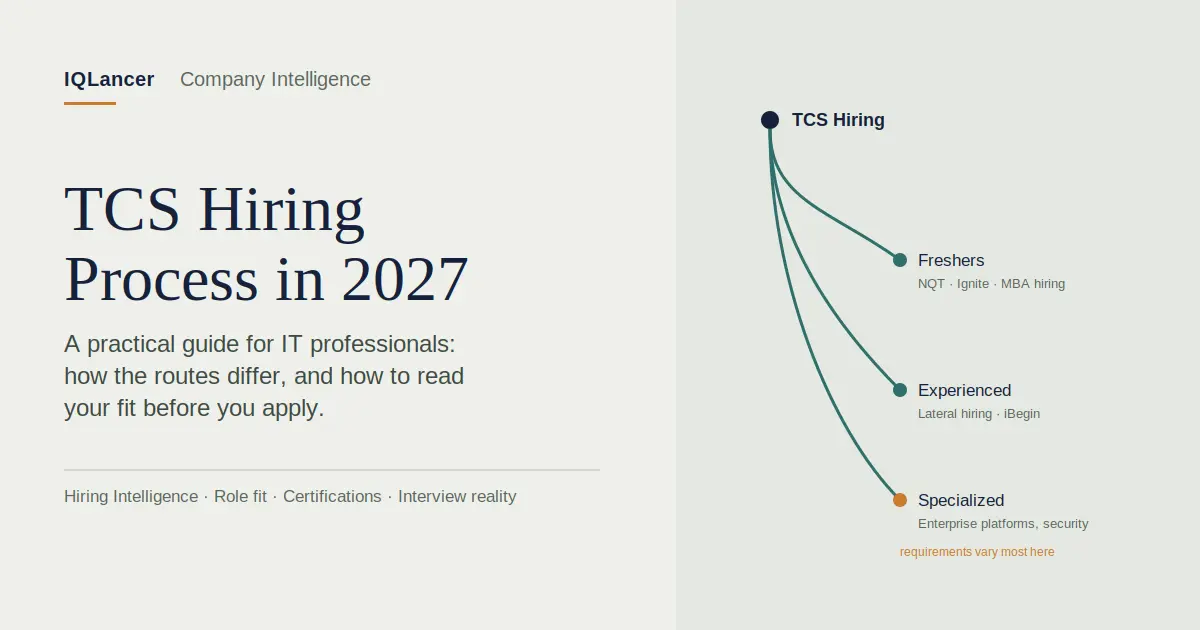
There is no single TCS hiring process. A fresher applying through TCS NQT, an experienced cloud engineer applying through TCS Lateral Hiring, and a B.Sc graduate applying through TCS Ignite are evaluated through different portals, different eligibility rules, and different evidence of readiness. IQlancer walks through how the TCS hiring process actually works in 2027, where it genuinely varies by role and candidate type, and how to evaluate your own fit before you apply, rather than preparing for “TCS” as a single abstract target.
How the TCS Hiring Process Works in 2027
At a structural level, most TCS hiring routes follow the same broad shape: find the relevant opening or program, confirm eligibility, apply through the correct official channel, go through screening and, where applicable, an assessment, then interview, then selection and onboarding. What differs by route is what sits inside each of those steps.
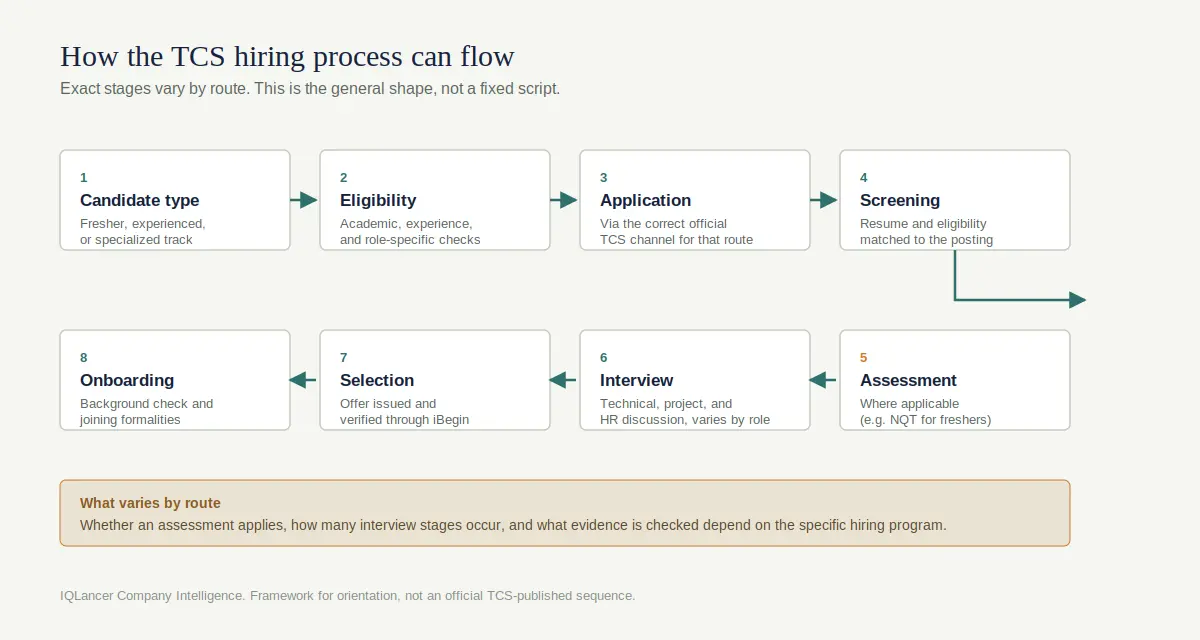
For engineering-graduate freshers, TCS runs the National Qualifier Test (NQT), a single integrated assessment that places candidates into offer tiers. Public, non-official reporting on the 2026 cycle describes a two-part structure: a Foundation section covering numerical ability, verbal ability, and reasoning, and an Advanced section covering aptitude and coding that primarily affects placement into higher-paying tracks. TCS itself confirms that NQT (Cognitive Skills) is a prerequisite for its NQT variants and that scorecards remain valid for two years, but does not publish exact question counts or cutoffs, so treat section-level detail from prep sites as a pattern, not a guarantee.
For B.Sc, BCA, and similar science-degree graduates, TCS runs a separate program called TCS B.Sc Ignite, which TCS describes as an in-centre assessment of about 120 minutes across four sections, followed by a shortlisting and interview stage for those who clear it.
For management postgraduates, TCS MBA Hiring targets a defined set of specializations from a specific graduating batch, applied for through the TCS NextStep portal.
For experienced IT professionals, there is no single qualifying test. Hiring runs primarily through the TCS Careers portal and TCS iBegin, where each job posting carries its own description and requirements, an eligibility check is run against that specific posting, and shortlisted candidates are called for interview with a formal interview letter and an EP (employee/candidate) number required for entry. TCS also runs a separate initiative called Rebegin for professional women returning after a career break, and periodically hosts virtual hiring events such as TCS CareersNext, where TCS states that a successful application is screened and, on clearing eligibility, candidates are contacted for a single-stage interview and discussion.
The practical takeaway is that “the TCS hiring process” is really a set of parallel processes. The one that applies to you depends on your candidate type and the specific opening you’re targeting.
Why the TCS Hiring Process Can Differ by IT Role
A software engineer, a cloud engineer, a data analyst, a cybersecurity analyst, and a DevOps engineer are not evaluated identically, even inside the same company and the same hiring cycle. A few structural reasons explain why.
Technical stack differs by role, so the skills a job description asks for will differ accordingly. Business need differs, since a client account staffing for a cloud migration project has different urgency and different skill gaps than one staffing for application maintenance. Role seniority changes what’s being tested: a fresher role screens primarily for aptitude and foundational ability, while an experienced hire is screened primarily against demonstrated project and delivery experience.
Specialization matters too. Enterprise-platform roles such as SAP, Salesforce, or ServiceNow often sit inside dedicated hiring tracks with their own screening criteria, distinct from general software engineering. Location and hiring program also shape the process, since a campus-linked NQT drive, a walk-in interview event, and a standard online application through TCS iBegin do not necessarily run through the same stages.
The implication for candidates: read the process signals in the specific job posting or hiring program you’re targeting, rather than assuming a generic sequence applies.
TCS Hiring Routes for Freshers and Experienced IT Professionals
Freshers. TCS’s primary fresher routes are program-based rather than posting-based: TCS NQT (for engineering graduates, feeding into Ninja, Digital, and higher tracks), TCS B.Sc Ignite (for science-degree graduates), and TCS MBA Hiring (for management postgraduates). Each has its own eligibility criteria (academic percentage thresholds, backlog and gap rules, batch year) published on the respective TCS page, and each explicitly warns that eligibility is verified at multiple points in the process, so misrepresented details can lead to disqualification even after an offer.
Experienced professionals. There is no equivalent single qualifying test. TCS Lateral Hiring and the general TCS Careers portal list open requirements by role, and candidates apply directly to postings that match their background. TCS states that the candidate should have the experience specified in the job description, which means experience requirements are set per opening, not company-wide. Selection for experienced hires generally centers on a resume and eligibility screen followed by a technical and, where applicable, managerial discussion, though TCS does not publish a fixed round count for lateral hiring.
Do not assume a fresher route and an experienced route share process, timeline, or evaluation criteria simply because both lead to TCS employment.
How TCS Hiring Can Differ Across IT Roles
The table below is a role-fit framework for how candidates typically map skills and evidence to IT roles. It is not a list of universal TCS requirements. Always compare it against the actual job description for the opening you’re applying to.
| Target IT role | Typical capabilities to evaluate | Evidence candidates can demonstrate | Certification relevance |
|---|---|---|---|
| Software Engineering | Programming, data structures, problem solving, databases | Development projects, code samples, prior delivery experience | Often secondary to demonstrated coding ability |
| Data Analytics | SQL, analytical thinking, data visualization, business interpretation | Analytics projects, dashboards, spreadsheet/BI work | Can support structured learning, not a substitute for SQL/analysis skill |
| Cloud Engineering | Cloud platforms, networking, Linux, infrastructure automation | Cloud deployment projects, infrastructure-as-code work | AWS/Azure/GCP certifications can strengthen a cloud-focused profile |
| DevOps | Linux, CI/CD, containers, cloud, automation | Pipeline builds, deployment automation, infrastructure projects | Cloud, Kubernetes, or DevOps certifications may help when role-aligned |
| Cybersecurity | Networking, security fundamentals, monitoring, incident analysis | Security labs, SIEM/tool exposure, incident-response exercises | Security certifications can support a security-focused profile |
| AI / ML | Python, ML fundamentals, model development, data handling | AI/ML projects, model deployment, data-pipeline work | Secondary to demonstrated model-building and evaluation ability |
| Testing / QA | Test design, automation frameworks, defect analysis | Automation scripts, test plans, QA project evidence | Testing/automation certifications may support, not replace, hands-on QA work |
| Enterprise Technology (SAP, Salesforce, ServiceNow) | Platform-specific configuration and implementation knowledge | Platform implementation or support project evidence | Vendor certifications carry higher relevance in these specialized ecosystems |
What TCS Looks for in IT Candidates
Across the routes described above, a consistent set of themes recurs, even though the weighting differs by role. Technical capability relevant to the specific opening matters, as does role fit, meaning whether a candidate’s background aligns with what the position actually requires rather than a generic technology list. Relevant experience and projects function as evidence that a skill claim is real. Problem-solving ability, communication, and, for some roles, domain knowledge (such as banking, healthcare, or retail) are commonly assessed in interview discussions. Certifications matter where the specific role uses the technology they cover.
There is no published, universal TCS scoring rubric, and no evidence that every candidate is assessed through an identical checklist. Treat the above as consistent hiring themes, not a formula.
TCS Software Engineer Requirements
Since “software engineer” is one of the highest-volume searches around TCS hiring, it deserves a focused answer here, though a full breakdown of software-role prep is better handled in a dedicated article.
Programming and technology-stack requirements vary by the specific opening: a fresher-track software engineering role will emphasize foundational programming ability (commonly evaluated through TCS NQT’s coding component), while an experienced software engineering opening will specify a particular stack, such as Java, Python, or a specific framework combination, tied to the client account being staffed.
Experience requirements scale accordingly, from entry-level for fresher tracks to multi-year, stack-specific experience for lateral openings. Development projects and prior delivery experience function as the strongest evidence of readiness in either case. The single most reliable reference point is the actual job description for the opening, not a generic “TCS software engineer” checklist.
A dedicated TCS Software Engineer Requirements article can go deeper into stack-specific expectations and interview patterns.
How Certifications Can Affect a TCS IT Job Application
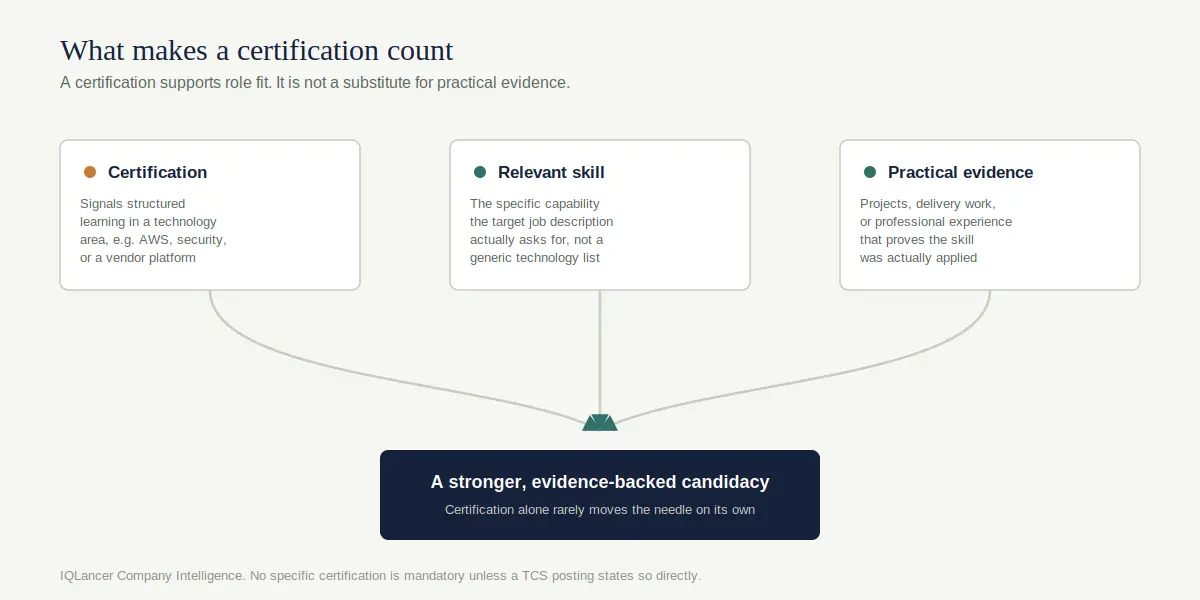
Certifications are worth including in your preparation, but they should not be treated as a universal requirement, because none currently exists across TCS’s IT roles as a whole. Their value depends on the target role, the technology stack in the job description, your experience level, your specialization, and whether you can back the certification with practical evidence.
For cloud roles, AWS, Azure, or Google Cloud certifications can support a cloud-focused profile when the certification’s content matches what the posting asks for. For cybersecurity roles, security certifications can support a security-focused profile when aligned with the role’s actual requirements.
For DevOps, cloud, Kubernetes, or DevOps-specific certifications may strengthen a relevant profile. For data roles, data or analytics certifications can demonstrate structured learning, but they do not substitute for demonstrated SQL, analytical, or programming ability.
For software development, certifications are often secondary to demonstrated programming and development experience, depending on the specific role. For enterprise technology roles such as SAP, Salesforce, or ServiceNow, vendor-specific certifications tend to carry more weight, because these ecosystems are specialized and certification is a more direct proxy for platform knowledge.
The core principle across all of these: a certification supports role fit. It is not a substitute for practical ability, and no specific certification should be treated as mandatory unless the exact job posting or hiring program states so explicitly.
Projects, Experience and Other Evidence of Technical Ability
Projects and professional experience exist to answer one question for a recruiter or interviewer: can this candidate actually do what their resume claims? A project is strongest when it maps directly to a skill the target role needs.
A candidate applying for a data analytics opening benefits more from a project that involves real SQL queries, a dataset, and a business question than from an unrelated general-purpose app. A candidate applying for a DevOps opening benefits from evidence of pipeline builds or infrastructure automation more than from a certificate alone.
The general chain worth following is: identify the skill the role requires, build or select a project that demonstrates that skill, and make sure your resume and, where relevant, portfolio or GitHub reflect that evidence clearly.
GitHub or a public portfolio is useful for demonstrating software and data-related work but is not a stated requirement for every TCS IT role, particularly for infrastructure, enterprise-platform, or support-oriented positions where other forms of evidence (documented project work, certifications tied to hands-on labs, or prior employer references) may carry more weight.
TCS Interview Process for IT Professionals
Based on current evidence, IT candidates can encounter some combination of a technical discussion focused on the target role’s skills, a discussion of prior projects or experience, problem-solving questions relevant to the role, and, depending on seniority, a managerial or business-context discussion, alongside a general HR discussion covering fit, expectations, and logistics such as relocation.
Publicly available candidate interview accounts describe technical rounds that include questions on core subjects, project explanations, and standard HR questions, but these are individual, self-reported experiences rather than an official TCS-published structure, and round counts described in such accounts differ from case to case.
TCS does not publish a fixed number or sequence of interview rounds that applies to every IT candidate. Treat any specific round count you encounter online as one candidate’s experience for one role in one cycle, not a company-wide standard.
How to Read a TCS Job Description Before Applying
This is where most of the practical value of this guide sits, because a job description tells you far more about your actual odds than any general TCS hiring article can.
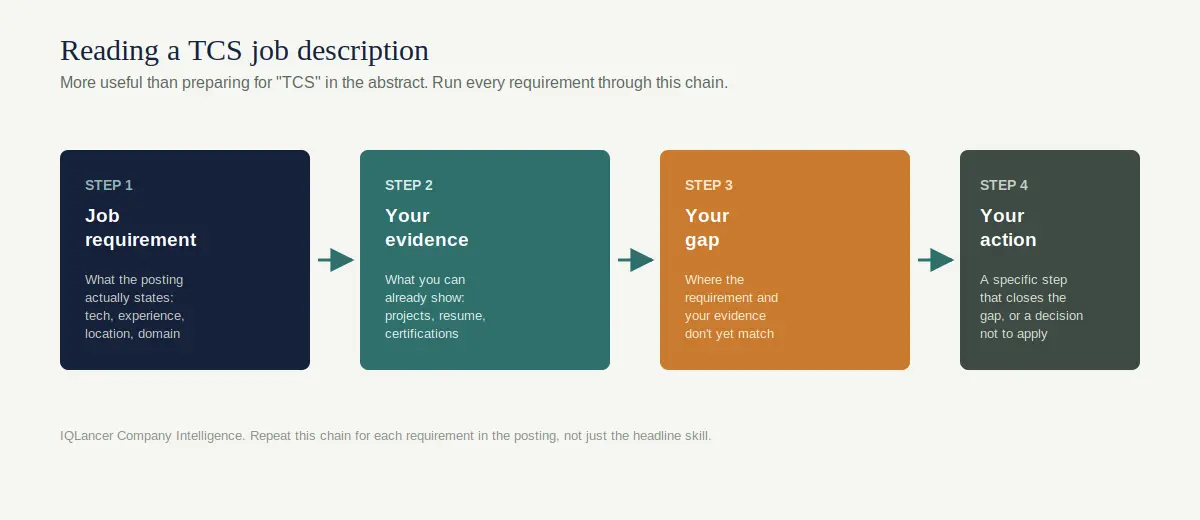
Before applying, extract the following from the posting: job title, experience level required, required technologies, preferred (but not mandatory) technologies, core responsibilities, location, work arrangement, eligibility criteria, any certifications explicitly mentioned, and any domain requirements (such as banking or healthcare experience).
Then run each requirement through a simple chain: what does this requirement ask for, what evidence do you currently have for it, where is the gap between the two, and what specific action closes that gap, whether that’s a project, a certification, a resume rewrite, or simply not applying to that particular posting. This job-description-first approach is more useful than preparing for “TCS” in the abstract, because it forces your preparation to match the actual opening rather than a generic idea of the company.
Does TCS Offer Work From Home for IT Professionals?
This is one of the more time-sensitive parts of the TCS hiring picture, and it has changed materially in recent years, so treat the following as current-as-of-research rather than permanent.
TCS moved away from its pandemic-era hybrid model starting October 2023, when it mandated most employees work from the office five days a week, a stance TCS’s leadership described at the time as necessary to rebuild in-person culture. That mandate has since extended and tightened rather than reversed: in July 2025 TCS enforced an immediate five-day return-to-office requirement for its US operations as well. Separately, a bench policy effective June 2025 caps unallocated (non-project) time at 35 business days a year and requires employees who are not staffed on a billable project to work from the office during that period. By January 2026, reporting indicated TCS had begun withholding appraisals for employees found non-compliant with work-from-office rules in prior quarters.
Taken together, current information indicates TCS’s default posture is office-based work, with attendance increasingly tied to performance and compensation outcomes, rather than a company-wide remote or hybrid option. That said, work arrangement can still depend on the specific role, client account, and location, and TCS itself notes that limited exceptions (such as client-site placement or previously agreed arrangements) exist.
Do not assume “TCS is work from home,” and do not assume every role has zero flexibility either. Verify the work-arrangement expectation in the specific job posting and with the recruiter before making a decision based on this factor.
How to Apply to TCS Through Official Channels
For freshers, applications run through program-specific official channels: the TCS NextStep portal for programs such as MBA hiring, and equivalent NQT and Ignite application flows linked from tcs.com/careers. For experienced professionals, the primary channels are the TCS Careers portal and TCS iBegin, where postings are listed with their own job descriptions, and periodic hiring events such as TCS CareersNext.
TCS explicitly states it does not charge or accept any amount or security deposit from job seekers at any stage, and does not authorize any external agency or company to conduct interviews or extend offers on its behalf. Apply only through these official TCS-branded channels, and treat any recruiter or portal outside them with caution.
How to Identify Fake TCS Recruitment Offers
TCS maintains a formal Recruitment Fraud Alert page that outlines its official position: TCS never asks for money or a security deposit at any stage of recruitment, sends hiring communication only from the @tcs.com domain and not from personal email services such as Gmail or Yahoo Mail, and states it bears no responsibility for money paid to scammers impersonating the company. TCS also provides an offer-verification tool through its TCS iBegin portal so candidates can check the authenticity of an offer letter before acting on it, and lists a dedicated recruitment helpline (1800-209-3111) alongside a careers@tcs.com contact.
Warning signs to treat as red flags include any request for payment or a security deposit, promises of guaranteed employment without an assessment or interview, communication from personal or unofficial email domains, unofficial third-party “agents” claiming to represent TCS, pressure to share sensitive financial information quickly, and job offers that arrive with no corresponding application or interview on your part. If in doubt, verify directly against TCS’s own careers domain and fraud-alert page rather than trusting a forwarded message or third-party portal.
TCS Application Readiness Checklist
- I identified the exact role and hiring route (fresher program, lateral hiring, or specialized track).
- I checked the current eligibility requirements for that specific route.
- I understand the required technologies listed in the job description.
- My experience level matches what the role asks for.
- I have project or work evidence of the relevant technical capability.
- My projects support the specific skills I’m claiming, not just general familiarity.
- My certifications, if any, are relevant to the target role’s technology stack.
- My resume reflects the target role rather than a generic IT profile.
- I verified the current location and work-model expectations for this opening.
- I am applying only through an official TCS channel (tcs.com/careers, TCS iBegin, TCS NextStep, or TCS iON).
- I checked the live job description immediately before applying, not an old or cached version.
What Candidates Should Verify Before Applying in 2027
Company hiring information changes, and this article cannot stay current indefinitely on its own. Before applying, verify directly on TCS’s official channels: whether the specific opening or hiring program is still active, current eligibility criteria for that route, the experience level and technology requirements stated in the live posting, the location and work-arrangement expectation, the correct official application channel, and any assessment or interview details communicated directly by TCS or its official test partner. Treat anything from this article that touches dates, policies, or figures as a snapshot from the time of research, not a permanent fact.
What TCS Hiring Candidates Should Prepare For
Bringing the framework together, useful preparation for a TCS IT opening follows this order:
- identify the specific role you’re targeting,
- map the skills that role’s job descriptions consistently ask for gather or build project and experience evidence for those specific skills,
- tailor your resume to reflect that evidence clearly,
- add certifications only where they align with the role’s technology stack,
Prepare for the assessment format relevant to your hiring route (NQT-style aptitude and coding for fresher programs, technical-and-experience discussion for lateral hiring), and prepare for an interview grounded in your actual project work rather than generic company trivia. This model transfers across hiring cycles even as TCS’s specific programs, portals, and policies continue to evolve.
Conclusion
The most useful thing to take from this guide is not a round-by-round script. It’s a way of thinking: TCS’s hiring process is not one fixed sequence, it’s a set of related routes that differ by candidate type and IT role. The TCS hiring process that actually matters to you is the one tied to the specific opening, program, and job description you’re targeting, evaluated against your own skills, projects, and experience.
Preparing for “TCS” in the abstract wastes effort. Preparing for the specific role, the specific requirements, and your specific evidence of fit is what actually moves an application forward, and it’s the only version of preparation that stays useful as TCS’s programs and policies continue to change.
FAQS For TCS Hiring Process
What is the TCS hiring process?
It is not one fixed process. It is a set of routes (TCS NQT for engineering freshers, TCS B.Sc Ignite for science graduates, TCS MBA Hiring for postgraduates, and TCS Lateral Hiring or TCS Careers/iBegin for experienced professionals) that share a broad shape of eligibility, application, screening, interview, and selection, but differ in exact stages by route and role.
Is the TCS hiring process the same for every IT role?
No. Requirements and evaluation emphasis differ by technical stack, seniority, specialization, and the specific job description, even within IT.
Does TCS hire experienced IT professionals?
Yes, through TCS Lateral Hiring and the general TCS Careers/iBegin portal, where each posting has its own experience and skill requirements.
Are certifications required for TCS jobs?
Not universally. Certification relevance depends on the target role and technology stack, and TCS does not publish a company-wide certification requirement for IT roles.
Does TCS offer work from home?
TCS moved away from company-wide hybrid work starting October 2023 and has since tightened office-attendance requirements, including a 2025 bench policy and attendance ties to appraisals. Work arrangement can still vary by role and account, so verify it on the specific job posting.
What skills does a TCS software engineer need?
This depends on the specific opening, from foundational programming for fresher tracks to a specified stack and years of experience for lateral roles. Always check the live job description.
Can projects help with a TCS application?
Yes, when they demonstrate the specific skills the target role requires, rather than generic or unrelated work.
How should I verify a TCS job opening?
Apply only through official TCS channels (tcs.com/careers, TCS iBegin, TCS NextStep, TCS iON) and cross-check any offer against TCS’s Recruitment Fraud Alert page and offer-verification tool.
Candidates should check whether an application is online or offline before applying for a recruitment.
Yes! This is important information that we always mention in the article so that people can understand how it is implemented.
Government jobs are available in many departments and offer opportunities for candidates from different backgrounds.
Yes! We know that over 500 people are securing government jobs by using IQLancer ATS-friendly resume and the awareness by provide us.