A capable IT professional can still fail to move forward in a hiring process, and one of the most overlooked resume rejection reasons is not a lack of ability but a lack of clarity: the resume simply does not communicate the right evidence at the stage where someone is deciding whether to move the candidate forward.
Being qualified for a role and being shortlisted for it are not the same event. Between those two points sits a chain of separate steps, automated processing, recruiter screening, hiring manager review, each of which can quietly stall an application for a different reason. IQlancer article breaks that chain apart, section by section, so you can figure out which link is actually failing for you instead of guessing.
Why IT Resumes Can Fail Even When the Candidate Is Qualified
It matters to separate “qualified” from “shortlisted” early, because most candidates assume a rejection is proof of a skills gap when it is frequently something else entirely. Qualification is about whether you can genuinely do the job. Shortlisting is a comparative, resource-constrained decision made against everyone else who applied for that specific opening, at that specific company, in that specific week.
Several forces sit between those two things: how closely your resume’s language matches the requirements, how easy it is for a reader (human or software) to locate proof of your relevant experience, how many other applicants are competing for the same role, and which stage of screening is actually evaluating your file. A resume can be accurate and still lose out on any of these dimensions without the candidate being unqualified in any real sense. None of this means candidates bear no responsibility. It means the responsibility is more specific than “the resume is bad,” and a vague explanation cannot be fixed with a vague solution.
Resume Rejection Can Happen at More Than One Stage
Before assuming where an application failed, it helps to see the full path a resume typically travels, because “no response” can mean very different things depending on which point it stopped at.
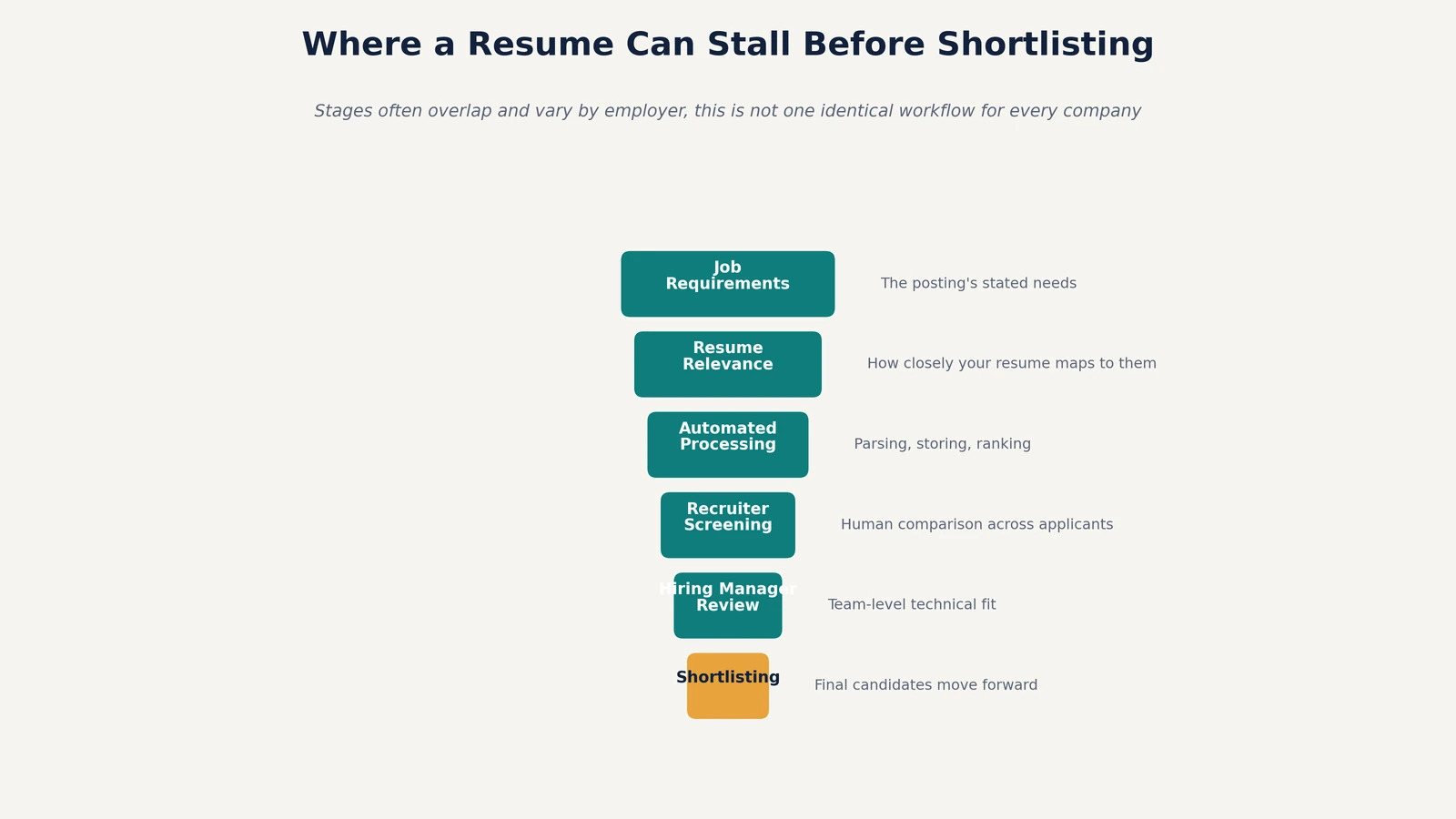
Job Requirements → Resume Relevance → Automated Processing → Recruiter Screening → Hiring Manager Review → Shortlisting
A resume can be filtered out at the automated processing step because a system could not extract information cleanly. It can pass that step and still be screened out by a recruiter comparing dozens of applicants against the same three or four requirements. It can pass recruiter screening and still stall with a hiring manager who is prioritizing a different kind of experience. These stages frequently overlap, and not every employer runs them in the same order or with the same rigor.
- A small startup might skip automated screening entirely and have a manager reading resumes directly.
- A large enterprise might route the same resume through several automated and human touchpoints before a person sees it.
Diagnosing a rejection without knowing roughly which stage it happened at is a bit like debugging a system without knowing which service actually threw the error.
ATS Resume Mistakes That Can Create Screening Problems
It’s worth being precise about applicant tracking systems, because they are one of the most misunderstood parts of this whole process. An ATS does not “reject” a resume the way a human does. It stores, parses, and organizes applicant data, and in most modern hiring workflows a person still reviews the shortlist it produces.
Most large employers do use some form of recruiting software. Close to 98% of Fortune 500 companies use an applicant tracking system as part of their hiring process (U.S. Chamber of Commerce, 2025). What creates screening problems is less the software itself and more how a specific employer has configured it, and how the resume is structured for it to read. Common ATS resume mistakes include:
- Dense tables, columns, or text boxes that can make content harder to extract correctly.
- Unlabeled or unconventional section headings that make it difficult to identify where experience, skills, or education actually sit.
- Uncommon file formats or heavily designed templates that were not built with parsing in mind.
- Keyword stuffing that lists terms out of context instead of describing real, relevant work.
- Missing terminology that genuinely applies to the candidate’s background, which can reduce how well a resume matches the language of a specific posting.
Research from Harvard Business School and Accenture found that a large share of employers, 88% in their global survey, agreed that qualified, higher-skilled candidates are sometimes filtered out because their resumes do not exactly match a job description’s stated criteria (Hidden Workers: Untapped Talent, HBS/Accenture, 2021). The researchers were clear that this outcome traces back to how employers configure screening criteria, such as rigid degree requirements or automatic exclusion of resume gaps, rather than to the software behaving unpredictably on its own. That distinction matters for candidates: the fix is rarely “beat the algorithm” and more often “make relevant terminology and experience easy to find.”
| ATS / Automated Processing | Recruiter Screening |
|---|---|
| Parses and organizes resume data | Compares candidates against role priorities |
| Ranks or filters based on configured rules | Applies judgment, context, and nuance |
| Behavior varies by platform and employer setup | Varies by recruiter workload and experience |
| Can misread poorly structured formatting | Can miss information buried in a dense layout |
The Resume Relevance Gap: Your Experience vs the Job Requirements
IQLancer Analysis. This is where a lot of otherwise strong candidates lose ground, and itF is rarely about missing skills. It is about which skills the resume chooses to foreground.
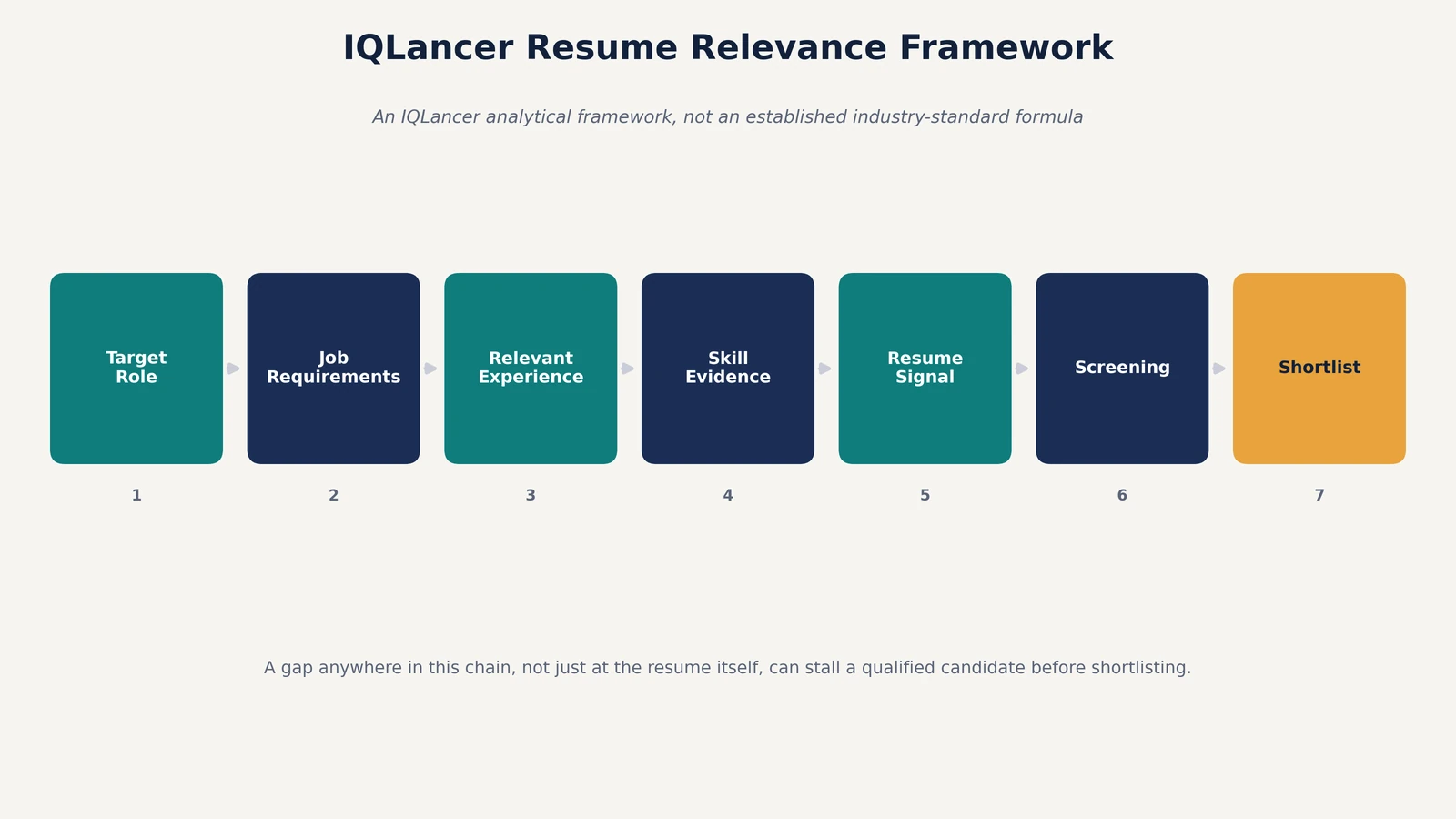
Consider a candidate who genuinely has hands-on experience with Python, Linux, AWS, Docker, and CI/CD pipelines. They apply for a DevOps role, but their resume is structured around a previous “Python Developer” title, with two lines mentioning Linux, one mentioning AWS, and nothing about CI/CD or containers beyond a skills list. A recruiter scanning that resume for DevOps signals may reasonably conclude the candidate is a backend developer with light exposure to infrastructure, even if the candidate’s actual day-to-day work involved far more operations and deployment responsibility than the resume shows.
We call this the IQLancer Resume Relevance Gap: the difference between what a candidate can actually do and how clearly the resume communicates that capability for the specific role being considered. This is an IQLancer analytical framework, not an industry-standard scoring formula, but it describes a pattern we see repeatedly across IT resumes.
Closing the gap does not mean fabricating experience. It means restructuring emphasis so the resume’s headline story matches the role being targeted, with the deployment work, infrastructure decisions, and automation experience moved to where a DevOps recruiter would actually look first.
What Recruiters May Look for When Shortlisting IT Candidates
Observation. No two recruiters evaluate a resume identically, and practices vary by employer, seniority level, and industry, but some factors tend to recur often enough to be worth naming.
Recruiters screening IT resumes commonly consider things like relevant technical skills, prior responsibilities and how closely they mirror the open role, specific technologies used, seniority signals, evidence from projects or work history, education or certifications where the role calls for them, and, depending on the position, location or work authorization requirements.
How much weight any single factor gets can depend heavily on the role, the company’s hiring stage, and the individual recruiter’s own priorities. There is no single universal scorecard that every recruiter applies, and treating any one factor (a job title, a certification, a keyword count) as decisive on its own tends to produce misleading conclusions about why an application did or did not move forward.
Why Skills Alone Don’t Prove Technical Capability
IQLancer Analysis. Listing a skill is the cheapest possible signal a resume can offer, which is exactly why it tends to carry the least weight on its own.
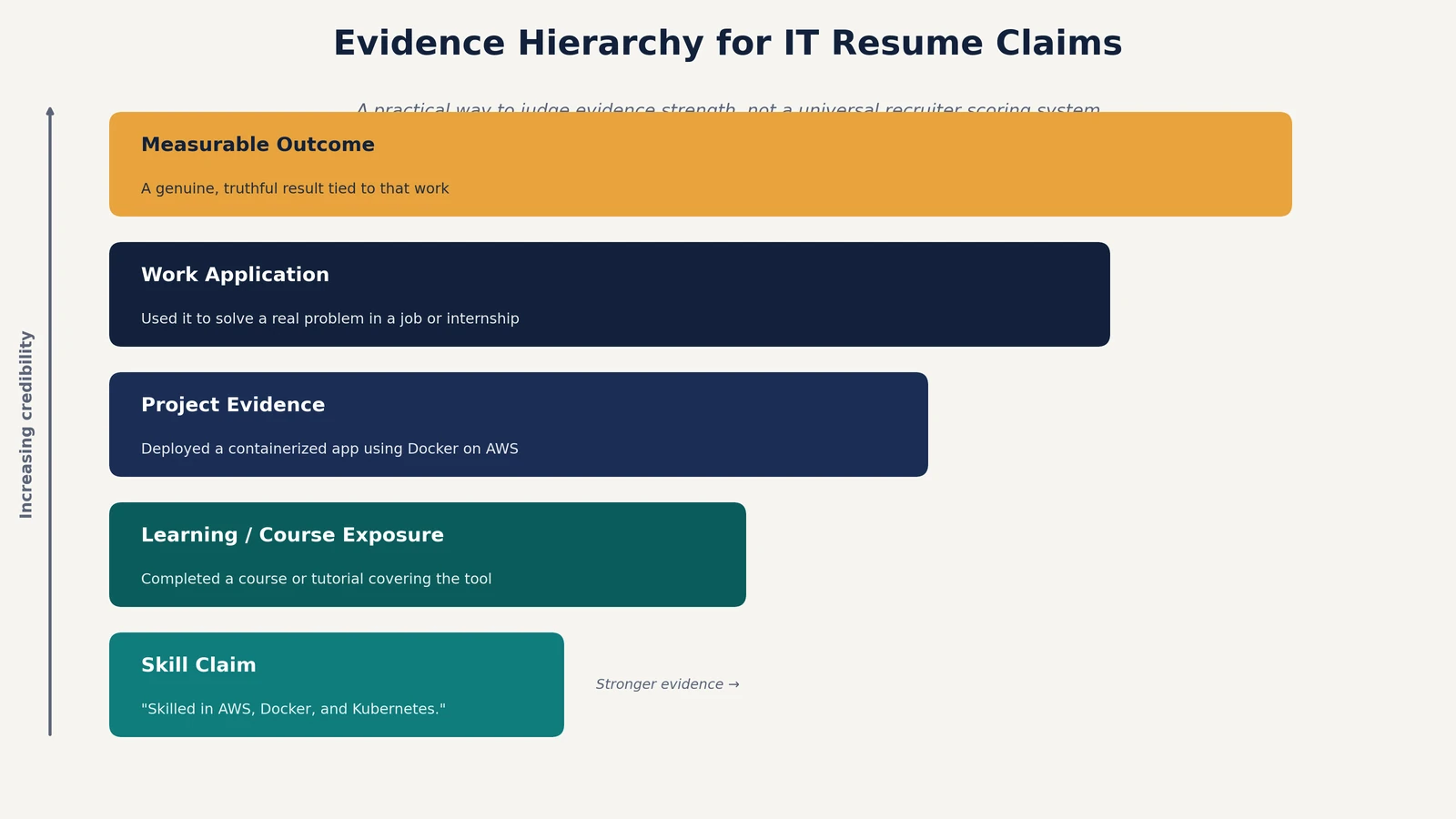
A practical way to think about this is a rough progression of evidence strength, not a formal recruiter scoring system:
Skill Claim → Learning / Course Exposure → Project Evidence → Work Application → Measurable Outcome
“Skilled in AWS, Docker, and Kubernetes” sits at the weak end of that scale. Something like “Deployed a containerized application using Docker and configured AWS services to support the deployment” sits further along it, because it describes an actual action rather than an abstract label. Where a genuine, truthful measurable outcome exists, such as a specific reduction in deployment time or a concrete scale the system handled, it strengthens the claim further.
None of this is a reason to invent a metric that never happened. A specific, honest description of what was built and how it worked is more credible, and more checkable in an interview, than a manufactured number attached to a project the candidate cannot actually speak to in depth.
Why Generic IT Resumes Struggle to Show Role Fit
Observation. A resume trying to represent every skill a candidate has ever touched often ends up representing none of them clearly, and that is a common reason a well-rounded background can still read as unfocused.
Generic resumes tend to bury relevant experience among unrelated details, apply the same emphasis to every job regardless of the role being targeted, and use terminology that does not match the specific posting. A structure worth considering instead:
Master Career Profile → Target-Role Version → Job-Specific Relevance Adjustments
The master profile holds the full, unfiltered career history. The target-role version reorganizes that history around one type of role (say, cloud engineering versus data analysis), prioritizing the experience most relevant to it. From there, small job-specific adjustments, terminology matched to a particular posting, a reordered bullet, are far faster than rewriting a resume from scratch for every application, and they tend to produce a more targeted result than a single one-size-fits-all document ever can.
Weak Project Descriptions Can Hide Strong Technical Skills
Observation. This matters most for freshers, junior candidates, and career switchers, because projects are often the primary evidence they have when formal work history is thin.
A weak project description names a tech stack and stops there: “Built a web app using React, Node.js, and MongoDB.” A stronger description explains what was actually built, the candidate’s specific responsibility, the technical problem being solved, how it was implemented, and, where truthful, the outcome: for example, describing an inventory tracking application built for a small business, where the candidate designed the database schema, built the REST API, and handled deployment, resulting in the client moving off a manual spreadsheet process. The second version gives a recruiter something concrete to ask about in an interview. The first gives them a list of nouns.
Resume Claims vs Evidence: What Makes an IT Resume Credible?
A claim without a description behind it asks the reader to take the resume’s word for it, and that is a weaker position than most candidates realize.
| Weak Claim | Evidence-Based Description |
|---|---|
| “Experienced in Kubernetes” | “Configured and managed Kubernetes clusters to deploy and scale a microservices application” |
| “Strong in cloud technologies” | “Set up AWS EC2, S3, and IAM configurations to support a production deployment pipeline” |
| “Skilled in automation” | “Built CI/CD pipelines using Jenkins to automate testing and deployment for a Node.js application” |
None of this is a license to exaggerate. It is a case for replacing vague adjectives with specific, truthful descriptions of what was actually done.
Formatting Problems That Can Make a Resume Harder to Process
Formatting rarely decides a hiring outcome on its own, but it can quietly slow down how easily a reader finds relevant information, whether that reader is a person or a parsing system.
Common issues include inconsistent heading structures that make sections hard to identify, overly complex layouts with multiple columns or embedded text boxes, unusual file types that some systems handle poorly, and heavy use of graphics or icons in place of readable text for core content like job titles and dates.
A clean, conventional structure (clear section headers, standard fonts, straightforward reverse-chronological order) tends to be easier for both automated systems and busy human readers to process quickly.
What Happens After a Resume Is Processed?
Passing an automated processing step is not the same as being hired, and treating it that way sets up unrealistic expectations about what “getting through the ATS” actually means.
After initial processing, a recruiter typically screens a shortlist against the role’s core requirements, often comparing many candidates at once. A resume that clears this step may then reach a hiring manager, who evaluates it with a different lens, often closer to the day-to-day technical needs of the team. Each of these is a distinct filter with different priorities, and a resume can satisfy one while still needing work to satisfy the next.
Why You Shouldn’t Assume Every Missing Response Means Resume Rejection
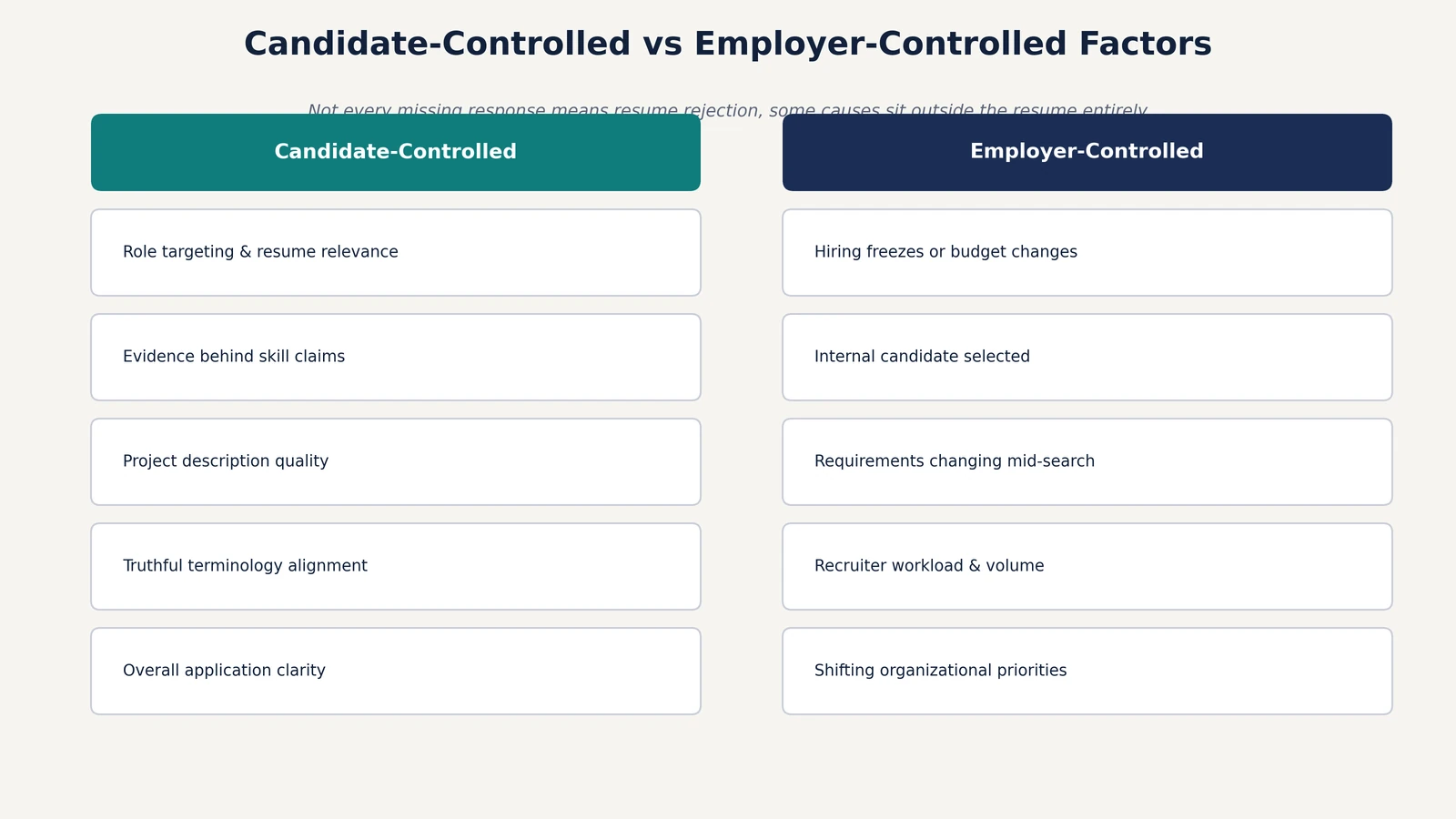
This distinction matters because candidates who assume every silence is a resume problem often “fix” the wrong thing repeatedly, without ever addressing what is actually going on.
A number of outcomes sit entirely on the employer’s side of the process: hiring freezes after a role is posted, budget changes, the role being filled internally, requirements shifting mid-search, high applicant volume overwhelming a small recruiting team, or a role being deprioritized without candidates ever being notified.
It is genuinely difficult to know how often any of these occur for a specific application, and it would be inaccurate to claim a fixed percentage of silence is explained by them. What is reasonable to say is that they exist, they are outside a candidate’s control, and they should be part of how you interpret a lack of response, alongside genuine resume relevance issues rather than instead of them.
The IQLancer Resume Relevance Audit
IQLancer Recommendation. Before touching a single bullet point, it helps to answer a short set of questions honestly, because most resume fixes fail when they start from formatting instead of relevance.
- What exact role am I applying for?
- What requirements appear repeatedly in the job description?
- Where does my resume demonstrate those requirements?
- Is that evidence easy to find within the first few lines a reader will scan?
- Are my strongest relevant experiences prioritized near the top?
- Do my projects demonstrate actual technical work, not just a tool list?
- Are irrelevant skills or experiences taking up valuable space?
- Does the resume communicate the target role clearly within seconds?
- Am I using relevant terminology truthfully, not just for keyword coverage?
- What part of my profile would still be unclear to a recruiter reading this cold?
How to Diagnose Why Your Resume Isn’t Getting Shortlisted
A symptom-based approach tends to be more useful than a generic checklist, because different patterns of non-response point toward different root causes.
Symptom: Hundreds of applications, almost no recruiter calls.
- Investigate: job targeting, actual role fit, resume relevance to the roles chosen, general application quality, and current market conditions in that specific niche.
Symptom: Recruiter calls happen, but progression stalls afterward.
- Investigate: how skills are communicated in conversation, evidence depth, technical fit for the specific team, and alignment with role expectations that may not have been obvious from the posting.
Symptom: Calls for some roles, silence for others.
- Investigate: role-specific relevance, whether a single resume version is being used for meaningfully different roles, and how well terminology is matched to each posting.
None of these symptoms should be read as automatic proof that “the resume is rejected.” They are starting points for investigation, not conclusions.
What Should You Fix First?
IQLancer Recommendation. This is a suggested diagnostic order, not a universal hiring law, but starting in the wrong place wastes time that candidates rarely have to spare.
- Target role
- Relevance to that role
- Evidence behind the claims
- Experience and project depth
- Terminology and keyword alignment
- Formatting
Fixing keywords before fixing relevance tends to be ineffective because it treats a symptom as the disease. Adding the right terms to a resume that is still structured around the wrong role, or that lacks real evidence behind its claims, may improve terminology alignment without changing whether the underlying story makes sense for the job being applied to.
Practical IT Resume Audit Before Your Next Application
Run through this before submitting, not after weeks of silence:
- Does the resume clearly target this specific role?
- Are the job description’s most repeated requirements visibly addressed?
- Is there real evidence (projects, work, outcomes) behind every skill claim?
- Do project descriptions explain what was built and the candidate’s actual role in it?
- Are achievements described accurately, without invented metrics?
- Is terminology aligned with the posting, without keyword stuffing?
- Is the resume easy to scan in under a minute?
- Is every claim on the resume accurate and something you could defend in an interview?
- Is the most relevant experience placed where a reader will see it first?
- Has anything irrelevant to this specific role been trimmed or deprioritized?
Conclusion
Understanding resume rejection reasons starts with accepting that no single explanation covers every outcome. Some resumes lose ground at automated processing because of formatting. Some lose ground at recruiter screening because the relevance gap between the candidate’s real experience and the target role was never closed. Some outcomes have nothing to do with the resume at all.
A resume’s job was never to list everything a candidate has ever done. It needs to make relevant capability, evidence, and role fit understandable at the exact stage where it is actually being evaluated, and that is a narrower, more solvable problem than “fix my resume” ever sounds like.
Frequently Asked Questions
Why do IT resumes get rejected?
IT resumes can lose ground at several different points, including automated processing, recruiter screening, or hiring manager review, and the cause is often a mismatch between how the resume is structured and the specific role’s requirements rather than a lack of genuine capability.
Can an ATS reject a resume?
An ATS generally organizes, parses, and ranks resumes according to rules an employer configures. Whether that counts as “rejection” depends on the employer’s specific setup, and in most workflows a recruiter still reviews the results rather than a system making a final hiring decision on its own.
What makes a resume relevant to a job?
Relevance comes from how clearly the resume’s language, structure, and evidence match a specific job’s stated requirements, not just from including the right keywords.
What are common ATS resume mistakes?
Complex layouts, unconventional section headings, unusual file formats, and keyword stuffing without real context are among the most common issues that can make a resume harder to process accurately.
Why am I not getting shortlisted despite having the required skills?
This can happen when a resume does not clearly communicate those skills for the specific role being targeted, when evidence behind the skills is thin, or when factors outside the resume, such as employer-side hiring changes, are affecting the outcome.
Does adding more keywords improve shortlisting?
Keywords can improve terminology alignment with a job description, but they do not guarantee shortlisting on their own, especially if the underlying experience and evidence do not support the role being targeted.