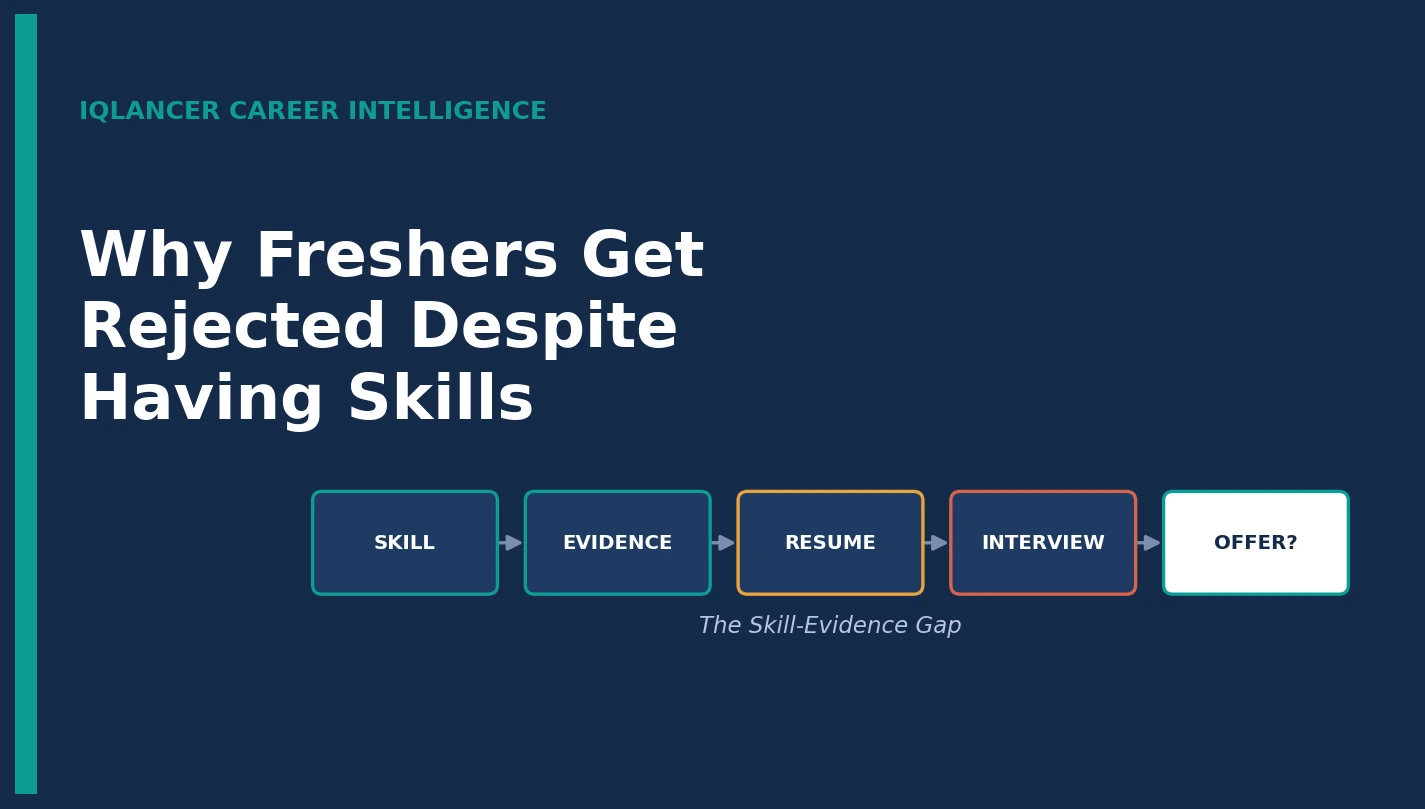
A fresher can know Python, SQL, cloud basics or a modern JavaScript framework and still get rejected at almost every stage of hiring. This is not always a contradiction. Why freshers get rejected is rarely explained by a single missing skill; it is usually explained by a gap between what a candidate knows and what an employer can actually see, verify or evaluate during a short hiring process.
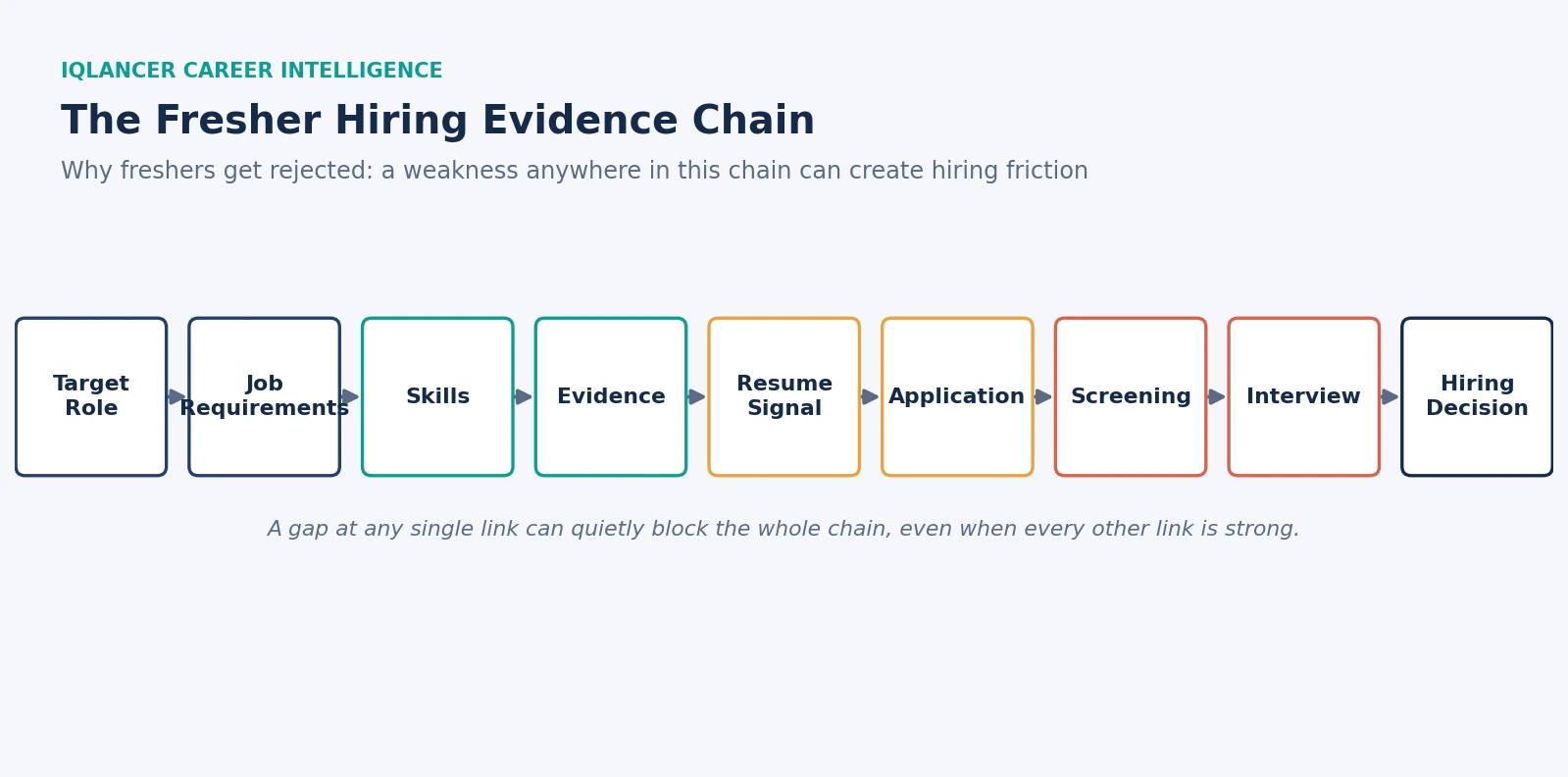
Skills matter, but they are only one link in a longer chain that runs from job targeting to resume signal, screening, interview performance and the final hiring decision. IQlancer article does not claim to know why any specific candidate was rejected. Instead, it gives freshers a practical way to diagnose which link in that chain is weakest for them right now.
Why Freshers Get Rejected Even When They Have Relevant Skills
There is rarely one single reason. In current hiring conditions, a technically capable fresher can lose ground at several possible points, including:
- Role and job targeting: applying to postings where the required experience, seniority or technology stack does not match the candidate’s actual background.
- Resume signal: skills exist, but the resume does not communicate them clearly enough for a recruiter or an automated system to recognize relevance in the first few seconds of review.
- Project and evidence quality: the candidate has done real work, but it is not documented or explained in a way that proves independent understanding.
- Application strategy: a high volume of applications sent without adjusting for each role’s specific requirements.
- Interview performance: the candidate knows the material but struggles to explain reasoning, handle follow-up questions or discuss their own projects with depth.
- Structural market conditions: entry-level hiring itself has tightened. One analysis of 2,000 postings labeled “entry-level” found that roughly 35% of them asked for three or more years of experience, a pattern cross-referenced against a separate UK study covering more than 49,000 listings and against NACE data on college-to-career transitions. In technical roles specifically, one industry report found this requirement mismatch appearing in more than 60% of entry-level software and IT postings.
These are possible friction points, not a checklist that guarantees an explanation for any individual rejection. The goal of this article is to help a fresher work through them systematically instead of guessing.
Having a Skill Is Different From Proving a Skill
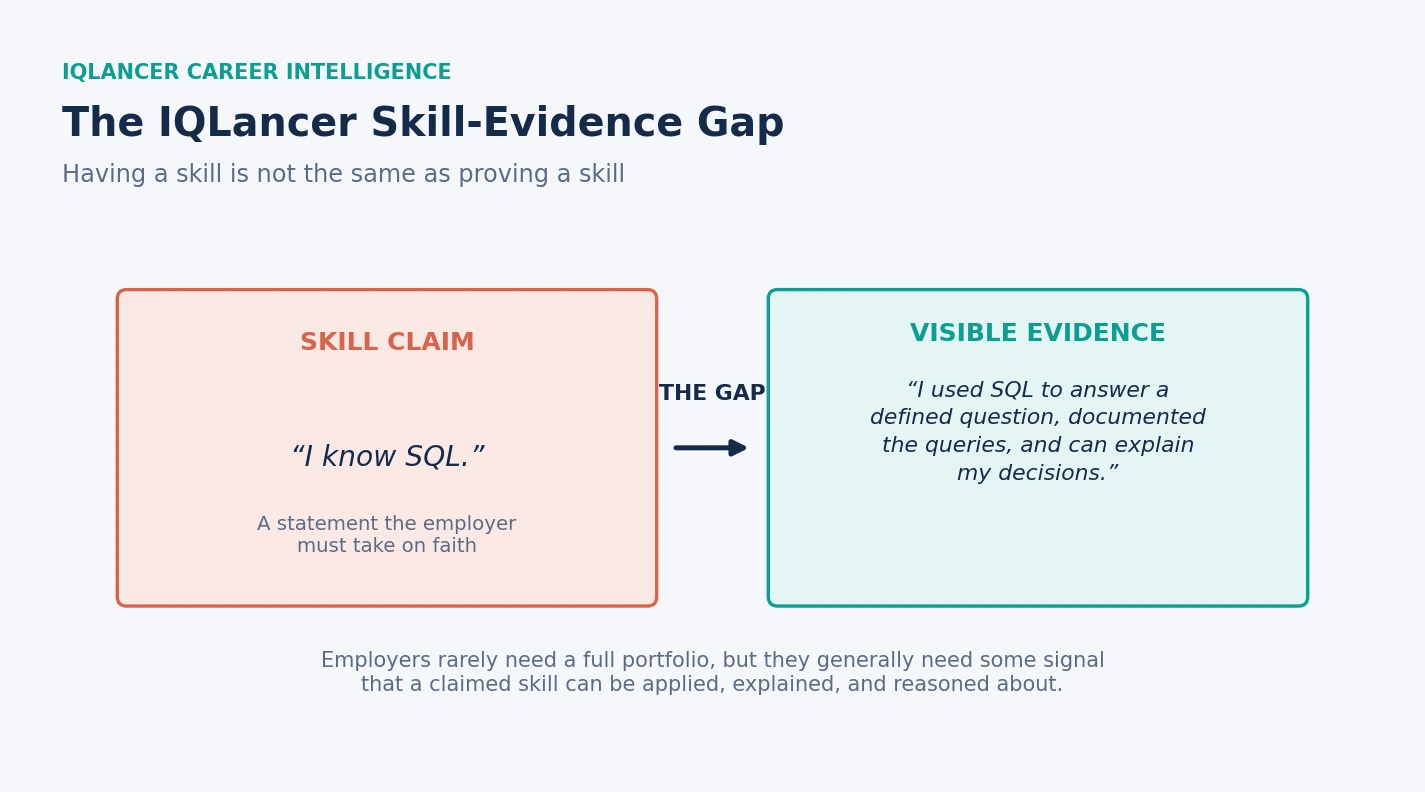
This is the central distinction behind what IQLancer calls the Skill-Evidence Gap: an IQLancer analytical concept, not an established academic framework. It describes the space between a skill a candidate genuinely has and the evidence an employer can actually observe of that skill during a hiring process.
Consider the difference between two statements:
Skill claim: “I know SQL.”
Visible evidence: “I used SQL to answer a defined analytical question, wrote and documented the queries, and can explain why I structured them that way.”
The first statement asks an employer to take the skill on faith. The second gives the employer something to evaluate. Employers rarely need a full portfolio for every fresher role, but they generally need some signal that a claimed skill can be applied, explained and reasoned about rather than only recognized.
A skill that only exists as a line on a resume, with no visible application, communication or reasoning attached to it, is harder for an employer to trust than one backed by a small, explainable example.
Where a Fresher Can Lose the Hiring Opportunity
Hiring is a funnel, not a single decision point. A common version of that funnel looks like this:
Job targeting → Application → Resume review → Recruiter screen → Technical evaluation → Interview → Final decision
Every company runs this differently, and some stages are combined or skipped depending on company size and process maturity. Still, at each stage there is typically a different question being asked:
- Job targeting: Does this candidate’s background roughly match what the role needs?
- Resume review: Can a reviewer, human or automated, quickly recognize relevant skills and experience?
- Recruiter screen: Does the candidate’s background, availability and expectations align with the role?
- Technical evaluation: Can the candidate apply and explain the required skills?
- Interview: Can the candidate communicate reasoning, handle follow-up questions and demonstrate fit?
- Final decision: How does this candidate compare to the other finalists, given the specific requirements and constraints of that hiring round?
A fresher who is strong on skills but weak on evidence often clears job targeting and resume review, only to lose ground once technical or interview evaluation begins. A fresher with strong skills and strong evidence but a poorly targeted resume may never get a resume review at all. Diagnosing which stage is breaking down matters more than trying to fix everything at once.
Job Targeting: Are You Applying for the Right Role?
Before questioning the resume or the interview, it’s worth checking whether the applications themselves were reasonably aligned. This means comparing the job description against the candidate’s profile on several dimensions:
- Required skills versus skills actually demonstrated, not just listed.
- Experience expectations: many postings labeled “entry-level” still specify a minimum number of years, and a growing share now expect prior internship or project experience as a substitute.
- Technology stack overlap: knowing React does not automatically qualify a candidate for a role built primarily around Angular, even though both are frontend frameworks.
- Domain and industry context: a data analyst role in healthcare may expect some familiarity with healthcare data conventions that a general analytics background does not cover.
- Seniority language: postings that use words like “independently,” “own,” or “lead” even in entry-level titles may expect more autonomy than a first job typically allows.
This is not about avoiding ambitious applications. It’s about understanding, before applying, roughly how far the gap is between the posting’s requirements and the candidate’s current evidence, so effort can be spent where it is most likely to convert.
Resume Rejection Reasons: Why Relevant Skills May Not Be Visible
Common resume rejection reasons for freshers are rarely about a total absence of skill. More often, the resume fails to make existing skill visible and relevant within the few seconds a recruiter or an automated system spends on an initial pass. Contributing issues can include:
- A generic resume used for every application, rather than adjusted for each role’s specific language and requirements. Recruiter research has found that a majority of recruiters report being more likely to consider candidates who tailor their resume to the specific role.
- Skills buried inside a long, undifferentiated list rather than organized around the target role.
- Project descriptions that state a tool was used without describing the problem, the candidate’s specific contribution or the outcome.
- Terminology mismatches, where a candidate’s actual experience is real but described using different words than the ones the job posting or the screening system is looking for.
- Missing structure: contact details, headers or skills sections placed where automated parsing tools may not reliably extract them.
It’s worth being precise about what this means. Modern applicant tracking systems increasingly combine keyword matching with more flexible semantic analysis, and most large employers still use some form of structured screening before a resume reaches a person.
It is inaccurate to say “the ATS rejected you” without direct evidence of that outcome, but it is reasonable to say that an application may fail to communicate enough relevance during automated or recruiter screening if the resume’s language does not connect clearly to the posting’s requirements. This is not a complete resume-writing guide; it is a way of understanding why a technically qualified candidate’s resume may not be converting.
Why Listing More Skills Can Make a Fresher Look Less Focused
A resume listing fifteen or twenty tools, languages and platforms is not inherently a problem. Broad exposure is common and often genuine. But when a resume reads as an inventory rather than a positioning statement, it can become harder for a recruiter to quickly answer a simple question: what role is this person actually going for?
Compare:
Skill inventory: Python, Java, C++, AWS, Azure, Docker, Kubernetes, React, Node.js, Machine Learning, Power BI, Cybersecurity fundamentals.
Role positioning: a candidate targeting a data analyst role who leads with SQL, Python for data analysis, and Power BI, supported by one or two adjacent skills, with everything else moved lower or removed.
A clearer principle is:
Target role → core skills → supporting skills → evidence
This does not mean broad skill sets are a weakness. It means the resume, for a specific application, should make it obvious which skills are core to the role being applied for, and back those specific skills with visible evidence rather than spreading emphasis evenly across everything the candidate has ever touched.
Why Projects Don’t Always Prove Technical Ability
Projects are one of the most common ways freshers try to compensate for limited work experience, but not all projects carry the same evidential weight. A useful way to think about the range:
Tutorial project → copied project → guided project → independent project → realistic, production-style project
A project built by closely following a tutorial demonstrates that a candidate can follow instructions, which is real but limited evidence. A project built independently, where the candidate made their own technical decisions, hit real obstacles and resolved them, is stronger evidence because it more closely resembles what the job itself will require.
Interviewers evaluating project work commonly ask some version of the following, though not always in this exact form:
- Why did you choose this particular technology or approach?
- What specific problem were you solving?
- What part did you personally build or decide, especially in a team project?
- What went wrong during development, and how did you resolve it?
- What would you change if you rebuilt it today?
A candidate who can answer these clearly, even about a simple project, generally comes across as stronger than one who cannot explain a more complex project they technically built. This is consistent with hiring-manager guidance on developer portfolios, which tends to emphasize that a short written explanation of the problem, the decisions and the trade-offs matters more than the size of the project itself.
Freshers should never fabricate outcomes such as user counts, performance improvements or production usage that did not actually happen; overclaiming tends to unravel under a few follow-up questions and damages credibility more than a modest, honestly described project would.
Skill Depth vs Skill Exposure: What Can You Actually Explain?
There is a meaningful difference between having seen a technology and being able to apply and explain it. A rough progression looks like this:
Exposure → basic understanding → completed course → guided lab work → independent project → troubleshooting under new conditions → explaining trade-offs and decisions
Two candidates can both list “Docker” on a resume. One has run containers by following a course’s exact steps. The other has containerized their own project, run into a networking or volume issue, debugged it, and can explain why they chose a particular base image. Both are legitimately at different points on this scale, and neither should be shamed for where they currently stand.
The practical question a fresher should ask is: what level of depth does my target role actually expect, and where on this scale is my current evidence? A support-adjacent entry-level role may only expect basic understanding. A role advertised as requiring hands-on ownership of a technology will expect something closer to independent application and the ability to reason about trade-offs.
Fresher Interview Issues That Can Hide Strong Technical Skills
Fresher interview issues often have less to do with a lack of knowledge and more to do with how that knowledge is communicated under interview conditions. Research on technical interviewing backs this up in a specific way: one academic review of software engineering interview practices found that technical interviews are demanding across multiple dimensions at once, including problem-solving ability, technical knowledge and communication, and cited separate industry data suggesting that a majority of candidates who attempt these interviews do not pass them on a given try, with far fewer performing consistently across repeated attempts. This does not mean communication outweighs technical ability; it means interview evaluation tends to combine multiple signals rather than isolating pure technical correctness.
Common contributing issues include:
- Memorized answers that break down as soon as a follow-up question changes the framing.
- Weak project ownership, where a candidate struggles to say specifically what they built versus what a team, tutorial or template provided.
- Difficulty narrating a thought process, arriving at a correct answer without being able to explain the reasoning that led there, which can look like guessing even when it wasn’t.
- Overclaiming familiarity with a specific technology named in the job description, then being unable to answer basic follow-up questions about it.
- Struggling to recover after a hint, where an interviewer offers a nudge and the candidate cannot incorporate it into their approach.
None of this implies weak fundamentals are irrelevant; a shaky grasp of core concepts is still a real and common cause of interview failure. But a fresher who is confident their fundamentals are solid and is still failing interviews should specifically examine how they communicate their reasoning, not just how much they know.
Why Application Volume Doesn’t Always Mean Application Quality
“I’ve applied to 200 jobs and heard nothing back” is one of the most common frustrations among freshers, and it is a reasonable thing to feel. But application count alone doesn’t tell us much about whether the underlying strategy is working. Two additional facts are worth holding alongside that frustration.
First, competition for entry-level roles has genuinely intensified. One source tracking student recruiting activity found that competitive tech internship postings now draw an average of 273 applications per posting, roughly double the volume from the prior year, which means a well-matched application can still go unanswered simply due to volume.
Second, a portion of postings may not represent a genuine, actively-filled opening at the time of application. Survey research of HR professionals has found a meaningful share admitting to posting roles they were not actively trying to fill, sometimes described as “ghost jobs,” and a separate share reporting that their organizations frequently stop responding to candidates without notice, regardless of candidate quality. This is a real structural factor, not a reason to assume every unanswered application reflects a flaw in the candidate’s profile.
That said, a targeted, well-matched application is generally in a stronger position than a generic one sent broadly. Recruiter surveys cited in resume-screening research suggest that resumes tailored to a specific posting’s language tend to be viewed more favorably than one-size-fits-all versions.
The practical takeaway is not “apply less” or “apply more”; it is to periodically check whether the applications being sent are actually aligned with roles the candidate is qualified for, and to treat a long silence as a prompt to review targeting and resume relevance rather than as proof that nothing about the strategy needs to change.
Candidate Reality vs Hiring Reality
This IQLancer comparison highlights how a candidate’s internal sense of readiness can differ from what an employer is actually trying to evaluate.
| Candidate assumption | What the employer may need to evaluate | Evidence that could help |
|---|---|---|
| “I know Python.” | Can this candidate apply Python to a real problem and explain their choices? | A small, independently built script or project with a short explanation of the approach. |
| “I completed a course.” | Can the candidate work without step-by-step guidance? | An unguided project, even a simple one, built after the course. |
| “I have five projects.” | Can the candidate explain what they specifically built and why? | The ability to walk through one project in depth rather than list five briefly. |
| “My resume lists 20 skills.” | Which of these skills are actually relevant to this role? | A resume reorganized around the target role’s core requirements. |
| “I applied to 200 jobs.” | Were these applications aligned with the candidate’s actual background? | A review of how many postings genuinely matched the candidate’s skill level and experience. |
| “I passed the coding round.” | Can the candidate explain their reasoning, not just produce a correct answer? | Practice narrating a thought process out loud, not just solving problems silently. |
These are not literal questions every employer asks in every hiring conversation. They are an IQLancer framework meant to help a candidate see the gap between how they perceive their own readiness, Why freshers get rejected and what a hiring process is generally trying to confirm.
The IQLancer Skill-Evidence Gap Framework
This is an original IQLancer framework, not an established industry standard, intended to help a fresher trace where a hiring signal breaks down.
Skill → Application → Evidence → Communication → Evaluation
- Skill: the underlying knowledge or capability the candidate actually possesses.
- Application: whether that skill has been used to do something real, even something small.
- Evidence: whether that application is visible to an employer, through a project, a repository, a write-up or a demo.
- Communication: whether the candidate can explain the skill, the application and the evidence clearly, including under follow-up questioning.
- Evaluation: the employer’s actual judgment, which depends on all four prior stages, not on the skill alone.
A weakness at any single stage can suppress the outcome even when every other stage is strong. A candidate with real skill, real application and real evidence, but weak communication, can still underperform in interviews. A candidate with strong communication but no real evidence behind their claims tends to struggle once interviewers probe for specifics. Improvement is most efficient when it targets the actual weak stage rather than assuming the fix is always “learn more.”
The IQLancer Fresher Rejection Diagnostic
A practical way to narrow down where to focus, organized by symptom. These are diagnostic hypotheses to investigate, not guaranteed explanations for any individual outcome.
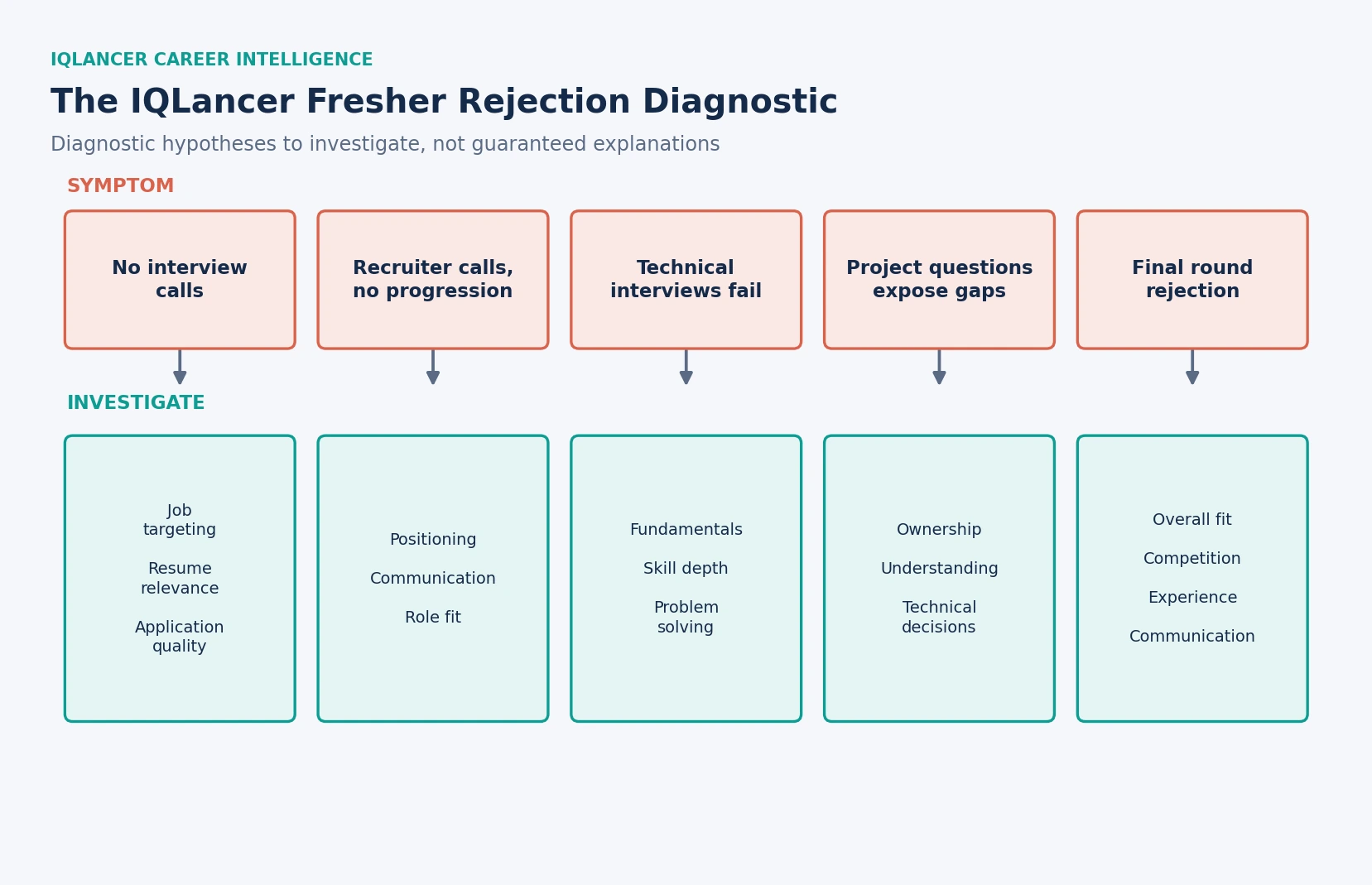
Symptom: No interview calls at all.
- Investigate: job targeting, resume relevance to the specific postings applied to, and whether the application volume is being spent on well-matched roles.
Symptom: Recruiter calls happen, but progression stops there.
- Investigate: positioning and expectations, including experience level, availability, and whether the recruiter conversation revealed a mismatch not visible on the resume.
Symptom: Technical interviews are where things break down.
- Investigate: fundamentals, skill depth versus skill exposure, and the ability to explain a thought process rather than just produce a correct answer.
Symptom: Interviewers’ project questions expose gaps.
- Investigate: project ownership, whether the candidate can explain their own technical decisions, and whether prior projects were guided, copied or genuinely independent.
Symptom: Rejection happens at the final round.
- Investigate: overall role fit, the strength of competing candidates, experience expectations for that specific role, and communication under higher-stakes interview conditions.
What Freshers Can Control vs What They Cannot
Can control:
- Which roles to target and how closely they match current skills.
- How clearly the resume is written and organized for each specific application.
- What projects to build next and how well they are documented.
- How thoroughly interview answers explain reasoning, not just conclusions.
- How accurately applications are matched to actual qualifications.
- How consistently feedback and rejection patterns are reviewed and acted on.
Cannot fully control:
- How many other candidates apply for the same role.
- Whether an internal candidate is already being considered.
- Hiring freezes, budget changes, or a role being cancelled after applications open.
- An employer’s specific, sometimes unstated, priorities for that hiring round.
- Where a candidate ranks against a specific competing pool on a given day.
This distinction matters because energy spent trying to control the second category is generally energy misallocated. A fresher who obsesses over competition levels or hiring freezes, both real and outside their control, has less energy left for the resume, project and interview improvements that are actually within reach.
How to Audit Your Profile Before Applying Again
A practical checklist to work through before sending out another batch of applications:
- Target role: is it clearly defined, or are applications spread across loosely related roles?
- Job requirements: has each posting’s specific requirements actually been read and compared against the candidate’s profile?
- Skill match: which required skills are genuinely strong, and which are only surface-level exposure?
- Evidence: is there something visible, a project, a repository, a write-up, that backs each core claimed skill?
- Projects: are they independent and explainable, or mostly guided and hard to discuss in depth?
- Resume: is it adjusted for this specific role, or a generic version sent everywhere?
- Application strategy: is effort concentrated on well-matched roles, or spread thin across mismatched ones?
- Interview preparation: can the candidate explain their reasoning out loud, not just solve problems silently?
- Technical depth: for the specific skills the target role emphasizes, is understanding at the application level or only the exposure level?
- Communication: has the candidate practiced discussing their own projects and decisions with another person, not just themselves?
- Experience gap: does the target role’s stated experience requirement realistically match what the candidate can offer right now?
- Competitive positioning: is there anything that differentiates this candidate’s application beyond a list of skills shared by most other applicants?
What Should You Fix First: Resume, Skills, Projects or Interviews?
Trying to fix everything at once is rarely efficient. A more useful approach is to match the fix to the specific symptom:
No interview calls at all → investigate job targeting, resume relevance and application matching before anything else.
Interview calls happen, but technical rounds fail → investigate skill depth, fundamentals and the ability to explain a thought process, not the resume.
Technical performance is solid, but project discussions fall flat → investigate project ownership and whether recent projects were guided rather than independent.
A strong profile is missing one specific required credential or piece of experience → investigate that specific job requirement directly, rather than assuming the whole profile is weak.
Skills, projects and resume are all genuinely strong, but offers still aren’t coming → investigate role fit, realistic experience expectations for that role, competition level and interview performance under pressure, since the remaining friction is likely at the evaluation and comparison stage rather than in the visible parts of the profile.
These are possible diagnostic paths, not a rigid formula. The right starting point depends on where the candidate’s own hiring funnel is actually breaking down.
A 30-Day Plan to Improve Your Hiring Evidence
This plan is meant to be adapted to whichever gap the audit above actually reveals, not followed rigidly regardless of individual circumstances. It does not guarantee interviews or offers.
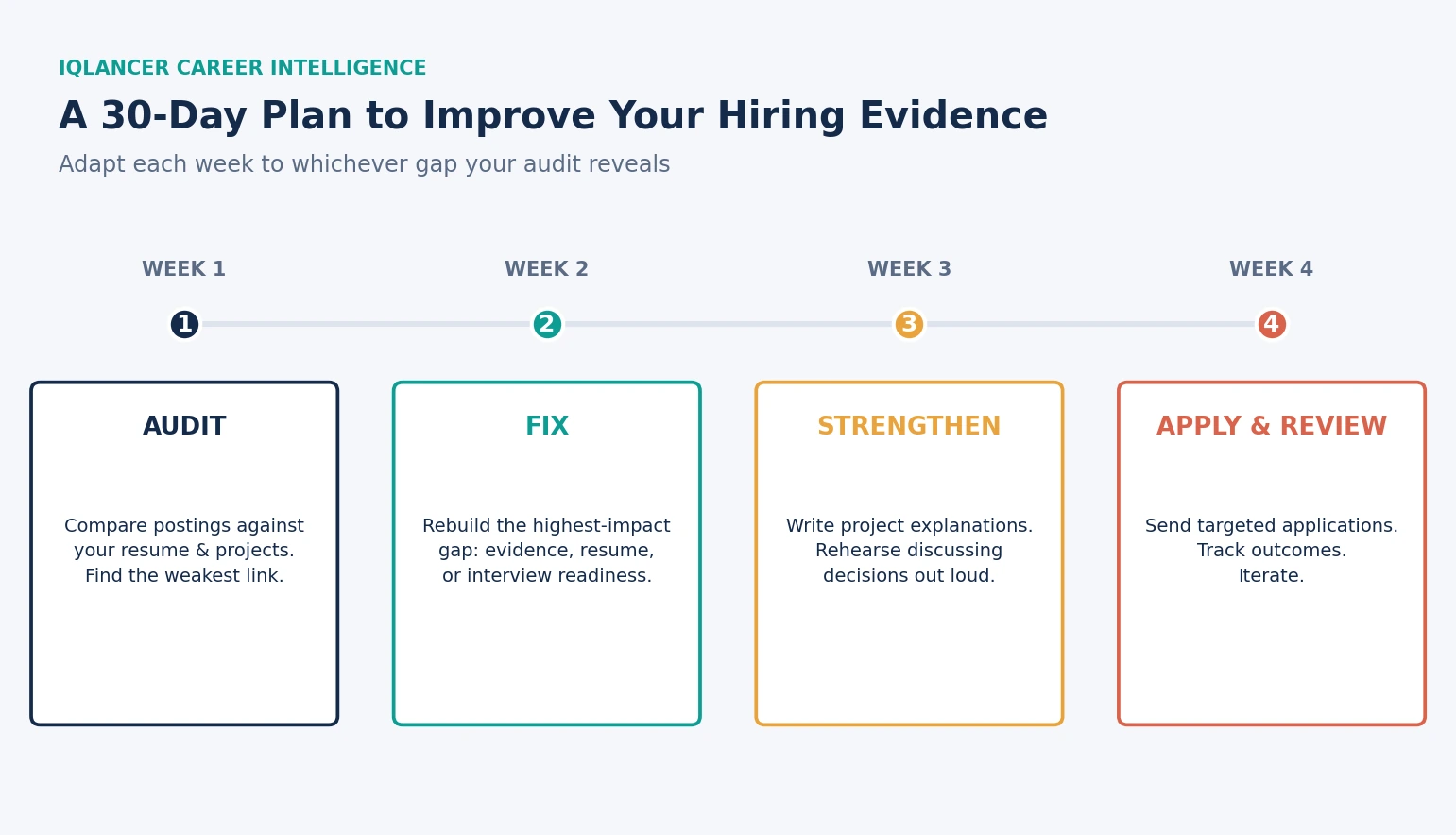
Week 1: Audit. Compare 5 to 10 recent job postings against the current resume and project list. Identify the single weakest link, whether it’s targeting, resume clarity, evidence or interview readiness.
Week 2: Fix the highest-impact gap. If it’s evidence, start one small, independent project. If it’s the resume, rewrite it around one target role instead of a generic version. If it’s interview readiness, begin practicing explaining reasoning out loud, not just solving problems silently.
Week 3: Strengthen presentation. Write a short explanation for each key project covering the problem, the approach, the challenges and what would be done differently. Rehearse discussing at least one project in depth with another person.
Week 4: Apply strategically and review outcomes. Send a smaller number of carefully matched applications rather than a large batch of generic ones. Track what stage each application reaches, and use that pattern to decide what to adjust in the next cycle.
Common Fresher Hiring Mistakes to Stop Repeating
Some of the most consequential fresher hiring mistakes, along with a better approach for each:
- Applying without checking role alignment. Consequence: low response rates regardless of actual skill. Better approach: compare the posting’s specific requirements against the resume before applying.
- Treating the resume as a skill inventory. Consequence: recruiters can’t quickly tell what role is being targeted. Better approach: lead with core skills for the specific role, supported by evidence.
- Building only tutorial projects. Consequence: weak answers when interviewers ask about independent decisions. Better approach: extend at least one project beyond the tutorial with an original feature or fix.
- Claiming skills that can’t be explained under questioning. Consequence: credibility damage that can outweigh the benefit of listing the skill at all. Better approach: only list skills at the depth they can genuinely be discussed.
- Ignoring fundamentals in favor of tools and frameworks. Consequence: struggling with follow-up questions that probe underlying concepts. Better approach: balance tool familiarity with core concept understanding.
- Treating application volume as the only relevant metric. Consequence: high effort with little insight into what’s actually not working. Better approach: track outcomes by application and adjust targeting based on the pattern.
- Assuming an automated system explains every rejection. Consequence: overcorrecting the resume while ignoring interview or project weaknesses. Better approach: investigate each stage of the funnel separately.
- Assuming a certificate or project guarantees an interview. Consequence: disappointment when evidence alone doesn’t convert without proper targeting and positioning. Better approach: pair every credential with a specific way to demonstrate it in practice.
- Not learning from repeated rejection patterns. Consequence: repeating the same mismatched approach across dozens of applications. Better approach: after each rejection cluster, revisit the audit checklist above before applying further.
The Real Reason Skilled Freshers Still Struggle to Get Hired
Skills alone are rarely enough, not because skills don’t matter, but because hiring decisions depend on evidence, positioning and communication built on top of those skills. A fresher can have the right technical foundation and still lose ground anywhere along the chain that runs from role targeting through resume signal, application quality, technical evaluation, interview communication and the employer’s final comparison against other candidates.
Understanding why freshers get rejected means tracing that full chain rather than assuming the answer is always “not skilled enough” or always “the system is broken.” Usually, it’s a specific, identifiable link that’s weaker than the rest, and that link is what deserves attention next.
Conclusion
Why freshers get rejected despite having skills rarely comes down to one clean explanation. It usually comes down to a weak link somewhere between having a skill and proving it clearly enough for an employer to act on: through role targeting, resume signal, project evidence, application quality or interview communication. Some rejections also reflect factors genuinely outside a candidate’s control, including competition, internal candidates and shifting hiring conditions, and it’s fair to hold both truths at once.
The most useful next step isn’t to learn another skill or send another hundred applications. It’s to work through the audit in this article, honestly identify the weakest part of the chain, and rebuild the evidence and positioning around that specific gap before applying again.