Every IT candidate eventually asks the same question: should I get another certification, or should I build another project? The honest answer is that certifications vs projects is the wrong framing for the decision. Certifications and projects are different types of evidence, and each one proves something the other usually cannot. Some employers explicitly require or prefer certifications, while others care far more about what a candidate can actually build and explain. IQlancer article is not about picking a winner. It is about identifying what your specific target role is still missing from your profile, and closing that gap efficiently.
Certifications vs Projects: What Actually Matters to Recruiters?
There is no universal answer to whether recruiters prefer certifications or projects, because recruiters are not evaluating candidates in a vacuum. They are evaluating candidates against a specific job description, at a specific hiring stage, for a specific level of seniority. A recruiter filling a compliance-heavy security role may treat a certification as a hard filter. A hiring manager filling a hands-on developer role may care almost entirely about what the candidate has built.
NACE’s Job Outlook 2026 survey found that 70% of employers now use some form of skills-based hiring for entry-level roles, up from 65% the year before, and GPA screening has fallen from 73% of employers in 2019 to 42% today. That shift matters because it means more employers are actively looking for direct evidence of what a candidate can do, not just what they claim to know. The real question a strong candidate needs to answer is not “which credential is more impressive?” It is: what evidence does this candidate still need to make their case complete?
What a Certification Signals to an Employer
A certification is a compact, third-party signal of structured learning. It can tell an employer that a candidate has studied a defined body of knowledge, passed a standardized assessment, and met a baseline that is recognized across the industry rather than defined by one company. For candidates entering a new domain, that structure is genuinely useful: it organizes learning, sets a clear finish line, and gives a hiring manager a shorthand reference point they already understand.
Certification value depends heavily on relevance and recognition. A CompTIA survey of HR professionals found that a large majority of employers believe IT certifications play an important role in hiring decisions and help predict on-the-job success, but that finding applies to certifications that are recognized and aligned with the role in question, not to certifications in general. A candidate who collects certifications unrelated to their target job is not building certification value; they are building a longer list.
It’s also worth being direct about the limits. Certification exams are shifting: reporting on the space notes that certification exams are increasingly emphasizing hands-on, performance-based tasks instead of pure multiple-choice recall, specifically because employers were skeptical that passing a theoretical exam proved someone could do the job. That shift is itself evidence of the core IQLancer position: a certification is strongest when it validates applied ability, not just memorized knowledge. Certification is not automatic proof of practical capability. It is proof of validated knowledge, which is valuable, but it is a different kind of evidence than proof of application.
What a Project Demonstrates That a Certification Usually Cannot
A project puts a candidate’s decisions on display. It can show how someone defined a problem, chose an approach, implemented it, ran into something that didn’t work, and fixed it. None of that shows up in an exam score. A certification can confirm that a candidate knows what a load balancer does; a project can show that the candidate configured one, misconfigured it once, diagnosed why traffic wasn’t distributing correctly, and corrected it.
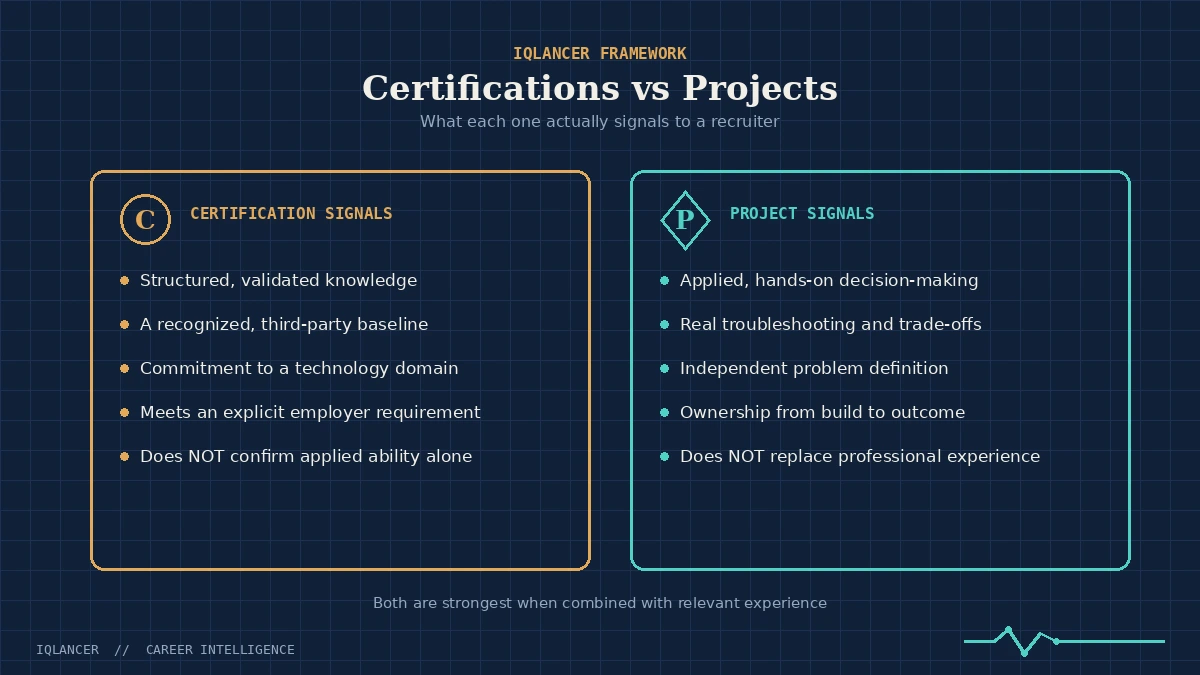
This is why project-based hiring has gained traction, especially for roles where employers want to see applied thinking rather than recalled facts. A project becomes strong evidence when a candidate can walk through:
- The problem they were solving and why it mattered
- The technical decisions they made and the alternatives they considered
- What they actually implemented, not what a tutorial implemented for them
- What broke, and how they diagnosed and resolved it
- The outcome, explained honestly rather than inflated
Project count is not the signal. A candidate with one project they can explain in depth is in a stronger position than a candidate with ten projects they can only describe in generic terms. That distinction matters more than almost anything else in this article, and it comes up again below.
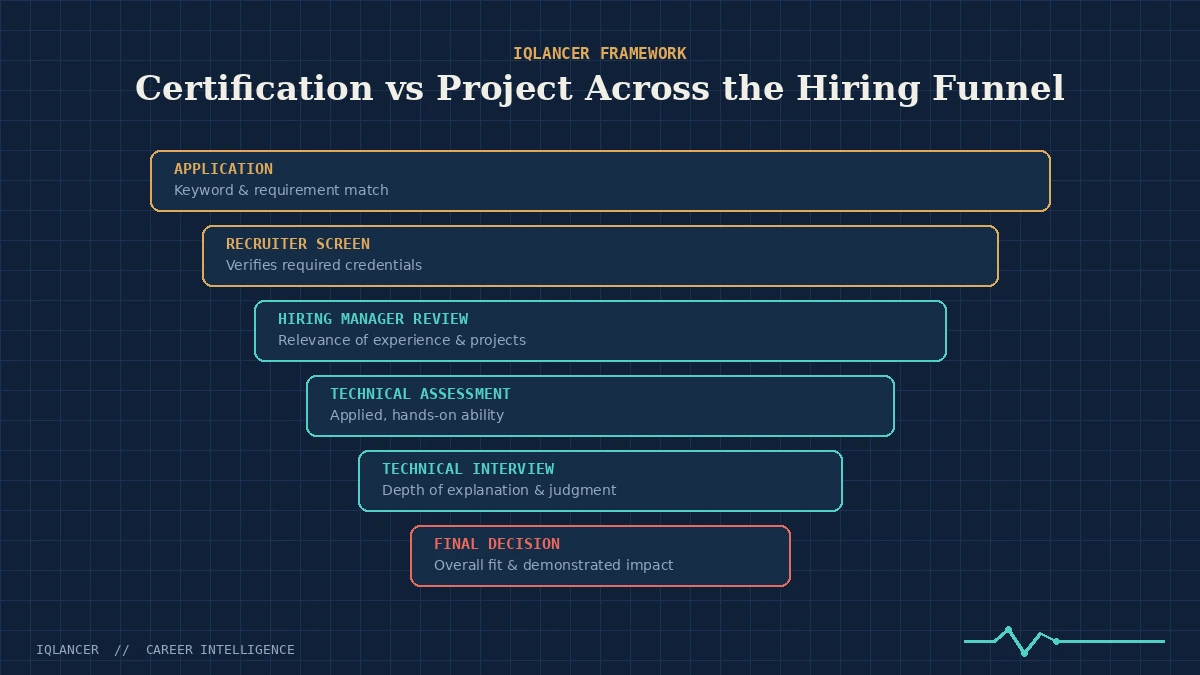
Certification vs Project Across the Hiring Funnel
The relative weight of a certification or a project changes depending on where a candidate is in the hiring process:
| Stage | What tends to matter most |
|---|---|
| Job application / resume screen | Keyword and requirement matching; a required certification or a clearly labeled, relevant project can both help a resume clear this stage |
| Recruiter screen | Quick verification that a candidate meets stated requirements, including any required certification |
| Hiring manager review | Relevance of experience and projects to the actual work the team does day to day |
| Technical assessment | Practical, applied ability; this is where project experience and hands-on certification content both carry weight |
| Technical interview | Depth of explanation; a candidate’s ability to reason through their own project decisions or explain what a certification actually covered |
| Final decision | Overall fit, including professional experience, communication, and how well the candidate’s evidence matches the team’s real problems |
The same certification or project does not carry identical value at every stage. A required certification may be decisive at the application stage and almost irrelevant in a live technical interview, where the interviewer is testing whether the candidate can reason under pressure, not whether they hold a credential. This is an observed pattern in how hiring stages are typically structured, not a claim about how every applicant tracking system scores candidates, since scoring logic varies by employer and tool.
Required, Preferred, or Optional: Read the Job Description First
Before deciding whether to pursue a certification or build a project, read the actual job posting closely. Job-posting language is not random. Employers distinguish minimum (required) qualifications from preferred qualifications on purpose: minimum qualifications are what a candidate must have to be considered at all, while preferred qualifications describe what would make a candidate stronger without disqualifying anyone who lacks them.
| Job-posting language | What it may mean | Candidate action |
|---|---|---|
| “Certification required” | The employer treats this as a hard filter, often for compliance, client-facing, or regulated work | Prioritize the certification before applying, or expect an automatic screen-out |
| “Certification preferred” | The certification strengthens an application but is not disqualifying | Weigh it against your current evidence gaps; a strong project may cover the same ground |
| “Portfolio or projects preferred” | The employer wants to see applied work, not just credentials | Prepare a project you can explain in technical depth, not just link to |
| “Hands-on experience required” | The employer expects demonstrable practical ability, regardless of how it was gained | A well-documented project or real work experience can both satisfy this |
| “Demonstrated experience with [technology]” | The employer wants specific, verifiable exposure to that tool or platform | Match your project or work history to the exact technology named, not an adjacent one |
These interpretations describe common patterns, not universal hiring rules; wording and internal hiring processes vary by employer, industry, and country.
When a Certification Matters More Than a Project
A certification is likely to carry more weight in these situations:
- The job posting explicitly lists the certification as required, often true in cybersecurity, cloud infrastructure, project management, and some regulated IT environments
- The credential is directly and narrowly relevant to the target role, not a general-purpose badge
- The employer or industry treats that specific certification as a recognized baseline, which is common where a vendor’s own platform certification (for example, a cloud provider’s associate-level exam) is the standard reference point for that ecosystem
- The candidate is missing a credential that is currently blocking otherwise-qualified applications
- The candidate is entering a genuinely new domain and needs structured, sequenced learning rather than open-ended exploration
None of this means every certification carries equal hiring value. A niche, unrecognized, or outdated certification will not do the same work as one that is current, vendor-recognized, and clearly tied to the role.
When a Project Matters More Than a Certification
A project is likely to carry more weight in these situations:
- The job emphasizes hands-on ability, ownership, or applied problem-solving over credentialed knowledge
- The candidate already has relevant knowledge but no way to prove they can apply it
- The candidate is a beginner or career switcher with no professional track record yet; a strong project becomes a substitute for a resume line an employer would otherwise be looking for
- The certification under consideration is unrelated or only loosely related to the target role
- The candidate already holds several certifications but has little to show for applying that knowledge
- The employer’s posting or interview process signals they want demonstrable technical work, not just a credentials list
One industry analysis referencing LinkedIn Talent Insights data found that a large majority of hiring managers view online certificates as a useful supplement rather than a decisive factor in their decision. That is a reasonable description of how many hiring managers weigh a standalone certificate against demonstrated, explainable work, though the exact weighting still depends on the role and the employer.
How Career Stage Changes the Equation
The evidence a hiring team expects changes as a candidate’s career stage changes.
- Beginners and students usually have no professional track record, so a well-documented project often does more work than a certification alone, because it is the clearest way to show applied thinking without prior employment.
- Career switchers face a similar gap but with an added complication: they need to prove transferable capability in a new domain, which is often where a targeted, relevant certification and a project that applies it together outperform either one alone.
- Junior professionals typically already have some work history, so the marginal value of one more certification is lower than it was as a beginner; a project or contribution that shows independent problem-solving tends to matter more at this stage.
- Mid-level professionals are usually being evaluated on ownership and judgment, not raw technical knowledge, so the strongest evidence is often a documented decision they made under real constraints, whether that came from a project or from work experience.
- Senior professionals are generally evaluated on scope of impact and technical leadership; at this stage, another entry-level or intermediate certification rarely moves the needle, while a track record of outcomes, architecture decisions, or team impact does.
Seniority is not just years of experience. It is a combination of skill evidence, applied judgment, and the ability to explain trade-offs, which is why two candidates with identical tenure can present very differently to a hiring panel.
Certifications vs Projects Across IT Roles
The following is a hiring-evidence comparison, not a list of recommended certifications or project ideas. Always verify current requirements against the specific job description you are targeting.
Data Analyst. Certifications can signal structured knowledge of statistics, SQL, or a specific analytics platform. Projects demonstrate whether a candidate can take messy, real-world data and produce a defensible interpretation, which is closer to the actual job. Certification tends to matter more when a specific platform (for example, a particular BI tool) is explicitly required. Project evidence tends to matter more when the role emphasizes independent analysis and communicating findings to non-technical stakeholders.
DevOps Engineer. Vendor and platform certifications can validate familiarity with a specific toolchain. Projects and real infrastructure work demonstrate whether a candidate can actually automate a pipeline, recover from a failure, or manage configuration drift. Certification matters more when a job posting names a required platform certification. Practical evidence matters more when the interview process includes live troubleshooting or system-design discussion, which is common for this role.
Cloud Engineer. A cloud provider’s associate or professional certification is often used as a recognized baseline within that provider’s ecosystem, particularly for early-career hires. Projects that show a working, reasoned architecture (not just a deployed tutorial) demonstrate design judgment. Certification carries more weight when required for a specific vendor-aligned role. Project evidence carries more weight in architecture-focused interviews.
Cybersecurity Analyst. This is one of the domains where a specific certification is most likely to appear as a hard requirement, partly for compliance and partly because some employers use certification as a standardized way to verify baseline knowledge across a large candidate pool. Projects (home labs, incident-response write-ups, capture-the-flag work) demonstrate applied detection and response skills that a multiple-choice exam cannot fully capture. When a job posting requires a named certification, prioritize it. When the posting emphasizes hands-on detection or response work, prioritize demonstrable lab or project evidence alongside it.
AI Engineer. Certifications in this space are newer and less standardized than in cloud or cybersecurity, so recognition varies significantly by issuing organization. Projects that show how a candidate built, evaluated, and iterated on a real model or pipeline, including what didn’t work, tend to carry more practical weight here than in more mature certification ecosystems. Read the job description carefully, since some employers in this fast-moving field weight demonstrated technical depth over any specific credential.
Full Stack Developer. Certifications are relatively uncommon requirements in this role compared to cloud or security positions. A working application the candidate built, deployed, and can explain end to end (including trade-offs and what they would change) is usually stronger evidence than a certificate. Certification may still help candidates transitioning from a non-development background who need a structured way to demonstrate foundational knowledge.
Why Project Quality Matters More Than Project Count
Not every project carries the same evidentiary weight. A useful way to think about project quality is as a progression:
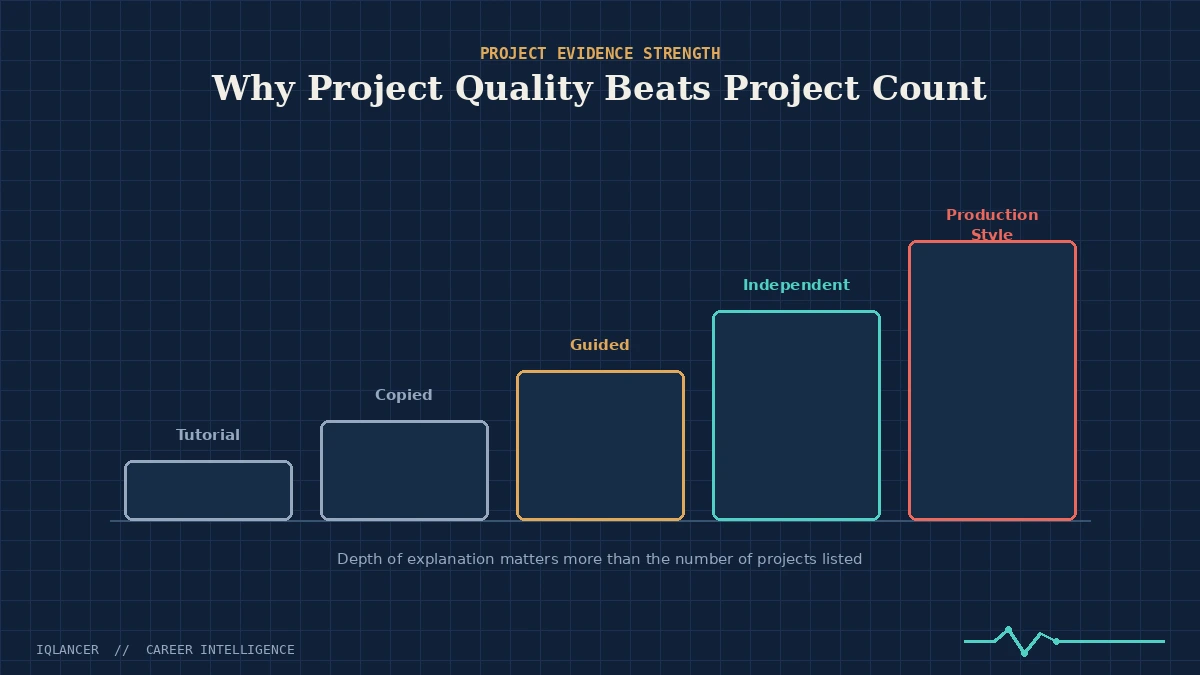
- Tutorial project → follows a guide step by step with no independent decisions.
- Copied project → duplicates someone else’s code with minimal understanding of why it works.
- Guided project → completed with significant outside direction, but with some original contribution.
- Independent project → the candidate defined the problem, made the technical decisions, and built the solution with minimal outside guidance.
- Production-style project → includes realistic constraints such as testing, deployment, documentation, and handling failure cases.
A project becomes stronger evidence as it moves up this progression, particularly when the candidate can clearly explain the problem, their specific contribution, the technical decisions made, what they tested, what they deployed (where relevant), what went wrong, and the honest outcome.
Production-style complexity is not mandatory for beginners; an independent project a beginner can explain in depth is far more useful than a production-style project they copied and cannot defend under questioning. Never fabricate results, users, or performance numbers for a project. Overstated outcomes tend to unravel the moment a technical interviewer asks a follow-up question.
Why Certification Relevance Matters More Than Certification Count
There is a meaningful difference between a certification that is relevant, currently recognized, and aligned with the target role, and one that is generic, unrelated, or carries low recognition in the field a candidate is targeting. A recognized, role-aligned certification narrows the gap between the candidate and the job. An unrelated certification, however impressive it looks on paper, does very little to close that specific gap.
This is not an argument against certification-based learning. Certifications remain a legitimate and often efficient way to build structured knowledge, especially for candidates entering a domain with no prior background. The point is relevance, not volume. Collecting five loosely related certifications rarely strengthens a candidate’s positioning as much as one certification and one project that are both tightly aligned with the target role.
Projects Don’t Replace Professional Experience
This distinction needs to be stated plainly, because it is one of the most common points of confusion for early-career candidates. Projects can demonstrate technical capability, initiative, applied problem-solving, and the ability to learn independently.
What projects usually cannot fully replicate is what comes from professional experience: working under real production constraints, coordinating with stakeholders who have competing priorities, maintaining a system over time rather than building it once, being accountable for reliability, understanding business context, and carrying operational responsibility when something breaks in production at 2 a.m.
That does not mean every employed candidate automatically outranks every project-based candidate. A candidate with years of shallow, poorly explained work experience is not automatically stronger than a candidate with one deeply understood, well-articulated independent project. Evidence quality and relevance still matter more than the source of the evidence.
Certifications Don’t Prove Practical Ability
The reverse distinction matters just as much. A certification can provide solid evidence of structured learning, domain knowledge, exam-based validation, and familiarity with a technology or framework. What a certification usually cannot independently establish is implementation ability, troubleshooting under real conditions, architectural judgment, production ownership, or how someone collaborates on a team.
Some newer, performance-based certification formats are narrowing this gap by testing applied tasks rather than recall, but the underlying principle holds: a credential and a demonstrated capability are not the same thing, and hiring teams that have been burned by candidates who “look qualified on paper” tend to know the difference.
The IQLancer Signal Framework: Credential → Application → Experience → Impact
To make this decision easier to reason about, IQLancer uses an original framework. The IQLancer Signal Framework. This is not an industry-standard model; it is IQLancer’s way of organizing the different layers of evidence a candidate can present.
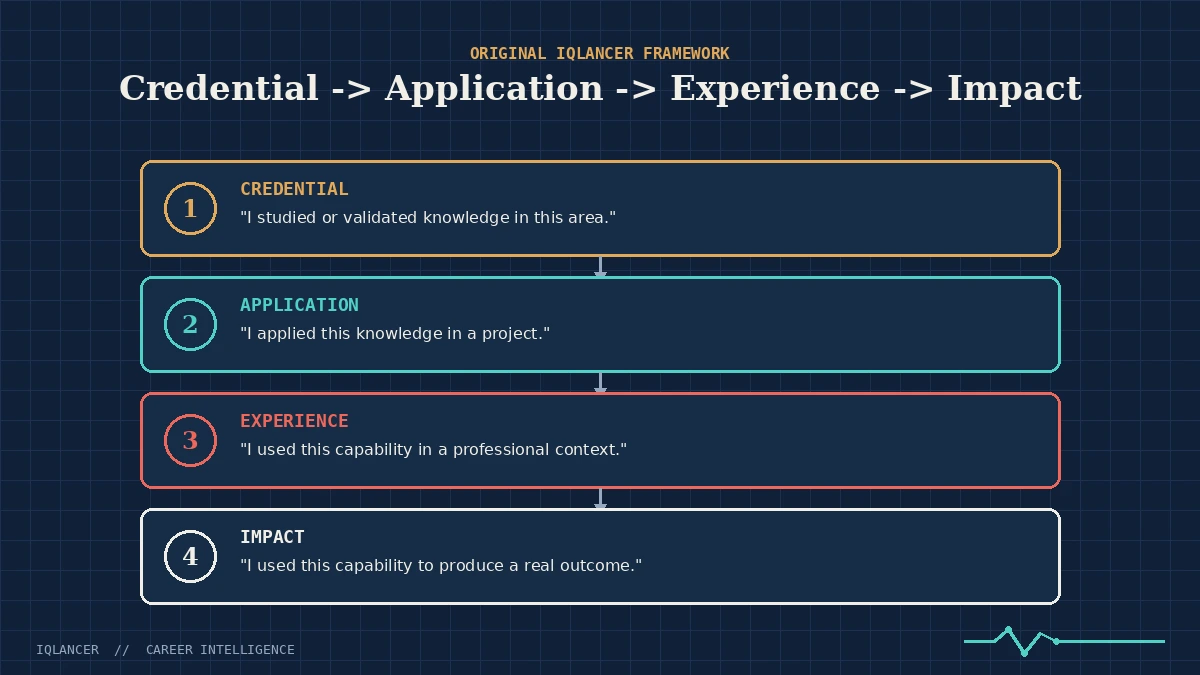
Credential: “I studied or validated knowledge in this area.” (Typically built through certification or formal coursework.)
Application: “I applied this knowledge in a project.” (Typically built through independent or guided project work.)
Experience: “I used this capability in a professional context.” (Typically built through employment, internships, freelance work, or client engagements.)
Impact: “I used this capability to solve a meaningful problem or produce a real outcome.” (Typically demonstrated through measurable results, ownership, or recognized contribution.)
Each layer is a different kind of evidence, and a strong candidate profile usually shows progression through more than one layer for their core skills, rather than depth in only one. A candidate with only credential-level evidence for their most important skill has a gap that either a project or real experience needs to fill.
If You Already Have X, What Should You Build Next?
These are practical starting points, not universal rules; always weigh them against your specific target job description.
If you have a certification but no meaningful project: consider building one relevant, well-documented project that applies what the certification covered. This moves you from the Credential layer to the Application layer.
If you have strong projects but the target job explicitly requires a certification: address the certification requirement directly. No amount of project strength reliably overrides a stated hard requirement.
If you have several certifications but weak practical evidence: stop adding certifications and prioritize demonstrable application. Additional credentials at this point have diminishing marginal value.
If you have strong projects and certifications but little professional experience: focus on internships, freelance work, real client engagements, open-source contributions, or other legitimate ways to gain production-style experience. This is the hardest gap to close artificially, and it should be closed through real opportunities rather than simulated ones.
If you have strong professional experience: focus more heavily on demonstrating relevant impact, technical depth, and role alignment rather than collecting more credentials without a clear objective. At this stage, another certification usually has lower marginal value unless it serves a specific, named career goal (for example, a role change that genuinely requires it).
The IQLancer Certification vs Project Decision Matrix
| Candidate situation | Likely priority | Why | Next action |
|---|---|---|---|
| Beginner with no practical evidence | Build one strong project | No professional history exists yet to lean on; a project is the fastest way to create real evidence | Choose one problem you can build and explain in depth, not several shallow ones |
| Career switcher | Certification + one applied project | Structured learning closes the domain-knowledge gap; the project proves you can apply it | Pick a certification directly aligned to the new target role, then apply it in a project |
| Certification held, no project | Build a relevant project | The credential proves knowledge but not application | Apply the certified knowledge to something you built yourself |
| Strong projects, required certification missing | Pursue the certification | A stated requirement is a hard filter regardless of project strength | Confirm the exact certification named in the job description before starting |
| Several unrelated certifications | Stop collecting, start applying | Volume without relevance adds little additional signal | Pick your two most relevant certifications and build a project around each |
| Strong portfolio, no formal credential | Evaluate whether any target job requires one | Portfolios can outweigh credentials, but only where certification isn’t a hard filter | Check target job descriptions for required credentials before deciding to skip certification entirely |
| Experienced professional | Prioritize impact and role alignment over new credentials | Marginal value of another certification is lower at this stage | Document ownership, outcomes, and technical decisions from real work instead |
| Targeting certification-heavy roles (security, compliance, some cloud roles) | Certification first | These fields more often use certification as a hard or near-hard filter | Confirm the specific required credential, then build supporting evidence |
| Targeting project/portfolio-heavy roles (most developer and AI roles) | Project first | These fields typically weight applied work more heavily than credentials | Build one project that reflects the actual problems the role solves |
A 30-60-90 Day Plan for Strengthening Your Hiring Profile
This plan is a starting structure, not a guaranteed formula, and it should begin with your target role, the actual job description, your current profile, and the specific evidence you are missing.
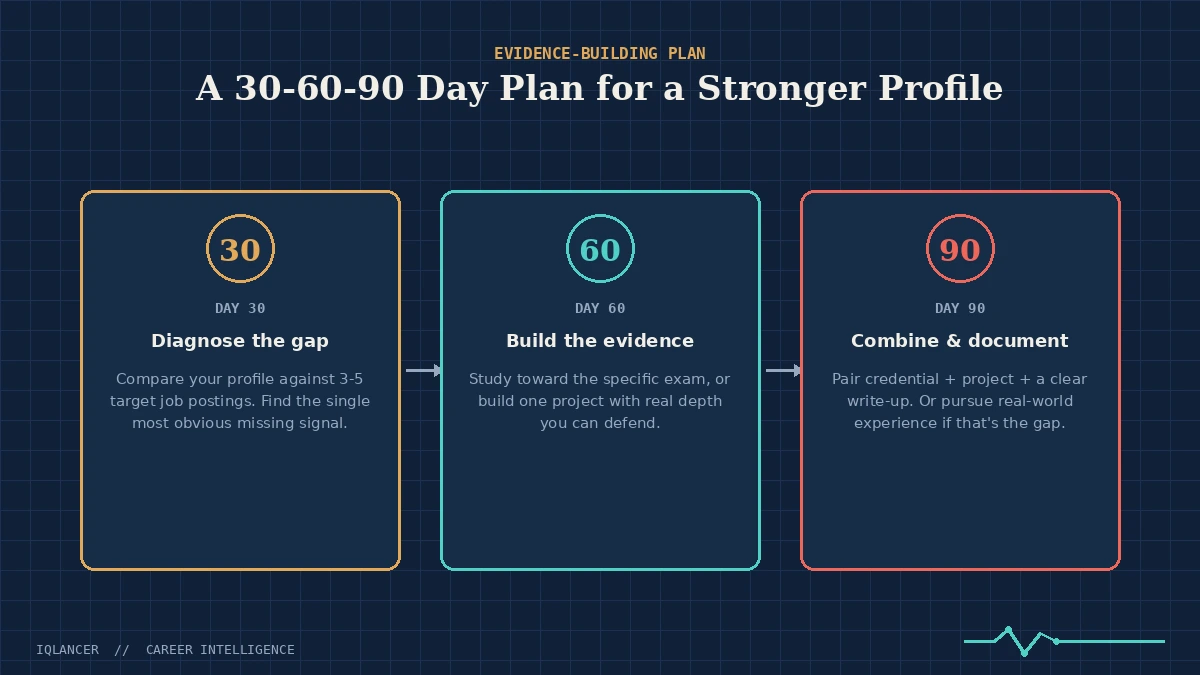
First 30 days: Identify your single most obvious evidence gap by comparing your current profile against three to five real job postings for your target role.
- If a certification is explicitly required and you don’t have it, start there.
- If your knowledge outpaces your applied evidence, start scoping one project.
Next 60 days: Build the missing evidence properly.
- If you’re pursuing a certification, study toward the specific exam rather than generic material.
- If you’re building a project, prioritize depth over speed, and make sure you understand every decision well enough to defend it in an interview.
By 90 days: Aim for a stronger combination of credential, applied project, and documentation (a clear write-up or README explaining your decisions) rather than one isolated artifact.
- If your evidence gap was professional experience itself, use this window to pursue internships, freelance work, or real client projects rather than another simulated exercise.
Common Mistakes Candidates Make With Certifications and Projects
- Collecting certifications without a target role. Consequence: a long list that doesn’t clearly answer any specific job’s requirements.
- Building projects without reading the job requirements first. Consequence: technically fine work that doesn’t map to what the employer is actually screening for.
- Listing too many unrelated certifications. Consequence: dilutes the credentials that are actually relevant and can read as unfocused.
- Building only tutorial projects. Consequence: cannot withstand follow-up questions about independent decisions, because there weren’t any.
- Copying GitHub projects without understanding them. Consequence: falls apart under basic technical interview questioning.
- Assuming projects equal professional experience. Consequence: candidates undersell the value of real work history, or overstate what a personal project proves.
- Assuming a certification guarantees interviews. Consequence: certification opens doors at the screening stage but rarely wins a technical interview on its own.
- Ignoring a required certification because “projects should be enough.” Consequence: automatic screen-out at roles where the credential is a hard filter.
- Ignoring practical evidence entirely. Consequence: strong theoretical knowledge with nothing to demonstrate it under interview pressure.
- Measuring progress by certificate count or project count alone. Consequence: mistakes activity for evidence, and misses the actual gap in the profile.
Final Decision: Should You Get a Certification or Build a Project?
Stop asking “which one is better?” That framing assumes a universal answer exists, and it doesn’t. Ask instead: what evidence is missing from my profile for the specific job I want?
If a certification is explicitly required, prioritize it before anything else; no project reliably substitutes for a stated hard requirement. If a certification is relevant but only preferred, weigh its value against the evidence you already have, since a strong, well-explained project may cover the same ground.
If practical, applied evidence is what’s missing, build it, and build it with enough depth that you can defend every decision in an interview. If you already have solid certifications and solid projects, shift your attention to professional experience, ownership, and demonstrated impact, since that is very likely your actual remaining gap. And if you already have strong professional experience, another credential usually has limited marginal value unless it serves a specific, clearly defined career objective.
This is not an oversimplified rule. It is a diagnostic question that changes its answer based on your role, your career stage, and your current evidence, which is exactly why it works better than a fixed ranking.
Conclusion
The certifications vs projects debate only feels difficult because it’s usually framed as a contest with one winner. It isn’t. Certifications validate structured knowledge and satisfy explicit employer requirements; projects demonstrate applied, independent capability that a credential alone cannot show; and professional experience adds context, ownership, and accountability that neither one fully replicates on its own.
Recruiter preference, hiring factors, and certification value all shift depending on the target role and the candidate’s current evidence. The practical path forward is simple to state, even if it takes real effort to execute: read the job description, audit what you already have, identify the specific evidence you’re missing, and build that, not whatever feels easiest to add next.