You’ve applied to sixty, eighty, maybe two hundred IT jobs. Some of them were a strong match on paper. And yet the responses either don’t arrive, or arrive as an automated rejection within hours. The instinct at this point is to send more applications, or to rewrite the resume for the fifth time and hope something sticks.
Neither move works reliably, because both skip the actual diagnosis. Not getting interview calls is rarely one problem; it’s usually a breakdown at one specific stage of the hiring funnel, and applying blindly means that stage never gets found. This article walks through where IT applications actually fail, and how to isolate which stage is yours.
What Actually Happens Between Applying and Getting an Interview?
Before you can fix anything, it helps to see the full path an application travels because “rejection” can mean six different things depending on which stage stopped you, and each stage requires a different fix.
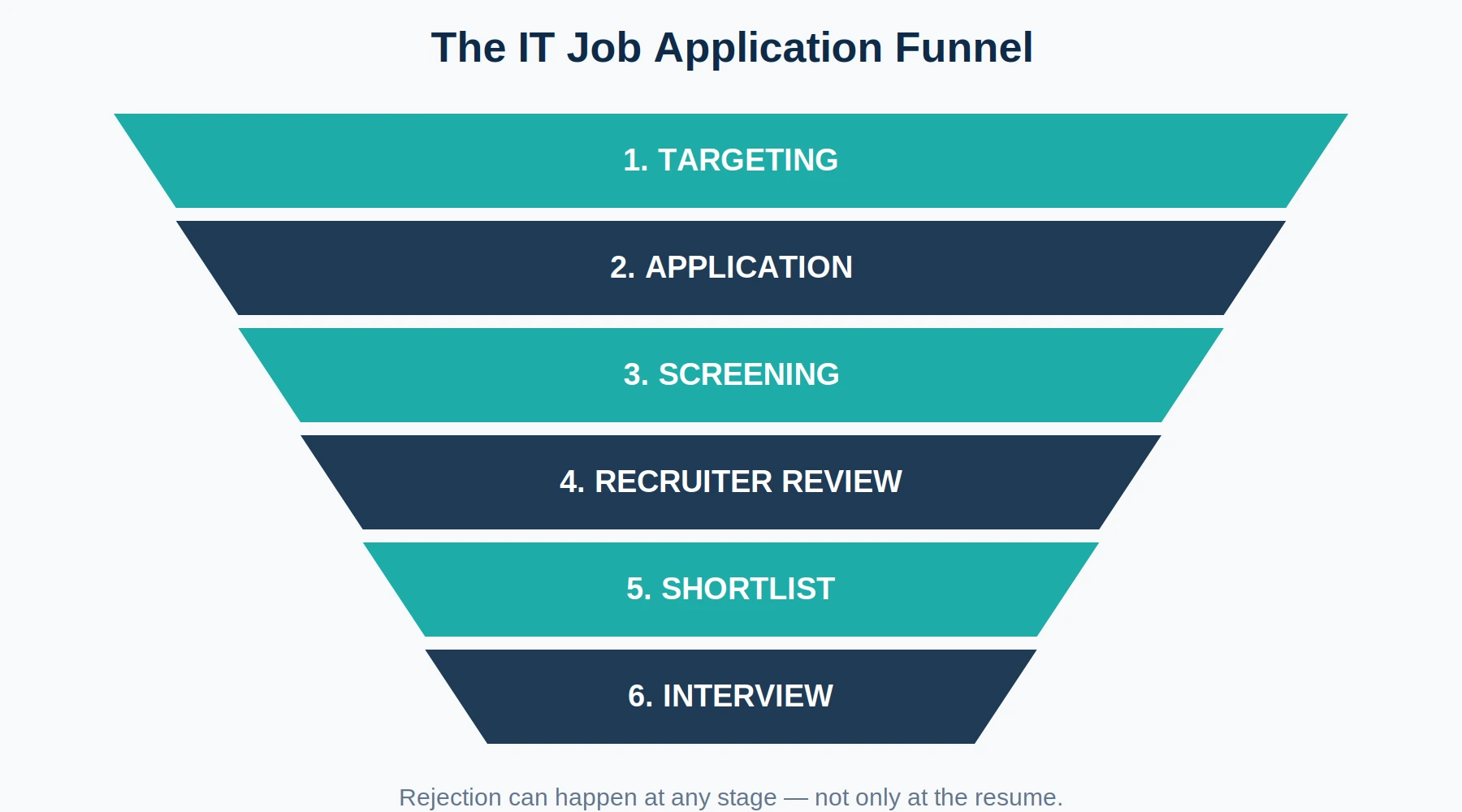
An IT job application generally moves through six stages: targeting (deciding which roles to apply to), application (submitting the resume and form), screening (automated or manual filtering against baseline criteria), recruiter review (a person reads the resume), shortlist (you’re selected to move forward), and interview (a live conversation).
A candidate can be filtered out at any of these points, and the visible outcome silence, or a generic rejection email looks identical no matter where in the funnel it happened. That’s precisely why “not getting interview calls” is a symptom, not a diagnosis.
Recent reporting on the 2026 tech hiring market captures this dynamic clearly: hiring managers describe posted roles pulling in a flood of applicants where the large majority are considered a poor fit, which pushes recruiters toward faster, blunter filtering earlier in the funnel meaning strong candidates can get caught in the same early net as weak ones (The Pragmatic Engineer, 2026).
Understanding which of the six stages is most likely stopping you is the first real step, and it’s the organizing idea behind everything that follows in this article.
Are You Applying to the Right IT Jobs?
This section matters because targeting problems are invisible from the resume you can have a well-written resume and still get zero traction if you’re consistently applying to roles that don’t match your actual profile.
A common assumption is that “IT experience” is interchangeable across roles. It isn’t. A recruiter filtering for a DevOps Engineer role is not evaluating general technical competence. They’re evaluating fit against a specific technology stack, deployment environment, and scope of ownership. This is worth stating plainly:
YEARS OF EXPERIENCE ≠ RELEVANT EXPERIENCE
Five years as a systems administrator does not automatically translate into five years of cloud infrastructure experience, even if both appear under an “IT” umbrella. Targeting mismatches typically show up in one of these forms:
- Role relevance: Applying to Cloud Engineer roles with a background that’s mostly on-prem infrastructure, with no hands-on cloud provisioning.
- Technology relevance: Applying to a role built around Azure when your practical experience is entirely AWS-based.
- Domain relevance: Applying to fintech-specific security roles without any regulated-industry exposure, when the posting treats that as central.
- Seniority: Applying to “Senior” roles on the strength of title alone, when scope of responsibility (team size, architecture ownership, decision authority) doesn’t match.
- Location and work authorization: Applying to roles with on-site or visa-sponsorship constraints that don’t match your situation this alone can end an application before anyone reads the resume.
- Compensation alignment: Applying to roles where the posted or typical range is meaningfully below your requirements, which can cause a recruiter to deprioritize outreach even with a technically strong match.
The tech hiring market itself matters here too. Demand is uneven: Robert Half’s 2026 hiring research shows sharp, sustained growth in AI/ML, cybersecurity, cloud, and data engineering roles, while more generalist software engineering roles face far more competition per opening (Robert Half, 2026). If you’re targeting a saturated category with a generalist profile, the lack of interview calls may say more about market conditions in that specific niche than about your resume.
Do You Meet the Job’s Core Requirements?
This section exists because candidates frequently misjudge job postings either applying to roles they’re genuinely unqualified for, or skipping roles they were actually qualified for because they misread a wish-list item as a hard requirement.
Job postings typically separate qualifications into two categories, and understanding the difference changes how you should apply:
- Must-have / required qualifications: these describe what’s needed to perform the role from day one. Recruiters and hiring guides generally treat these as close to non-negotiable (Goldbeck Recruiting).
- Preferred / nice-to-have qualifications: these describe what would make an ideal candidate, not what’s required to be considered. Career advisors are fairly consistent on this point missing several preferred items is not, by itself, a reason to skip applying (iHire).
The mistake IT candidates make in both directions is treating every bullet point as pass/fail. A posting that lists “5+ years in distributed systems” as required and “familiarity with Terraform” as preferred is not asking you to meet both at the same bar one is foundational, the other is a tie-breaker between similarly-qualified finalists (ShouldApply). This distinction runs in both directions:
- If you’re missing a required, core technical skill (say, a Kubernetes-heavy DevOps role and you’ve never worked with containers in production), that’s a genuine skills gap. Applying likely wastes both your time and the recruiter’s.
- If you’re missing a preferred certification or a secondary tool, that is not a reason to self-reject. Employers who inflate every line to “required” often shrink their own applicant pool unnecessarily, which is itself a known problem in how job descriptions get written (Main Line Talent Group).
Practically: read the posting once for the must-haves and decide honestly whether you can do the job on day one. Read it a second time for the preferred list and treat it as a checklist for what to emphasize in your resume, not a bar to clear before applying.
Is Your Resume Actually Proving the Match?
This section matters because meeting a requirement and demonstrating that you meet it are two different things a resume’s job is to convert your real experience into legible proof, and a lot of qualified candidates lose ground here without realizing it.
The chain that connects a job posting to a hiring decision looks like this:
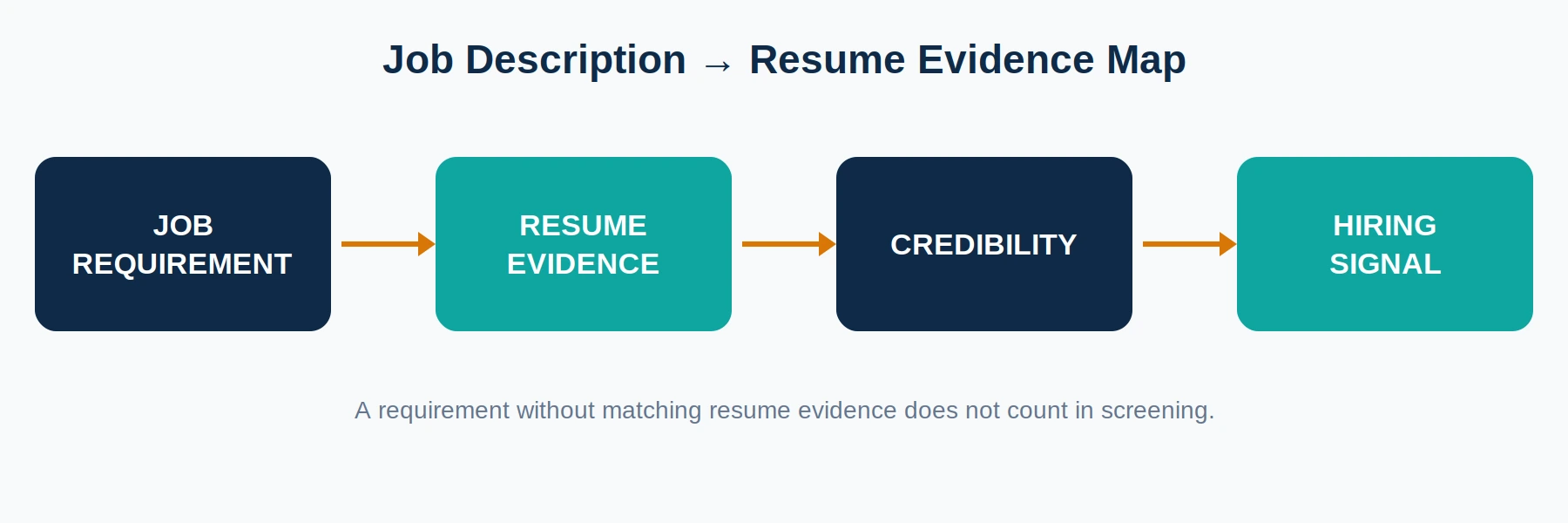
A requirement without corresponding evidence on the resume doesn’t count, no matter how true it is. Compare:
- Weak: “Worked with AWS.”
- Stronger: “Provisioned AWS infrastructure using Terraform and supported containerized workloads across staging and production environments.”
(Example only. Adapt this to your actual experience never copy language for experience you didn’t have.)
The second version does three things the first doesn’t: it names a specific tool used alongside AWS (Terraform), it states a concrete responsibility (provisioning infrastructure), and it implies scope (staging and production). This is not about padding language it’s about giving a recruiter something they can actually evaluate instead of a bare keyword.
The IQLancer Resume Evidence Density Concept
(This is an original IQLancer framework, not an industry-standard metric.)
We use this idea to explain why two resumes that both mention the same technology can perform very differently in screening:
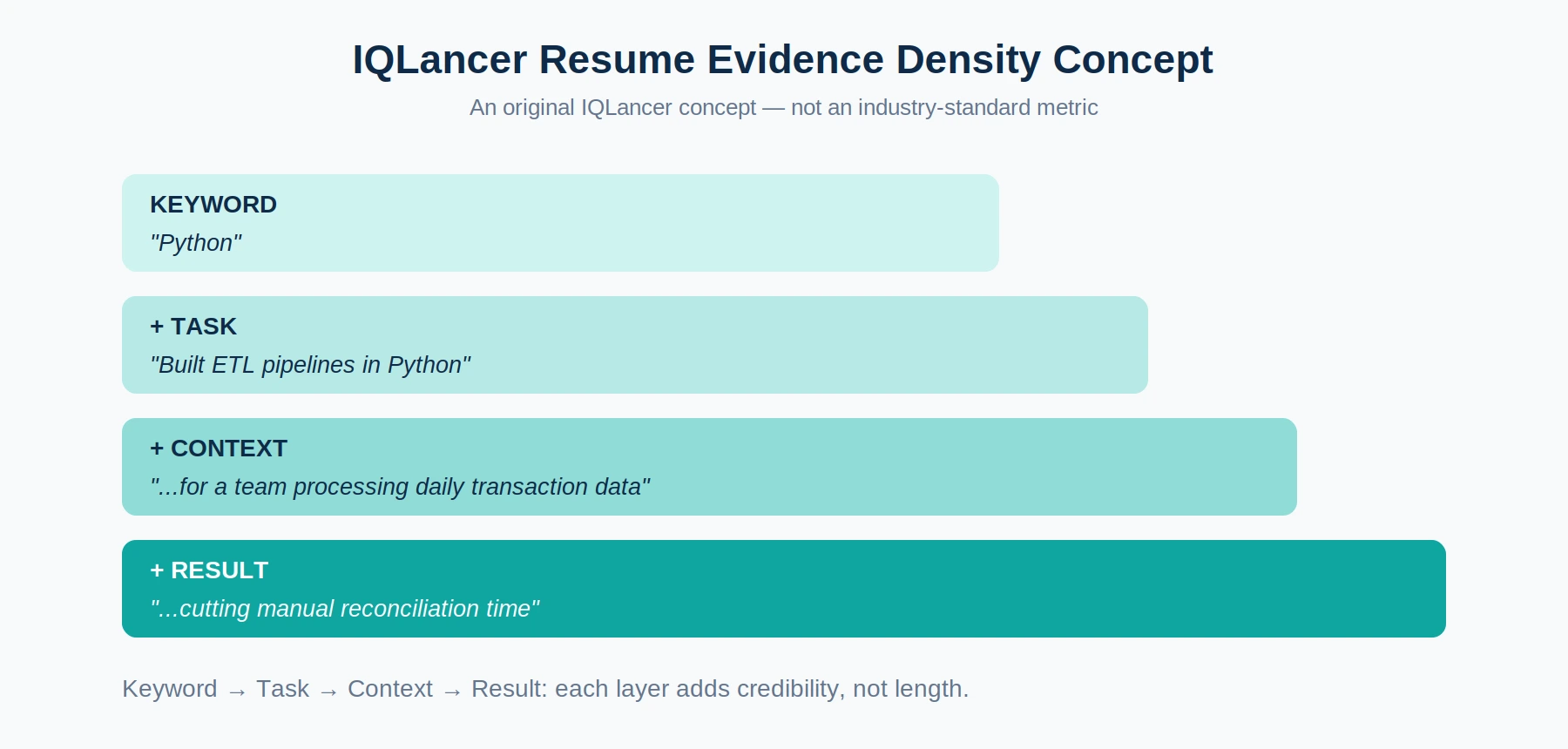
A keyword alone (“Python”) is the weakest form of evidence; it tells a reader only that the word exists somewhere in your history. Adding a task (“built ETL pipelines in Python”) adds a layer of specificity. Adding context (“for a team processing daily transaction data”) adds scope. Adding a result, where you can state one truthfully, adds proof of impact.
Career guidance across the industry consistently points in this direction quantified, specific claims are treated as more credible than duty-list phrasing like “responsible for,” because a specific claim gives a reader something concrete to evaluate rather than something to take on faith (Resume Optimizer Pro).
The goal of Resume Evidence Density is not to hit a specific number of metrics; it’s to notice which of your bullet points are still sitting at “keyword” level and move them one step further, only where the added detail is true.
Why Skill Recency and Career Level Can Affect Shortlisting
This section is here because two resumes can list the exact same technology and receive completely different responses the difference is often how recent, how deep, and how well-evidenced that experience is, not whether it’s listed at all.
Recruiters and hiring managers are not just checking whether a skill appears they’re forming a judgment about:
- Recency: Experience with a technology from four years ago reads differently than experience from the last twelve months, particularly in fast-moving areas like cloud platforms, AI tooling, or security frameworks.
- Depth: Having “used” a tool in a supporting role is different from having owned a system built on it.
- Scope: A “Senior Engineer” title with a two-person team and narrow ownership does not automatically match a posting that expects architectural decision-making across multiple services.
- Career transitions: Moving from, say, QA into DevOps, or from IT support into cybersecurity, is common and often achievable but the resume needs to make the transferable skill explicit rather than assuming the reader will infer it.
- Overqualification and underqualification: Both cut against you. A senior profile applying to a mid-level role can be screened out on the assumption you’ll leave once something bigger appears; a junior profile applying to a senior role is usually screened out on scope, not skill.
The useful formula here is:
SKILL + RECENCY + DEPTH + EVIDENCE
is a far stronger shortlisting signal than simply listing a technology once and moving on. If your resume mentions a skill but the surrounding work history doesn’t clearly show when, how deeply, or how recently you used it, a recruiter has no way to credit you for it.
Why Your Application Can Be Rejected Before a Recruiter Calls
This section covers a stage many candidates don’t think about: rejection that happens through structured screening criteria, before a person forms any opinion about your resume’s quality.
Employers commonly build hard filters into the application process itself not to judge writing quality, but to eliminate applications that fail baseline, non-negotiable criteria. These typically include:
- Required certifications, degrees, or clearances
- Location or on-site requirements
- Work authorization or visa sponsorship needs
- Minimum years of experience
- Specific must-have technical qualifications
- Incomplete applications (missing fields, broken uploads, unanswered required questions)
This is a distinct stage from “the resume wasn’t good enough.” A well-written, evidence-dense resume can still be filtered out here if a hard-line requirement like sponsorship doesn’t match the role’s constraints. Every employer configures this differently, and no single universal process applies across companies (Oleeo, 2026).
Why ATS Rejection Is Often Misunderstood
This is one of the most important sections in this article, because “the ATS rejected me” has become a catch-all explanation that is frequently wrong and believing it can lead you to fix the wrong thing.
Applicant tracking systems perform several distinct functions: resume parsing (extracting contact details, work history, and skills into a structured profile), organizing candidates for recruiters, supporting search and filtering, and in some newer platforms, AI-assisted matching or scoring (Tracker-RMS, 2026). What most ATS platforms do not do, according to detailed 2026 platform-by-platform research, is autonomously reject a resume without any human review.
A breakdown of major platforms including Greenhouse found that knockout questions (like visa status or required certifications) can disqualify a candidate automatically, and AI tools can rank or sort applicants but the decision to actually advance or reject a candidate is still made by a person, not the software itself (Huntr, 2026). This is a meaningfully different reality than the popular “the ATS scans your resume in isolation and throws it out” narrative.
It’s also true that hiring workflows are changing. Some research suggests that pure credential/keyword filtering is giving way to more capability- and evidence-based evaluation approaches as recruiting teams adopt newer tools (Asymbl, 2026).
At the same time, some 2026 IT hiring commentary notes that with a high volume of AI-assisted applications flooding entry-level postings, employers are leaning more heavily on automated keyword and requirement matching earlier in the process simply to manage volume (IT Support Group, 2026). Both things can be true at once: ATS behavior varies significantly by employer, platform, and configuration, and there is no single, universal “how ATS works” answer that applies to every application you submit.
The clearest way to state the relationship:
ATS COMPATIBILITY ≠ JOB QUALIFICATION ≠ INTERVIEW GUARANTEE
Passing formatting and keyword checks makes your resume readable to the system managing the process. It does not by itself establish that you’re the strongest candidate, and it does not guarantee a recruiter will call. Treat ATS compatibility as a minimum bar to clear (using standard formatting, avoiding parsing traps, mirroring the posting’s terminology where genuinely accurate) not as the primary strategy for getting interviews.
The “ATS Score” Myth
Many resume tools now advertise something like “your resume scored 82% for this job.” It’s worth being direct about what that number actually is: it reflects that specific tool’s internal methodology for comparing your resume text against a job posting usually keyword overlap, formatting checks, and some structural rules. There is no universal ATS scoring standard shared across employers, because there is no single ATS used by every company, and no shared scoring model even among companies using the same platform.
A high score from a third-party tool can be a useful diagnostic prompt; it might reveal that you’re missing an obviously relevant term but it is not a probability of getting an interview, and a low score does not mean an employer’s actual system would reject you the same way.
Why Recruiters May Not Be Calling Even When You Have the Skills
This section exists to correct a common and unfair assumption: that silence always means your resume failed. Often, it means something entirely outside your resume’s control happened.
NO INTERVIEW CALL ≠ AUTOMATICALLY BAD RESUME
Recruiters make decisions inside a much wider context than any single applicant can see. Common, non-resume factors include:
- Stronger competing candidates for that specific requisition
- Internal candidates who are prioritized before external sourcing even opens widely
- Referral candidates, who employers consistently treat as a preferred channel referrals typically make up a small share of total applicants but a disproportionately large share of hires, and referred candidates are considered by many employers their most effective hiring source (National University, 2026)
- Hiring manager preferences that shift after the posting goes live
- Applicant volume a single popular posting can draw an overwhelming number of applications relative to the number of interview slots available
- Timing your application may have landed after the shortlist was effectively already forming
- Position closure, hiring freezes, or budget changes that occur after a role is posted, sometimes without the listing being taken down promptly
None of this means resume quality doesn’t matter; it clearly does, especially at the screening stage. But it means that a string of no-responses is not sufficient evidence, by itself, that your resume is the problem. This is exactly why diagnosis matters more than reflexive rewriting.
Common Application Rejection Reasons for IT Professionals
This table exists to give you a fast reference point a way to match a pattern you’re seeing to a likely cause, without assuming the same explanation applies to every situation.
| Problem | Where It Hurts | What the Recruiter May See | What to Fix |
|---|---|---|---|
| Generic, non-tailored resume | Recruiter review | A resume that could apply to almost any role in the field | Tailor evidence to the specific posting’s core requirements |
| Wrong role targeting | Targeting | A profile that doesn’t map cleanly to the role’s scope | Re-evaluate which roles genuinely fit your background |
| Missing a core (must-have) skill | Screening | A hard requirement with no supporting evidence | Either build the skill or target roles where you meet the baseline |
| Weak evidence for a claimed skill | Recruiter review | A keyword with no task, context, or outcome behind it | Apply the Resume Evidence Density approach above |
| Seniority mismatch | Screening / recruiter review | Title or years don’t match expected scope of ownership | Target the level that matches your actual scope of responsibility |
| Outdated or stale experience | Recruiter review | Skill listed, but last used several years ago | Highlight recent projects or learning that refresh the skill |
| Keyword stuffing | Recruiter review | A skills list disconnected from the actual work history | Only list skills your experience bullets can support |
| Weak or missing project evidence | Recruiter review | No demonstrable, hands-on proof for a claimed skill | Add a relevant project with honest scope and outcome |
| Irrelevant experience emphasis | Screening / recruiter review | Resume leads with unrelated history instead of relevant work | Reorder resume to foreground the most relevant experience |
| No measurable outcomes | Recruiter review | A list of duties rather than a record of results | Add truthful, specific outcomes where they exist |
| Location or work authorization mismatch | Screening | A hard constraint the role can’t accommodate | Confirm eligibility before applying, or note flexibility clearly |
| Compensation mismatch | Screening / recruiter review | Expected range diverges significantly from the role’s budget | Research typical range for the role before applying |
How Resume Positioning Changes by IT Role
This section matters because “improve your resume” means something different for a Data Analyst than it does for a Cybersecurity Analyst generic advice tends to miss the specific evidence each role actually needs.
(All examples below are hypothetical. Adapt to your actual, truthful experience.)
Data Analyst
- Job requirement: SQL-based reporting and stakeholder communication
- Weak: “Used SQL and Excel for reporting.”
- Stronger: “Built recurring SQL-based reports for a marketing team, reducing manual reporting time and standardizing weekly KPI tracking.”
DevOps Engineer
- Job requirement: CI/CD pipeline ownership
- Weak: “Familiar with CI/CD.”
- Stronger: “Maintained CI/CD pipelines using Jenkins and GitHub Actions, supporting deployments across staging and production for a multi-service application.”
Cloud Engineer
- Job requirement: Infrastructure-as-code experience
- Weak: “Worked with cloud infrastructure.”
- Stronger: “Provisioned and maintained AWS infrastructure using Terraform, including networking and IAM configuration for a multi-environment setup.”
Cybersecurity Analyst
- Job requirement: Incident response experience
- Weak: “Knowledge of security tools.”
- Stronger: “Monitored security alerts using a SIEM platform and participated in incident triage for suspected phishing and access anomalies.”
AI Engineer
- Job requirement: Model deployment experience
- Weak: “Built machine learning models.”
- Stronger: “Trained and deployed a classification model into a production API, handling versioning and monitoring for prediction drift.”
Full Stack Developer
- Job requirement: End-to-end feature ownership
- Weak: “Built web applications.”
- Stronger: “Designed and shipped a customer-facing feature end-to-end, from database schema through React frontend, in a small-team environment.”
Are You Applying Too Broadly?
This section exists because “apply to more jobs” is the most common and often least useful advice given to frustrated candidates. Volume without targeting usually just produces more of the same result, faster.
There’s a meaningful difference between:
- High-volume applications: applying broadly to maximize the number of submissions, often with a generic resume across dissimilar roles.
- Targeted applications: applying selectively to roles that genuinely match your experience, with a resume tailored to each posting’s core requirements.
Targeted applications are not a guarantee of better outcomes market conditions, competition, and factors outside your control still apply. But high-volume, untargeted applying makes it much harder to learn anything from the results, because you can’t tell whether a rejection reflects targeting, evidence, or something else.
Data from a 2026 analysis of small-business hiring found the overall applicant-to-interview ratio sitting at roughly 3%, with roughly 180 applications submitted per hire across industries numbers that underline just how much of the funnel is filtering, regardless of source (CareerPlug data via StaffingHub, 2026). The practical implication isn’t “apply less” & it’s “apply in a way you can actually learn from.”
Does Application Timing and Source Matter?
This section is worth covering carefully, because timing and channel do appear to influence outcomes but not in the absolute, urgent-sounding way some career content implies.
Application source shows a real, measurable pattern. The same 2026 hiring-source analysis found that job boards generate the largest share of applications but convert to hires at a lower rate, while company career pages and referrals convert at meaningfully higher rates relative to their volume (National University, 2026). Referrals in particular are consistently reported across multiple 2026 industry sources as the highest-converting source employers use, which is why many employers actively lean on internal referral programs (National University, 2026).
This doesn’t mean job boards are pointless most hires still come through non-referral channels in absolute terms and it doesn’t mean a referral guarantees an interview. It means that if your applications are exclusively cold submissions through large job boards, diversifying toward company career pages and any available network connections is a reasonable, evidence-backed adjustment, not an urgent rule. Be skeptical of absolute claims like “apply within 24 hours or you’ll never get hired” hiring timelines vary too much by company and role for that kind of rule to hold universally.
The IQLancer Interview Call Diagnostic Framework
(This is an original IQLancer diagnostic framework. It is not an industry-standard recruitment methodology.)
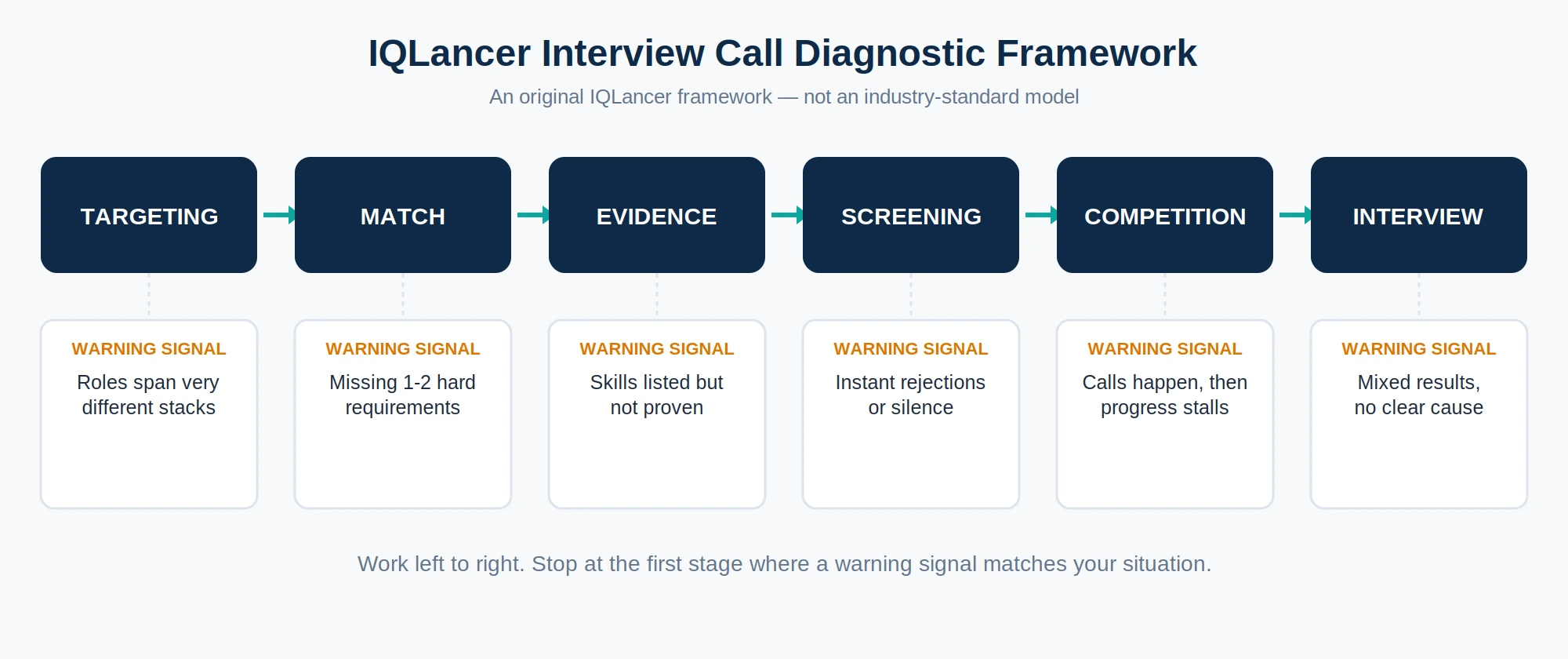
Use this framework to check each stage in sequence, rather than assuming the resume is always the problem.
| Stage | What to Check | Warning Signal | Likely Problem | What to Change |
|---|---|---|---|---|
| Targeting | Are the roles you’re applying to genuinely aligned with your background? | You’re applying to roles across very different tech stacks or seniority levels | Targeting mismatch | Narrow your search to roles matching your real profile |
| Match | Do you meet the must-have requirements? | You consistently lack 1-2 hard requirements | Skills/role-fit gap | Build the missing skill, or shift target roles |
| Evidence | Does your resume prove the requirements you do meet? | Skills are listed but not supported by task/context/result | Positioning/evidence gap | Apply the Resume Evidence Density approach |
| Screening | Are applications reaching a recruiter at all? | Instant rejections or total silence at scale | Screening/application/competition issue | Review hard constraints (location, authorization) and application completeness |
| Competition | Are you failing recruiter or technical screens after being contacted? | You get initial calls but stall afterward | Interview/communication/technical-depth issue | Practice technical communication and role-specific interview prep |
| Interview | None of the above shows a clear pattern | Mixed results with no obvious cause | External or competitive factors | Continue tracking; some causes are outside your control |
The Diagnostic Decision Tree
Use this as a quick self-check the next time you’re reviewing a stretch of rejections.
Not getting interview calls? → Are you applying to relevant roles?
→ Do you meet the core requirements?
- No → Skills/role-fit problem
- Yes → continue
→ Does your resume demonstrate those requirements?
- No → Positioning/evidence problem
- Yes → continue
→ Are applications reaching recruiter screening?
- No / Unknown → Screening/application/competition problem
- Yes → continue
→ Are you failing recruiter or technical screens?
- Yes → Interview/communication/technical-depth problem
- No → Continue tracking, and consider competition or external factors
This is a diagnostic model meant to narrow down likely causes; it won’t identify the exact reason for every individual rejection, since some causes (like an internal hire or a canceled requisition) are invisible from the outside.
The 30-Application Diagnostic
(This is a practical IQLancer tracking exercise, not a scientifically validated threshold.) Instead of changing everything at once, run a structured, three-phase experiment:
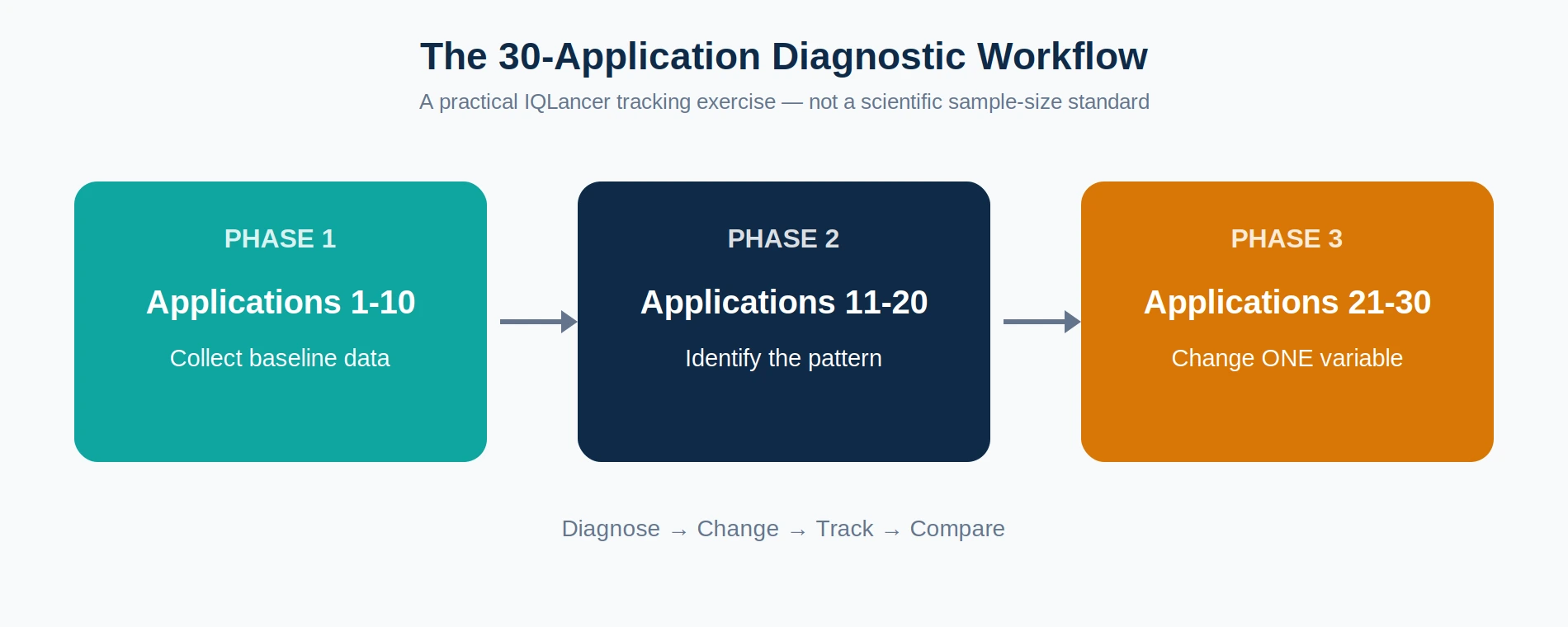
Phase 1 Applications 1-10: Apply as you normally would, but track every application in detail (see the tracking table below). This is your baseline.
Phase 2 Applications 11-20: Review the baseline data for patterns. Are most rejections happening at screening? At the recruiter-review stage? Are you not hearing back at all?
Phase 3 Applications 21-30: Change one major variable based on what Phase 2 revealed for example, resume positioning, target role, seniority level, application source, or the strength of your project evidence. Then compare outcomes against Phase 1.
Thirty applications is not a scientifically established sample size; it’s a practical number large enough to reveal a pattern without taking months to gather. The point of the exercise is the structure, not the exact count.
Change One Variable at a Time
DIAGNOSE → CHANGE → TRACK → COMPARE
A common mistake is rewriting the resume, updating LinkedIn, switching target roles, and changing application channels all in the same week. If results improve, you won’t know which change caused it and if they don’t, you won’t know which change to reverse.
Controlled, one-variable changes take longer but actually tell you something. If you change your resume’s evidence density and outcomes shift, you’ve learned something real about your positioning. If you change five things simultaneously, you’ve learned nothing you can repeat.
How to Track Your IT Job Applications Like a System
Treat your job search like an actual funnel, not a series of unconnected attempts. A simple tracking table.
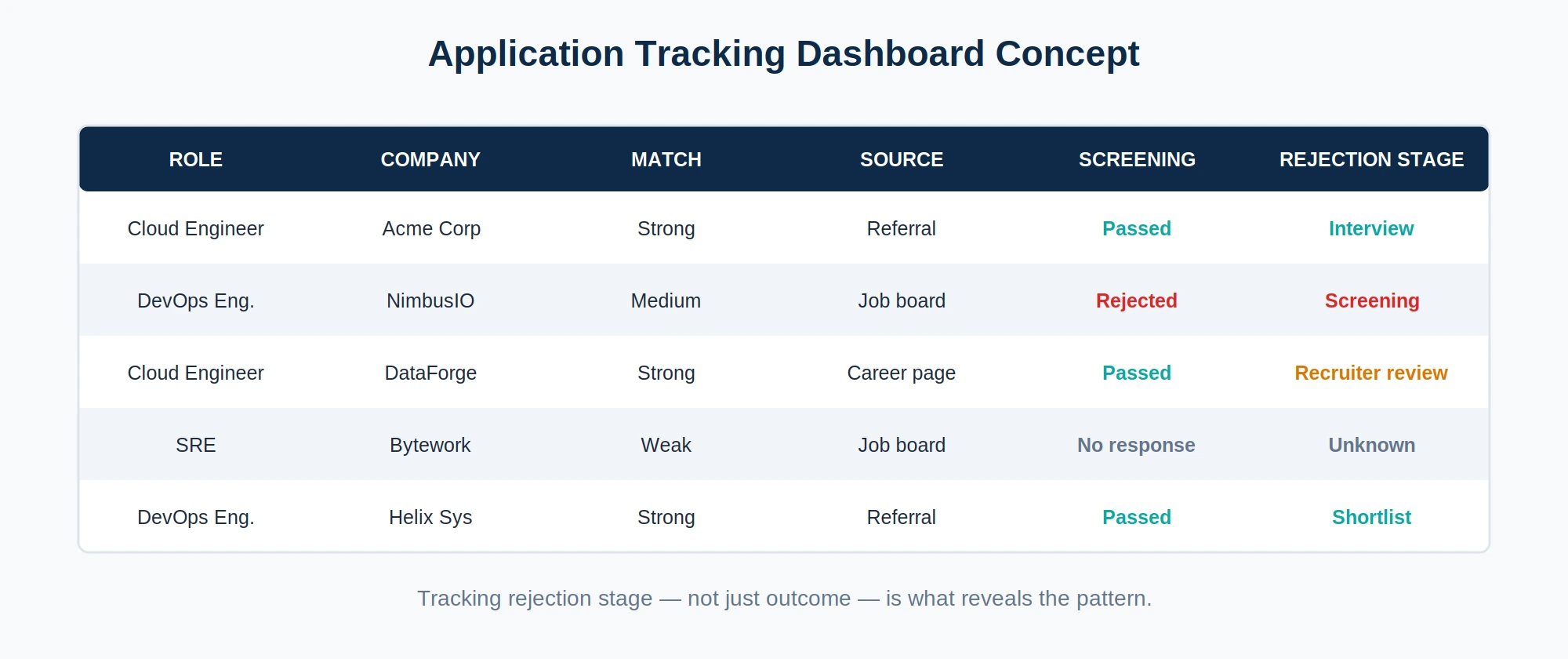
Filling this in consistently even briefly makes patterns visible that memory alone won’t catch. You may notice, for example, that every rejection at the screening stage involves a specific requirement, or that applications through one source consistently perform better than another.
Interview Call Rate
A simple metric worth tracking over time:
Interview Call Rate = Interview Invitations ÷ Targeted Applications × 100
This is a personal tracking metric, not a universal industry benchmark there is no single “good” percentage that applies across roles, seniority levels, and markets, so don’t compare your number against an arbitrary target. Use it only to compare your own results before and after a change.
AI-Generated Resumes Can Create a New Problem
This section matters because AI writing tools are now a default part of the job search, and they’ve introduced a specific new failure mode that’s easy to miss if you’re only thinking about keywords.
The pattern many recruiters now describe is:
GENERIC AI OUTPUT → GENERIC POSITIONING → LOW DIFFERENTIATION
Multiple 2026 surveys of hiring managers point in the same direction: a meaningful share of employers say they actively try to identify AI-generated resume content, and a substantial portion say they’re more likely to reject a resume that reads as generic or lacking personal specificity not because AI was used, but because the output lacks the concrete, verifiable detail that makes a claim credible (KraftCV, citing a 2026 Express Employment Professionals–Harris Poll survey). A separate analysis reached a similar conclusion: the rejection trigger across recent surveys tends to be impersonal, generic content not the underlying use of AI tools themselves (Phrasly, 2026).
The important distinction is:
AI-ASSISTED EDITING ≠ AI-INVENTED EXPERIENCE
AI tools can genuinely help with job-description analysis, identifying gaps between a posting and your resume, refining wording, and organizing content. What they can’t do is verify a claim, and using AI to invent responsibilities or results you didn’t actually have is where the risk lives both ethically and practically, since fabricated claims tend to unravel during an interview. If you use AI in your resume process, use it to sharpen and organize your real experience, not to generate experience you don’t have.
Resume Optimization vs Resume Manipulation
OPTIMIZE REPRESENTATION, NOT REALITY.
Truthful optimization means finding the strongest accurate way to describe work you actually did. It does not mean:
- Inventing experience you didn’t have
- Adding tools or technologies you haven’t genuinely used
- Fabricating metrics or outcomes
- Presenting tutorial or coursework projects as production experience
- Inflating a project’s scope or your role in it
- Misrepresenting job titles or dates
Every example in this article is explicitly hypothetical for a reason the goal is to show you a method for finding stronger, truthful language, not a script to paste in.
Not Every Rejection Is Something You Can Fix
This section is here because a diagnostic approach only works if it’s honest and honesty means acknowledging that some causes genuinely have nothing to do with you.
Control vs. Limited Control vs. No Control
You control:
- Which roles you target
- The evidence quality in your resume
- The skills you build
- The projects you complete
- Whether you track and analyze your applications
You do not fully control:
- The strength of other applicants for a given role
- Hiring manager preference
- Internal candidates
- Budget decisions
- Whether a position gets closed or paused after posting
Uncontrollable factors a hiring freeze, an internal promotion filling the role, a budget cut, a canceled requisition happen regularly and are rarely communicated to applicants. Recognizing this isn’t an excuse to stop diagnosing; it’s what keeps the diagnostic process honest instead of turning every rejection into evidence of a personal failure.
When Should You Stop Applying and Fix the Strategy?
The pattern worth watching for:
REPEATED SIGNAL → DIAGNOSE → FIX → TEST AGAIN
If the same rejection pattern shows up across 15-20 targeted applications for example, consistent silence at the screening stage, or consistent early-stage rejection tied to one specific requirement that’s a signal worth acting on rather than pushing through with more of the same. What to reconsider depends on what the pattern actually shows: target role, seniority level, a specific skill gap, resume evidence, portfolio strength, or application channel. There’s no fixed numerical rule for exactly when to pivot the honest answer is that it depends on sample size, role scarcity, and how consistent the pattern is but continuing to do the same thing after a clear, repeated signal rarely produces a different result.
What IT Professionals Should Track Before Their Next 30 Applications
- Target role
- Seniority level
- Core requirements met
- Resume version used
- Relevant evidence included
- Application source
- Date applied
- Screening response
- Interview response
- Rejection pattern
- Skills gap identified
- Portfolio evidence included
Final IQLancer Application Diagnostic Checklist
- Targeting : Am I applying to the right role?
- Role Fit : Do I meet the core requirements?
- Evidence : Does my resume prove the match?
- Screening : Is my application clear and complete?
- Competition : Am I competitive for this specific role?
- Tracking : Am I measuring outcomes?
- Experimentation : Am I changing one variable at a time?
Conclusion
If you’re not getting interview calls, the answer is almost never “apply to more jobs”t’s “find out where this specific application is breaking down.” That could be targeting, a genuine skills gap, weak resume evidence, a hard screening constraint, or competition you can’t see from the outside. Work through the funnel deliberately: audit your targeting, check your evidence against the job’s actual requirements, confirm your application is reaching a recruiter, and track the outcome instead of guessing.
Change one variable, test it, and compare results before changing the next. This won’t guarantee an interview on your next application nothing honestly can but it will tell you, with real evidence, what to fix next. Audit, fix, test, track: that’s the diagnostic habit that turns a frustrating job search into a solvable problem.