Most beginners finish a course, spin up Kali Linux, run a scan, and call it a cybersecurity project; then wonder why interviews go nowhere.
The problem isn’t effort. It’s that completing tutorials and installing tools doesn’t prove you can investigate, decide, and respond the way a security team needs. Cybersecurity projects only become hiring evidence when they’re built around a real security problem, a documented methodology, and a defensible outcome.
IQlancer roadmap walks through how to match projects to a target role, build them safely, turn the work into evidence, and present that evidence on GitHub, your resume, and in interviews without wasting months on labs that look busy but prove nothing.
What Makes a Cybersecurity Project Valuable to Employers?
This section exists because beginners often confuse activity with evidence. Understanding the difference determines whether a hiring manager sees a skilled candidate or a tutorial-follower, and it shapes every project decision that follows.
There are five things people call a “cybersecurity project,” and they are not the same:
| Type | What it actually shows |
|---|---|
| Security lab | You can configure an environment. Says nothing about analysis. |
| Tutorial completion | You can follow instructions. Says nothing about decision-making. |
| CTF writeup | You can solve a puzzle under artificial constraints. Useful, but narrow. |
| Portfolio project | You defined a problem, worked a methodology, and can explain your findings. |
| Production-like security project | The above, plus realistic scale, constraints, and trade-offs. |
A portfolio project worth showing an employer demonstrates a defined security problem, a controlled and documented environment, a methodology you followed, real security activity, collected evidence, analysis of that evidence, a decision you made from it, a response or remediation step, validation that the fix or detection worked, and clear documentation of the whole chain. That’s ten checkpoints, not one screenshot.
IQLancer Recommendation: repeat this to yourself before starting any lab tool ≠ skill. Installing Splunk doesn’t demonstrate SOC investigation ability any more than owning a stethoscope demonstrates diagnostic skill. What a tool produces, and what you do with what it produces, is the actual skill.
What Cybersecurity Skills Do Beginner Jobs Actually Ask For?
Before choosing a project, it helps to know what employers are consistently screening for versus what only shows up in specialized postings. This section exists so you stop guessing and start building against real demand.
Current market observation: across SOC analyst postings, the recurring technical asks are SIEM operations, log analysis across servers, endpoints, and cloud, incident handling and documentation, network security fundamentals, threat intelligence and IOC analysis, endpoint security, cloud security exposure, and scripting for automation a combination of SIEM operations, log analysis, incident handling, network security, threat intelligence, endpoint security, cloud security, and scripting for automation shows up repeatedly across job descriptions, according to a SOC analyst resume guide from CyberDefenders.
At the more advanced tier, postings increasingly expect hands-on detection-rule writing and tuning in tools like Splunk, Sentinel, or Elastic, EDR/XDR investigation ability, Python or PowerShell scripting, and protocol-level networking knowledge covering TCP/IP, DNS, HTTP/S, Kerberos, and SMB, per CyberDefenders’ advanced SOC analyst breakdown.
For penetration testing and ethical hacking roles, postings consistently ask for a working understanding of networking, operating systems, and common vulnerability classes, usually alongside familiarity with tools such as Kali Linux, Metasploit, and Burp Suite, according to ZipRecruiter’s junior penetration tester market data. Job listings for web-focused testing roles also frequently reference the OWASP Top 10 as the baseline vulnerability taxonomy.
For cloud security roles, the recurring theme is that adversaries chase credentials and tokens, which makes reading and pivoting across cloud audit logs AWS CloudTrail and GuardDuty, Azure Activity Logs and Entra ID sign-in logs, or Google Cloud Audit Logs a core skill, as described in Refonte Learning’s security analyst career path. IAM design and misconfiguration analysis is treated as foundational rather than optional across almost every cloud security posting reviewed.
| Skill area | Demand level | Why employers want it | Project opportunity |
|---|---|---|---|
| Networking (TCP/IP, DNS, HTTP) | Common | Nearly every investigation or exploit starts at the protocol level | Packet-capture analysis lab |
| Linux fundamentals | Common | Most servers, tools, and CTFs run on Linux | Hardened Linux server project |
| Windows & Active Directory | Frequently requested | AD is the most attacked identity system in the enterprise | AD attack-path & hardening lab |
| SIEM / log analysis | Frequently requested (SOC-heavy) | Detection and investigation both start in logs | Centralized logging + detection lab |
| Incident response | Frequently requested | Employers need people who can follow a process under pressure | Simulated incident investigation |
| Vulnerability management | Frequently requested | Continuous, unglamorous, and always staffed | Scan-triage-remediate-validate project |
| IAM / cloud security | Role-specific (cloud roles) | Identity is now the primary cloud attack surface | IAM misconfiguration audit |
| Scripting (Python/PowerShell) | Frequently requested, tier-dependent | Automates repetitive triage and detection work | Log-parsing or alert-enrichment script |
| Threat intelligence / MITRE ATT&CK mapping | Role-specific | Gives detections and investigations a shared vocabulary | ATT&CK-mapped detection project |
| Digital forensics basics | Advanced / differentiating | Needed once an alert becomes a confirmed incident | Timeline reconstruction exercise |
Current market observation: not every cybersecurity job requires every item on this list. A Tier 1 SOC role leans on log analysis and triage; a cloud security role leans on IAM and cloud logging. Choosing projects starts with choosing a direction, which is the next section.
Choose Projects Based on the Cybersecurity Role You Want
This section exists because “cybersecurity” is not one job. Picking a lane before picking a project prevents months of unfocused lab-building that doesn’t add up to a coherent story for any single role.
IQLancer Framework Role-to-Skill Mapping (an original simplification, not an industry standard):
- SOC Analyst → SIEM + logs + detection + investigation
- Junior Penetration Tester → networking + Linux + web security + vulnerability analysis
- Cloud Security Analyst → IAM + cloud networking + cloud logging + security controls
- Vulnerability Analyst → scanning + validation + risk scoring + remediation tracking
- Security Engineer → hardening + automation + monitoring + architecture
These are simplified learning paths meant to help you choose a starting direction not universal job requirements, and not a ceiling on what any of these roles eventually involve.
SOC Analyst vs. Ethical Hacking vs. Cloud Security: Choosing a Direction
Beginners often try to prepare for all three paths at once and end up mediocre at each. This section exists to help you commit to one primary direction while still understanding how the others connect to it.
For SOC-track projects, prioritize in this order: logs → SIEM → detection → investigation → incident response. This mirrors what a Tier 1 analyst actually does day to day, where the job centers on becoming comfortable identifying users, systems, timestamps, addresses, and suspicious patterns across multiple log formats before layering in SIEM search skills, according to CyberDefenTech’s SOC analyst roadmap.
For ethical-hacking-track projects, prioritize: networking → Linux → web security → vulnerability analysis → authorized testing. The goal is methodology, not tool memorization a beginner who can explain why a finding matters and how to fix it outperforms one who can only run a scanner.
For cloud-security-track projects, prioritize: IAM → cloud networking → cloud logging → security controls → detection. Focusing heavily on IAM policies, encryption, network security groups, logging, and monitoring while understanding the shared responsibility model is described as the backbone of progressing into cloud security by Networkers Home’s cloud security roadmap.
No path is superior to another. SOC roles tend to have more entry-level openings; ethical hacking and cloud security often expect slightly more prior foundation, but all three are legitimate, hireable directions.
The IQLancer Cybersecurity Project Progression
This framework exists to stop beginners from either freezing (not knowing where to start) or overreaching (attempting an “enterprise SOC” as their first project). It gives a difficulty ladder that maps to how real security capability is built.
IQLancer Cybersecurity Project Progression (an original framework created for this article, not an industry standard).
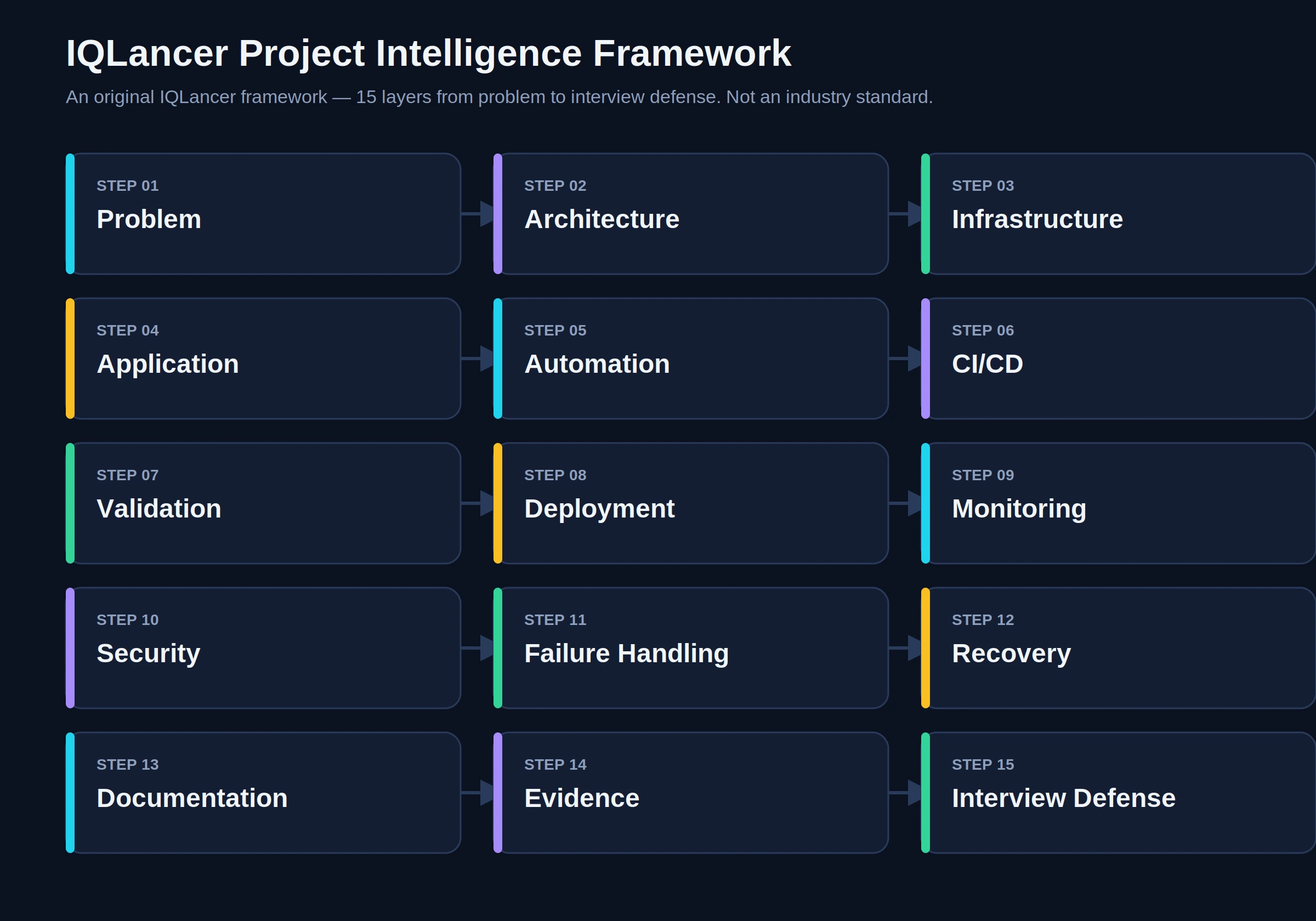
A beginner’s first project should sit at Level 1–2. By the third or fourth project, Level 3–4 is realistic. Level 5–6 is where a project starts to look like mid-level work.
This progression maps to the broader security workflow every project blueprint below follows:
Detect → Investigate → Respond → Document → Improve
For each stage, ask: What triggered the alert? What evidence was collected? How was it investigated? What decision was made? What response was performed? How was the fix verified? What control would prevent recurrence?
Critical Safety and Authorization Rule
Every offensive-security activity described below must stay inside systems you own, systems you have explicit written authorization to test, intentionally vulnerable applications built for practice, isolated virtual machines, or recognized training/CTF platforms.
Scanning, exploiting, or collecting data from systems you don’t own or lack authorization for is not a portfolio strategy; it’s a legal and ethical liability that can end a career before it starts. Every project blueprint below assumes an isolated lab.
Detailed Cybersecurity Project Blueprints
Project 1: SOC Monitoring & Detection Lab
Difficulty: Beginner-Intermediate Primary target role: SOC Analyst | Secondary roles: Security Engineer, Incident Response Analyst
Security problem: Most home networks and small labs generate no centralized logs at all, which means suspicious activity failed logins, unusual process execution, lateral movement attempts goes completely unnoticed. This mirrors the real-world problem SOC teams exist to solve.
Why build it? It demonstrates the single most requested SOC skill set: taking raw logs and turning them into a monitored, alertable environment. It signals you understand why a SIEM exists, not just how to click through its dashboard.
Lab environment: Two or three virtual machines (one Windows, one Linux) on an internal/host-only virtual network, isolated from your home network and the internet where possible.
What you will build: A small monitored environment where a Windows and Linux endpoint forward logs to a free SIEM instance (e.g., a self-hosted Elastic Stack or a community edition of a SIEM platform), with at least three custom detection rules.
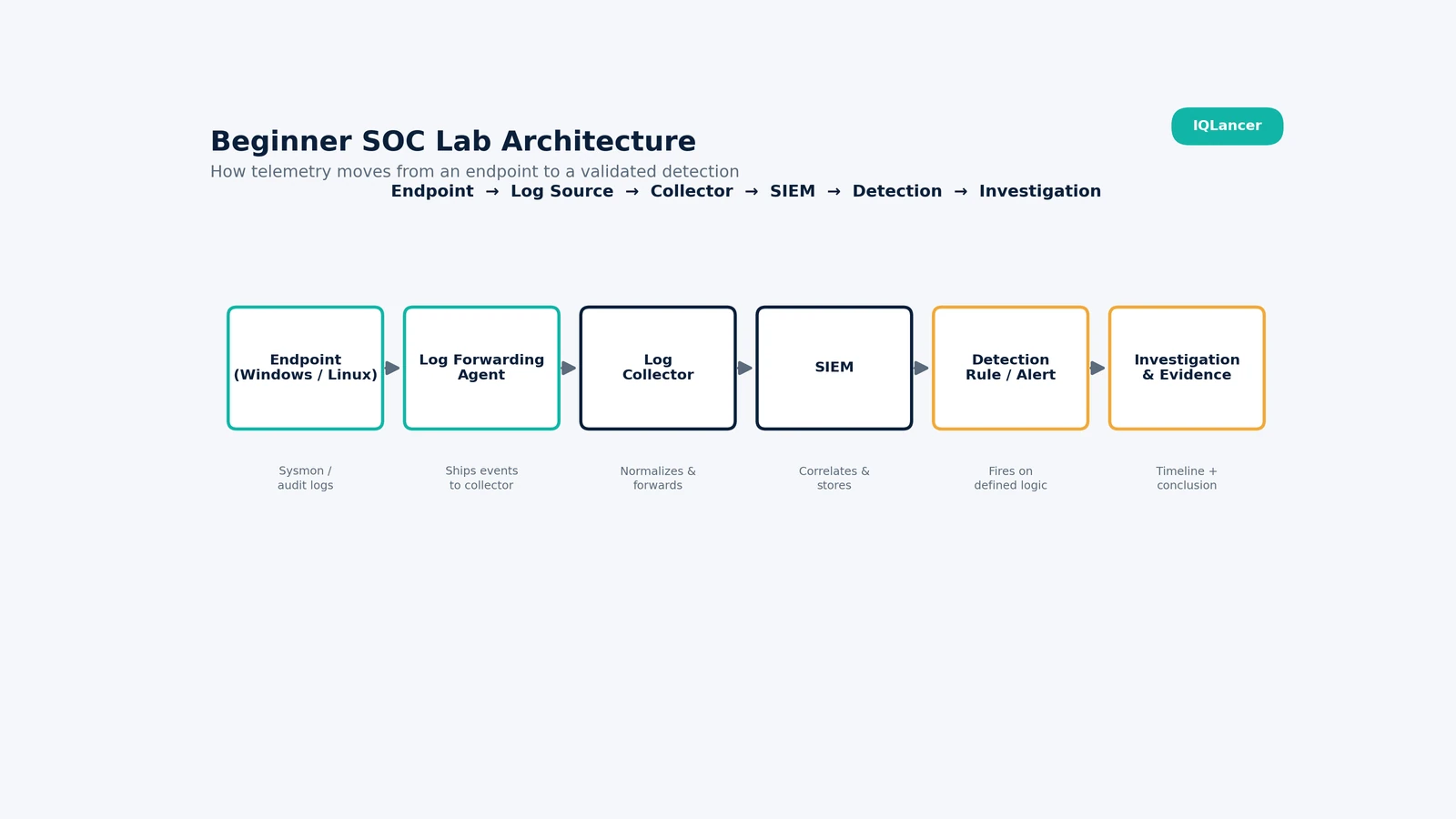
Architecture: Endpoint (Windows/Linux) → Log forwarding agent → Log collector → SIEM → Detection rule → Alert → Investigation notes
Tools:
- Sysmon → captures detailed Windows process/network events → why: default Windows logs miss most attacker behavior → evidence: exported Sysmon configuration and sample events.
- A SIEM (Elastic, Splunk Free, or similar) → centralizes and correlates logs → why: this is the core Tier 1 tool → evidence: dashboard screenshots and saved searches.
- A log-generation script (Python) → simulates normal and abnormal authentication activity → why: gives you controllable, repeatable test data → evidence: the script itself, committed to GitHub.
Prerequisites: Basic virtualization (VirtualBox/VMware), comfort with the Windows Event Viewer and Linux journalctl//var/log, and a working definition of “event vs. alert vs. incident.”
Implementation: Stand up the VMs on an isolated network, install a log-forwarding agent on each, point them at your SIEM, and confirm ingestion with a few manual test events before building detections.
Detection: Build at least three rules for example, multiple failed logins in a short window, a login from an unexpected account type, and an unusual process spawning from a common application. For each rule, document what should trigger it, what fields the query inspects, what false positives are likely (a legitimate password typo storm looks identical to a brute-force attempt at small scale), and how you validated it by intentionally triggering the condition.
Investigation: When a rule fires, build a short timeline: which account, which host, which source IP, what happened immediately before and after. Document how the evidence supports (or rules out) a genuine security concern.
Response/remediation: For a validated finding say, repeated failed logins followed by a success document the containment step you would take (disable the account, force a password reset) even if you don’t have real users to reset.
Validation: Re-trigger the same condition after tuning to confirm the detection still fires and that you’ve reduced an identified false-positive source.
Documentation: Objective, environment diagram, methodology, findings, evidence, analysis, response, lessons learned, limitations (a two-endpoint lab won’t reflect enterprise log volume), and future improvements.
Portfolio evidence: Architecture diagram, SIEM dashboard screenshots, sanitized log samples, the detection queries themselves, and a short investigation write-up. Never publish real personal data, credentials, or API keys use synthetic accounts and synthetic IPs.
GitHub structure:
README.md
architecture/
detections/
scripts/
reports/
screenshots/
The README should walk through the problem, lab setup, architecture, methodology, detections, one full investigation example, and limitations.
Resume evidence:
- Weak: “Completed a cybersecurity lab using Splunk.”
- Better: “Built a controlled security monitoring lab and analyzed authentication logs using a SIEM to investigate suspicious activity.”
- Strong: “Designed a two-endpoint monitoring lab, wrote three SIEM detection rules for authentication anomalies, and documented a full investigation-to-remediation workflow with false-positive analysis.”
Interview defense:
- Why did you choose this detection logic? tests whether you understand the underlying behavior, not just the query syntax.
- What false positives did you encounter, and how did you handle them? tests real-world judgment versus tutorial-following.
- How would this scale to 500 endpoints? tests awareness of your lab’s limitations.
- Walk me through your investigation timeline? tests structured analytical thinking under a hypothetical.
- What would you automate first? tests whether you’re thinking about analyst efficiency, not just detection.
Project 2: Authorized Web Application Security Assessment
Difficulty: Beginner-Intermediate Primary target role: Junior Penetration Tester | Secondary roles: Vulnerability Analyst, Security Engineer
Security problem: Web applications remain one of the most common entry points for attackers, and beginners rarely practice the reporting half of testing finding a bug is only half the job.
Why build it? This project demonstrates methodology-driven web testing mapped to the OWASP Top 10, the taxonomy referenced across nearly every junior penetration tester posting reviewed. It also proves you can write a remediation-focused report, which is what separates a hire from a hobbyist.
Lab environment: An intentionally vulnerable web application (such as OWASP Juice Shop or DVWA) running locally in a container or VM, never exposed to the internet, never tested against a live third-party site.
What you will build: A documented assessment covering reconnaissance, at least three distinct vulnerability classes, proof-of-concept evidence, business-impact framing, and remediation guidance.
Architecture: Attacker VM/host → isolated internal network → target vulnerable application (containerized) → evidence capture (Burp Suite project file, screenshots, request/response logs)
Tools:
- Burp Suite Community → intercepts and manipulates HTTP requests → why: the standard tool referenced across web-testing job postings → evidence: exported request/response pairs.
- A vulnerable target app (Juice Shop/DVWA) → provides a legal, safe target → why: lets you practice real vulnerability classes without legal risk → evidence: version and configuration used, for reproducibility.
Prerequisites: Basic HTTP knowledge (methods, headers, cookies, status codes), basic understanding of how authentication and sessions work.
Implementation: Map the application’s functionality first (authentication, search, file upload, admin panels), then test methodically against categories such as broken access control, injection, and security misconfiguration rather than randomly clicking around.
Investigation: For each finding, document the exact request that triggers it, what data or functionality it exposes, and what an attacker could realistically do with it this impact framing is what a report reviewer actually reads first.
Response/remediation: For each vulnerability, write the specific fix (parameterized queries for injection, proper authorization checks for access control issues) rather than a generic “patch the vulnerability” line.
Validation: Re-test after applying (or describing) the fix in your local copy of the app where feasible, to show you understand what “resolved” looks like, not just “found.”
Documentation and GitHub structure:
README.md
methodology/
findings/
  01-broken-access-control/
  02-injection/
  03-misconfiguration/
screenshots/
report/
Resume evidence:
- Weak: “Practiced hacking on Juice Shop.”
- Strong: “Performed a structured web application assessment against an intentionally vulnerable target, identified and validated three OWASP Top 10 vulnerability classes, and produced a remediation-focused report.”
Interview defense:
- Why did you test in this order? tests methodology over randomness.
- How did you confirm this wasn’t a false positive? tests validation discipline.
- What’s the real-world impact of this finding? tests business-risk thinking, not just technical description.
- What would you do differently on a production engagement? tests awareness of scope, rules of engagement, and client communication.
Project 3: Cloud IAM Misconfiguration Audit
Difficulty: Intermediate Primary target role: Cloud Security Analyst | Secondary roles: Security Engineer, SOC Analyst (cloud-focused)
Security problem: Misconfigured identity and access permissions are consistently the root cause behind cloud breaches, yet most beginner portfolios never touch IAM at all.
Why build it? IAM audit skill directly reflects the top requirement in cloud security postings hands-on experience with AWS security fundamentals like IAM, security groups, logging, and monitoring is called out repeatedly, according to ZipRecruiter’s AWS security role data. It signals you understand cloud-native risk instead of only on-premises security.
Lab environment: A free-tier or sandboxed personal cloud account (AWS, Azure, or GCP) with strict budget alerts and no production or client data anywhere near it.
What you will build: A small cloud environment with intentionally introduced (by you) IAM misconfigurations, an audit process that finds them, and a hardened end state.
Architecture: Cloud account → IAM users/roles/policies → resource (storage bucket, small compute instance) → audit tooling → findings → remediation → validation
Tools:
- Cloud-native IAM console/CLI → defines and inspects permissions → why: this is the actual attack surface → evidence: before/after policy exports (sanitized of account IDs).
- A free IAM-scanning tool (e.g., an open-source cloud security posture tool) → flags overly permissive policies → why: mirrors how real teams triage misconfigurations at scale → evidence: scan output and your manual verification of each finding.
- Cloud audit logs (CloudTrail/Activity Log/Cloud Audit Logs) → records who did what → why: this is where cloud investigations start → evidence: a log excerpt tied to one specific finding.
Prerequisites: Understanding of the shared responsibility model, basic familiarity with your chosen cloud provider’s console.
Implementation: Create a small set of test IAM roles and policies, deliberately introduce two or three realistic misconfigurations (an overly broad wildcard permission, a publicly accessible storage bucket, an unused access key), then run your audit process to find them.
Detection/Investigation: For each misconfiguration, document how it was found, what access it actually grants, and what an attacker with that access could do this is the same reasoning cloud security analysts apply during real assessments.
Response/remediation: Tighten each policy to least privilege, close the public bucket, rotate or remove unused keys, and document each change.
Validation: Re-run your audit tool and confirm each finding no longer appears; document any remaining accepted risk and why.
GitHub structure:
README.md
iam-policies/ (sanitized)
audit-findings/
remediation-notes/
screenshots/
Resume evidence:
- Strong: “Built a personal cloud IAM audit lab, identified three intentionally introduced misconfigurations, remediated each to least-privilege, and validated the fix using audit logging.”
Interview defense:
- What’s the difference between authentication and authorization in this context? tests fundamentals.
- How did you decide this policy was overly permissive? tests risk judgment, not just tool output.
- What would you monitor going forward to catch this drifting back? tests forward-thinking, detection-oriented mindset.
- What are the limitations of a personal free-tier lab compared to an enterprise environment? tests honesty about scale.
Project → Skill → Role Matrix
| Project | Target role | Core skills demonstrated | Difficulty | Hiring signal |
|---|---|---|---|---|
| SOC Monitoring & Detection Lab | SOC Analyst | SIEM, log analysis, detection engineering | Beginner-Intermediate | Can build and validate detections, not just watch dashboards |
| Authorized Web Application Assessment | Junior Penetration Tester | OWASP methodology, reporting, impact analysis | Beginner-Intermediate | Can find and explain business risk, not just run scanners |
| Cloud IAM Misconfiguration Audit | Cloud Security Analyst | IAM, least privilege, cloud audit logging | Intermediate | Understands the actual root cause of most cloud breaches |
| Network Traffic Analysis Lab | SOC Analyst / Security Engineer | Packet analysis, protocol knowledge | Beginner | Can read traffic, not just recognize tool icons |
| Linux/Windows Hardening Project | Security Engineer / SOC Analyst | Configuration baselines, patching discipline | Beginner | Understands prevention, not only detection |
| Incident Response Tabletop Lab | SOC Analyst / IR Analyst | IR process, documentation, decision-making | Intermediate | Can operate under a structured process, not improvise |
How to Build a Safe Cybersecurity Home Lab
This section exists because an unsafe or poorly isolated lab is the single most common way beginners accidentally create legal or technical problems for themselves. Getting isolation right up front removes that risk entirely.
A safe cybersecurity lab project typically includes: a hypervisor (VirtualBox, VMware, or a cloud sandbox), a Windows VM and a Linux VM, a host-only or internal-only virtual network so lab traffic never touches your home network, dedicated test accounts (never your personal credentials), synthetic data instead of real personal information, an optional intentionally vulnerable machine for offensive practice, and a lightweight SIEM or logging stack.
Isolation matters for two reasons: it prevents lab activity from accidentally affecting real systems or networks, and it prevents any confusion about authorization everything inside the isolated network is unambiguously yours to test. A lab should also be reproducible (someone reading your documentation could rebuild it) and purpose-driven build only what’s needed to answer your project’s security question, not a sprawling environment meant to look impressive.
How to Turn Security Activity Into Evidence
Running a scan or reading a log is an activity. Evidence is what remains after you’ve analyzed that activity and drawn a defensible conclusion from it. This distinction is what most beginner portfolios miss.
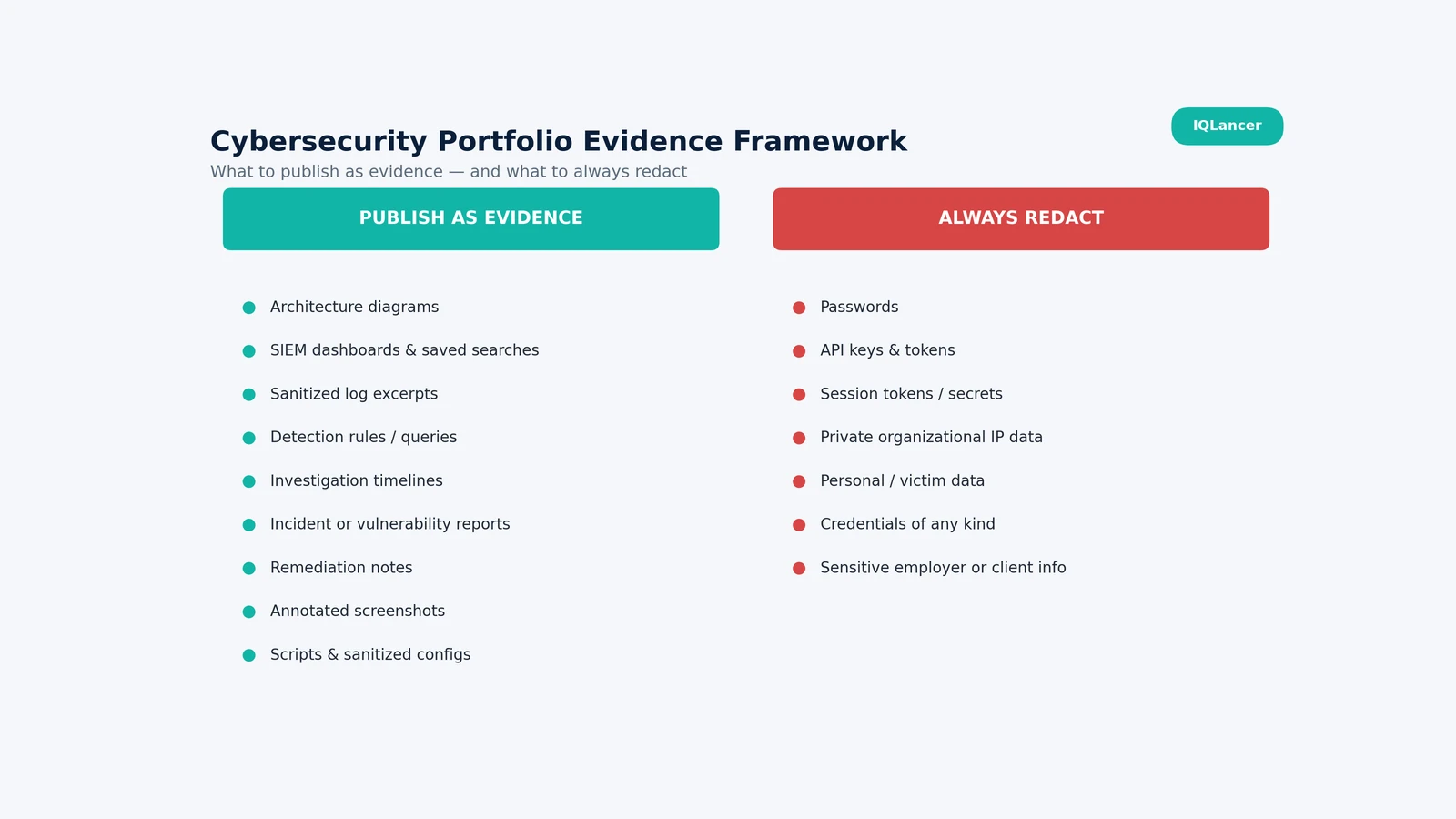
Meaningful cybersecurity portfolio projects produce evidence such as an architecture diagram, SIEM dashboards and saved searches, sanitized log excerpts, detection rules or queries, an investigation timeline, an incident or vulnerability report, remediation notes, relevant screenshots with annotations (not raw, unexplained tool output), scripts, sanitized configuration files, and full lab documentation.
Evidence should never include real passwords, API keys, tokens, private IP ranges tied to a real organization, personal data, credentials of any kind, or sensitive information from any employer or client. If a screenshot could expose any of these, redact it before publishing.
How to Document Cybersecurity Projects on GitHub
A reviewer should be able to understand what you built, why, and what you found within two minutes of opening your repository. That’s the bar this section is aimed at.
A typical structure adapts to the project but generally includes a README.md, an architecture/ folder for diagrams, a detections/ or findings/ folder, a scripts/ folder, a reports/ folder, a screenshots/ folder, and a docs/ folder for supporting notes.
The README itself should walk through the problem, objective, lab setup, architecture, tools used, methodology, implementation, detection or testing approach, investigation, findings, remediation, validation, lessons learned, limitations, and future improvements in that order, so a hiring manager skimming it gets the full story without opening every file.
How to Put Cybersecurity Projects on Your Resume
Resume bullets should follow action + security problem + technology + analysis + outcome, and should only include measurable outcomes you actually measured never fabricate detection rates, incident counts, percentage improvements, or time saved.
- Weak: “Completed a cybersecurity lab using Splunk.”
- Better: “Built a controlled security monitoring lab and analyzed authentication logs using a SIEM to investigate suspicious activity.”
- Strong: “Designed a multi-endpoint SOC monitoring lab, authored three SIEM detection rules mapped to common authentication-abuse patterns, investigated simulated alerts end-to-end, and documented findings with false-positive analysis.”
How to Defend Cybersecurity Projects in an Interview
Interviewers use project questions to test whether you actually did the thinking, not just the typing. For each project, be ready to answer :
- Why you chose that architecture and tools,
- What security problem you were solving,
- What evidence you collected,
- How you validated your detection or finding,
- What false positives you encountered,
- What you’d investigate next,
- How you’d respond to a confirmed incident,
- How you’d improve the detection,
- What would change in a production environment, and
- What your lab’s limitations were.
Interviewers testing for maturity specifically listen for unprompted mention of limitations candidates who volunteer what their lab couldn’t show tend to be trusted more than candidates who present their lab as flawless.
5 Cybersecurity Projects Beginners Should Not Start With
This section exists because ambition without sequencing usually produces an impressive-sounding but shallow project that falls apart under interview questioning.
- Enterprise-scale SOC simulations look impressive on paper but are premature before you can run a two-endpoint detection lab confidently learn detection fundamentals first.
- Advanced malware analysis (reverse engineering, unpacking) looks impressive but requires assembly-level and OS-internals knowledge most beginners haven’t built yet start with static/behavioral analysis of known-safe samples in an isolated sandbox first, if at all.
- Complex threat-intelligence platforms look impressive but often become tool-integration exercises with no real analytical depth start by manually working with a handful of IOCs first.
- Multi-cloud security architecture looks impressive but multiplies complexity across three providers before you’ve mastered one start with single-provider IAM and logging.
- Kubernetes security platforms look impressive but assume container and orchestration fundamentals most beginners skip learn container basics and a single misconfiguration audit first.
None of these areas are useless; they’re simply sequenced too early for a first or second project.
How One Lab Can Become Multiple Portfolio Projects
Building one well-architected lab and expanding it produces a more coherent story than building five disconnected ones. This section exists to show that path.
Starting from the SOC Monitoring & Detection Lab above:
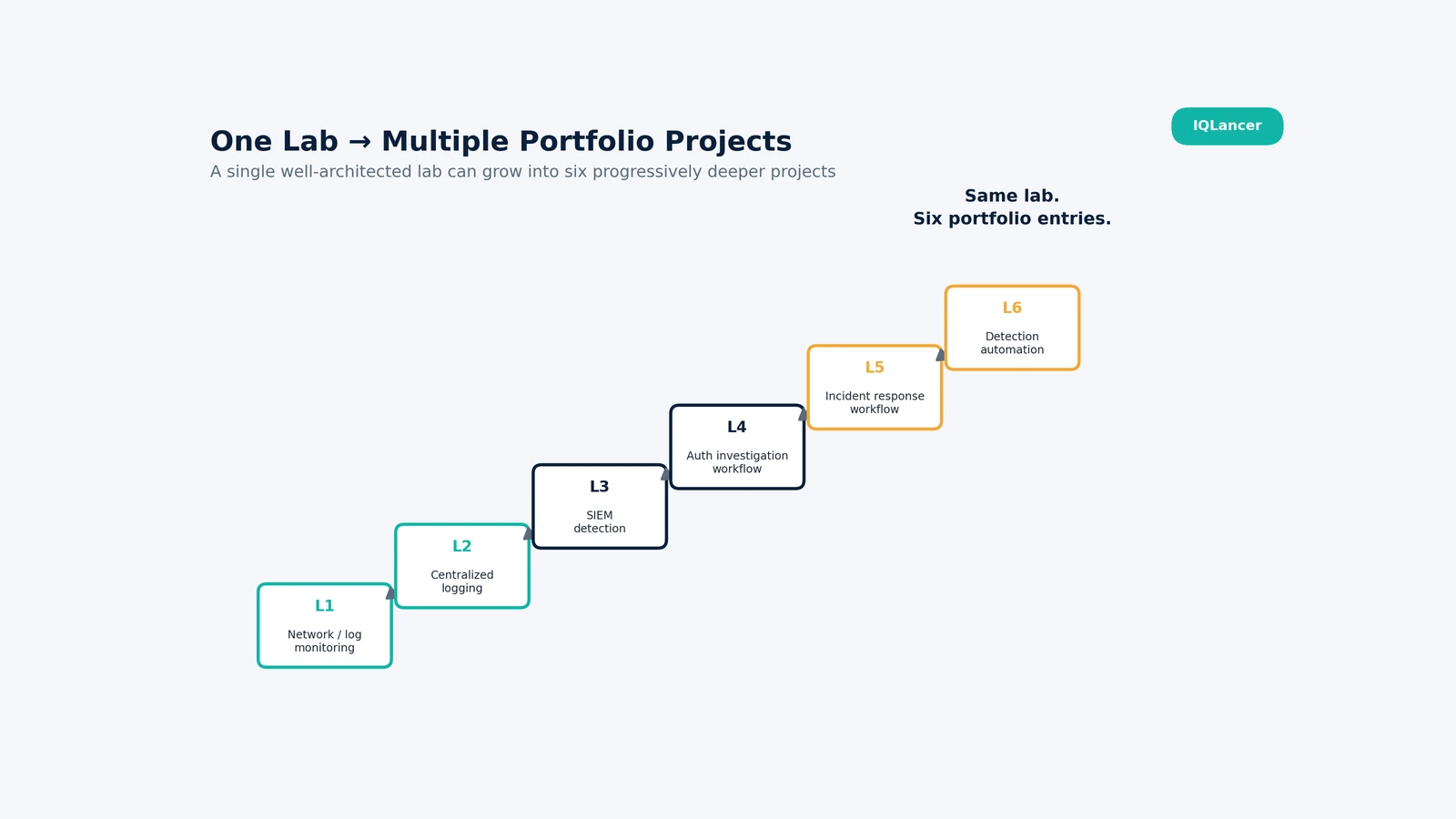
- Level 1 is basic network and log monitoring.
- Level 2 adds centralized logging across more endpoints.
- Level 3 layers in SIEM detection rules.
- Level 4 adds a full suspicious-authentication investigation.
- Level 5 adds a documented incident-response workflow.
- Level 6 adds detection automation via a script or SOAR-style playbook.
Each level can be its own README section or its own GitHub release tag, letting one lab tell a progressively deeper story instead of five shallow, unrelated ones.
What Not to Put in a Cybersecurity Portfolio
Avoid anything involving unauthorized scanning of systems you don’t own, claims about testing real companies’ websites without authorization, exposed credentials or API keys of any kind, real victim or personal data, copy-pasted raw tool output with no analysis, screenshots without explanation, CTF writeups that show the solution but not the reasoning, long tool lists with no evidence of what you did with them, fabricated production claims about labs, or fabricated metrics of any kind. Instead: keep everything inside authorized or isolated environments, always pair evidence with your analysis, and only claim what you can defend in detail if asked a follow-up question.
Minimum Viable Cybersecurity Portfolio
Beginners often assume more projects means a stronger portfolio. In practice, three well-documented projects that fully demonstrate the chain from problem to evidence consistently outperform ten shallow ones because interviewers spend their limited time on depth, not volume.
SOC-focused: a network/log monitoring project, a SIEM detection + investigation project, and an incident-response project. Offensive-security-focused: a networking/security-fundamentals project, an authorized web-security assessment, and a vulnerability-assessment-with-remediation project. Cloud-security-focused: an IAM/security-controls project, a cloud logging/monitoring project, and a cloud security incident investigation.
Three strong, fully documented projects beat ten shallow ones almost every time, because the depth is what survives interview questioning.
Project Stopping Criteria
A project is complete enough to publish when you can check off: security problem defined, authorized or isolated environment confirmed, lab documented, relevant telemetry captured, detection or security test working, investigation completed where relevant, response or remediation demonstrated, validation completed, evidence collected and sanitized, documentation finished, GitHub organized, and most importantly you can explain every decision you made out loud without notes. Resist the urge to keep adding features indefinitely; a finished, well-documented project beats an endless work-in-progress.
Certification vs. Projects
Keep this comparison simple: a certification is structured learning plus a credential; a project is applied capability plus evidence. Neither guarantees a job on its own. A certification tells an employer you covered a defined body of knowledge; a project tells them you can apply parts of it. The two complement each other a certification like Security+ can open resume screening filters, while projects give you something concrete to discuss once you’re in the interview room.
2026-2027 Cybersecurity Skills Worth Watching
Several beginner-relevant shifts are visible in current job data. Sixty-four percent of 2026 cybersecurity job listings now require some AI, ML, or automation skill, according to Vectra AI’s SOC analyst career guide, making basic automation and AI-assisted triage familiarity increasingly relevant even at entry level.
SIEM platforms are also shifting: modern SIEM tools increasingly offer behavior analytics, automated alert prioritization, and natural-language querying for investigation, per CyberDefenders’ SOC skills guide, meaning beginners should understand what these features do, not just click through them.
Identity-centric attacks continue to push cloud security and Active Directory knowledge earlier into SOC-track learning paths, and detection engineering (writing and tuning your own rules, rather than only consuming vendor-built ones) is increasingly treated as a differentiator rather than a senior-only skill.
AI and Cybersecurity Projects
AI tools can reasonably assist with log summarization, drafting detection-rule logic for you to review, documentation and report writing, script scaffolding, background research, and alert triage support. They introduce real risks too: hallucinated commands or queries that look plausible but are wrong, false conclusions presented confidently, incorrect or overly broad detection logic, security misconfigurations suggested without context, accidental data leakage if sensitive lab data is pasted into a third-party tool, and general overreliance that erodes your own analytical skill over time.
The governing principle: AI can assist the work, but the analyst remains responsible for validating every output before it becomes evidence in a portfolio project.
Minimum Viable Cybersecurity Portfolio IQLancer Cybersecurity Project Quality Score
This is an IQLancer self-assessment framework, not an industry-standard recruiter scoring system use it to sanity-check a project before publishing it, not as a guaranteed predictor of hiring outcomes.
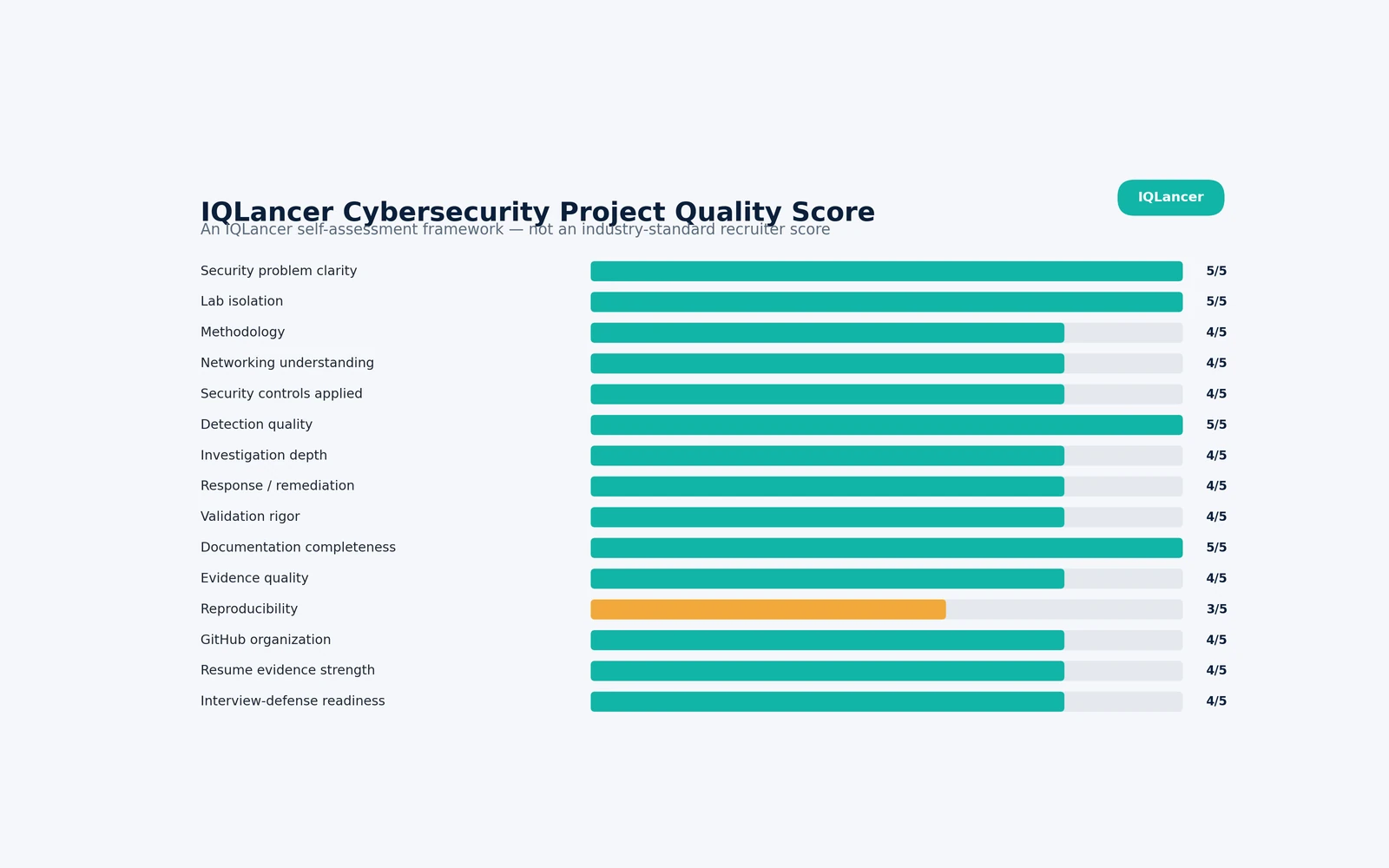
Score each area from 1–5: security problem clarity, lab isolation, methodology, networking understanding demonstrated, security controls applied, detection quality, investigation depth, response/remediation quality, validation rigor, documentation completeness, evidence quality, reproducibility, GitHub organization, resume evidence strength, and interview-defense readiness.
A project scoring mostly 4s and 5s across these fifteen areas is genuinely portfolio-ready; a project scoring mostly 1s and 2s needs another pass before it goes on a resume.
Final Practical Recommendation
Pick one target role. Build one lab that can grow through the IQLancer Cybersecurity Project Progression instead of five disconnected ones.
Keep everything inside authorized or isolated environments. Collect real evidence diagrams, queries, timelines, sanitized logs and document the full chain from problem to remediation to validation. Three deep, defensible projects will outperform a longer list every time, because what gets you hired isn’t the number of cybersecurity projects on your GitHub it’s whether you can explain, in detail, exactly what you built and why.
Conclusion
Cybersecurity projects earn their value from what they prove, not from which tools they mention. A beginner who builds one well-documented lab with a real security problem, a controlled environment, detection or testing work, an investigation, a remediation step, and honest validation has stronger evidence than someone who lists ten disconnected tutorials.
Choose a target role first, build toward it deliberately, keep every offensive activity inside authorized systems, and document each project so a stranger could rebuild it and understand your reasoning. That combination quality over quantity, role alignment, and real evidence is what turns a portfolio into an interview, and an interview into an offer.
Start with one project this week, and finish it completely before starting the next.