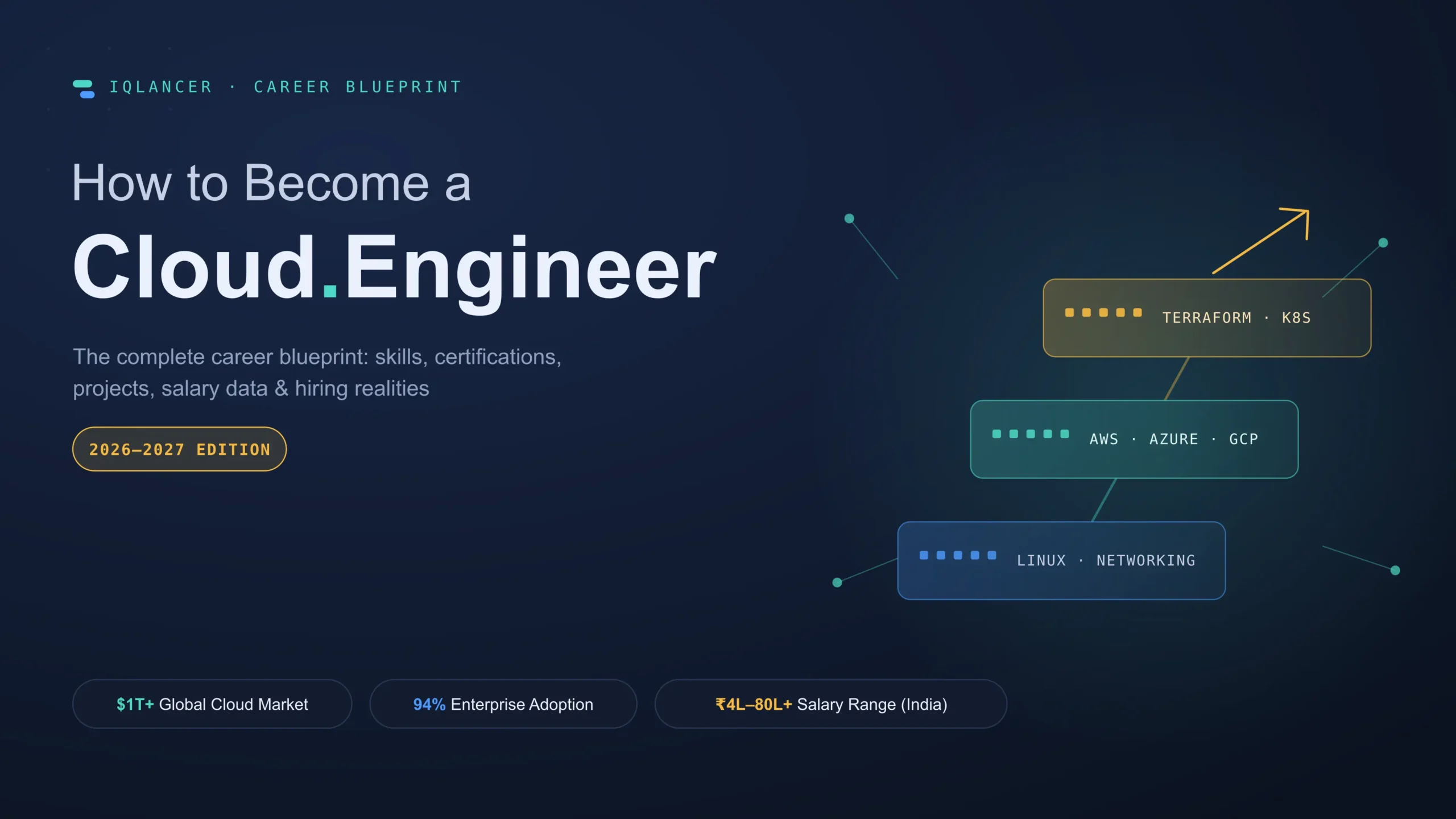
Cloud Engineering is the discipline of designing, deploying, securing, and maintaining the infrastructure that modern applications run on compute, storage, networking, and automation, delivered on-demand instead of racked in a server room.
Enterprise cloud spend is accelerating rather than plateauing: global cloud infrastructure spending hit roughly $129 billion in Q1 2026 alone, growing 35% year-over-year, the fastest quarterly growth since 2021, according to Synergy Research Group. That momentum is exactly why so many IT professionals want to know how to become a cloud engineer in 2026 but it is also why the role has gotten harder to break into.
Certifications have multiplied, bootcamps have flooded LinkedIn with identical resumes, and recruiters have grown skeptical of credentials unbacked by real deployments. This Career Intelligence is not motivation: it tells you exactly what skills, certifications, projects, and experience actually move you from “candidate” to “hire.”
What Does a Cloud Engineer Do?
Before chasing certifications, understand the job itself. A Cloud Engineer’s day-to-day work spans deployment, security, monitoring, and cost control not just clicking around a console. Employers hire for demonstrated ownership of these responsibilities, not textbook familiarity with them.
Infrastructure deployment is the core function: provisioning compute (EC2, Azure VMs, GCE), storage (S3, Blob Storage, Cloud Storage), and networking (VPCs, subnets, load balancers) either manually at first or, increasingly, entirely through code. A cloud engineer at a mid-size fintech, for example, might spend a sprint standing up a three-tier VPC architecture with public-facing load balancers, private application subnets, and isolated database subnets, then codify it in Terraform so it can be replicated across staging and production.
Cloud management covers the ongoing operational work: patching, scaling, backup policies, and disaster recovery planning. This is where junior engineers often underestimate the job cloud engineering is not “set it and forget it,” it’s continuous tuning.
Security responsibilities sit inside almost every task, not off to the side. IAM policy design, least-privilege access, encryption at rest and in transit, and security group configuration are daily concerns, especially since misconfiguration is widely cited as a leading cause of cloud security incidents (industry breach research, unverified against a single primary source).
Monitoring and observability : CloudWatch, Azure Monitor, Prometheus/Grafana let engineers catch problems before customers do. Cost optimization is a skill employers explicitly screen for: an estimated 29% of cloud spend is currently wasted across enterprises, per Flexera’s 2026 State of the Cloud Report, and engineers who can right-size instances, use reserved/spot capacity, and clean up orphaned resources are directly protecting margin.
Automation ties it together writing scripts and IaC so that infrastructure changes are repeatable, auditable, and fast, rather than manual and error-prone.
Is Cloud Engineering a Good Career in 2026-2027?
Cloud engineering remains one of the more durable technology careers heading into 2027, driven by three converging forces continued enterprise migration, multi-cloud complexity, and AI infrastructure demand. The long-term signal is stronger than the short-term hype cycle suggests.
Enterprise cloud adoption is no longer a growth story about “getting companies onto the cloud” that’s largely done. Roughly 94% of enterprises worldwide already use some form of cloud service, with only about 3% reporting no migration plans at all. The growth story now is about how much and how complex that usage becomes. Public cloud end-user spending is projected at roughly $850 billion for 2026, a 21.3% jump from 2025, per Gartner’s 3Q25 forecast update. The overall cloud computing market infrastructure, platforms, and software combined is on track to cross the $1 trillion mark during 2026, per Synergy Research Group and Persistence Market Research estimates.
Multi-cloud has become the default operating model rather than an edge case roughly 87% of organizations now run a multi-cloud strategy, and about 73% operate hybrid cloud estates that combine public cloud with on-premises or private infrastructure. That complexity is a direct source of demand for skilled engineers, because multi-cloud environments do not run themselves someone has to reconcile IAM models, networking, and monitoring across providers.
AI infrastructure is the newest and fastest-growing driver. AI-related cloud spending now represents about 19% of total cloud spend in 2026, up from just 8% in 2023, and a large and growing share of AI model training and inference already runs on public cloud infrastructure. This is reshaping what “cloud engineer” means day to day GPU provisioning, inference infrastructure, and cost governance for AI workloads are increasingly part of the job description, not a separate specialization.
The honest caveat: growth in cloud spend does not automatically mean unlimited headcount growth in every adjacent role. Basic system-administration-style roles are flat to declining in the U.S. the Bureau of Labor Statistics projects network and computer systems administrator employment to decline about 4% from 2024 to 2034 while roles that combine architecture, automation, and security are the ones still growing. BLS projects 12% growth for computer network architects and 29% growth for information security analysts through 2034, both well above the roughly 3% average projected across all occupations.
The takeaway: cloud engineering is a good career specifically for people who build automation and architecture skills, not for people who stop at basic administration.
Which Degree Is Required to Become a Cloud Engineer?
No single degree is mandatory to become a cloud engineer, but your degree still shapes how hard you have to work to prove yourself. Understanding what each background gets you and what it doesn’t prevents wasted time on the wrong first steps.
A Computer Science degree gives you the strongest theoretical foundation (networking, operating systems, data structures) and is still the most common background recruiters see on cloud engineer resumes, particularly at product companies.
An Information Technology degree is arguably even more directly relevant, since IT programs typically include hands-on networking, systems administration, and increasingly cloud modules many IT graduates enter cloud roles faster than CS graduates because they’ve already touched Linux and networking labs.
Electronics and Communication Engineering (ECE) graduates in India frequently pivot into cloud and DevOps roles; the transition works because ECE curricula cover networking fundamentals, but these candidates typically need 3–6 months of dedicated Linux and cloud-platform study to close the gap.
Self-taught candidates and career switchers without a CS/IT/ECE degree are hired regularly but almost never on the strength of a certification alone. Employers hiring self-taught candidates are, in practice, hiring the portfolio and the projects, with the degree functioning only as an HR filter at some large companies (and not at all at most mid-size and startup employers).
The realistic hiring pattern: a strong GitHub with real Terraform/AWS projects will outperform a mediocre CS degree with no projects, but a self-taught candidate has to work harder to get the first interview because there’s no degree to pass an initial ATS or recruiter screen.
Can Non-Technical Candidates Become Cloud Engineers?
Commerce graduates, non-IT graduates, and complete career switchers can become cloud engineers, but the path is longer and requires managing expectations honestly this section avoids the unrealistic “become a cloud engineer in 8 weeks” promises common on other sites.
Commerce and non-IT graduates face two simultaneous gaps: no formal networking/OS foundation, and no coding exposure. Realistically, this path takes 9–15 months of consistent study to reach an entry-level-competitive standard: 2–3 months on Linux and networking fundamentals, 2–3 months on a cloud platform plus scripting (Python or Bash), 3–4 months building real projects, and ongoing interview preparation. Candidates who try to compress this into 8–10 weeks typically end up with certifications but no practical depth, which recruiters detect quickly in technical screens.
Career switchers from adjacent technical roles QA, technical support, database administration, network operations have a meaningfully shorter path, often 4–8 months, because they already understand ticketing systems, basic troubleshooting, and often some scripting. Their main gap is usually IaC and cloud-native services specifically, not technical aptitude generally.
The realistic advice: non-technical candidates should not lead with certifications. They should lead with a structured 90-day Linux-and-networking foundation, because certification exams without that foundation get passed on memorization and fail in interviews the moment a scenario question comes up.
IQLancer’s position: certifications compress what you need to know; they do not replace building the muscle to apply it under pressure.
Cloud Engineer Skills Required in 2026-2027
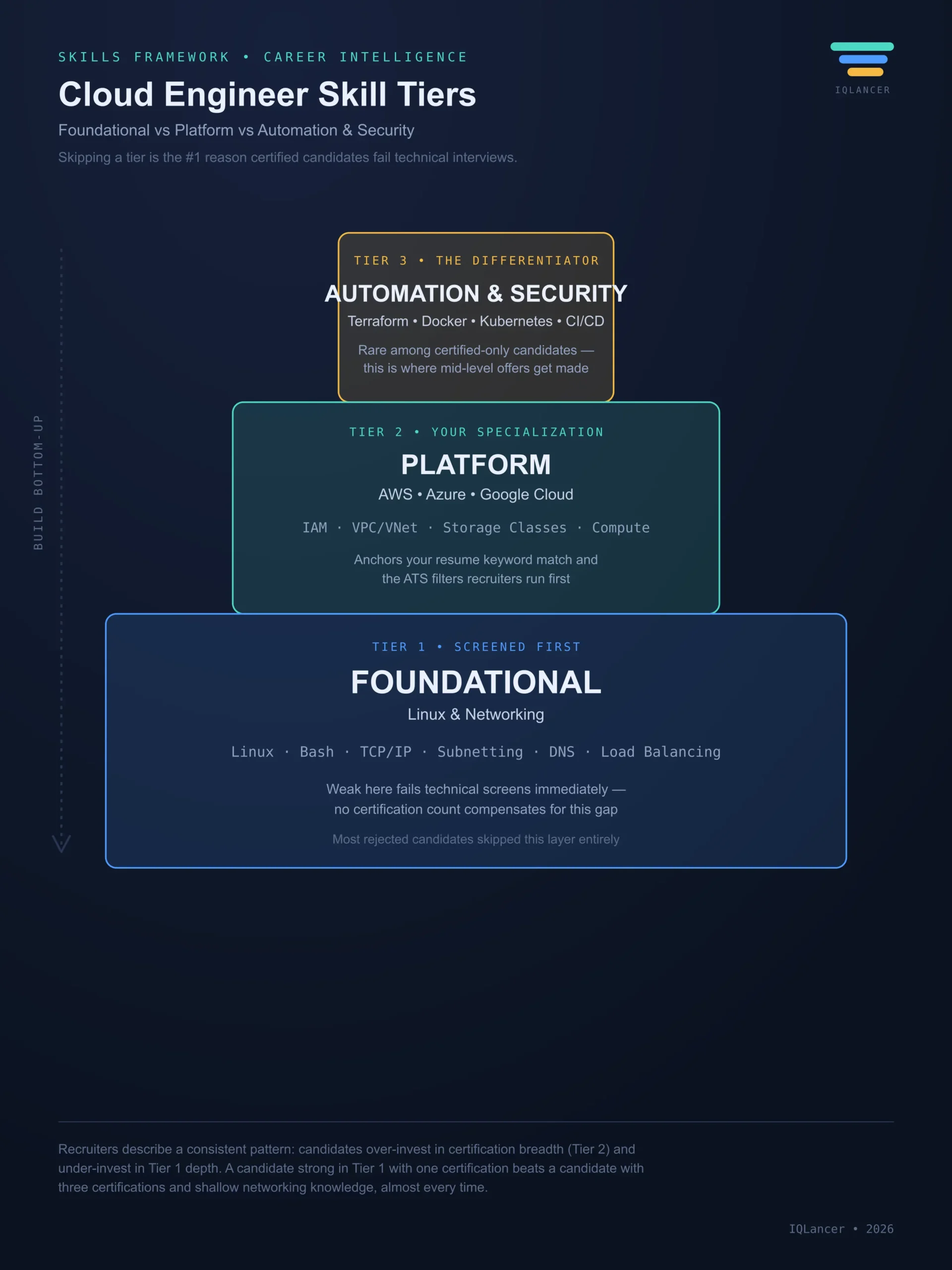
The cloud engineer skills employers actually screen for in 2026-2027 fall into distinct tiers foundational skills recruiters check first, platform skills that anchor your specialization, and automation skills that separate mid-level engineers from juniors. Skipping tiers is the single most common reason technically certified candidates fail interviews.
| Skill | Why It Matters to Employers | How Employers Evaluate It | How to Build It |
|---|---|---|---|
| Linux | Nearly every cloud workload runs on Linux underneath; weak Linux skills show up immediately in troubleshooting scenarios | Live terminal tasks, “debug this broken service” scenarios | Daily CLI use, a home lab, RHCSA-style practice, real server administration |
| Networking | Cloud networking (VPCs, subnets, routing, DNS, load balancing) is where most production outages originate | Whiteboard/scenario questions on VPC design, subnetting, troubleshooting connectivity | Study TCP/IP fundamentals, then rebuild those concepts inside AWS VPC / Azure VNet labs |
| Cloud Fundamentals | Baseline literacy shared responsibility model, regions/AZs, pricing models | Usually a quick screening filter, not a deep-dive area | Cloud Practitioner-level study, official provider documentation |
| AWS | Largest market share (~28–30% of cloud infrastructure spend), most job postings | Console + CLI tasks, architecture questions | Free-tier hands-on labs, real deployed projects, SAA-level study |
| Azure | Dominant in enterprise BFSI and Microsoft-shop environments, especially in India | Similar hands-on + architecture format | AZ-900 → AZ-104 study path with real resource groups |
| Google Cloud | Smaller market share (~13–14%) but strong in AI/ML-heavy and startup environments | GCP console + gcloud CLI tasks | Associate Cloud Engineer labs, Qwiklabs/Cloud Skills Boost |
| Security Fundamentals | Security is the top-cited barrier to cloud adoption; IAM misconfiguration is a leading breach cause | IAM policy-writing exercises, least-privilege scenario questions | Build IAM policies from scratch, study CIS benchmarks, practice policy audits |
| Infrastructure as Code | Employers now expect console-only administration to be the exception, not the norm | Reviewing a candidate’s actual Terraform/CloudFormation repos | Convert manual projects into IaC; publish the code |
| Terraform | The dominant cross-cloud IaC tool, valued because it isn’t locked to one provider | Code review, “explain your state management” questions | Rebuild your AWS/Azure projects entirely in Terraform |
| Docker | Containerization is now baseline for anything beyond a static site | Dockerfile review, “why did this image fail to build” debugging | Containerize a real application end-to-end, not a tutorial clone |
| Kubernetes | Production adoption has climbed sharply among container users — CNCF puts it at 82% in 2026; it’s now a differentiator for mid-level roles | Deployment/troubleshooting scenarios, YAML review | Deploy a multi-service app on a managed K8s cluster (EKS/AKS/GKE) |
| Monitoring | Employers need engineers who catch problems before customers report them | “Walk me through your alerting setup” questions | Set up CloudWatch/Grafana dashboards on your own projects |
| Scripting (Python/Bash) | Automation is the thing that separates a cloud engineer from a cloud “operator” | Take-home scripting tasks, live coding of small automation scripts | Automate a real recurring task backups, tagging, cost reports |
The pattern recruiters describe consistently: candidates over-invest in certification breadth and under-invest in Linux and networking depth. A candidate with three certifications and shallow networking knowledge loses to a candidate with one certification and a genuinely strong grasp of subnetting and IAM.
Which Cloud Platform Should You Learn First?
Choosing AWS, Azure, or GCP first is less about “which is best” and more about matching platform to market reality and career goal each has a distinct hiring footprint you should weigh before committing months of study.
| Factor | AWS | Azure | Google Cloud |
|---|---|---|---|
| Market Demand | Largest job posting volume globally; ~28–30% infrastructure market share | Strong and fastest-growing among the Big Three; dominant in enterprise/BFSI, especially in India | Smallest of the three (~13–14% share) but concentrated in AI/ML-heavy and startup roles |
| Learning Difficulty | Broadest service catalog more to learn, but the most learning resources exist | Considered slightly friendlier for candidates already familiar with Microsoft/Windows ecosystems | Cleaner, more opinionated console; smaller surface area but fewer beginner resources |
| Typical Use Cases | General-purpose, e-commerce, startups, global-scale systems | Enterprise IT, hybrid environments, regulated industries (many Indian banks are Azure-committed) | Data/AI-heavy workloads, Kubernetes-native companies (GCP originated GKE) |
| Hiring Opportunities | Highest overall volume of open roles; AWS Solutions Architect Associate appears in a large share of Indian cloud job descriptions | Strong senior-level BFSI demand in India; steep premium for Azure specialists in banking | Fewer roles overall, but strong pay premium at AI-first employers |
Beginner recommendation: if you have no strong reason to pick otherwise, start with AWS the largest job market means the most practice opportunities, the most tutorials, and the most forgiving path if your first job search takes longer than expected.
Choose Azure first specifically if you’re targeting BFSI/enterprise employers in India, since Azure fluency is close to a hard requirement there.
Choose GCP first only if you’re deliberately targeting AI/ML infrastructure roles, where it carries outsized weight relative to its market share.
Cloud Certifications That Can Help
Cloud certifications function as a hiring filter, not a hiring guarantee recruiters use them to shortlist resumes, but interviews expose candidates who can’t apply what the certification tested. Understanding each certification’s real career value, and its limitations, prevents wasted study time.
AWS Certified Cloud Practitioner
- Career value: low on its own, but useful as an on-ramp for non-technical or early-career candidates.
- Best use case: complete beginners building initial cloud literacy.
- Limitation: rarely moves salary or passes a technical screen alone.
AWS Solutions Architect Associate (SAA)
- Career value: the single most requested AWS certification in job postings and the most common credential attached to cloud engineer and DevOps roles.
- Best use case: candidates targeting general cloud engineer, DevOps, or junior architect roles.
- Limitation: on its own it validates knowledge, not experience pairing it with real deployed projects is what actually gets interviews.
AWS SysOps Administrator Associate
- Career value: strongly aligned with operations-heavy cloud engineer roles (monitoring, troubleshooting, automation).
- Best use case: candidates aiming at day-2 operations and reliability-focused roles rather than design-focused architect roles.
- Limitation: less recognized outside operations-specific job titles.
Azure Fundamentals (AZ-900)
- Career value: an on-ramp certification, comparable to AWS Cloud Practitioner.
- Best use case: candidates targeting Microsoft-shop employers who need baseline Azure literacy fast.
- Limitation: same ceiling as Cloud Practitioner not sufficient alone for a paid role.
Azure Administrator Associate (AZ-104)
- Career value: the Azure equivalent of AWS SAA in terms of hiring relevance, especially strong in India’s BFSI sector.
- Best use case: candidates targeting enterprise/banking employers already committed to Microsoft infrastructure.
- Limitation: narrower job market outside enterprise/regulated industries compared to AWS.
Google Associate Cloud Engineer
- Career value: solid credential in a smaller but often better-paying niche.
- Best use case: candidates targeting AI/ML-adjacent or Kubernetes-native employers.
- Limitation: fewer total job postings require it compared to AWS or Azure equivalents.
Terraform Associate (HashiCorp)
- Career value: increasingly important as IaC becomes a baseline expectation rather than a bonus skill; cloud-agnostic, so it complements any platform certification.
- Best use case: candidates who want to signal automation maturity beyond console administration.
- Limitation: rarely sufficient as a standalone credential; it’s a strong complement to a platform certification, not a replacement for one.
The honest limitation across all certifications: none of them test your ability to debug a real production incident under time pressure, communicate trade-offs to a non-technical stakeholder, or read someone else’s messy Terraform state and fix it. That gap is exactly what projects and portfolios are for covered later in this guide.
AWS Certification Roadmap for Cloud Engineers
For candidates who choose AWS as a first platform, certification value compounds in a specific order jumping straight to Professional-level exams without the Associate foundation is a common, costly mistake.
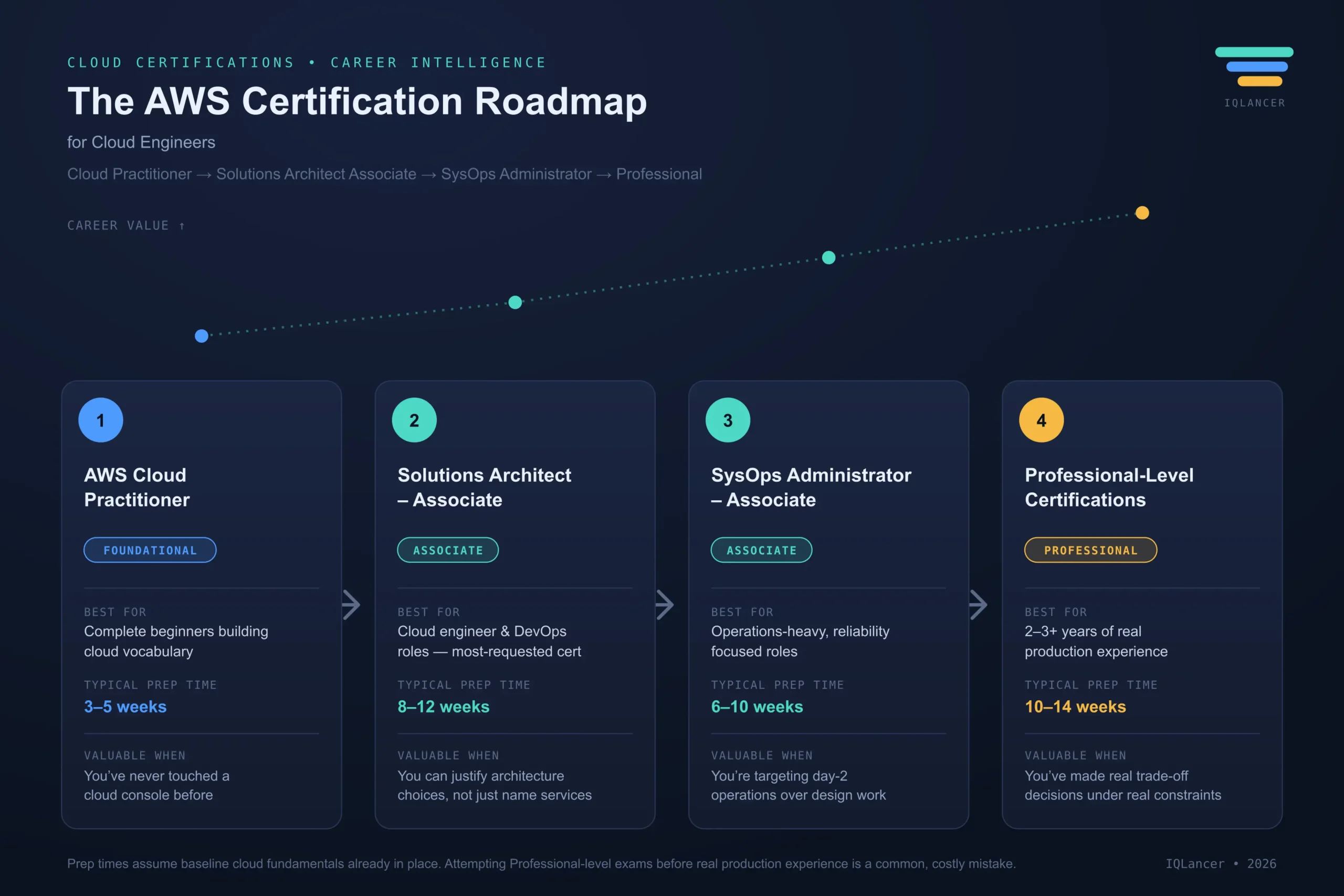
Cloud Practitioner → Solutions Architect Associate → SysOps Administrator → Professional Certifications
Cloud Practitioner becomes valuable in month one or two of study, mainly for candidates with zero prior cloud exposure; it builds vocabulary and shared-responsibility-model literacy before you touch real architecture decisions. Skip it if you already have a year or more of development or operations experience; go straight to Solutions Architect Associate.
Solutions Architect Associate becomes valuable once you can explain, unprompted, why you’d choose a particular VPC design, storage class, or compute option for a given workload not just recite service names. This is the certification with the highest hiring signal-to-effort ratio for most candidates: it appears in a large share of Indian cloud job postings and typically takes 8–12 weeks of focused study for someone with basic cloud fundamentals.
SysOps Administrator Associate becomes valuable once you’re targeting operations-heavy roles specifically, or once you want to demonstrate depth in monitoring, patching, and troubleshooting rather than design. Many engineers skip this and go straight to a Professional cert that’s a reasonable choice if your target roles are architecture-leaning rather than operations-leaning.
Professional-level certifications (Solutions Architect Professional, DevOps Engineer Professional) become valuable only after 2–3 years of real hands-on experience.
Attempting them earlier is a common and expensive mistake: pass rates drop sharply for candidates without production experience, because the exams are scenario-based and assume you’ve actually made trade-off decisions under real constraints, not studied them from a course. Professional-level AWS certifications tend to report higher average salaries than Associate-level ones, but that premium tracks the seniority of the role, not the badge itself.
How Many Projects Are Needed to Become Competitive?
Recruiters and hiring managers consistently say the same thing: certifications get you shortlisted, projects get you hired. A realistic target is 4–6 well-documented projects spanning increasing complexity not fifteen shallow tutorial clones.
Beginner Projects
- Static website hosting (S3 + CloudFront, or Azure Static Web Apps): demonstrates basic deployment competence and understanding of CDN/caching. Recruiters care because it’s the simplest possible proof you can actually deploy something end-to-end, not just describe it.
- EC2 deployment with a real application: shows you can provision compute, configure security groups, and get something running the baseline “can this person operate a cloud console” check.
- IAM configuration exercise (custom roles, least-privilege policies, MFA enforcement): security-literate candidates stand out immediately, because most beginner portfolios ignore IAM entirely.
Intermediate Projects
- Auto Scaling + Load Balancing setup for a multi-instance application: demonstrates you understand availability and elasticity, not just single-server deployment.
- CI/CD pipeline (CodePipeline, GitHub Actions, or Azure DevOps) deploying automatically on code push: this is the single highest-signal intermediate project, because it proves you understand the deployment lifecycle, not just infrastructure in isolation.
- These projects improve hiring chances specifically because they mirror what a first 90 days on the job actually looks like most entry-level cloud engineer work is exactly this: deploy, scale, automate, repeat.
Advanced Projects
- Kubernetes deployment (EKS/AKS/GKE) running a multi-service application with proper resource limits and health checks: signals readiness for mid-level roles where container orchestration is now a baseline expectation.
- Terraform-automated multi-environment infrastructure (dev/staging/prod from the same codebase): this is the project recruiters specifically look for as evidence a candidate can operate beyond console clicking.
- Multi-tier architecture combining networking, compute, database, and monitoring into one coherent, documented system: this is the closest a portfolio project gets to simulating actual production responsibility, and it’s what separates candidates who get offers from candidates who get “we’ll keep your resume on file.”
What Should a Cloud Engineer Portfolio Include?
A portfolio’s job is to let a hiring manager verify your claims in under five minutes most fail this test not because the work is bad, but because it’s undocumented or unexplained.
- GitHub repositories should contain actual infrastructure code (Terraform, CloudFormation, Kubernetes manifests), not just application code.
- Documentation a clear README explaining what the project does, why specific architectural choices were made, and what trade-offs were considered is the single most-skipped element, and its absence is the fastest way a strong project gets ignored.
- Architecture diagrams (even simple ones made in draw.io or Excalidraw) let a recruiter or hiring manager understand your system in seconds rather than reading through code.
- Deployment screenshots or short screen recordings prove the thing actually ran, rather than existing only as unrun code.
- Infrastructure code should be genuinely reusable parameterized, modular Terraform rather than one-off hardcoded scripts.
- Project explanations a short written or recorded walkthrough of the problem, the decision-making process, and what you’d do differently at scale demonstrate the communication skill that separates senior-track engineers from purely technical operators.
What separates strong portfolios from weak ones is rarely technical sophistication; it’s narrative clarity. A hiring manager scanning 40 resumes will spend 90 seconds on a GitHub profile. Projects with a clear README, a diagram, and an honest “what I’d improve” section consistently outperform more technically complex but undocumented projects.
What Do Employers Actually Look For in Cloud Engineers?
Employers weigh degrees, certifications, and projects very differently than most candidates assume, and understanding how to become a cloud engineer that actually clears interviews means understanding this hierarchy correctly.
- Degrees vs. Skills: a degree opens the door at large enterprises and government-adjacent employers with rigid HR filters; skills win the interview everywhere else, and increasingly even at large enterprises once you’re past the initial resume screen.
- Certifications vs. Projects: certifications get you shortlisted by keyword-matching ATS systems and recruiters; projects get you hired, because interviews are where certifications stop mattering and demonstrated judgment starts mattering.
- Tutorials vs. Real Deployments: hiring managers can tell the difference within minutes of technical conversation a candidate who followed a tutorial can describe what they did; a candidate who built something real can explain why they made each decision and what broke along the way.
The hiring reality most competitor articles/magazine/publication/newsletters avoid stating plainly: a resume with three certifications and no projects reads, to an experienced technical recruiter, as “this person can pass exams” which is a weaker signal in 2026 than it was in 2020, because certification content is now widely available through brain-dump sites and AI-assisted study tools that inflate pass rates without inflating actual competence.
This is exactly why the guidance throughout this article keeps returning to projects: they are the fastest way to differentiate yourself from an increasingly certified but increasingly homogeneous applicant pool.
What Recent Cloud Engineer Job Descriptions Commonly Require
Across current cloud engineer postings, a consistent skill cluster repeats regardless of company size or industry this is the practical checklist to benchmark your resume against.
| Requirement | How Often It Appears | Employer Expectation |
|---|---|---|
| Linux | Near-universal | Comfortable in the CLI, not just aware it exists |
| AWS and/or Azure | Near-universal (often “AWS or Azure,” sometimes both) | Hands-on deployment experience, not just certification |
| Networking | Very common | Can troubleshoot connectivity, not just define OSI layers |
| Terraform (or another IaC tool) | Increasingly standard at mid-level and above | Real repos, not just “familiar with” on a resume |
| Docker | Standard for most roles beyond pure infrastructure ops | Can containerize an app, not just run docker run on someone else’s image |
| Kubernetes | Common at mid-level and product companies; rising fast | At minimum conceptual fluency; hands-on for mid-level+ |
| Git | Universal | Version control fluency, including for infrastructure code |
| Security | Increasingly explicit, not implied | IAM, encryption, and compliance awareness baked into daily work, not a separate specialty |
The pattern: postings increasingly bundle “cloud + automation + security” into one role rather than separating them, which is why candidates who study only the cloud platform in isolation without networking, IaC, and security consistently underperform in interviews relative to their certification count.
How Much Experience Is Needed?
Experience expectations for cloud engineer roles vary sharply by level, and understanding what’s realistically expected at each stage prevents both underselling and overselling yourself in applications.
Freshers (0 years): expected to show cloud fundamentals, at least one platform certification, and 3–4 completed projects. Not expected to have production experience but expected to demonstrate you understand what production reliability requires conceptually.
1–3 Years: expected to have owned real deployments (even small ones), be comfortable with IaC, and show growing automation skill. This band is where the market is most competitive in India, because it’s the largest applicant pool relative to open roles.
3–5 Years: expected to lead architecture decisions on at least part of a system, mentor juniors, and hold or be working toward a Professional-level certification. Employers at this stage screen hard for incident-response experience “tell me about an outage you handled” is a near-universal interview question at this band.
5+ Years: expected to operate at architect or lead level designing multi-service, multi-environment systems, owning cost governance, and making platform-level decisions (multi-cloud strategy, security posture, disaster recovery). Certifications matter far less at this stage than a track record of systems you’ve actually run in production.
How Long Does It Take to Become a Cloud Engineer?
Realistic timelines vary significantly by starting point the biggest mistake candidates make is applying a bootcamp’s marketed “12 weeks” timeline to a background that actually needs 6–12 months.
CS graduates with strong fundamentals: typically 3–6 months to reach entry-level competitiveness, since networking and Linux basics are often already covered in coursework the remaining work is cloud-platform depth and project-building.
Working IT professionals (sysadmins, support engineers, network techs) transitioning into cloud: typically 4–8 months, since foundational technical skills transfer directly; the gap is usually cloud-native services and IaC specifically.
Career switchers from unrelated technical fields (QA, data entry-adjacent roles, other engineering disciplines): typically 8–12 months, requiring foundational Linux/networking study before cloud-specific learning begins.
Complete beginners (no technical background at all): typically 12–18 months for genuine competitiveness this is the honest number competitor sites often understate. Compressing this timeline usually produces certified-but-shallow candidates who struggle in technical interviews.
Cloud Engineer Salary in India
Cloud engineer compensation in India varies enormously by company type, city, and certification/skill stack national averages hide more than they reveal, so this section breaks the range down by level and driver.
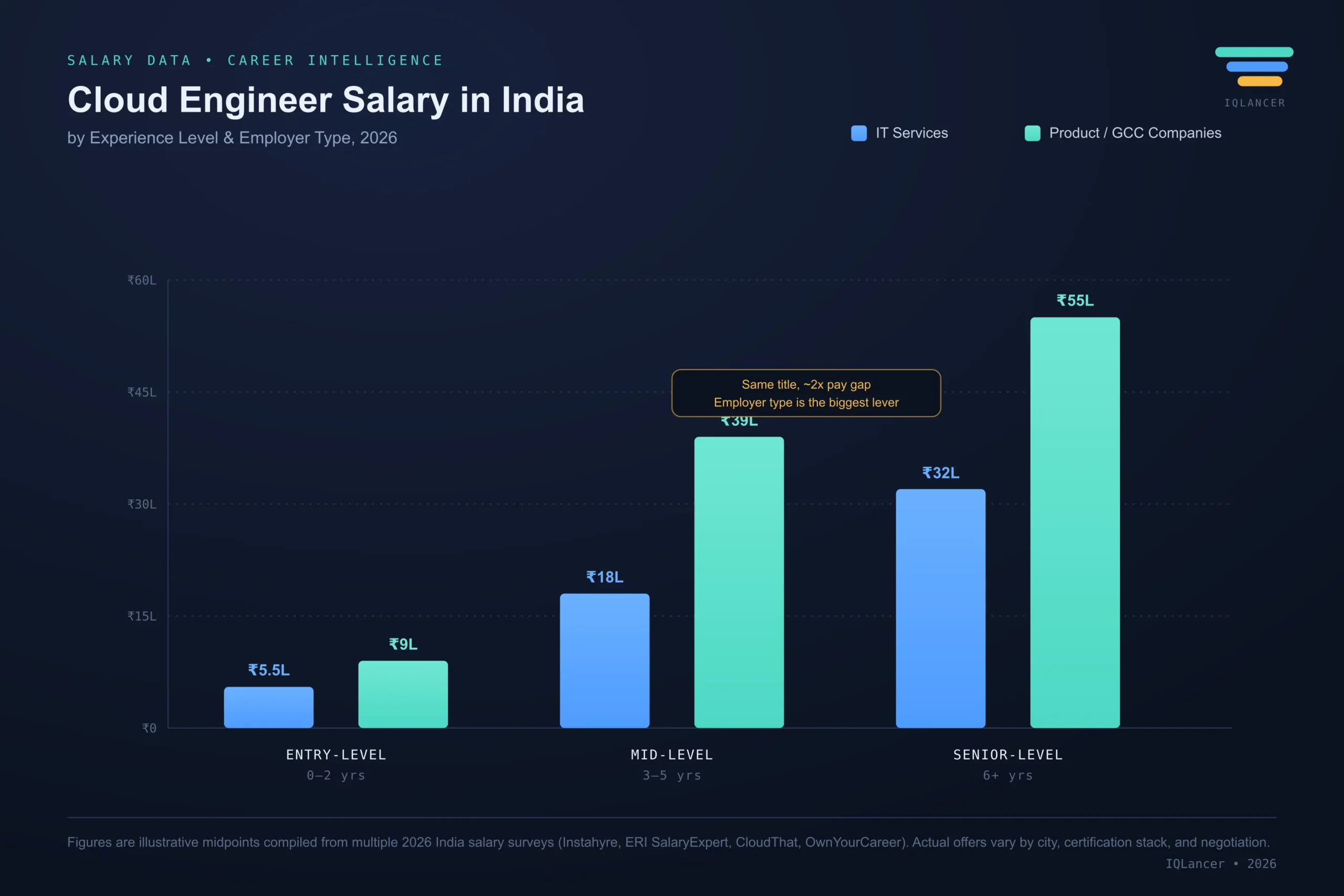
Entry-level (0–2 years): most sources converge on roughly ₹4–9 LPA, with IT services firms clustering toward the lower end (₹3.5–7 LPA) and product companies toward the higher end (₹6–12 LPA). Freshers holding AWS SAA or a CCNA-equivalent networking credential tend to land at the upper end of this band.
Mid-level (3–5 years): roughly ₹12–24 LPA at services and mid-size product companies, rising to ₹28–50 LPA at Global Capability Centres (GCCs) and FAANG-tier employers. This is where certification and skill stacking produces the sharpest divergence engineers combining Kubernetes (CKA), Terraform, and a cloud platform certification report the strongest offers relative to peers with a single certification.
Senior-level (6+ years): roughly ₹26–45 LPA is typical, with senior cloud architects and specialized roles (multi-cloud, security, AI infrastructure) reaching ₹45–80+ LPA at top-tier employers.
Factors influencing salary, in rough order of impact: employer type (product company vs. IT services can mean a 2x difference at the same experience level), specialization stack (multi-cloud, Kubernetes, and security combinations command the steepest premiums reportedly 25–40% above standard cloud engineering pay), city (Bangalore and Hyderabad consistently pay the most due to product-company concentration), and industry (BFSI reportedly pays a 15–25% premium over general IT services for equivalent cloud roles, reflecting compliance and criticality demands).
Note: this section draws on aggregated recruiter and salary-survey data (Instahyre, ERI SalaryExpert, CloudThat, OwnYourCareer, and similar sources). These are compiled industry estimates rather than a single, independently verifiable dataset treat the ranges as directional rather than precise.
Why Cloud Engineer Candidates Get Rejected
Rejection patterns repeat across recruiter feedback, and most are fixable; this section names them directly rather than softening them into vague advice.
Certification-heavy resumes with no projects. Why it happens: candidates (reasonably) assume certifications are the credential employers want, so they stack more of them instead of building anything. Fix: cap certification study once you have one platform Associate-level cert, and redirect that time into 2–3 documented projects.
No practical projects. Why it happens: tutorials feel like progress but don’t produce anything a recruiter can independently verify. Fix: convert every tutorial you follow into a modified, personally-documented project change the architecture, document your reasoning, and push it publicly.
Weak Linux knowledge. Why it happens: cloud consoles make it possible to avoid the command line almost entirely at the beginner stage. Fix: deliberately work outside the console SSH into instances, manage services via systemd, script routine tasks in Bash.
Weak networking knowledge. Why it happens: networking feels abstract compared to clicking through a cloud console, so it gets deprioritized. Fix: rebuild core networking concepts (subnetting, routing, DNS) inside real VPC labs until you can explain traffic flow end-to-end without notes.
No portfolio. Why it happens: candidates assume a resume bullet point is sufficient proof of a project. Fix: every project needs a public repo, a README, and ideally a short diagram treat the portfolio as a second resume that speaks for itself.
No GitHub activity. Why it happens: candidates do project work locally and never push it, especially when the project “isn’t finished.” Fix: push early and often an evolving, honestly-documented repo is more convincing than a polished one that appeared overnight.
7 Mistakes That Prevent Candidates From Getting Hired
1. Chasing certifications instead of depth. Why it happens: certifications feel like measurable progress. How recruiters view it: a wall of badges with no projects reads as exam-passing skill, not job-readiness. Fix: one certification per platform, then build.
2. Skipping Linux and networking fundamentals. Why it happens: cloud platforms abstract these away at the surface level. How recruiters view it: candidates who can’t explain basic subnetting fail technical screens immediately, regardless of certification count. Fix: treat Linux and networking as prerequisites, not electives.
3. Building only tutorial-clone projects. Why it happens: tutorials are the path of least resistance to “doing something.” How recruiters view it: identical portfolio projects across hundreds of candidates are an instant red flag. Fix: modify every tutorial meaningfully different architecture, added monitoring, different failure scenarios handled.
4. Ignoring Infrastructure as Code. Why it happens: console-based deployment feels faster when you’re learning. How recruiters view it: console-only administration reads as junior/legacy skill in 2026. Fix: rebuild your existing projects in Terraform before adding new ones.
5. Underestimating security expectations. Why it happens: security feels like a separate specialization rather than a baseline skill. How recruiters view it: absence of IAM/least-privilege thinking in a portfolio signals risk to hiring managers. Fix: bake IAM policy design and encryption configuration into every project, not just a dedicated “security project.”
6. Applying only to postings requiring 3+ years with zero years of experience. Why it happens: candidates misjudge which postings are realistic targets. How recruiters view it: irrelevant to the recruiter, but wastes candidate time and morale. Fix: target entry-level and “0–2 years” postings explicitly, and use projects to compensate for the experience gap.
7. Undocumented, unexplained portfolios. Why it happens: candidates assume the code should “speak for itself.” How recruiters view it: an undocumented repo gets skipped in the 90 seconds a recruiter spends scanning it. Fix: write the README first, before you consider the project done.
Cloud Engineer vs DevOps Engineer
These two roles overlap heavily in skill set but differ in focus, and the distinction matters when choosing which career path to target from the start.
| Dimension | Cloud Engineer | DevOps Engineer |
|---|---|---|
| Core Responsibility | Designing, deploying, and managing cloud infrastructure | Bridging development and operations CI/CD, release automation, reliability |
| Primary Skills | AWS/Azure/GCP, networking, IaC, security | CI/CD tooling, scripting, containers, IaC, monitoring |
| Daily Work | More infrastructure- and architecture-centric | More pipeline-, automation-, and release-centric |
| Career Opportunities | Cloud Architect, Solutions Architect, Platform Engineer | SRE, Platform Engineer, DevOps Lead, Release Engineering Manager |
| Salary Trends | Comparable at entry level; cloud architecture roles pull ahead at senior level | Comparable at entry level; DevOps/SRE roles often command a premium at senior level due to reliability accountability |
Choosing between them: if you’re more drawn to designing systems deciding how infrastructure should be architected lean cloud engineer. If you’re more drawn to the software delivery lifecycle how code gets from commit to production reliably and fast lean DevOps. In practice, the two roles converge heavily by the mid-career stage; the choice matters more for your first 1–2 years than for your long-term ceiling.
Cloud Career Path and Growth Opportunities
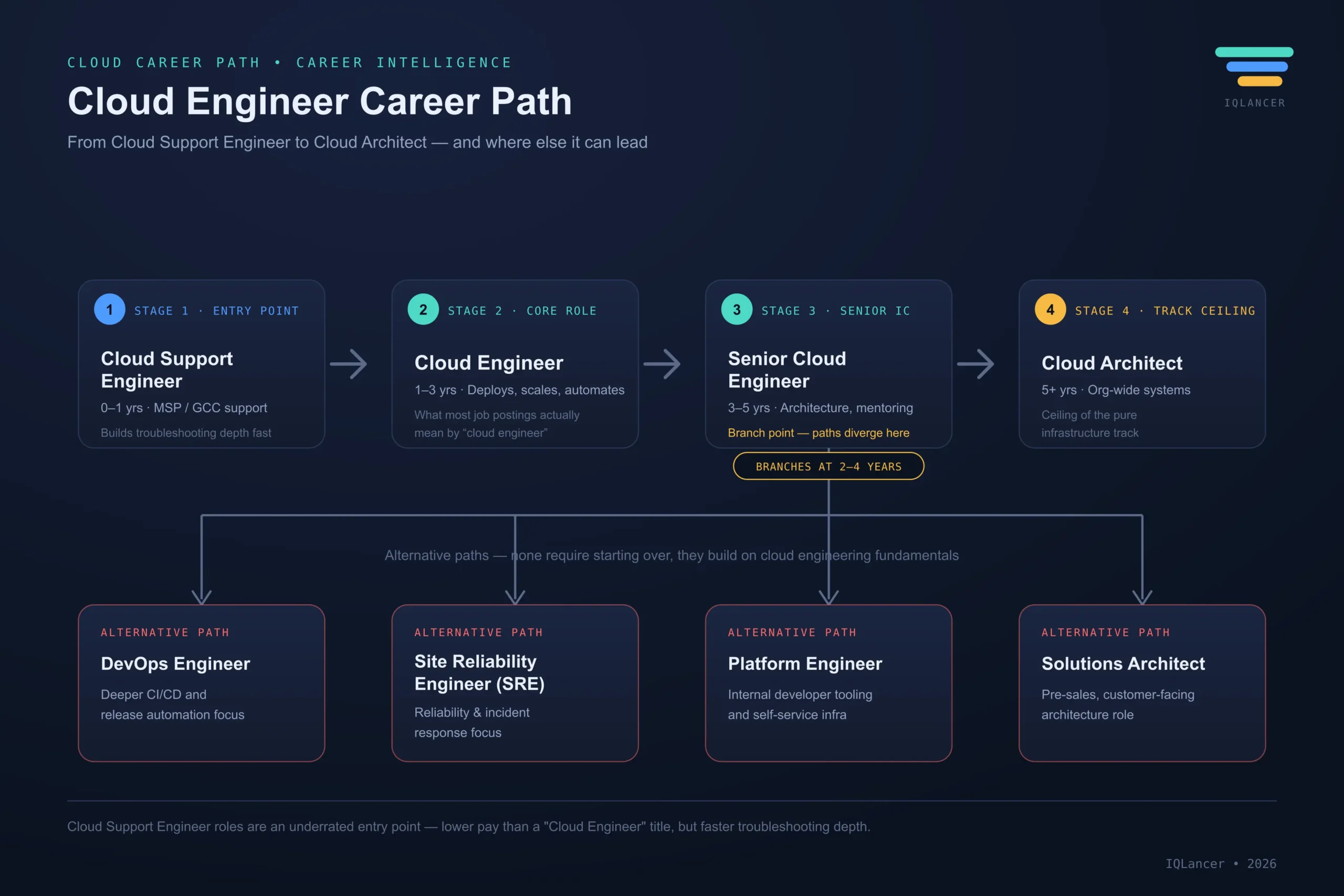
The cloud career path in India and globally follows a fairly consistent progression, with clear alternative branches once you reach the mid-level stage.
Cloud Support Engineer → Cloud Engineer → Senior Cloud Engineer → Cloud Architect
Cloud Support Engineer roles (often at MSPs, GCCs, or hyperscaler support organizations) are a common, underrated entry point they build troubleshooting depth fast, even though the pay is typically lower than a “Cloud Engineer” title at the same experience level. Cloud Engineer is the core operational role covered throughout this guide. Senior Cloud Engineer adds architectural ownership, mentoring, and cross-team coordination. Cloud Architect is the natural ceiling of the pure infrastructure track designing systems at the organizational level rather than implementing individual pieces.
Alternative paths branch off around the 2–4 year mark: DevOps Engineer (deeper CI/CD and release focus), SRE (Site Reliability Engineer) (deeper reliability, incident response, and error-budget focus), Platform Engineer (building internal developer tooling and self-service infrastructure), and Solutions Architect (a more pre-sales/customer-facing architecture role, common at hyperscalers and consulting firms). None of these paths require starting over they build directly on cloud engineering fundamentals, which is exactly why getting those fundamentals right early matters so much.
ATS Intelligence: Cloud Engineer Resume Keywords
Applicant Tracking Systems parse resumes for specific keyword matches before a human ever sees them understanding what ATS systems search for (and why) helps you write a resume that survives the first filter without resorting to obvious keyword stuffing.
| Keyword Category | Examples | Why ATS Systems Search for Them |
|---|---|---|
| Platforms | AWS, Azure, GCP | Directly maps to job requirements; the most heavily weighted match category |
| Core Services | EC2, S3, IAM, VPC | Confirms hands-on service-level experience, not just platform-level familiarity |
| Automation/IaC | Terraform, CloudFormation, Ansible | Signals modern practice vs. console-only administration |
| Containers | Docker, Kubernetes | Increasingly a baseline filter for mid-level+ roles |
| Foundational Systems | Linux, Networking | Filters for prerequisite technical depth |
| Delivery | CI/CD, Git | Confirms integration into modern software delivery workflows |
| Security | Cloud Security, IAM, Compliance | Reflects security’s shift from “nice to have” to baseline expectation |
Why this matters practically: ATS systems rank resumes by keyword density and relevance, but recruiters still read the top-ranked resumes manually so the goal is accurate, evidence-backed keyword inclusion (a project or role where you actually used each term), not blind stuffing. A keyword with no supporting evidence in your project descriptions gets caught in the technical interview almost immediately.
IQLancer Cloud Engineer Readiness Checklist
Use this self-assessment honestly before applying broadly it’s designed to surface real gaps, not to make you feel ready prematurely.
| Area | Not Started | Developing | Job-Ready |
|---|---|---|---|
| Linux | No CLI comfort | Can navigate and troubleshoot with guidance | Comfortable managing services, permissions, and scripting unaided |
| Networking | Can’t explain subnetting | Understands VPC basics | Can design and troubleshoot multi-tier network architecture |
| AWS | No hands-on use | Completed guided labs | Deployed and can explain real, unguided projects |
| Azure | No hands-on use | Completed guided labs | Deployed and can explain real, unguided projects |
| Security | No IAM experience | Basic policy creation | Designs least-privilege IAM and encryption strategies independently |
| Terraform | No IaC experience | Following tutorials | Writes modular, reusable Terraform from scratch |
| Docker | Never containerized an app | Containerized a simple app | Containerized a real multi-service application |
| Kubernetes | No exposure | Completed guided deployment | Deployed and troubleshot a real cluster independently |
| Projects | 0 completed | 1–3 completed | 4–6 documented, varied-complexity projects |
| Portfolio | No GitHub presence | Repos exist, undocumented | Documented repos with READMEs and diagrams |
| Resume | Generic, no keywords | Some relevant keywords | ATS-optimized with evidence-backed keywords |
If more than three areas sit in “Not Started” or “Developing,” prioritize those before increasing your application volume a higher application count does not compensate for gaps that show up in the first technical screen.
Final Thoughts
Becoming a cloud engineer in 2026-2027 is achievable for students, freshers, working professionals, and career switchers alike but the path runs through demonstrated skill, not credential accumulation. The pattern across this entire guide repeats for a reason: employers reward candidates who pair one solid platform certification with real, documented projects, genuine Linux and networking depth, and security literacy baked into their work rather than bolted on.
Certifications open the door to a recruiter’s shortlist; projects, portfolio quality, and interview performance are what actually get you hired. If you’re serious about how to become a cloud engineer, start with fundamentals, build 4–6 projects that show increasing complexity, document everything publicly, and target your certification study to the platform your desired employers actually use.
The market has room for you enterprise cloud spend isn’t slowing down but it has stopped rewarding certification-only resumes. Build accordingly.