If you have searched for how to become a DevOps engineer, you have probably noticed the advice online splits into two useless extremes: “just learn Docker and Kubernetes” or “get a computer science degree and years of sysadmin experience.” Neither reflects how hiring actually works in 2026.
DevOps hiring today rewards a specific combination of cloud fluency, automation skill, and demonstrated system-level judgment not certificates alone and not tool-hopping. This guide breaks down exactly what recruiters screen for, what separates shortlisted candidates from rejected ones, and what a realistic devops roadmap looks like for freshers, working professionals, and career switchers alike.
What Does a DevOps Engineer Do?
Before chasing tools or certifications, you need clarity on what the job actually involves day to day. Recruiters reject a surprising number of candidates simply because they cannot describe the role beyond buzzwords.
A DevOps engineer sits at the intersection of software development and IT operations, responsible for making software delivery fast, repeatable, and reliable. In practice, this breaks down into a few concrete areas of ownership:
- CI/CD pipeline management : Building and maintaining automated pipelines (Jenkins, GitHub Actions, GitLab CI, CircleCI) that take code from commit to production without manual intervention.
- Infrastructure as Code (IaC) : Provisioning servers, networks, and cloud resources using Terraform, Pulumi, or CloudFormation instead of manual console clicks.
- Container orchestration : Deploying and operating applications on Kubernetes or similar platforms, including scaling, networking, and self-healing configurations.
- Monitoring and observability : Implementing tools like Prometheus, Grafana, and Datadog to catch problems before customers do, and responding to incidents when they occur.
- Security integration (DevSecOps) : Embedding vulnerability scanning, secrets management, and compliance checks directly into the delivery pipeline rather than treating security as an afterthought.
- Collaboration between teams : Acting as the bridge between developers who write code and operations teams who keep systems running, often owning the on-call rotation for production incidents.
This work spans nearly every industry that ships software: fintech, healthcare tech, e-commerce, SaaS, media, and increasingly AI infrastructure teams that need engineers who can operate GPU clusters and MLOps pipelines. The business impact is direct faster, more reliable deployments translate into faster feature delivery and fewer costly outages, which is exactly why the role commands strong compensation relative to years of experience.
Is DevOps Engineering a Good Career in 2026-2027?
This is the question every fresher and career switcher asks before committing months of study, and the honest answer requires looking past headlines about AI replacing developers.
DevOps remains one of the strongest career bets in technology through 2026 and beyond, but the shape of the role is shifting. Industry analysis from Boundev’s 2026 job market report projects that software engineering demand overall will grow significantly through the early 2030s, with DevOps-specific roles growing roughly 28% as AI reshapes rather than shrinks the broader engineering job market. Cloud migration is far from finished a meaningful share of enterprise workloads still run on-premises, and that migration work alone sustains steady hiring for engineers who can design and manage cloud infrastructure.
On the AI question specifically, the data is more reassuring than the panic suggests. The 2026 Perforce State of DevOps Report, which surveyed 820 technology professionals globally, found that 87% of respondents believe AI will shift their focus toward system design and away from repetitive scripting, and demand for DevOps and platform engineering roles is described as growing, not shrinking.
AI tools are automating YAML generation, alert triage, and routine pipeline configuration but they still struggle badly with genuinely broken systems: a node stuck in a bad state, flaky DNS, or a rollout that only fails under specific production load. That is precisely the kind of mental-model, root-cause reasoning that keeps experienced DevOps engineers essential.
The realistic outlook: junior, purely execution-focused DevOps work is shrinking as AI absorbs routine scripting. Demand is consolidating around engineers who understand why systems behave the way they do which is good news for candidates willing to build real depth rather than surface-level tool familiarity.
Platform engineering and Site Reliability Engineering (SRE) are also emerging as premium specializations branching directly off the DevOps career path, often paying above standard DevOps roles.
Which Degree Is Required to Become a DevOps Engineer?
Candidates frequently assume a computer science degree is mandatory, and this misconception stops capable career switchers from even starting. Here is what hiring data actually shows.
Relevant degrees: A bachelor’s degree in Computer Science, Information Technology, or a related engineering field is the most common background among DevOps engineers and remains the path of least resistance into the field, particularly for campus hiring at larger companies.
Alternative educational paths: A degree in electronics, IT, or even non-technical fields combined with strong hands-on cloud and scripting skills is increasingly acceptable, especially at mid-size companies and startups that screen primarily on demonstrated ability. System administration backgrounds, network engineering experience, and QA/testing roles are common and credible entry points into DevOps.
Self-taught routes: It is entirely possible to break into DevOps without a traditional CS degree, but the burden of proof shifts entirely onto your portfolio. Employers hiring self-taught candidates look for a GitHub history showing real infrastructure code, a documented home lab or cloud sandbox project, and at least one recognized certification that validates foundational knowledge.
The hiring reality: Degrees matter most for the first job, particularly at larger, more traditional employers with rigid ATS filters. Past your first role, experience, certifications, and project depth outweigh where you studied. Recruiters consistently report that a candidate with a non-CS degree, a Terraform Associate certification, and two solid deployed projects gets shortlisted over a CS graduate with no hands-on cloud experience.
Skills Required to Become a DevOps Engineer
This is the section that determines whether you get shortlisted or filtered out at the resume stage, because recruiters and ATS systems are scanning for specific, verifiable skills not generic phrases like “team player” or “problem solver.”
Technical Skills
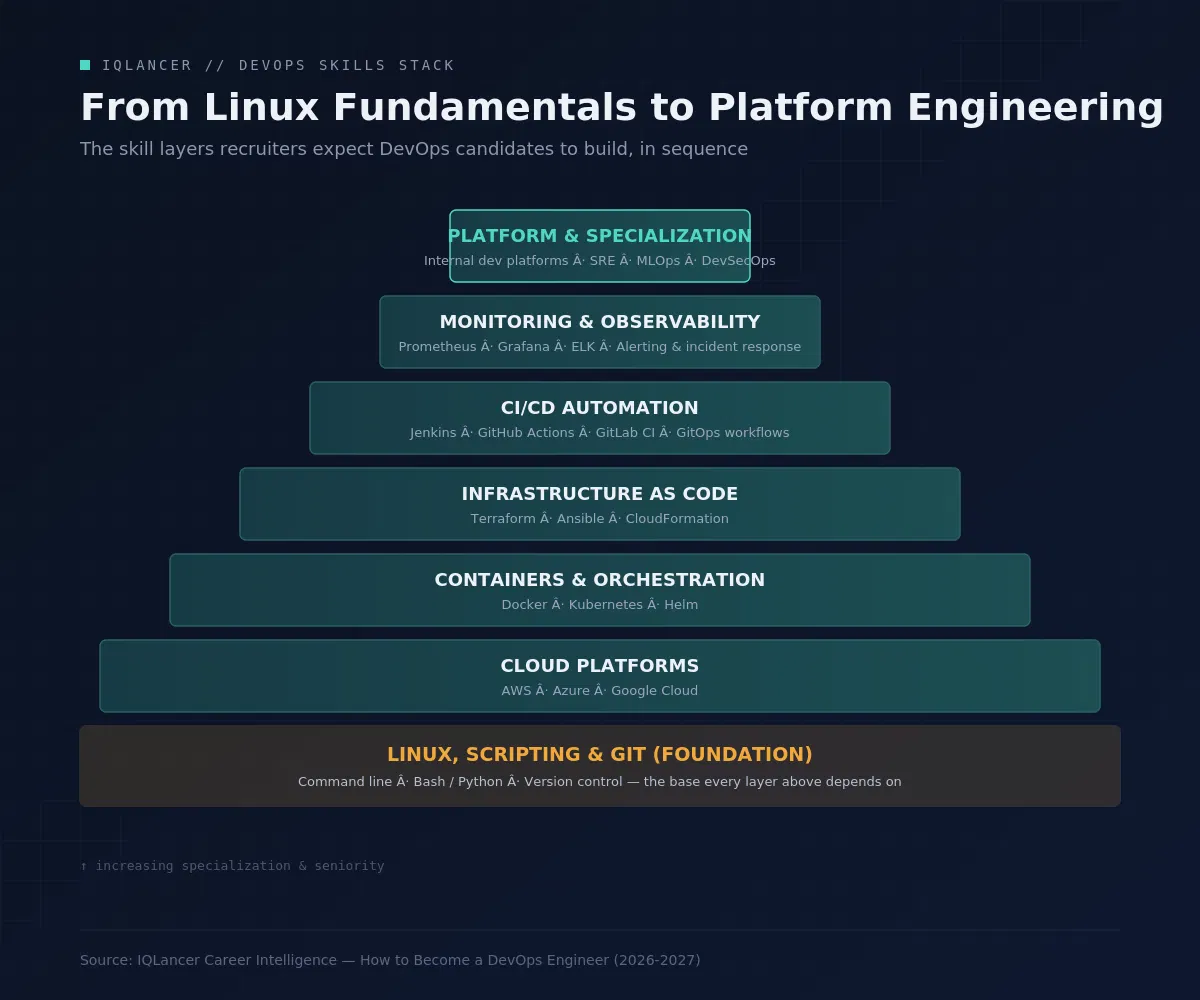
Linux and command-line proficiency : Nearly all production infrastructure runs on Linux. Recruiters test this directly in technical screens by asking candidates to troubleshoot a broken service or read log files live. Build this by running your own Linux server, not just watching tutorials.
Scripting (Python or Bash) : Automation is the core of DevOps, and scripting is how you build it. Employers evaluate this by asking candidates to automate a real task during interviews deploying an app, parsing logs, or writing a health-check script. Build this by automating something in your current job or personal projects, however small.
Cloud platforms (AWS, Azure, or GCP) : At least one cloud platform is now a baseline expectation on nearly every DevOps job posting. Recruiters check this via certifications and, more importantly, by asking candidates to explain architecture decisions they’ve actually made. Build this using the free tiers of AWS, Azure, or GCP to deploy real applications, not just following guided labs.
Containerization (Docker) and orchestration (Kubernetes) : Kubernetes has become the de facto standard for container orchestration, and companies now expect DevOps engineers to design, deploy, and troubleshoot Kubernetes clusters in production environments. This is tested through scenario questions (“a pod is stuck in CrashLoopBackOff walk me through your debugging steps”). Build this by deploying a multi-service application to a managed Kubernetes cluster and deliberately breaking and fixing it.
Infrastructure as Code (Terraform, Ansible, CloudFormation) : Terraform in particular shows up as a baseline expectation across mid-to-senior job descriptions, since manual infrastructure provisioning does not scale. Recruiters evaluate this by reviewing your GitHub for real, reusable Terraform modules not copy-pasted starter templates.
CI/CD tools (Jenkins, GitHub Actions, GitLab CI) : Building and maintaining automated pipelines is one of the most commonly tested practical skills in interviews. Build this by setting up a complete pipeline build, test, security scan, deploy for one of your own projects.
Monitoring and observability (Prometheus, Grafana, ELK stack) : Employers increasingly ask candidates how they would detect and respond to an outage, not just how to deploy code. Build this by instrumenting one of your projects with real dashboards and alerts, not just default configurations.
Version control (Git) and GitOps practices : Managing infrastructure and deployments through Git as the single source of truth is increasingly expected at companies running Kubernetes at scale, and interviewers probe your branching strategy and rollback approach, not just whether you know git commit.
Business Skills
Understanding cost and cloud economics : Recruiters at mid-to-senior levels specifically probe whether candidates think about infrastructure cost, not just uptime. Being able to explain how you reduced cloud spend, right-sized instances, or chose a cheaper managed service signals business maturity that pure technical skill does not.
Risk and change management awareness : DevOps engineers frequently make changes to live production systems. Employers look for candidates who understand rollback plans, blast-radius thinking, and staged rollouts (canary or blue-green deployments) rather than “deploy and hope.”
Prioritization under incident pressure : During on-call incidents, engineers must triage which issues threaten the business most. Interviewers test this with incident-scenario questions to see if candidates think in terms of business impact, not just technical curiosity.
Communication Skills
Incident documentation and postmortems : Writing clear, blameless postmortems after outages is a skill recruiters specifically screen for at mid and senior levels, since poor documentation compounds operational risk. Practice this by writing postmortems for issues you fix in personal or work projects.
Cross-team collaboration : DevOps engineers sit between developers, security teams, and business stakeholders. Interviewers assess this through behavioral questions asking you to describe a disagreement with a developer over a deployment decision and how you resolved it.
Explaining technical trade-offs to non-technical stakeholders : Being able to justify why a migration will take three weeks, not three days, to a product manager is a skill that directly correlates with promotion speed once hired.
Certifications That Can Help
Certifications alone will not get you hired, but the right ones paired with projects measurably shorten your path to an interview. Here is what actually carries weight in 2026 hiring pipelines, and where each one fits. Each certification below links to its official certifying body always confirm current pricing and exam blueprints there before registering, since exam versions and fees are updated periodically.
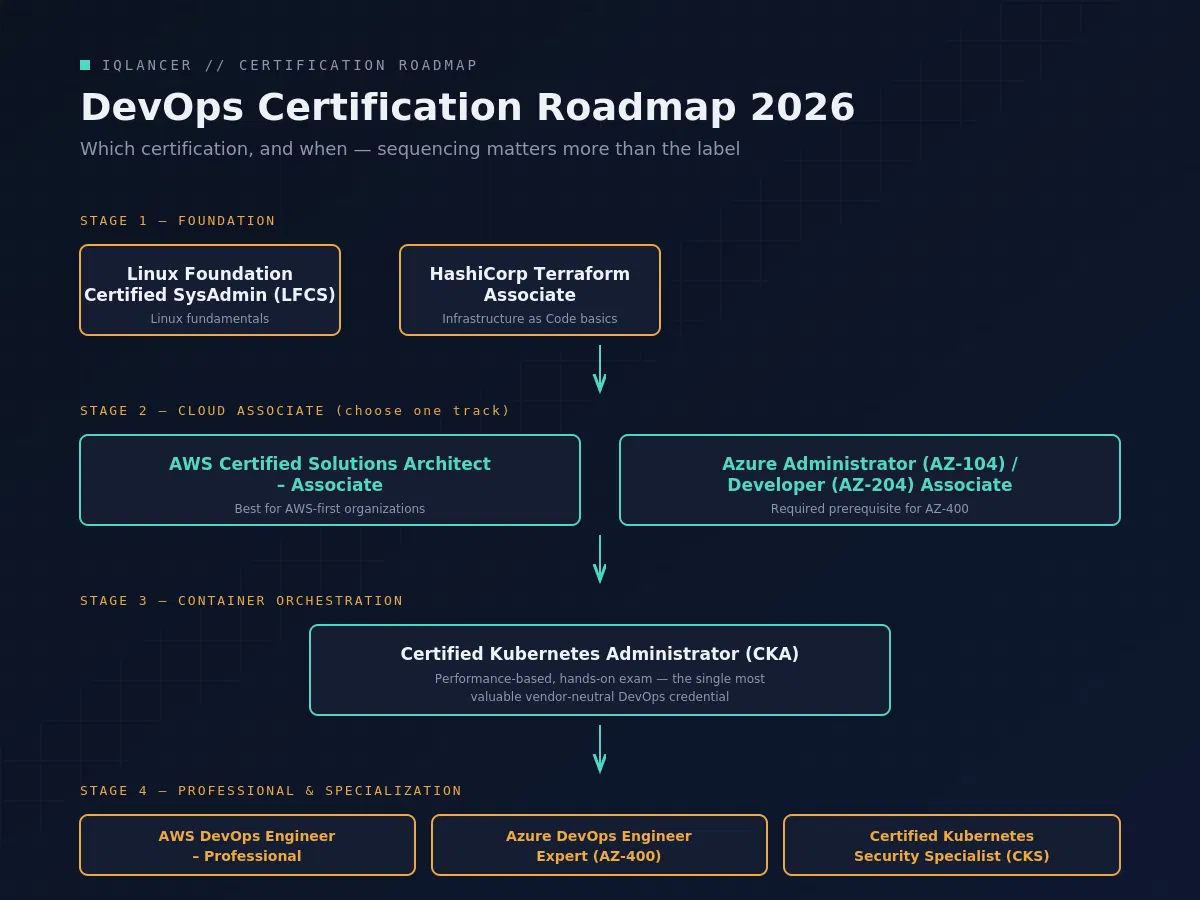
AWS Certified Solutions Architect – Associate. A strong entry point that signals broad, hireable cloud architecture knowledge. It typically requires 40–80 hours of study and maps to associate-level cloud roles.
- Best use case: candidates with little to no cloud experience who need a credible first credential.
- Limitation: it is architecture-focused, not operations-focused, so pair it with hands-on deployment work.
HashiCorp Terraform Associate. At roughly $70, this is widely regarded as the best-value certification in the DevOps space, since Infrastructure-as-Code skills are in acute demand across every major cloud provider.
- Best use case: near-universal relevance regardless of which cloud you specialize in.
- Limitation: it validates syntax and concepts, not real-world module design recruiters will still expect to see your own Terraform code on GitHub.
Certified Kubernetes Administrator (CKA). This is a performance-based exam requiring 60–120+ hours of lab practice, and it aligns with Kubernetes-focused roles that can reach well into six-figure compensation. Recruiters consistently rate this as one of the most respected DevOps credentials because unlike many theoretical exams, the CKA requires candidates to solve real administrative tasks in a live environment rather than answer multiple-choice questions.
- Best use case: candidates targeting Kubernetes-heavy or platform engineering roles.
- Limitation: it is demanding and not a beginner’s first certification foundational Linux, Docker, and networking knowledge should come first.
AWS Certified DevOps Engineer – Professional. This is recognized by employers for both depth and breadth across CI/CD, automation, security, and large-scale cloud deployment, and is directly relevant to hybrid and multi-cloud environments.
- Best use case: professionals with 2+ years of AWS experience aiming for senior or lead DevOps roles.
- Limitation: it assumes working AWS fluency; attempting it without practical experience results in a high failure rate.
Microsoft Certified: DevOps Engineer Expert (AZ-400). Highly regarded for professionals specializing in Azure-centric organizations, particularly in enterprise and consulting environments. Requires an Azure Administrator Associate or Azure Developer Associate certification as a prerequisite.
- Best use case: candidates targeting companies with existing Microsoft/Azure infrastructure investments.
Certified Kubernetes Security Specialist (CKS). The security-focused follow-up to CKA candidates must already hold a CKA to sit this exam. Valued specifically at senior DevOps, platform engineering, and DevSecOps levels.
- Limitation: only worth pursuing after CKA; it assumes deep Kubernetes fluency already in place.
Linux Foundation Certified System Administrator (LFCS). An excellent starting point for building fundamental Linux administration skills, particularly for candidates without prior sysadmin exposure. Like the CKA, it is a performance-based, hands-on exam rather than multiple-choice.
Recruiter reality check: hiring managers repeatedly note that certifications without project proof are a red flag, not a green one a certificate with no corresponding GitHub activity signals someone who studied for an exam rather than built anything real. Always pair certification study with a matching hands-on project.
How Many Projects Are Needed to Become Competitive?
Certifications tell recruiters you studied the theory. Projects tell recruiters you can actually do the job. This is the single most under-invested area for candidates who get rejected despite strong resumes.
Beginner Projects
- Dockerize and deploy a personal application to a cloud platform (Render, Railway, or a free-tier AWS EC2 instance), demonstrating containerization fundamentals.
- Build a basic CI/CD pipeline using GitHub Actions that automatically tests and deploys a small application on every push to main.
- Provision cloud infrastructure with Terraform even a simple setup (VPC, EC2 instance, security group) shows you understand IaC over manual console configuration.
What it demonstrates: baseline tool literacy. Why recruiters care: it proves you can follow through on a deployment end-to-end, which a surprising number of self-taught candidates cannot demonstrate. Competitiveness impact: necessary but not sufficient; this alone will not differentiate you in a competitive applicant pool.
Intermediate Projects
- Deploy a multi-service application on Kubernetes, including health probes, resource limits, and basic network policies then deliberately break and fix components to document your troubleshooting process.
- Build a monitoring stack using Prometheus and Grafana on top of an existing project, with real alerting rules, not default dashboards.
- Implement a GitOps workflow using ArgoCD or Flux to manage Kubernetes deployments declaratively through Git.
What it demonstrates: operational thinking, not just deployment ability. Why recruiters care: this is the level where candidates start resembling engineers who can be trusted with production systems. Competitiveness impact: this tier is what typically moves a resume from “maybe” to “interview.”
Advanced Projects
- Design a multi-environment CI/CD pipeline (dev/staging/production) with automated rollback, canary deployment logic, and integrated security scanning (SAST/DAST tools).
- Build a self-service internal developer platform (IDP) component even a simplified version reflecting the platform engineering trend companies are investing in.
- Set up an MLOps pipeline for a machine learning model (training, versioning, serving, monitoring), directly relevant given the growing demand for DevOps engineers who can support AI infrastructure.
What it demonstrates: senior-level systems thinking and awareness of where the industry is heading. Why recruiters care: these projects mirror actual senior-level responsibilities, not tutorial exercises. Competitiveness impact: this tier is what gets candidates fast-tracked past standard screening into direct technical interviews.
Recruiter Perspective
Recruiters and technical hiring managers repeatedly emphasize the same pattern: certifications with no project evidence read as memorization, while GitHub activity showing real infrastructure code with commit history, documentation, and evidence of debugging reads as capability.
A candidate with one well-documented intermediate project consistently outperforms a candidate with three shallow beginner projects. Document your reasoning, not just your code: a README explaining why you made specific architecture decisions is often what separates a shortlisted resume from an ignored one.
What Do Employers Actually Look For?
Understanding how employers weigh different signals against each other helps you allocate your limited preparation time correctly and this is precisely where most self-guided learners misallocate effort.
Skills vs. Degrees: For DevOps specifically, demonstrated skill consistently outweighs degree pedigree past the first job. Degrees matter more for initial ATS filtering at large enterprises; skills and project evidence matter more everywhere else, including at the majority of mid-size companies and startups.
Certifications vs. Projects: Certifications validate that you know the theory; projects validate that you can apply it. Employers use certifications as a filtering signal to get you an interview, but projects are what actually get discussed and evaluated during that interview. Neither replaces the other the strongest candidates have both.
Portfolio vs. Resume: A resume tells an employer what you claim to have done. A portfolio GitHub repositories, deployed applications, documented infrastructure code lets them verify it. Recruiters increasingly check GitHub activity before or during the interview process, particularly for candidates without extensive prior DevOps job titles.
How to become a DevOps engineer competitively, in practical terms, means treating these three signals as complementary layers: a credible educational or certification foundation to pass initial filters, a portfolio of real projects to prove capability, and interview-ready communication skills to explain your decisions clearly under questioning. Missing any one layer significantly weakens your position, even if the other two are strong.
How Much Experience Is Needed?
Expectations shift meaningfully at each experience tier, and misjudging which tier you’re being evaluated against is a common reason strong candidates get rejected for roles above their current readiness.
Freshers (0-1 Years)
Expected to know Linux fundamentals, basic scripting, Git, and at least one cloud platform at a conceptual level. Employers do not expect production incident experience, but they do expect evidence of self-directed learning deployed projects, a certification, or open-source contributions. Realistic entry point: junior DevOps engineer, cloud support engineer, or a hybrid developer/DevOps role.
1-3 Years
Expected to independently build and maintain CI/CD pipelines, write production-quality Terraform, and handle routine Kubernetes operations without heavy supervision. This is typically the stage where candidates should be pursuing an associate-level cloud certification alongside real production experience. On-call participation usually begins here.
3-5 Years
Expected to design infrastructure architecture decisions, not just implement them, and to mentor junior engineers. This is the tier where professional-level certifications (AWS DevOps Professional, CKA) become genuinely differentiating rather than optional.
According to ThinkCloudly’s 2026 salary analysis, once candidates cross into this bracket, salaries in the $110,000–$140,000 range become realistic, especially with demonstrated GitOps and automation experience rather than purely theoretical knowledge.
5+ Years
Expected to own platform-level decisions across teams, drive cost optimization initiatives, and often specialize into Site Reliability Engineering, Platform Engineering, or DevSecOps leadership.
According to KORE1’s 2026 salary data, Platform Engineers were averaging over $172,000 in early 2026 roughly 20% above standard DevOps compensation reflecting the thin supply of engineers who can build internal developer platforms.
Salary Expectations for DevOps Engineers
Compensation data varies meaningfully by source and region, but the overall trend across 2026 salary surveys is consistent enough to plan around, and understanding the full range helps you negotiate realistically at each stage.
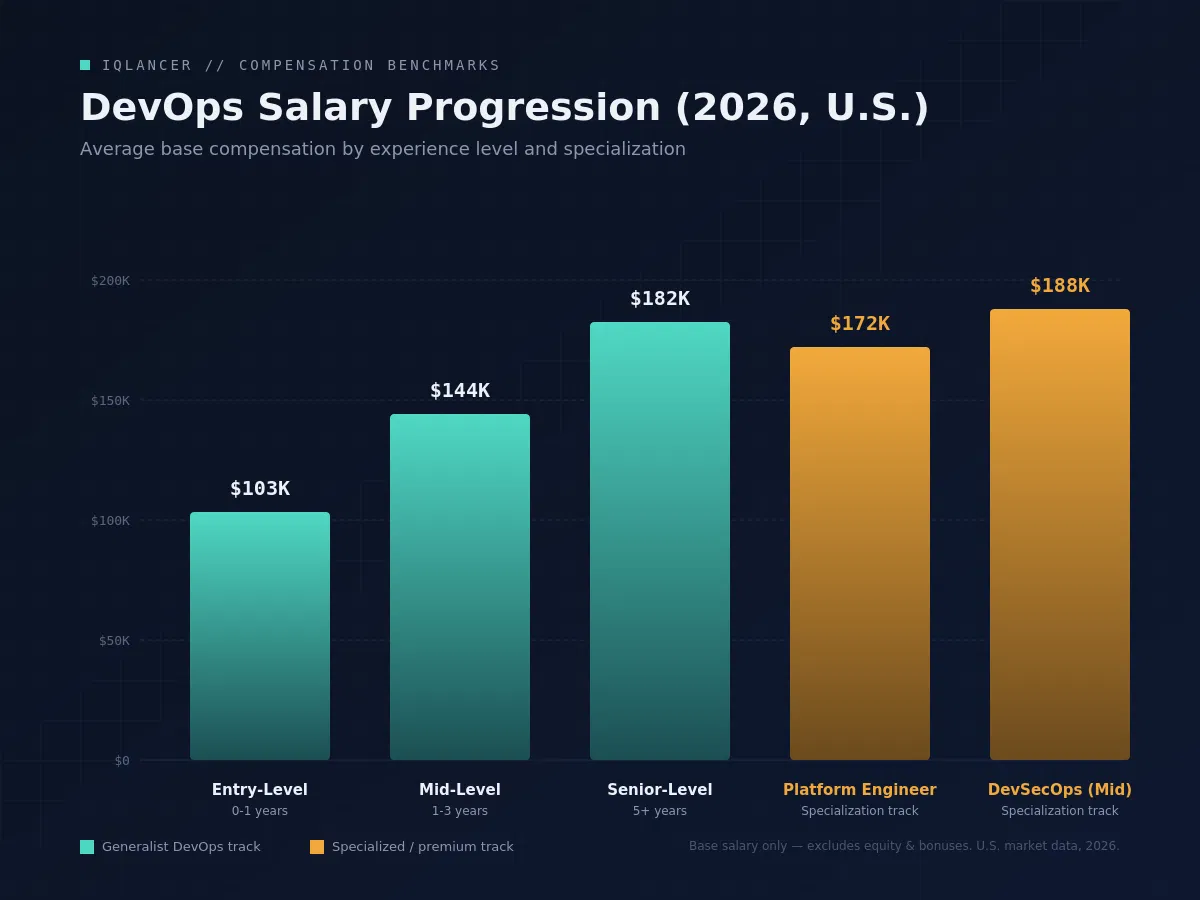
Entry-level: Depending on region and company size, entry-level DevOps compensation in the U.S. generally ranges from roughly $85,000 to $120,000, with Glassdoor’s 2026 salary data putting the average entry-level DevOps salary around $118,895, with a wide range depending on employer and location.
Mid-level: Mid-level DevOps Engineers nationally can expect to earn between approximately $128,800 and $159,300 annually according to Motion Recruitment’s 2026 IT Salary Guide, a figure that lines up closely with MentorCruise’s 2026 DevOps Salary Guide, which places the mid-level median around $130,000.
Senior-level: Glassdoor’s 2026 data shows the average salary for a Senior DevOps Engineer sits around $182,133 per year, with pay typically ranging from roughly $149,000 at the 25th percentile up to $225,000 at the 75th percentile, and top earners exceeding $270,000 including bonuses and equity at large tech companies.
Factors affecting compensation: Company size and industry matter significantly Glassdoor’s data indicates bigger companies typically pay around 35% more than smaller companies for the same DevOps title.
Specialization also carries a clear premium: candidates with in-demand certifications or niche expertise (Kubernetes security, MLOps, platform engineering) can command a 10-20% uplift over generalist compensation, per MentorCruise’s 2026 guide.
Remote work has become widely available, with the same source showing over 70% of employers now offering remote options for DevOps roles, which has partially flattened geographic pay disparities.
These figures reflect primarily U.S. market data; candidates evaluating international or India-based roles should benchmark against regional salary surveys, since absolute figures differ substantially by country even where the underlying skill expectations remain similar.
Why Candidates Get Rejected
Understanding rejection patterns is more useful than generic advice, because it tells you exactly what to fix rather than vaguely what to “improve.”
Certification without practical proof. A resume listing three certifications and zero visible projects reads as exam-passing ability, not engineering capability, and experienced interviewers probe past the certificate within the first few questions.
Tool-name-dropping without depth. Listing “Kubernetes, Docker, Terraform, Jenkins” without being able to explain a real decision you made using any of them fails almost immediately in technical screens, which are specifically designed to test past surface familiarity.
No evidence of production thinking. Candidates who can deploy something but cannot discuss rollback strategy, monitoring, or what happens when it fails signal junior-level thinking regardless of years of experience claimed.
Weak or generic GitHub presence. Forked tutorial repositories with no original commits, no README explaining decisions, and no evidence of debugging read as unconvincing to recruiters actively screening portfolios.
Practical fix: for each rejection pattern above, the fix is the same build fewer, deeper projects with documented reasoning, and be prepared to defend every line on your resume in conversation.
7 Mistakes That Prevent Candidates From Getting Hired
1. Chasing certifications before fundamentals. Many candidates jump straight to AWS DevOps Professional or CKA without solid Linux, Git, and scripting fundamentals. Recruiters see this as exam memorization rather than genuine skill.
Fix: sequence learning Linux and scripting first, cloud fundamentals second, advanced certifications last.
2. Learning tools in isolation instead of building systems. Watching a Kubernetes tutorial without ever deploying a real multi-service application leaves candidates unable to answer scenario-based interview questions.
Fix: always attach new tool knowledge to a real, end-to-end project.
3. Ignoring monitoring and observability entirely. Many self-taught candidates focus exclusively on deployment and skip monitoring, which recruiters increasingly treat as a core competency, not an optional extra.
Fix: instrument every project with real dashboards and alerts, not just deployment automation.
4. Underestimating the interview’s system-design component. Candidates prepare for tool-specific trivia but freeze when asked to design a deployment pipeline from scratch.
Fix: practice whiteboard-style system design questions specifically, not just tool syntax.
5. Treating security as someone else’s job. With DevSecOps now standard practice, candidates who cannot speak to secrets management, vulnerability scanning, or basic security principles are increasingly filtered out at mid-to-senior levels.
Fix: integrate at least basic security scanning into your CI/CD projects.
6. Not documenting decisions or trade-offs. A GitHub repository with code but no explanation of why specific architecture choices were made undersells real engineering judgment.
Fix: write a proper README for every project explaining the reasoning, not just the setup instructions.
7. Failing to demonstrate incident-response thinking. Interviewers frequently ask “what would you do if this broke in production,” and candidates who have never simulated failure scenarios struggle to answer convincingly.
Fix: deliberately break your own projects and document how you diagnosed and fixed the issue.
Career Path and Growth Opportunities
Mapping the full devops career path helps you make deliberate choices now rather than drifting into whichever role happens to be hiring, and shows recruiters you understand where you’re headed.
Entry-level progression: Most engineers start as Junior DevOps Engineer, Cloud Support Engineer, or Systems Administrator, spending 1-3 years building core automation and cloud fundamentals before taking on independent pipeline and infrastructure ownership.
Mid-level progression: DevOps Engineer roles at the 3-5 year mark typically expand into architecture-level decision-making, mentoring, and cross-team infrastructure ownership, often branching toward specialization in Kubernetes, cloud cost optimization, or CI/CD platform design.
Senior-level progression: Senior DevOps Engineer, Lead DevOps Engineer, or DevOps Architect roles typically follow, with engineers increasingly choosing to specialize into adjacent high-demand tracks rather than staying generalist.
Adjacent career paths:
- Site Reliability Engineer (SRE) : a reliability-focused evolution of DevOps, popularized by Google, with strong compensation at senior and staff levels.
- Platform Engineer : building internal developer platforms that abstract infrastructure complexity for other engineering teams; currently one of the highest-paid specializations branching from DevOps.
- DevSecOps / Cloud Security Engineer : embedding security expertise into the DevOps pipeline, valued highly as compliance and security requirements intensify.
- Cloud Solutions Architect : a natural progression for DevOps engineers with strong architecture and stakeholder communication skills.
- MLOps Engineer : supporting machine learning infrastructure, an increasingly premium specialization as companies race to productionize AI workloads.
IQLancer Readiness Checklist
Use this checklist honestly to assess where you genuinely stand before applying, rather than after receiving a string of rejections.
| Readiness Area | Beginner Signal | Competitive Signal |
|---|---|---|
| Linux & Scripting | Comfortable with basic commands | Can write automation scripts solving real problems |
| Cloud Platform | Completed guided labs on one platform | Deployed and managed real infrastructure independently |
| Containers & Kubernetes | Ran Docker containers locally | Deployed, debugged, and scaled a multi-service Kubernetes app |
| Infrastructure as Code | Followed a Terraform tutorial | Wrote original, reusable Terraform modules on GitHub |
| CI/CD | Used someone else’s pipeline | Built a complete pipeline from scratch, including rollback logic |
| Monitoring | Aware of monitoring tools conceptually | Implemented real dashboards and alerting on a live project |
| Certifications | None, or foundational-only | At least one associate/professional cert matched to real project work |
| Portfolio | Forked repos, no original commits | Documented projects with clear README explaining decisions |
| Interview Readiness | Can define DevOps terms | Can walk through incident-response and system-design scenarios confidently |
If most of your honest answers fall in the “Beginner Signal” column, focus your next 60-90 days on closing those specific gaps rather than adding more certifications.
Final Thoughts
Learning how to become a DevOps engineer in 2026-2027 comes down to sequencing: fundamentals before certifications, projects before job applications, and depth over tool-collecting. The skills that matter Linux, scripting, one cloud platform, containers, IaC, and monitoring are well-documented, but the differentiator is always the same across every hiring conversation: can you explain the reasoning behind what you built, and can you talk through what happens when it breaks.
Certifications like AWS DevOps Professional, CKA, and Terraform Associate open doors, but only when backed by real, documented project work. Pair that with clear communication and incident-response thinking, and you become genuinely competitive rather than just credentialed. Start with one solid intermediate project this month, not another course.
2 thoughts on “How to Become a DevOps Engineer: The Complete 2026-2027 Career Blueprint”