A forward deployed engineer (FDE) is a software engineer who works directly with a customer to configure, build and deploy software for that customer’s specific problem, often inside the customer’s own systems and teams.
Here is an illustrative example. A logistics company buys a data platform that looked excellent in the vendor’s demo. Back at the company, shipment records sit in three older systems, planners still work in spreadsheets, and nobody agrees which delays cost the most money. Someone has to connect those systems, build screens the planners will actually use, and keep it all running in production. That gap between building software and making it work in a customer’s environment is why many forward deployed engineer roles exist.
Palantir made this model well known. Its own job postings describe the forward deployed software engineer role as the blueprint, and The Pragmatic Engineer notes that until around 2016 Palantir had more FDEs than traditional software engineers. More recently, an a16z analysis described postings for the role as up by hundreds of percent in a single year, as other companies copied the approach.
What Is a Forward Deployed Engineer?
A forward deployed engineer is a software engineer embedded with a customer to adapt a company’s product to that customer’s real environment and keep it working in production.
“Forward” points to being placed close to where the problem is, not at headquarters. One secondary summary of WIRED’s reporting says the term appears inspired by forward-deployed troops.
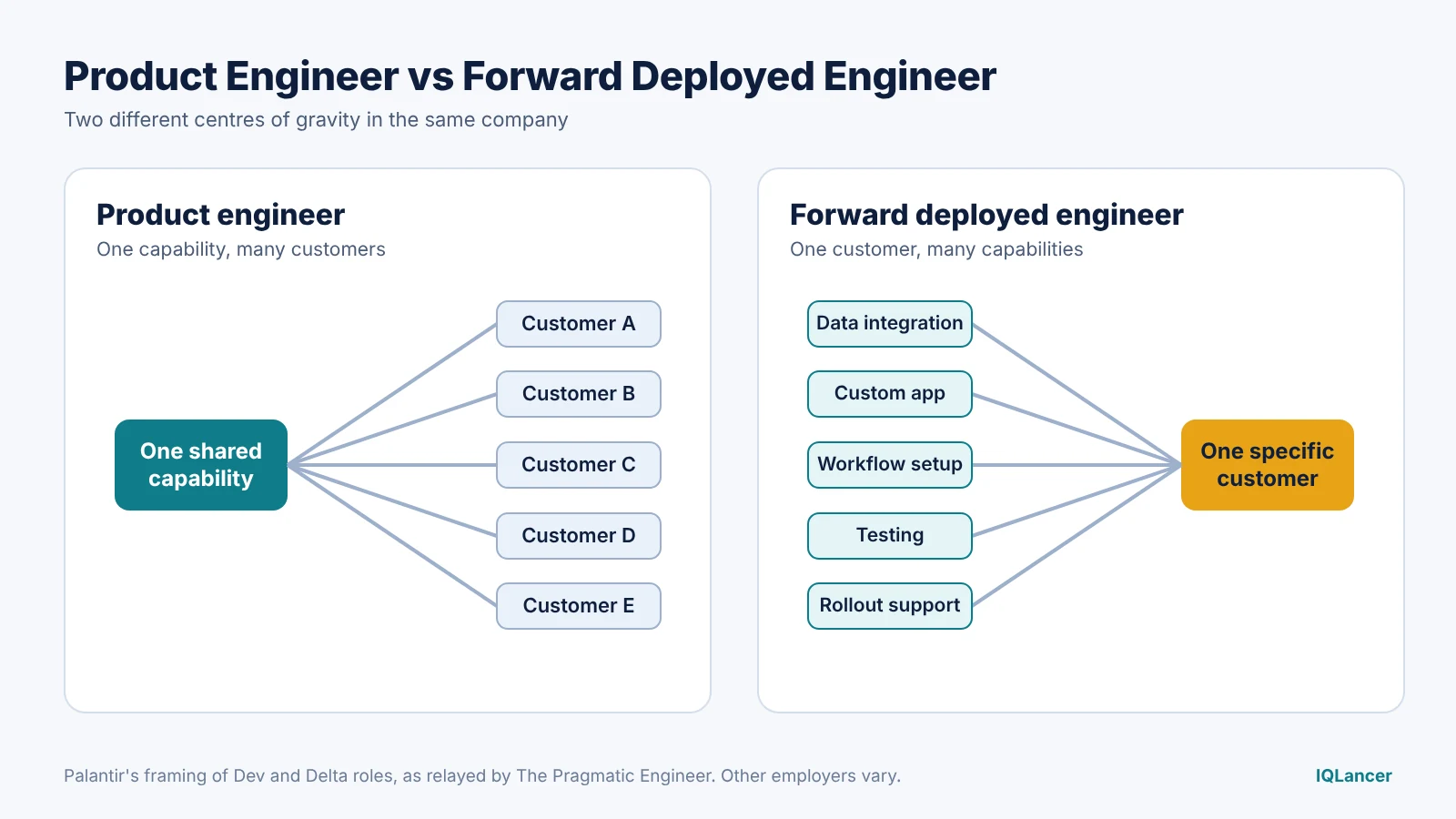
Conventional product engineering builds a capability that many customers share. Customer-facing engineering of this kind works the other way round. As relayed by The Pragmatic Engineer, Palantir describes a product engineer as focused on one capability for many customers and a Delta as focused on many capabilities for one customer. This is why the job blends engineering with customer problem-solving. The engineer must understand the customer’s business well enough to decide what is worth building.
FDSE stands for Forward Deployed Software Engineer, which is Palantir’s title for the role. Palantir’s postings say FDSEs work directly with customers to understand their biggest problems and implement data-driven solutions. Other employers use FDE or variants such as FDSWE in OpenAI’s NYC posting.
Responsibilities vary because the role is still defined company by company. The Pragmatic Engineer observes that some employers emphasise closing sales, some helping customers, and others contributing to the core product.
What Does a Forward Deployed Engineer Actually Do?
A forward deployed engineer typically takes a customer problem from first conversation to working production software, then improves it using feedback. This is a common pattern, not a fixed workflow every employer follows.
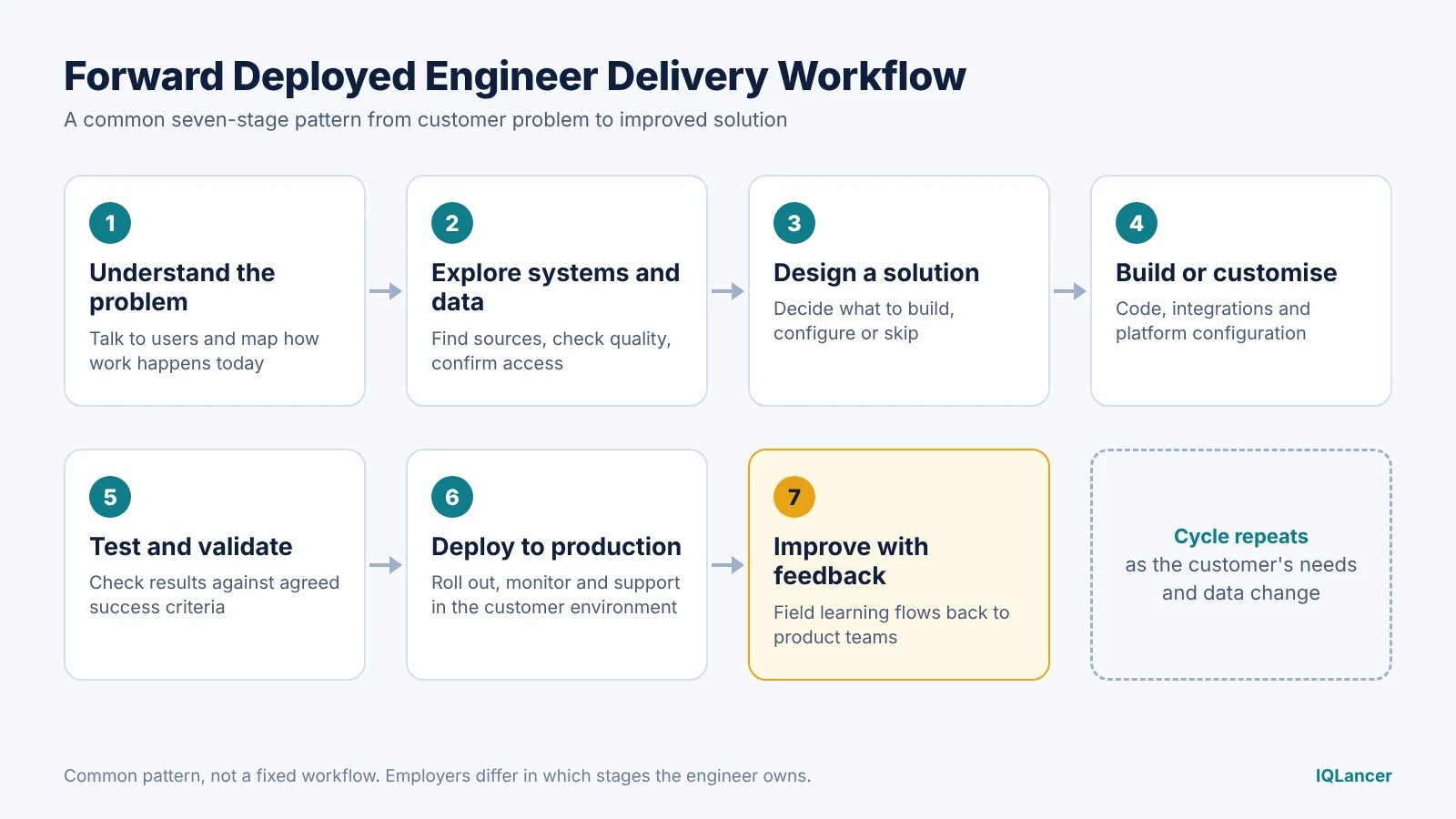
- Understand the customer’s problem. Palantir says projects often begin with an open-ended question, such as why a customer is delaying so many flights. The engineer sits with users, maps how work happens today and clarifies what “better” means in measurable terms.
- Explore systems and data. Next comes finding where the data lives, how reliable it is and who controls access. OpenAI’s head of FDE told The Pragmatic Engineer that what customers describe in scoping often differs from the data and system reality.
- Design a solution. The engineer decides what to configure, what to build and what to leave out. In OpenAI’s described approach, the aim is the smallest end-to-end solution that can be demonstrated.
- Build or customise software. This may be custom applications and data integrations on a vendor platform, as in Palantir’s US government posting, or full-stack systems as in OpenAI’s FDE posting.
- Test and validate. The engineer agrees success criteria with the customer and checks results against them. For LLM work, this can include building evaluations (structured quality checks) before full delivery.
- Deploy into production. Rollout means handling security, environment limits and monitoring. Palantir’s Tactical Edge posting covers deploying software across varied hardware and debugging infrastructure, networking and application issues.
- Improve through feedback. Field learning flows back to product teams. OpenAI’s posting says success is measured through production adoption, workflow impact and feedback that changes product and model roadmaps.
What Are the Main Responsibilities of an FDE?
The main responsibilities of a forward deployed engineer fall into six areas: discovery, development, integration, AI/ML work where relevant, production support and product feedback. The workflow above shows the order of work. This table shows what an FDE owns.
| Responsibility | What it involves | Where postings show it |
|---|---|---|
| Customer discovery and requirement analysis | Turning an ambiguous business question into scoped, testable work | OpenAI lists discovery and technical scoping |
| Software development and customisation | Building applications, workflows and configurations on or around the company’s platform | Palantir, C3 AI |
| Data and API integration | Connecting customer systems, data feeds and scripts to the platform | Bluecore |
| AI/ML implementation, where relevant | Building LLM or ML features and measuring their quality | OpenAI, C3 AI |
| Deployment and production support | Rolling out, monitoring and fixing issues in the customer’s environment | Palantir Tactical Edge |
| Customer communication and product feedback | Explaining trade-offs to stakeholders and passing field insight to product teams | OpenAI |
Which areas dominate depends on the employer and the product.
Is Forward Deployed Engineering Only About AI?
No. The model predates the current AI wave and covers integrations, data platforms and enterprise applications as well as AI and GenAI work.
Traditional integrations. Bluecore’s earlier postings (one on The Muse is dated August 2020) describe writing JavaScript integrations, configuring an internal domain-specific language and working with clients. A November 2025 team-lead posting describes a client-facing team handling data feeds and website scripts. Bluecore markets itself as an AI-driven platform, so “non-AI” applies to the FDE tasks described, not the product.
Data and enterprise applications. Palantir’s US government posting lists application development and data integration, using tools such as Java, Python, Spark and TypeScript.
Modern AI. OpenAI describes FDEs leading deployments of frontier models in production. C3 AI’s London posting describes building full-stack AI applications on its platform with customers.
It is more accurate to see FDE as a delivery model than as an AI job.
What Types of Forward Deployed Engineer Roles Exist?
Employers use several FDE-style titles. These are practical variations seen in job postings, not an official or universal classification.
- Forward Deployed Software Engineer. Focuses on custom software and integrations for one customer on a vendor platform, as in Palantir’s postings.
- AI Forward Deployed Engineer. Focuses on making AI systems work in production. Accenture’s posting describes a production engineer embedded in a client’s enterprise to make complex AI platforms work.
- Forward Deployed Data Engineer. Focuses on pipelines and migrations. A Datafold listing (on an aggregator site) describes owning delivery of data platform migration projects.
- Forward Deployed Infrastructure Engineer. Focuses on deploying and upgrading a platform inside customer environments. Sierra’s posting stresses security, compliance and operational requirements.
- Forward Deployed Security Engineer. Focuses on securing deployments or deploying security tooling. OpenAI’s posting is about securing applications of its technology, and TENEX’s posting is about deploying and advising on security tools.
- Forward Deployed Reliability Engineer. The closest title seen in postings is Forward Deployed Site Reliability Engineer at Twenty, focused on reliability and incident response in a restricted environment.
Skills and specialisations will be covered in Forward Deployed Engineer Skills.
Forward Deployed Engineer vs Software Engineer vs Solutions Engineer
A forward deployed engineer usually builds and deploys for one customer, a product software engineer builds shared capabilities for many, and a solutions engineer usually advises and demonstrates. Overlap is common.
| Aspect | Forward Deployed Engineer | Software Engineer (product) | Solutions Engineer |
|---|---|---|---|
| Main purpose | Make the product work for a specific customer | Build and maintain capabilities many customers use | Help customers evaluate, adopt and design around a product |
| Coding | Often substantial, sometimes on customer infrastructure | Core of the job | Varies; often prototypes, demos or scripts |
| Customer interaction | High and ongoing | Usually indirect | High, often pre-sales or advisory |
| Work environment | Mix of customer sites, remote and internal teams | Company engineering teams | Mix of customer calls and internal work |
| Deployment responsibility | Often owns rollout in the customer’s environment | Ships product releases; customer rollout is rarely owned | Usually design guidance, with hand-off after approval |
| Typical success outcomes | Production adoption, measurable customer result | Product quality, reliability, use across customers | Successful pilots, onboarding, closed deals |
These are tendencies, not rules. The Pragmatic Engineer reports that at OpenAI, solutions architects are more advisory and rarely write code on customer infrastructure, while FDEs do. Cognizant’s glossary draws a similar line, with architects owning the design and FDEs owning the running system.
The boundaries blur in practice. A Bluecore posting asks its FDE to act as a sales engineer before launch, and a16z argues that some companies relabelled solutions and integration engineers as FDEs. Product engineers also carry long-term platform quality, which FDEs rarely own.
How Do Forward Deployed Engineers Work With Other Teams?
FDEs sit between customers and a company’s internal teams, so they collaborate widely, and boundaries differ by employer.
- Software Engineering: FDEs flag product gaps and sometimes contribute fixes to the core product.
- Data Engineering: In many teams, FDEs depend on shared data models and pipelines, and request changes when customer data does not fit.
- AI/ML Engineering: At OpenAI, FDEs hold regular knowledge-sharing sessions with Research.
- Product Management: Field findings reach Product through readouts. OpenAI’s posting names Product and Research.
- Solutions Engineering: OpenAI’s FDSWE posting says FDEs work alongside solutions engineers and architects on the same account.
- Customer Success: The same posting names customer success managers.
- Security and Infrastructure: OpenAI’s FDE posting lists Security and GRC teams.
Structures differ. Palantir’s postings mention Deployment Strategists, and OpenAI’s Platform team embeds with customer-tagged FDE pods.
How Do Companies Use Forward Deployed Engineers?
Companies use FDEs to close the gap between a product and a working customer deployment. Each company below applies the model differently.
Palantir. Palantir pioneered the model and says its FDSEs embed with customers to deploy and customise its platforms. After Foundry launched in 2016, more FDEs moved into core product work.
OpenAI. Its FDEs lead complex deployments of frontier models in production with strategic customers. They own work from discovery to rollout and feed results back to Product and Research.
C3 AI. The title covers two flavours in its listings. The London posting is about building full-stack AI applications with customers, while a Redwood City listing centres on product support for the C3 AI Services team.
Bluecore. Its FDE unit is described in a 2025 posting as a client-facing engineering team for data feeds and website scripts. Current openings were not confirmed.
Accenture. It is building FDE capacity as a services model, including a practice with Microsoft and a Google Cloud group planning up to 1,000 FDEs. Accenture calls them reinvention deployed engineers in one partnership.
What Does a Forward Deployed Engineer’s Typical Workday Look Like?
There is no universal workday. The table below is illustrative, not a schedule any employer guarantees.
| Time | Activity | Category |
|---|---|---|
| 9:30 | Stand-up with the delivery team; review blockers | Team coordination |
| 10:30 | Working session with the customer’s operations users | Customer discussion |
| 12:00 | Investigate why a source system’s records do not match | Technical investigation |
| 14:00 | Write integration code; review a teammate’s pull request | Engineering and coding |
| 16:00 | Run tests against the criteria agreed with the customer | Testing and validation |
| 17:00 | Write up field feedback for the product team | Customer feedback |
Palantir FDEs quoted in 2019 described very different weeks. One said some weeks are mostly coding and others mostly scoping with a client, according to The Pragmatic Engineer.
What Should You Check Before Applying for an FDE Job?
Read the posting for what the role actually owns, because FDE titles cover very different jobs.
- Production coding expectations: Does it ask for production-grade code, as OpenAI’s posting does, or mainly configuration and support?
- Customer discovery responsibilities: Will you scope problems yourself or receive defined tasks?
- Deployment ownership: Do you own production rollout and incident response, or hand off after building?
- Technical specialisation: Is the focus software, AI, data, infrastructure or security?
- Customer interaction: Who will you talk to, and how often?
- Travel and onsite requirements: Check only if specified. Palantir’s Chicago listing states up to 25%, while OpenAI’s Platform role says travel is not required. If a posting is silent, ask.
Frequently Asked Questions About Forward Deployed Engineers
What does a Forward Deployed Engineer do?
They build, configure and deploy software for a customer’s problem, from discovery to production support. The balance depends on the employer.
What does FDSE mean at Palantir?
Forward Deployed Software Engineer. Some employers use the same abbreviation for Forward Deployed Security Engineer, as in a Cyrad listing, so check the context.
Is a Forward Deployed Engineer a software engineer?
Usually yes, in background. Palantir’s NATO posting asks for a strong engineering background. Palantir still treats product (Dev) and deployment (Delta) as separate tracks, and titles vary elsewhere.
Is Forward Deployed Engineering only about AI?
No. See the AI section above for non-AI examples.
Do Forward Deployed Engineers write code?
Generally yes. Palantir’s Chicago listing asks for a strong coder. Some listings lean toward support, so read the duties.
Do Forward Deployed Engineers work directly with customers?
Yes, that is the defining feature. It can mean being embedded onsite or running regular working sessions remotely.
Do Forward Deployed Engineers need to travel?
It depends on the role. A March 2026 Anthropic posting (since closed) estimated about 25% travel, and C3 AI’s London posting asks for onsite work and travel as needed.
What is the difference between an FDE and a Solutions Engineer?
An FDE usually owns hands-on building and running of the solution, while a solutions engineer usually advises, demonstrates and designs. Companies overlap these titles, as the comparison table shows.
Conclusion: What Makes Forward Deployed Engineering Different?
Forward deployed engineering combines software engineering, customer understanding and responsibility for what runs in production. The job is not only writing code or only advising customers. It is making software work in a messy real environment.
The next step is understanding the path into the role How to Become a Forward Deployed Engineer.