Engineering teams move testing earlier because defects found late are harder to diagnose, slower to fix and more likely to delay a release. The Carnegie Mellon Software Engineering Institute (SEI) lists the usual consequences of late testing. Testers are less involved in planning, requirement and design defects survive until after significant implementation effort, and debugging gets harder as more code is integrated.
In a traditional model, developers build a feature and hand it to a separate test team. Feedback arrives long after the code was written, when context has faded and many changes are stacked together. Shift-left testing addresses this by moving quality activities such as reviews, test design, automated checks and security validation earlier in the software development life cycle (SDLC).
Earlier testing is not a QA-only change. The people who write requirements, write code and maintain the delivery pipeline all shape quality, so shift-left testing only works when responsibilities and accountability are clear. IQLancer covers the definition, the four approaches described by SEI, the engineering practices behind them, how quality ownership should be distributed, an illustrative payment-processing example, and how to implement and measure the change.
What Is Shift-Left Testing?
Shift-left testing is the practice of performing testing and quality activities as early as practical in the SDLC, so teams get feedback while a change is still small and its context is fresh. SEI describes it as beginning testing as early as practical in the lifecycle. The ISTQB Foundation syllabus treats it as another name for the principle of early testing.
“Left” comes from the V-model, where requirements, design and implementation sit on the left and integration and testing sit on the right. Moving testing left means that validation starts closer to where defects are introduced.
One terminology note matters. SEI uses “testing” narrowly, meaning executing software against expected behavior. It treats inspections and static analysis as non-testing methods that were always early, and suggests “shift-left quality assurance” for the broader idea. This article uses shift-left testing in the wider sense common in industry and ISTQB material, which includes reviews and static analysis.
Shift-left is more than asking QA engineers to start sooner. It can include earlier QA/QE involvement, testable acceptance criteria, test-driven development, static analysis, early API and contract validation, automated tests during development, earlier security checks and closer collaboration between developers, QA and other stakeholders.
| Aspect | Waterfall / V-model testing | Shift-left testing |
|---|---|---|
| When tests are designed | After requirements, often after build | During requirements and design |
| Who finds defects | Mostly a separate test phase | Developers, QA/QE and automated checks throughout |
| Feedback loop | Long, because testing waits for integrated software | Short, because checks run as changes are made |
| Typical weakness | Late discovery and compressed test time | Needs reliable automation and clear ownership |
Under the right conditions, shift-left testing can give faster feedback, earlier defect visibility, less downstream rework and more confidence at release. The mechanism is a shorter distance between introducing a defect and finding it. The conditions matter, though.
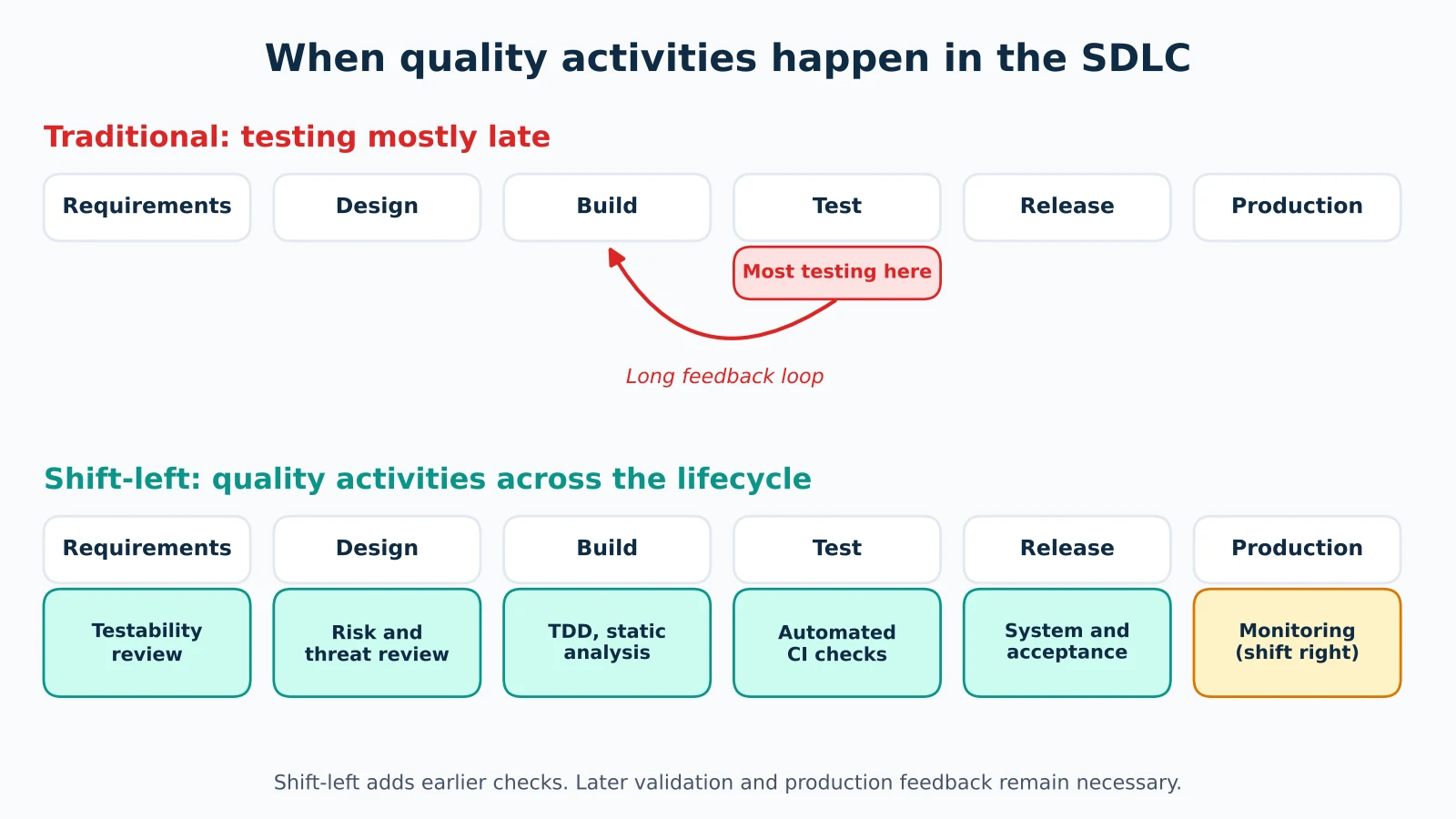
Microsoft’s guidance aims for most testing to finish before a change merges and stresses that early tests must be fast and reliable. Slow or flaky checks erode trust. Shift-left does not automatically cut cost, remove defects or speed up every release.
It also does not eliminate later testing. The ISTQB syllabus says shifting left does not mean testing later in the SDLC should be neglected. Teams still need system validation, acceptance testing, performance validation and production monitoring. Microsoft notes that some tests cannot run without deploying part or all of a solution, which is why “shift right” (testing and learning in production) complements shift-left.
What Are the Four Established Approaches to Shift-Left Testing?
SEI’s Donald Firesmith described four approaches to shift-left testing in 2015: traditional, incremental, Agile/DevOps and model-based. SEI presents them as a historical progression in which each builds on the previous one. They are not a ranking, and organisations often combine them. Security and API testing are applications of shift-left practices, not a fifth SEI approach.
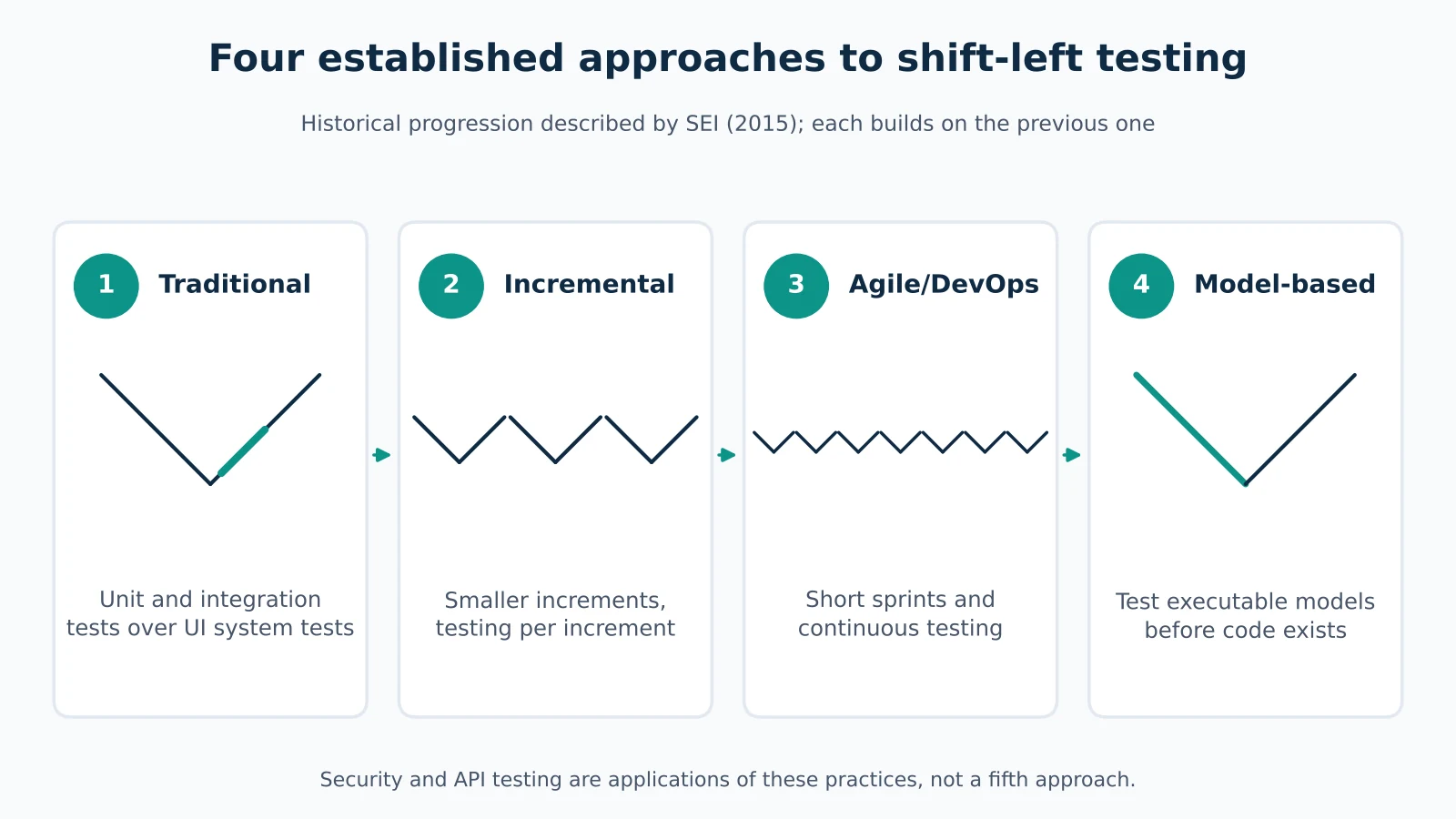
1. Traditional shift-left testing. Its central idea is to move emphasis lower on the right side of the V. Instead of leaning on UI-based system and acceptance tests, teams concentrate on unit and integration testing, for example through API-level tests. It suits teams with slow, brittle UI suites. As an illustration, a team with hundreds of slow UI checks might add component and API tests that run in minutes. The consideration is that testing can still wait until software exists, so requirement and design defects may remain hidden.
2. Incremental shift-left testing. Here a single large waterfall V is split into a small number of shorter increments, so each increment’s testing happens earlier. When each increment is also delivered to the customer and operations, operational testing shifts left as well. SEI notes it is popular for large, complex systems, especially those with significant hardware. The consideration is that increments are still relatively few and long, so feedback is slower than in Agile teams.
3. Agile/DevOps shift-left testing. This replaces large Vs with many short ones (sprints), introducing continuous testing and sometimes test-first or TDD. SEI points out that Agile testing is typically limited to developmental testing, while operational testing occurs once the system is in use. It suits teams that release frequently. The consideration is that fast cycles need dependable automation, and system-level and operational validation must still be planned deliberately.
4. Model-based shift-left testing. This moves testing before software exists by testing executable requirements, architecture and design models. SEI argues that waiting for software limits testing to coding defects, and states that 45 to 65 percent of defects are introduced in requirements, architecture and design. That figure is the SEI author’s statement and should be read as such. SEI described this approach as just beginning and dependent on executable models and simulation tools. The consideration is modelling effort, tooling and skills, which makes it most realistic where such models already exist.
What Practices Help Teams Implement Shift-Left Testing?
The practices that make shift-left testing work share one purpose: shortening the time between making a change and learning whether it is correct or risky. Each one catches a different kind of problem, so the goal is to match the practice to where defects actually originate.
Test-Driven Development (TDD)
In TDD, a developer writes a failing test, writes the simplest code that passes it, then refactors. The ISTQB syllabus lists TDD alongside ATDD and BDD as test-first approaches. The engineering purpose is to force clarity about expected behavior before implementation and to leave behind fast unit tests. The limitation is that unit tests cannot show that integrated components work together, and weak tests create false confidence.
Static Code Analysis and Early Code Reviews
Static analysis and peer review examine code without running it. Linters and analyzers flag risky patterns, and reviewers catch design and logic problems before later test stages. SEI notes these verification methods have always been used early in development. Their limits are false positives and blind spots. They cannot confirm runtime behavior or detect a requirement that was misunderstood.
Early QA Involvement and Testability Reviews
The ISTQB syllabus says testers should review work products as soon as drafts are available. In practice, QA/QE professionals review acceptance criteria for ambiguity, ask how each behavior will be observed, and flag missing error cases. A testability review asks whether outputs can be observed, dependencies controlled and test data created. The limitation is that this needs QA capacity during refinement and requirements stable enough to review.
Continuous Integration and Automated Testing
When developers integrate changes frequently, automated checks run on every change and report problems while the change is fresh. DORA’s research suggests feedback from automated tests should arrive in under ten minutes, locally and from CI. It also finds that performance improves when developers are primarily responsible for creating and maintaining automated tests. Tolerating unreliable tests is a named pitfall. Pipeline design belongs to a separate IQLancer article.
Shift-Left Security and API Testing
The OWASP DevSecOps Guideline aims to detect design flaws and application vulnerabilities as early and as cheaply as possible, and to keep detecting them continuously. It covers practices such as threat modeling, secrets management and static application security testing (SAST). For APIs, consumer-driven contract testing has the calling service specify the interactions it expects, which the providing service then verifies. PactFlow explains that this does not stop breaking changes from being released, but it highlights them as early as possible. Limitations: contract tests check interface expectations, not business correctness or full workflows, and SAST cannot find every runtime or configuration issue, so later security assessment remains necessary.
Why Does Shift-Left Testing Fail Without Software Quality Ownership?
Shift-left testing fails when earlier findings have no owner. Automation and earlier QA involvement only improve quality if someone clarifies the ambiguous requirement, fixes the defect, repairs the unreliable test and makes the risk decision. DORA reports that when other groups own test automation, suites are often broken and the pipeline stays broken until the responsible team fixes the tests.
Shared Quality Ownership vs. Dedicated QA Models
Shared quality ownership means product, development, QA/QE and operations all hold responsibility for quality, with QA/QE acting as specialists and coaches. It works well in cross-functional product teams with solid automation. Its risk is that “everyone owns quality” quietly becomes “no one is accountable” unless decisions have named owners, and developers need testing skills.
Dedicated QA teams provide test strategy, specialist skills (such as performance or accessibility testing) and independence. They can suit regulated or complex domains. The risk is handoffs and bottlenecks, and developers may stop treating quality as their job.
Isolated testing silos, where a separate group tests after development with little collaboration, are the pattern shift-left testing was designed to correct. They may persist for contractual or regulatory reasons, but they should be recognised as a delivery risk. No model fits every organisation.
Who Is Responsible for Software Quality?
Many people contribute to quality, but specific decisions need one accountable owner. The matrix below is a general illustration, not a universal structure, because many organisations have no separate SRE, platform or security team and combine these roles. These are the core DevOps team responsibilities for quality, and QA responsibilities in DevOps sit alongside them.
It uses RACI: R = Responsible (does the work), A = Accountable (one owner per row who answers for the outcome), C = Consulted, I = Informed. RACI is distinct from ARCI, and a task should have exactly one A.
| Activity or decision | Product Owner | Developer | QA/QE | DevOps / Platform | SRE / Service Owner | Security |
|---|---|---|---|---|---|---|
| Business acceptance criteria | A/R | C | C | I | I | C |
| Unit tests and code-level defect fixes | I | A/R | C | I | I | I |
| Test strategy and risk-based test design | C | C | A/R | C | C | C |
| CI/CD reliability and deployment automation | I | C | C | A/R | C | C |
| Security requirements and risk guidance | C | C | C | C | I | A/R |
| Quality evidence and release-risk summary | I | R | A/R | R | C | C |
| Release go/no-go decision | A | C | C | R | C | C |
| Operational risk after release | C | C | I | C | A/R | I |
Four things are easy to confuse. Performing a task, being accountable for its outcome, approving a release and accepting business or operational risk can sit with different people. A QA professional can supply the evidence for release readiness without holding authority to approve every production release.
Code Ownership, Defect Ownership and Release Ownership
Defects. The team that owns the component investigates and fixes code-level defects. QA/QE supplies reproduction steps, impact and retesting, and the Product Owner helps prioritise. Unresolved defects should follow an agreed escalation path, from team triage to the service owner or engineering manager, and finally to the Product Owner when business risk must be accepted. Define severity thresholds and time limits in advance.
Release risk. QA/QE compiles quality evidence: what was tested, what was not, open defects and residual risks. The service owner assesses operational readiness, security gives risk guidance, and the Product Owner or designated release owner makes the go/no-go call and accepts business risk. Who coordinates release readiness varies, and may be a release manager, DevOps lead or engineering manager.
QA should not automatically own every quality or release decision. A gatekeeper role recreates the silo shift-left testing is meant to remove, and it separates the decision from the people who weigh the trade-offs.
How Does Shift-Left Testing Work in a Real Engineering Scenario?
This is an illustrative example, not a case study. A software team is adding a card payment feature that calls an external payment gateway. Real workflows vary by organisation.
| Stage | What the team does and how shift-left contributes | Roles involved | Quality evidence |
|---|---|---|---|
| 1. Requirements and acceptance criteria | Clarify outcomes for success, decline, timeout, duplicate submission and refund. QA/QE asks how each case will be observed and simulated, finding ambiguity before coding. | Product Owner, QA/QE, Developer, Security | Agreed criteria with examples, logged open questions |
| 2. Design and risk identification | Review which data the system will store, rank risks such as double charging, plan safe retries and decide what monitoring is needed. | Developer, QA/QE, Security, SRE/Service Owner | Risk list, threat-model notes, test focus for high-risk areas |
| 3. Development and early validation | Write unit tests first for amount calculation and retry logic. Run static analysis and secret scanning, and hold peer review. | Developer, QA/QE | Unit tests, analysis results, review comments |
| 4. Automated testing and integration | Run unit, component and API contract tests on each change, using stubs or a gateway sandbox. Failures return within minutes. | Developer, DevOps/Platform, QA/QE | Pipeline results, contract verification status, test duration trend |
| 5. Defect identification and resolution | A contract check flags a changed gateway response. Exploratory testing finds a duplicate charge on double-tap. Developers fix, QA/QE verifies, and regression tests are added. | Developer, QA/QE, Product Owner | Defect records noting where each was introduced and found, new regression tests |
| 6. Release readiness and deployment | QA/QE summarises evidence and residual risk. System, acceptance and performance validation still run. DevOps deploys gradually, SRE confirms alerts and rollback, and the Product Owner decides go/no-go. | QA/QE, DevOps/Platform, SRE, Security, Product Owner | Release-readiness summary, performance results, recorded decision |
| 7. Production feedback and improvement | Track payment success and error rates. Incident reviews feed new tests and sharper acceptance criteria. | SRE/Service Owner, Developer, QA/QE, Product Owner | Dashboards, incident reviews, added tests |
How Can Engineering Teams Implement and Measure Shift-Left Testing?
A team can implement shift-left testing by finding where defects currently surface, then adding the cheapest earlier check that would have caught them, with clear owners. Start with evidence from past releases, not a tool purchase.
A Practical Implementation Roadmap
- Identify where defects are discovered. Review recent releases. For each defect, record where it was introduced and where it was found (requirements, development, CI, QA, acceptance, production). The largest gap between those two points shows where earlier checks pay off.
- Involve QA/QE in requirements and design. Add a testability review to backlog refinement, and require testable acceptance criteria before work starts.
- Introduce suitable early practices. Match practice to problem. Logic errors suggest unit tests or TDD, integration breaks suggest contract tests, and misunderstood requirements suggest example-based criteria. Pilot with one team or service.
- Integrate automated checks into development workflows. Run fast checks on every change, set a feedback-time target (DORA suggests under ten minutes), quarantine flaky tests quickly and give every failing check a named owner.
- Define ownership and escalation. Agree a responsibility matrix, defect triage rules, release-readiness criteria and who approves releases.
- Review outcomes and improve. In retrospectives, trace escaped defects to their origin, add an earlier check, and retire tests that no longer add value.
Common Adoption Challenges
- Late QA involvement: QA joins after design decisions are made, so testability problems become expensive. Fix it by adding QA/QE to refinement.
- Poor acceptance criteria: Vague criteria produce vague tests. Use concrete examples, including failure cases.
- Flaky and poorly maintained tests: Unreliable results train teams to ignore failures. Track, quarantine and repair them.
- Slow feedback loops: Heavy suites on every change discourage frequent integration. Keep fast checks fast and move slow suites later.
- Skills gaps and resistance to shared ownership: Developers may lack testing skills, and some roles fear losing status. Pair developers with QA/QE and clarify how roles evolve.
- Unclear release accountability: Without a named decision owner, QA becomes a default gatekeeper. Use the matrix above.
How Should Teams Measure Shift-Left Effectiveness?
No single metric proves shift-left testing is working. Use a small set, read them together and watch trends.
- Defect escape rate (defects found after a stage that should have caught them): shows whether earlier checks catch problems. It depends on consistent defect classification and can be gamed by under-reporting.
- Time to detect defects: shows whether feedback is getting shorter. It does not reveal defects nobody has found yet.
- Time to resolve defects: reflects ownership and triage. It can fall simply because teams close easy defects first.
- Automated test execution time: shows whether feedback stays usable. Fast tests can still be low value.
- Flaky test rate: indicates trust in automation. It needs a consistent definition of “flaky”.
- Rework and unplanned work: shows whether late surprises are shrinking. It is hard to measure without disciplined work tracking.
- Change failure rate: one of DORA’s software delivery metrics, commonly the share of production changes needing remediation such as a rollback or hotfix. It reflects many factors beyond testing, and DORA’s guidance lists pitfalls to avoid when adopting its metrics.
Treat production feedback as a complement, not a replacement. As Microsoft’s shift-right guidance explains, some risks only appear in a deployed system. Also avoid turning any metric into a target, because teams will optimise the number instead of the quality.
What Does Shift-Left Testing Mean for QA and DevOps Professionals?
Shift-left testing changes how responsibilities are expressed, but expectations vary widely by employer. QA responsibilities in DevOps can evolve towards quality engineering: designing test strategy, improving testability, building automation and guiding risk decisions, in addition to executing tests. Developers need stronger validation skills, because they write and maintain many of the earliest checks. DevOps and platform professionals contribute reliable test infrastructure, fast pipelines and environments that make early feedback practical.
Capabilities that tend to matter include programming, test automation, API testing, CI/CD familiarity, risk-based testing, debugging and collaboration with product and engineering colleagues.
Practical project evidence can show these capabilities better than a list of tools:
- A small API service with unit tests, contract tests and CI that reports execution time.
- A risk-based test strategy for one feature, with reasoning for what is tested early and later.
- A defect log showing where each bug was introduced and caught, with the earlier check added afterwards.
- A short ownership note describing who fixes, escalates and approves.
Conclusion: Shift-Left Testing Is a Development-Wide Quality Practice
Shift-left testing means testing and quality activities begin earlier in the SDLC, through approaches SEI describes as traditional, incremental, Agile/DevOps and model-based. Practices such as TDD, static analysis, testability reviews, continuous integration and early API and security checks make that earlier feedback faster and more useful. Clear responsibilities and single accountable owners make those practices sustainable, and later-stage validation and production feedback remain essential.
A useful next step is to take your last five escaped defects, trace each to where it was introduced, and ask which earlier check and which named owner would have caught it.