You can spend years writing SQL, shipping dashboards and answering stakeholder requests, and still watch the next promotion stay out of reach. The numbers explain part of this. In Pave’s analysis of 245,000 US tech employees, the average annual promotion rate was 14%.
That means roughly 86% of employees were not promoted in that 12-month window (our arithmetic, not Pave’s claim), and rates were lower at higher levels. With odds like these, how to become a Senior Data Analyst is less about collecting tools and more about proving ownership, judgment, influence and impact.
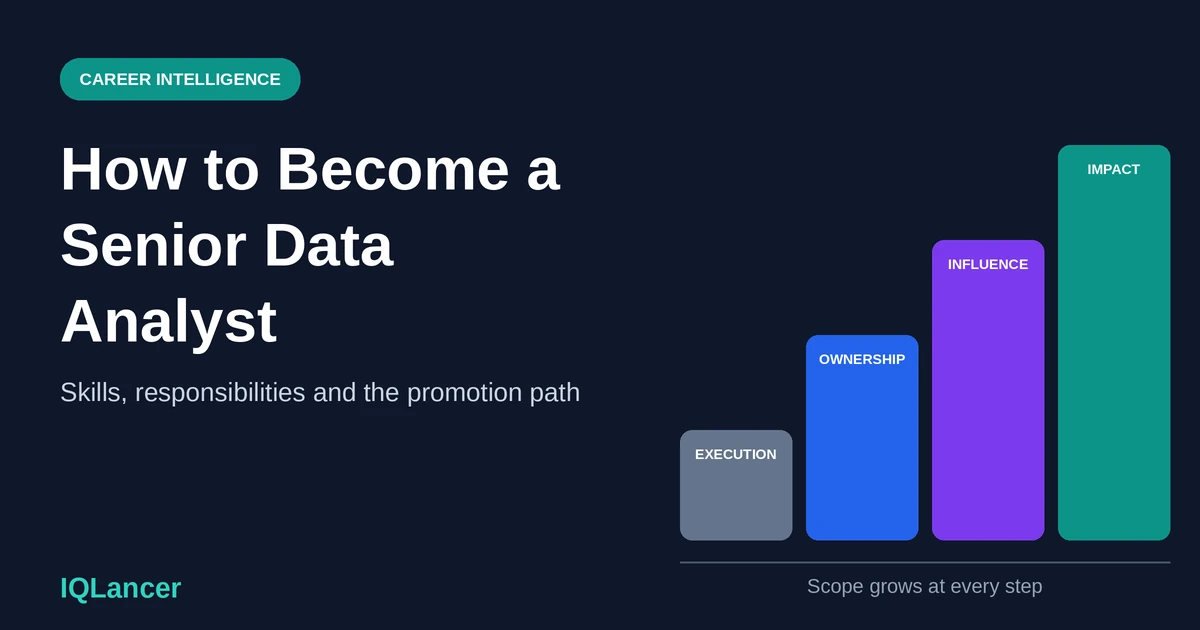
IQLancer follows one path: EXECUTION → OWNERSHIP → INFLUENCE → IMPACT. It shows what each step looks like in real work.
What Is a Senior Data Analyst?
A Senior Data Analyst typically goes beyond executing assigned analysis to independently frame problems, own analytical work, influence stakeholders and connect findings to business decisions.
That sentence describes a pattern, not a universal standard. The title covers very different jobs. One university job classification for Senior Data Analyst centers on managing master data, data quality and the reporting environment. A 2026 UK posting for the same title asks the analyst to define KPIs, mentor junior analysts and present findings to senior leadership with a business impact narrative. Same title, very different scope. Titles, as it turns out, are a weak signal of seniority.
Across employers, the senior-level pattern usually includes six things:
- Scope: the problems are larger and less defined.
- Independence: less direction is needed to reach a sound answer.
- Problem ownership: the analyst is accountable for the outcome, not just the output.
- Business context: findings are tied to how the organization makes money, spends money or serves customers.
- Stakeholder interaction: the analyst advises rather than only responds.
- Team contribution: other analysts get better because of the senior analyst’s work.
Table 1: Data Analyst vs Senior Data Analyst (common pattern, not a universal leveling standard)
| Dimension | Data Analyst | Senior Data Analyst |
|---|---|---|
| Problem | Usually receives a defined question | Helps define the problem |
| Ownership | Owns assigned analysis | Owns the analytical outcome |
| Stakeholders | Responds to requests | Challenges, advises and influences |
| Complexity | Handles defined analytical tasks | Handles ambiguity and complex problems |
| Team | Individual contribution | May improve team capability |
| Impact | Produces useful analysis | Connects analysis to decisions and outcomes |
Organizations level differently. Some compress these distinctions, and others split them across more titles.
The goal is not to look senior. The goal is to produce evidence that your scope has already expanded.
How Is Senior Different From Data Analyst?
The biggest difference is not technical difficulty. It is the scope of the problem, the level of ownership, independence, judgment and business influence expected from the analyst.
TDWI’s 2026 piece on the data career ladder makes a similar point. It describes the move to senior as largely about how much ambiguity an analyst can absorb, including questions where part of the job is deciding what should be asked at all. Technical skills sharpen along the way, but the bigger shift is operating independently where a more junior analyst would stall.
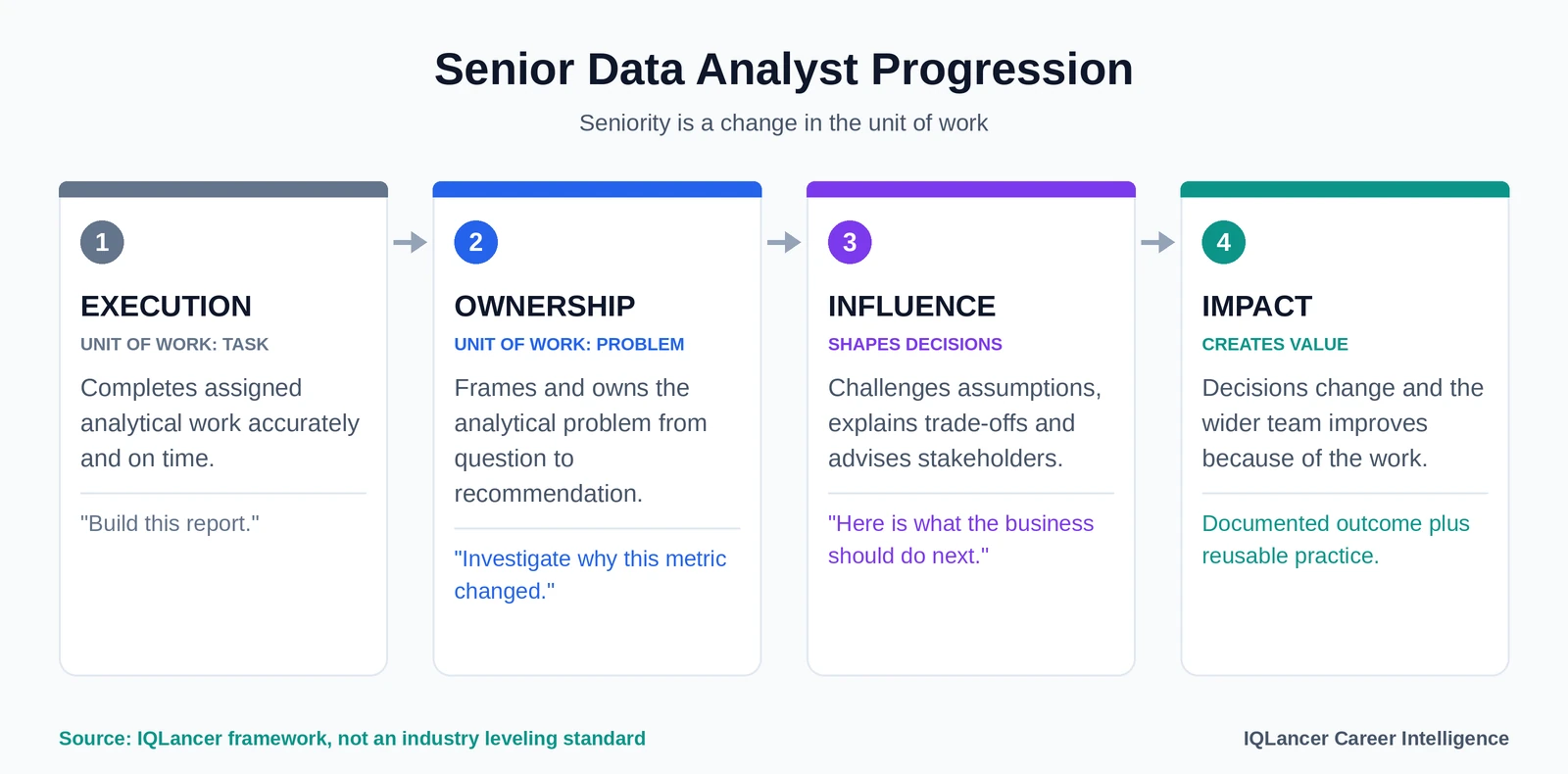
IQLancer uses one framework to explain this. It is an IQLancer interpretation, not an industry leveling standard:
SENIORITY IS A CHANGE IN THE UNIT OF WORK
- Data Analyst: TASK. “Build this report.”
- Experienced Data Analyst: ANALYSIS. “Investigate why this metric changed.”
- Senior Data Analyst: PROBLEM. “Determine what is driving this business problem and what the business should do next.”
- Lead / Principal: SYSTEM. “How should the organization measure and solve this class of problems repeatedly?”
- Manager: PEOPLE / PRIORITIES / FUNCTION.
Here is a concrete contrast. A Data Analyst gets the request “Build a report showing conversion rates.” A Senior Data Analyst gets “Conversion is declining.” The senior analyst has to determine which factors matter, challenge assumptions and recommend what the business should investigate or change next.
This matters because the unit of work decides who carries the risk of being wrong. When you deliver a task, the requester carries it. When you own a problem, you carry it, and that is exactly the responsibility employers are testing for.
What Skills Actually Separate a Senior Data Analyst?
Senior-level capability combines analytical depth with business judgment, ownership, communication, stakeholder influence and the ability to create leverage beyond individual analysis.
Each skill below follows one chain: capability, what it looks like, why it matters, and what evidence shows it.
Analytical Judgment
This is the ability to choose the right analysis, not just run one. In practice it means recognizing a misleading pattern (a metric that moved because the definition changed, for example), questioning assumptions and deciding whether the evidence is strong enough to act on. It matters because a confident wrong answer costs more than a delayed correct one. Evidence includes written notes on data limitations, documented assumptions and a record of times you told stakeholders “this data cannot answer that yet.”
Business Understanding
This means knowing how the business model, KPIs, customer behavior and operational constraints shape what a good answer looks like. A senior analyst knows which metric the business actually cares about and what each decision costs. Without that context, accurate analysis can still be irrelevant. Evidence is analysis framed around a named decision, such as pricing, staffing or retention spend, rather than around a dataset.
Ownership
Ownership means you carry a problem from vague question to recommendation, and you follow up afterward. It looks like writing the problem statement yourself, setting the scope, flagging risks early and checking whether the recommendation was acted on. It matters because ownership is what lets a manager stop supervising you. Evidence is a problem you drove end to end, with your name on the framing and not just the output.
Stakeholder Management
The transition is from request taker to analytical partner. A request taker delivers what was asked. A partner asks what decision the work supports, pushes back on weak assumptions and explains trade-offs. It matters because stakeholders often ask for what they think they need, not what they need. Evidence is a case where the request changed after you asked a good question, and the final answer was better for it.
Technical Depth
Technical depth at senior level is measured by outcomes, not by a tool list. It means writing queries that are correct, maintainable and fast enough for the use case, and knowing when a simpler method beats a complex one. A senior analyst who can explain why a method suits the data and the decision is stronger than one who simply uses more tools. Evidence is analysis that other people can reproduce, review and trust.
Communication
Strong senior communication follows a sequence: what happened → why it matters → what should happen next. It looks like leading with the recommendation, giving the evidence second and stating the uncertainty plainly. It matters because analysis that cannot be acted on has no impact. Evidence is a stakeholder who made a decision from your summary without needing a walkthrough.
Mentoring and Team Leverage
This is the ability to raise the quality of other people’s work: reviewing analyses, documenting standards, sharing methods. It matters because senior roles are expected to create value beyond individual output. Evidence is a review that caught a flawed method, a template others adopted, or a junior analyst who now works more independently because of your guidance. The section on mentoring below covers this in more detail.
What Does a Senior Data Analyst Actually Do?
A Senior Data Analyst owns analytical problems: framing them, investigating them, validating the evidence, and influencing what the business does next.
Real postings show the pattern. Employers ask for analysts who navigate ambiguous requirements and communicate risks to leadership, mentor junior staff and maintain process documentation. Organized by ownership, the work looks like this. Each item follows the chain: responsibility, senior behavior, evidence.
Framing business problems. A senior analyst turns “sales feel slow” into a testable question with a defined metric, time window and comparison. The evidence is a written problem statement agreed with stakeholders before analysis starts.
Choosing metrics. The senior analyst decides what to measure and why, including when a popular metric is misleading. The evidence is a metric definition others now use.
Investigating ambiguous problems. The senior analyst breaks a problem into hypotheses, tests them in order of likely impact and drops dead ends openly. The evidence is a documented investigation path, not just the final chart.
Validating data. The senior analyst checks sources, joins, filters and definitions before trusting a result. The evidence is a validation note or reconciliation that caught an error.
Communicating and influencing. The senior analyst presents findings in a form that leads to a decision, including trade-offs and uncertainty. The evidence is a decision, policy or priority that changed.
Improving process and supporting others. The senior analyst creates reusable queries, review checklists and documentation, and helps juniors reason through problems. The evidence is something the team still uses after you stop touching it.
Spotting opportunities proactively. The senior analyst raises questions the business has not asked yet. The evidence is an analysis nobody requested that led to action.
“Works with stakeholders” is not a responsibility. “Challenges a stakeholder’s assumption before building the analysis” is.
How Many Years Does It Take to Become a Senior Data Analyst?
There is no universal timeline. Organizations use different leveling systems, and relevant experience matters, but demonstrated scope, independence, business impact and senior-level behavior can matter more than tenure alone.
Current postings show how wide the range is, so treat these as examples, not standards:
- A remote Senior Data Analyst posting asks for a bachelor’s degree and 7+ years in a data role or equivalent.
- A UK posting asks for 5+ years in a data analyst or similar role.
- A remote India posting from EPAM asks for 3+ years of relevant experience.
- A staffing listing in India asks for 6 to 10 years.
- Another remote posting lists 3 to 5 years, with 5 to 7 years preferred alongside a bachelor’s degree.
The spread, from 3 years to 10, tells you the title does not map to a fixed number. Internal promotion and external hiring also differ. Internally, your manager has watched your scope grow. Externally, a hiring panel infers scope from your resume and interviews, so your evidence has to be clearer.
The distinction that matters is this: YEARS OF EXPERIENCE ≠ YEARS OF SENIOR-LEVEL BEHAVIOR. Five years of building the same dashboard types is not five years of owning ambiguous problems. Two years of owning an investigation end to end can be stronger evidence than five years of fulfilling tickets.
What Actually Gets a Data Analyst Promoted?
Data Analysts are more likely to be considered ready for senior-level progression when they consistently demonstrate greater ownership, independent judgment, business impact, stakeholder influence and team leverage.
In practice, promotion cases tend to rest on eight signals:
- Greater ownership: you drive problems, not just tasks.
- More complex problems: you take on ambiguity others avoid.
- Greater independence: your work needs less review and rework.
- Stronger business impact: decisions or outcomes change because of your analysis.
- Stakeholder influence: people seek your view before deciding.
- Better decision-making: your recommendations hold up over time.
- Team leverage: others improve because of you.
- Proactive problem identification: you surface issues before anyone asks.
Promotion is also not purely meritocratic, and the data shows it. Pave’s dataset found a median promotion rate of 11.5% at companies shrinking headcount versus 18.3% at companies growing it. An ADP study of US firms found employers promoted 8.9% of employees annually, and a WorldatWork survey reported about 9% for 2014. These datasets differ in scope and age, but together they show that annual promotion rates in the high single digits to mid-teens are common, so even strong performers face limited openings.
Structure matters too: available roles, headcount, manager support, performance cycles and company leveling all shape the outcome. Visibility of the rules matters as well. In that same 2014 WorldatWork survey, 46% of organizations did not proactively share promotion guidelines unless asked, and 21% never shared them. The survey is dated, but the lesson holds: ask your manager what the next level requires, and do not assume you will be told.
If a promotion stalled for reasons outside your control, that is not a personal failure. It is useful information about whether to push internally or look externally.
What Evidence Proves You’re Ready for Senior Level?
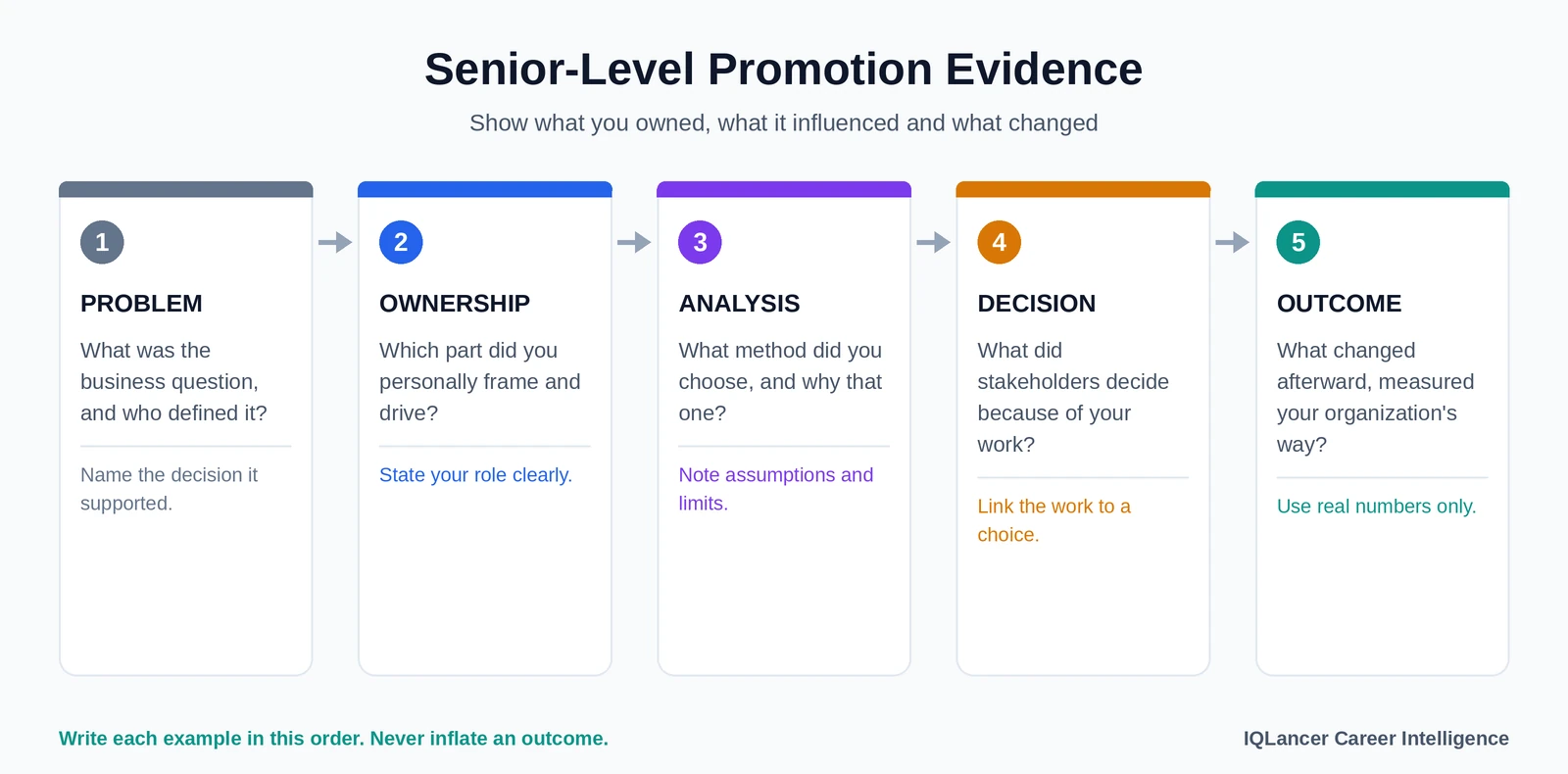
The strongest promotion evidence shows not only what you completed, but what problem you owned, what decision your analysis influenced and what changed afterward.
This is where the uncertainty starts to turn into a plan. You may already have the evidence and simply not have written it down. Use this chain:
PROBLEM → OWNERSHIP → ANALYSIS → DECISION → OUTCOME
- Problem: what was the business question, and who defined it?
- Ownership: what part did you personally frame and drive?
- Analysis: what method did you choose, and why that one?
- Decision: what did stakeholders decide because of your work?
- Outcome: what changed afterward, measured in whatever way your organization measures it?
Table 2: Senior-Level Evidence
| Senior-Level Evidence | What It Looks Like |
|---|---|
| Ownership | You independently drive an analytical problem |
| Business impact | Your work contributes to a meaningful decision or outcome |
| Stakeholder influence | Stakeholders change direction based on your analysis |
| Complexity | You handle ambiguity, competing explanations or incomplete data |
| Team leverage | You improve another analyst’s work or create reusable practices |
| Initiative | You identify important questions instead of waiting for requests |
Write each example in this shape:
“I owned [problem]. I chose [method] because [reason]. Stakeholders decided [decision]. Afterward, [outcome, with the number only if your organization actually measured it].”
Do not stretch an outcome you cannot verify. An honest, smaller claim is more credible than an inflated one.
What Does Senior-Level Analytical Work Look Like?
Senior-level analytical work treats a metric change as a problem to investigate and resolve, not a number to report.
This is an illustrative case, not a real result. A company notices that customer conversion has declined.
Standard analyst behavior: receive the request, pull the data, calculate conversion, build a dashboard and report the decline.
Senior-level behavior:
- Clarify what “conversion decline” actually means (which funnel step, which period, compared with what).
- Validate the metric, including whether tracking or definitions changed.
- Segment the problem by channel, device, region and customer type.
- Check possible drivers and question the team’s favorite explanation.
- Identify evidence gaps and consider competing explanations.
- Communicate uncertainty plainly.
- Recommend what to investigate or change next.
Mapped to the model, the standard analyst stays at EXECUTION. Clarifying and validating is OWNERSHIP. Challenging assumptions and recommending next steps is INFLUENCE. If the business acts on the recommendation and the decline is addressed, that is IMPACT. Notice that the impact depends on what the business does, which is why you document the decision and outcome, not just the analysis.
How Do Senior Data Analysts Work With Stakeholders?
A senior analyst increasingly operates as an analytical partner rather than a request-taker.
The flow is REQUEST → QUESTION → CONTEXT → EVIDENCE → DECISION. The analyst clarifies vague requests, challenges weak assumptions, finds the real business question, explains trade-offs, communicates uncertainty and recommends next steps.
A short before and after:
Before (request taker). A manager asks, “Can you add a region filter to the churn dashboard?” The analyst adds it and sends it back.
After (analytical partner). The analyst asks, “What decision will the region view support?” The manager explains the team is deciding where to spend retention budget. The analyst realizes a filter will not answer that, proposes a comparison of churn drivers across regions and flags that two regions have too little data to compare reliably. The manager now has a decision-ready answer and an honest limitation.
Nothing in the second version required a new tool. It required a better question.
Is Mentoring Required to Become a Senior Data Analyst?
Not every organization requires formal mentoring for promotion, but helping other analysts improve can demonstrate the team-level leverage often expected at senior levels.
TDWI’s career-ladder piece notes that senior analysts tend to review others’ work and informally teach newer teammates, and postings such as the payment integrity role list mentoring directly. Mentoring can mean reviewing analyses, writing documentation, setting analytical standards, building reusable processes, helping others reason through a problem and sharing knowledge.
MENTORING ≠ PEOPLE MANAGEMENT. A Senior Data Analyst can remain an individual contributor and still be the person others consult before they finalize an analysis.
Are You Ready to Become a Senior Data Analyst?
Readiness is shown by what you can evidence, not by how long you have held the title. Use the IQLancer Senior Readiness Test and answer honestly. Writing the answers down will show you where your evidence is thin.
Ownership
- Do you independently define analytical problems?
- Can you take an ambiguous request and structure the investigation?
Analytical judgment
- Can you explain why a particular analysis is appropriate?
- Can you identify limitations in the data?
Business impact
- Can you connect analysis to a business decision?
- Can you explain what changed because of your work?
Stakeholder influence
- Can you challenge a stakeholder’s assumption constructively?
- Can you communicate uncertainty without weakening your recommendation?
Team leverage
- Have you helped other analysts improve?
- Have you created reusable processes or standards?
There is no score here, because an arbitrary number would mislead you. Each question you hesitate on points to a development area. It is uncomfortable to find a gap after years of hard-earned experience, but a named gap is something you can close.
Why Am I Not Getting Promoted to Senior Data Analyst?
Strong technical skills may not lead to promotion if your current work does not demonstrate enough ownership, business impact, stakeholder influence or senior-level scope.
It can be frustrating to spend years becoming technically stronger while your career still feels stuck at the same level. The gap is often not effort. It is the kind of work being recognized. Here are seven gaps worth checking.
Gap 1: Tool Depth Without Business Context
You can write complex queries but cannot say which decision they support. Tools raise your ceiling on execution, not on scope. Start every analysis by naming the decision it informs.
Gap 2: Completing Tasks Instead of Owning Problems
Your tickets close on time, but someone else frames the problem and follows through. Ask to own one problem from question to recommendation.
Gap 3: Reporting Insights Without Influencing Decisions
Your findings are accurate, yet nothing changes. Add a recommendation and a trade-off to every deliverable, and follow up on what was decided.
Gap 4: Waiting for Requests Instead of Identifying Problems
You respond well but rarely raise questions yourself. Bring one unrequested, well-evidenced observation to your manager each quarter.
Gap 5: Individual Excellence Without Team Leverage
Your own output is strong, but the team’s practices have not changed. Document a method, review a colleague’s work or turn a repeated query into a shared asset.
Gap 6: Good Work That Is Poorly Documented or Invisible
Decision makers cannot credit what they cannot see. Keep a running record of problems owned, decisions influenced and outcomes, so your promotion case does not depend on anyone’s memory.
Gap 7: Confusing Tenure With Readiness
Years can strengthen your resume, but they do not automatically prove your scope has grown. Compare what you do today with what you did two years ago. If the scope looks the same, the title will likely stay the same too.
Finally, remember the organizational barriers described earlier: headcount, budgets, leveling and manager support. If you have closed the gaps above and still see no movement, that is a signal to discuss expectations openly or consider an external move.
How to Become a Senior Data Analyst: Promotion Path
A practical path moves from reliable execution to owned problems, then to influence and team leverage, backed by visible evidence. These stages are not a guaranteed chronological formula. You will often build several at once.
Stage 1: Become Reliable
Deliver accurate, consistent work. Without trust here, nothing else holds.
Stage 2: Build Analytical Independence
Solve problems with less supervision. Your work should need fewer corrections each quarter.
Stage 3: Take Ownership
Own a problem from question to recommendation, including follow-up.
Stage 4: Increase Complexity
Take on ambiguity and competing explanations, not just cleaner versions of familiar tasks.
Stage 5: Build Business Judgment
Learn why the analysis matters: the KPIs, costs and constraints behind the request.
Stage 6: Influence Stakeholders
Move from reporting to advising. Offer recommendations, trade-offs and honest uncertainty.
Stage 7: Create Team Leverage
Mentor, document and improve analytical practices others can reuse.
Stage 8: Build Visible Evidence
Record your examples using the PROBLEM → OWNERSHIP → ANALYSIS → DECISION → OUTCOME chain.
Stage 9: Position for Promotion
Use that evidence in performance conversations, internal promotion cases and external applications. Ask your manager directly what the next level requires.
What Comes After Senior Data Analyst?
Senior Data Analyst does not automatically mean management. There are three broad directions.
Individual contributor path. Senior Data Analyst → Lead or Principal analytics roles → advanced analytical or strategic roles, where the unit of work shifts toward systems and standards.
Management path. Senior Data Analyst → Analytics Manager → Senior Manager → Director. The work shifts toward people, priorities and function.
Adjacent paths. Depending on skills and interests: Data Science, Product Analytics, Analytics Engineering, Business Intelligence, or Data and Product roles. TDWI notes that analysts drawn to the infrastructure side may move toward data engineering.
Not every transition is equally accessible. Movement depends on your existing skills, demonstrated evidence, organizational structure, business context and the requirements of the target role.
Senior Data Analyst Promotion Checklist
- I independently frame analytical problems.
- I can handle ambiguous questions.
- I connect analysis to business decisions.
- I demonstrate measurable or clearly documented impact.
- I influence stakeholders rather than simply deliver reports.
- I understand limitations and communicate uncertainty.
- I can handle complex analytical work independently.
- I help other analysts improve.
- I identify important problems proactively.
- I have concrete evidence of senior-level ownership.
FAQs
1. How long does it take to become a Senior Data Analyst?
There is no fixed timeline. Current postings range from 3+ years to 7+ years, and leveling varies by company. Scope, independence and impact often matter more than tenure.
2. What skills do you need to become a Senior Data Analyst?
You need analytical judgment, business understanding, ownership, stakeholder management, communication and enough technical depth to deliver reliable results independently. Mentoring and team leverage strengthen your case.
3. Is Python required for a Senior Data Analyst?
It depends on the role. Some postings, such as EPAM’s India role, list Python among required languages. Others emphasize Excel, Power BI and Power Query, as in the UK posting. Check the postings for the roles you want.
4. Is SQL enough to become a Senior Data Analyst?
SQL is often essential, and some postings ask for expert-level SQL, but it is rarely enough alone. Employers also look for ambiguity handling, stakeholder communication and business judgment.
5. Do Senior Data Analysts need to manage people?
No. Many Senior Data Analysts remain individual contributors. Mentoring is different from management, and some roles list it as an expectation.
6. What is the difference between a Data Analyst and Senior Data Analyst?
The main difference is the scope of the problem owned. A Data Analyst usually works on defined questions, while a Senior Data Analyst helps define the problem, owns the outcome and influences decisions.
7. What comes after Senior Data Analyst?
Paths include Lead or Principal analytics roles, management (Analytics Manager and above), and adjacent roles such as Data Science, Product Analytics, Analytics Engineering or Business Intelligence.
8. Can you become a Senior Data Analyst without a master’s degree?
Often yes. Several postings ask for a bachelor’s degree, and some accept experience instead. One payment integrity posting accepts 4 additional years of relevant experience in lieu of a degree. Requirements vary by employer.
Final Thoughts
Becoming senior is not about waiting long enough for a better title. It is about demonstrating that you can take on a larger problem, operate with greater independence, make stronger analytical judgments, influence decisions, create business value and improve the capability of the wider team.
That is the path from EXECUTION → OWNERSHIP → INFLUENCE → IMPACT, and the evidence for it is probably already hiding in your recent work. At IQLancer, we believe careers move when expectations become visible. Once you can see what senior-level work looks like, the next step stops being a guess and becomes a decision you control.